

The sofa is the problem. Everything else in the house can be boxed, taped and carried in a morning, but the three-seater won't go through the door of the new flat until the flooring is finished, and the flooring isn't booked until the 14th. The van arrives on the 3rd.
Most storage decisions start with a detail like that. Not a five-year plan, just a gap of ten days, a spare bed with nowhere to go, or a van full of pipe fittings taking up half the garage. This guide covers what container storage in Nottingham really involves, what fits in each size, which sites offer it, and the checks most local pages skip: fire risk, planning and flood.
What Container Storage Means in Nottingham
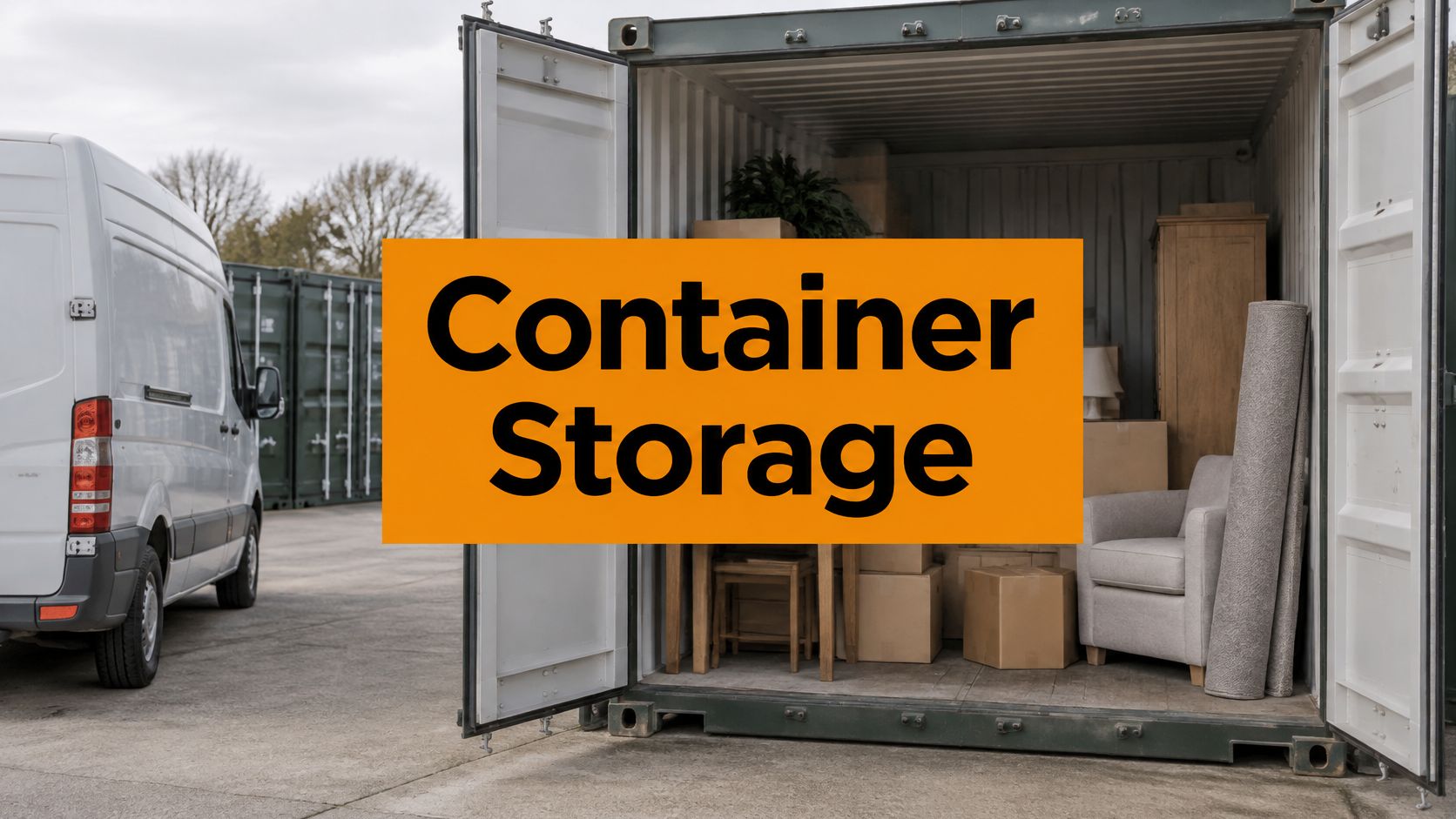
A container storage unit is a steel shipping container, or a container-style unit, rented as private space. You get your own door and your own lock, with no shared corridor to negotiate while carrying a wardrobe. Drive up, open the doors, unload straight from the van.
The comparison that helps is parking. An indoor unit is like a room inside a shared building: weather-protected, sometimes upstairs, reached through a loading bay and a lift. A container is closer to a private lock-up garage at the end of a yard. You drive right up to it, and the weather stays on the outside of the steel.
Four terms appear on every site's page, so it's worth knowing them before you ring anyone:
- Drive-up access: your vehicle parks beside the unit, so nothing is carried down a corridor.
- Indoor access: the unit sits inside a building, which suits anything sensitive to damp or temperature swings.
- Unit size: quoted in feet for containers (20ft, 40ft) and in square feet for indoor rooms.
- Rolling monthly contract: you rent month by month instead of signing for a year.
The people who rent containers in Nottingham fall into a few familiar groups. Homeowners stuck between a sale and a purchase. Students packing up a shared house in Lenton or Radford for the summer. Tradespeople storing timber, pipe and a spare boiler. Small online sellers holding stock that has outgrown the spare bedroom.
Local demand has a measurable backdrop. Office for National Statistics Census 2021 data recorded approximately 323,700 usual residents in Nottingham, against around 305,700 in 2011, an increase of 5.9% across the decade. The city ranked 33rd of England's 309 local authority areas by population, up four places on 2011.
That figure describes residents, not storage units. The ONS doesn't count container rentals, so treat the growth as context rather than a forecast. Your decision comes down to three practical questions: do you need to drive up to the door, which size holds your largest item, and will the site accept what you plan to put inside.
Container Sizes and What Each One Holds
Two sizes get quoted in Nottingham, and both use the standard shipping container footprint of roughly 2.35 m inside width. The difference is length, and length is what changes the price and the contents.
| Container | Typical contents | Best for |
|---|---|---|
| 20ft shipping container | Contents of a one- to two-bedroom home | Household moves, student storage, trade tools and stock |
| 40ft shipping container | Contents of a larger family home | Full house clearance, plant equipment, bulk stock |
Read that table by the largest thing you own, not by the number of boxes. A 20ft container gives you about 5.9 m by 2.35 m inside, which is roughly 14 sq m of floor. A 40ft gives about 12 m by 2.35 m, or roughly 28 sq m. Those internal dimensions are approximate, and they vary slightly between containers.
The door, not the floor, decides
The opening is the constraint. A container door is far narrower and shorter than the floor suggests, and a sofa turned on its side still needs clearance at the frame. Measure the longest item and the tallest item separately, then check both against the door opening before you book anything.
Floor area also isn't usable volume. Stacking gains height, but access routes take space back. Leave about a 60 cm aisle just inside the door so you can reach the back of the container without unloading the front half every time you want something.
What a container actually swallows
A three-piece suite, a double bed frame and around 40 boxes sit comfortably in a 20ft unit. A full three-bedroom house clearance, white goods included, points to a 40ft. Plant equipment, pallets of stock or a workshop's worth of benches push you towards the larger size even when the item count looks modest.
The booking rule: match your largest item and total volume to a row, then add roughly 20% for access and anything you buy in the next six months.
If you're unsure which row you sit in, this guide on how much space you need in a storage container walks through the same calculation with room-by-room examples.
Container Storage Locations Across Nottingham and the East Midlands
Orange Box Self Storage runs six sites across the East Midlands, and they don't all offer the same mix. Postcode alone won't tell you whether a container is waiting there, so check the column before you plan a drive.
| Site | Postcode | Container storage | Other unit types on site |
|---|---|---|---|
| Beeston | NG9 | Ask the team | Indoor units from 11 to 308 sq ft, drive-up access |
| Long Eaton | NG10 | Ask the team | Indoor and drive-up units, business enterprise units |
| Derby | DE24 | Yes | Indoor and drive-up units, business enterprise units, offices |
| Ilkeston | DE7 | Yes | Workshop units, business enterprise units, offices |
| Colsterworth | NG33 | Yes | Workshop units, drive-up units |
| Grantham | NG31 | Ask the team | Ask the team |
Three sites confirm containers today. Derby DE24 pairs containers with indoor storage, drive-up units, business enterprise space and offices, which suits a firm that needs one place for stock, paperwork and a desk. Ilkeston DE7 adds workshop units to the container offer, useful if you repair or assemble as well as store. Colsterworth NG33 combines containers, workshop units and drive-up units for readers heading north up the A1.
Beeston NG9 and Long Eaton NG10 are indoor and drive-up sites, with Beeston offering indoor units from 11 to 308 sq ft and seven-day opening. Ask about container availability before you set off. Grantham NG31 is a location without a published unit mix, so that's a question for the team rather than an assumption.
Check before you travel: confirm container availability, access hours and any vehicle size limit at the gate.
Why the yard, not the postcode, decides
A container needs a route in for the delivery vehicle and firm, level standing once it lands. Regional logistics planning in this corridor is about vehicles and ground, not unit numbers: the Erewash strategic logistics assessment.pdf) identified a requirement for approximately 550,000 to 750,000 square metres of logistics space, with residual demand of 235,000 to 435,000 square metres after existing or committed provision.
For you that translates into a simple check. If a trailer, long-wheelbase van or horsebox has to reach the door, ask about turning space and hardstanding, not just opening hours. Then ask for the monthly rate, any deposit, the security arrangements and whether your own contents insurance covers goods in a container.
Shortlist Derby, Ilkeston or Colsterworth first if you need vehicle access to a container. Shortlist Beeston or Long Eaton if your load is furniture and boxes that fit an indoor room.
Common Uses for Homes, Students and Businesses
A self-employed plumber in Ilkeston keeps copper pipe, fittings, a spare combi boiler and a wet-and-dry vacuum in the van. The van is full, the garage is fuller, and the boiler swap next week needs the old unit out of the way for ten days. A container solves that in one move.
The same pattern repeats across the city in slightly different forms:
- House moves: furniture held between completion dates, when the sale goes through before the purchase does.
- Decluttering: the boxes that survived three "we'll sort that out" weekends and now block the hallway of a family house.
- Student summers: belongings parked between term ends, or during a placement year abroad, instead of paying rent on a room you aren't using. Our student storage in Nottingham page covers the term-time pattern in more detail.
- Trades and contractors: tools, materials and plant that need to stay dry and locked rather than sitting in a van on a driveway.
- Online sellers: stock bought in bulk because the supplier's minimum order made sense at the time.
- Event and AV kit: speakers, stands and lighting that don't fit a garage and shouldn't sit in a damp shed.
A container earns its place with bulky, weatherproof or trade-heavy loads. Anything you'd handle carefully indoors, such as paper files, electronics or a relative's photographs, belongs in an indoor unit where damp and temperature swings are controlled.
Against that, the wider supply chain feeding local retailers and contractors has been growing. Department for Transport port freight statistics put container cargo at 66.9 million tonnes in 2025, up 10% on 2024. Those figures describe port activity, not Nottingham demand, but they explain why wholesalers and sellers here hold more stock than they used to.
Before you ring a site, do three things. List your main reasons for storing. Mark which items are bulky, valuable or time-sensitive. Let that list choose between a container and an indoor room.
Managing Business Stock Inside a Container
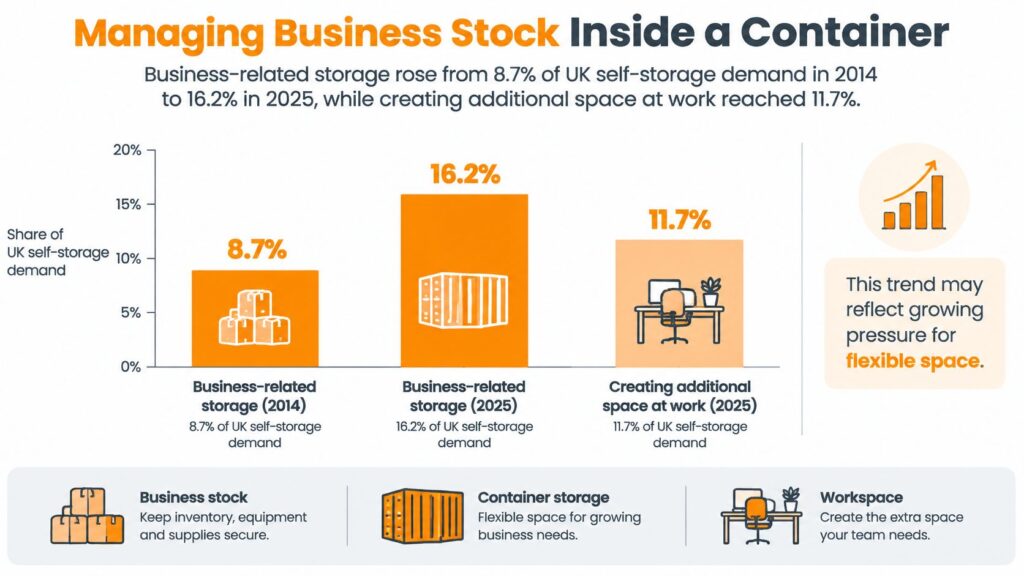
A delivery lands three weeks early. The supplier gave a discount for taking the full batch, so now forty boxes of stock need somewhere dry to sit while last month's order still waits to sell. That decision, whether to rent space or let stock pile into the workshop, has become a routine operational call for small firms. Cushman & Wakefield's 2025 self-storage report shows business-related storage rising from 8.7% of UK self-storage demand in 2014 to 16.2% in 2025, while creating additional space at work reached 11.7%, a pattern the report links to flexible and hybrid working.
The risk runs in the other direction too. When suppliers quote longer lead times, buyers respond by ordering earlier and in larger volumes to protect themselves, and each bigger order needs somewhere to go. Extra space protects continuity when a delivery lands early or late. Overbuying ties up cash and leaves stock sitting at the back of a steel box where nobody rotates it.
Work out usable capacity first
- Take the floor area of your container from the size you chose, then subtract a working aisle at the door and any gangway you need along one side.
- Divide what remains by the footprint of a pallet or a box stack, including the gap you need to pull stock out.
- Treat height as a limit set by what the bottom layer can bear, not by the roof.
- Write the number down. It's the figure that tells you when to stop buying.
Controls that keep stock moving
Label by arrival date: every carton gets the week it landed, so rotation isn't guesswork. Run first in, first out: the oldest stock sits nearest the door and leaves first. Audit on a fixed date: a monthly count on the same day catches shrinkage and slow movers before they become a write-off. Check humidity-sensitive goods: paper, cardboard and textiles pick up damp, so inspect after wet spells and keep stock off the floor on pallets.
A container protects continuity. It doesn't protect cash flow.
The break-even test is straightforward. Compare the monthly cost of rented space with the cost of expanding your premises, or of moving to managed warehouse space, once stock regularly exceeds the usable area you calculated. When you're consistently stacking in the aisle, the container has stopped being the cheaper option. Our guide to inventory management for small businesses sets out the rotation and counting routines in more detail.
Fire Risk and Hazardous Goods in Stored Containers
A general storage container is not the place for fuels, solvents or gas cylinders unless the operator has approved them in writing. This is the rule that matters more than any other, and it's the one most price comparison pages never mention.
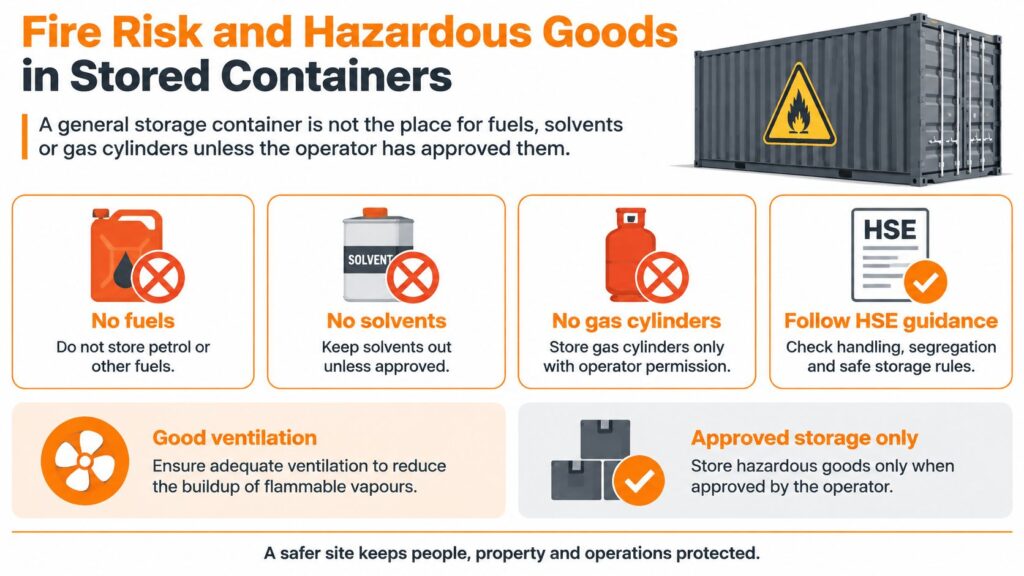
UK HSE guidance on storing flammable liquids in containers sets out what proper provision looks like. Containers used for flammable liquids must be designed for the material, with compatible construction and secure, leak-resistant closures. Stacked containers must stay stable, inspectable and removable if a leak occurs. Outdoor fire walls should reach at least the height of the stack and no lower than 2 metres. The guidance covers workplace storage of flammable liquids in containers up to 1,000 litres, which puts it squarely in scope for trade users renting commercial space.
What readers actually turn up with
| Item | Typical situation | Action |
|---|---|---|
| Paint thinner | Kept with a trade van's spare stock | Keep out of a general unit and declare it at booking |
| Petrol strimmer tank | Fuel left in a garden tool | Remove the fuel or ask for approved flammable storage |
| Gas bottle | Spare cylinder for a site heater | Keep out unless the operator approves it in writing |
| Unlabelled fuel or solvent | Contents unknown | Prohibited from general units |
The reasoning is practical rather than bureaucratic. A small leak in an enclosed steel box becomes a vapour release, and a vapour release next to a mower with a part-full tank becomes a fire. Blocked inspection routes turn a manageable incident into one where nobody can reach the door.
Operators who take this seriously will ask you to declare hazardous contents at booking, ban unlabelled fuels and solvents from general units, keep inspection routes clear, and separate ignition sources from combustible stock. Ask for those rules in writing before you sign, not after.
Battery-powered equipment deserves its own thought. E-bike packs, cordless tool batteries and ride-on mower cells can fail weeks after they were last charged, and the response is different from a paper or textile fire. This guide to how to suppress lithium battery fires explains why water alone often doesn't work and what containment looks like in practice.
Before you load anything, write a list of every chemical, fuel and gas item you own, including the half-empty ones. Take the list to the operator and keep anything unapproved out of the container entirely.
Planning and Flood Checks Before You Rent
A container looks like a box, and boxes feel like they don't need permission. That reasoning is where people get caught out. A container placed on land may need planning permission, a change of use, access works or a flood-risk assessment, and the answer depends on the site and the proposed use rather than on the container itself.
Temporary placement sits differently from permanent placement. So does land classed as industrial, agricultural or mixed-use, which is why two neighbouring fields can give two different answers. Storing your own goods is also a different proposition from running a customer-facing storage business from the same land, and the planning implications can diverge sharply.
The Environment Agency's flood map for planning lets you check whether a flood-risk assessment is likely to be required and pull the planning flood data for a site. Do that before you fall in love with a cheap patch of hardstanding.
The site questions that decide it
Hardstanding is the first. A container loaded with furniture or stock is heavy, and soft ground lets corners sink, which twists the frame and throws the doors out of alignment. Drainage is the second: water pooling at the door line creeps under the seals and rots the floor over a winter. Vehicle movements and turning space come third, because a delivery that can't reach the door becomes a manual carry across a yard. Emergency access comes last and matters most, since a fire crew needs a route that isn't blocked by a second container.
One question saves a wasted trip: ask the operator who owns the land and what it's currently used for.
The cheapest-looking option can create compliance, access or insurance complications that cost more than a year of rent. A site that can't answer a basic question about land use is telling you something.
Before renting anywhere, complete four checks. Confirm the land use and any permission with the local council. Check the flood map for the postcode. Confirm that your delivery vehicle can reach and turn at the unit. Then ring your insurer and ask, in plain terms, whether goods stored in a container at that address are covered.
Confirm the Site and Size Before You Book
A family-run company that has been storing the East Midlands since 2014 should have a straightforward answer when you ask which of its sites take containers. Orange Box Self Storage uses 20ft and 40ft shipping containers, so the size table translates directly into a real unit you can stand inside.
Work through the steps in order rather than in the order that feels easiest.
- Measure the largest item and count the boxes.
- Pick 20ft or 40ft using the size comparison.
- Shortlist the sites where containers are confirmed, and ask about any site where availability isn't published.
- Request written hazardous-goods rules and any planning guidance that applies to your site.
- Book around your move-out or delivery date rather than after it.
That third step deserves a second look. Container storage is confirmed at Derby DE24, Ilkeston DE7 and Colsterworth NG33, so treat those three as your starting list and ask the team before assuming a site closer to home can take a box.
Collection is offered in the Nottingham area for summer storage, and the team will book a time that fits your move-out date, which removes the awkward gap when the van has gone but the new place isn't ready.
Ask about price, security and insurance before signing anything. Then check the answers against your own list of what's going in, because a cheap unit your insurer excludes will cost more in a single claim than a year of higher rent.
If the measurements are still in your head rather than on paper, ring with them anyway. A two-minute conversation about a sofa's length and a rough box count settles the size question faster than another hour of browsing.
Orange Box Self Storage offers container storage at Derby DE24, Ilkeston DE7 and Colsterworth NG33, with 20ft and 40ft units for house clearances, trade kit and business stock, plus collection in the Nottingham area when your move-out date and your storage date don't line up. Tell the team what your largest item is, which postcode you're heading to and when the van is booked, and they'll point you to the site whose access suits your load. Start at Orange Box Self Storage and check availability before you hire a van.