


Moving out can arrive before you've found your next room. Your textbooks are boxed, your bike won't fit in a friend's flat, and the tenancy ends before you can move into your next place. A storage unit can bridge that gap, but the right size, site and booking date matter as much as the monthly quote.
For student storage in Nottingham, plan around your accommodation dates rather than waiting until move-out week. Work out what you need to store, check when you'll need it back, and ask about access, collection and contract terms before paying.
Choose a Unit Size and Plan How to Load It
The room is nearly empty, but the last pile is stubborn: boxes of course books, a desk, bedding and a bike that won't squeeze into your new flat. Start by estimating the space those items need, then choose a unit that leaves room to reach them. These examples are a starting point, not a substitute for checking the live dimensions and quote.
Match the space to your belongings
| Unit size | Typical contents | Best for |
|---|---|---|
| 1 sq m locker | A suitcase, a box of books and a bag of winter coats | Overflow items between terms |
| 2 sq m | Two or three boxes, a folded duvet and a bike wheel | Summer storage for a few boxes |
| 4 sq m | Boxed clothes, kitchen kit, books and a folded mattress | Leaving halls or storing a single room's belongings |
| 6 sq m | A desk, a chair and boxes from a shared-flat room | Half a room of furniture |
| 8 sq m | A bed base, wardrobe, desk and boxes | A full single room |
| 10 sq m | Contents of a one-bedroom flat | A whole flat or longer-term storage |
Storage providers may describe units in different ways, so compare the actual dimensions as well as the size label. If you're estimating a household move as well, this guide to estimating storage space for your Sydney move gives another way to think through volume and item mix. For a Nottingham-specific walkthrough, use this guide to choosing a storage unit size. Confirm live sizes, prices and availability with the provider before booking, because they can change.
Aim to fill a unit to about 70 to 80 per cent of its usable space. A unit packed solid may look efficient, but you'll have to unload boxes to reach anything at the back. A single room's furniture usually sits in the 8 sq m band, while the contents of a full one-bedroom flat point towards 10 sq m. Treat those as planning estimates, then check the size against your own furniture and box count.
Load for access, not just capacity
Put heavy boxes on the floor and build stable stacks rather than balancing loose items. Leave a clear path from the door to the things you may need first, such as a winter coat or kitchen box. Label boxes with both the room and the term, for example “Kitchen, autumn return”, so you can find them without opening everything.
Wrap fragile items and place them above heavier belongings, where they're less likely to be crushed. Stand a mattress on its edge if the unit layout allows it, and keep it protected from dirt and moisture. Don't block the door with furniture: that makes loading harder and can prevent you reaching boxes behind it.
Quick self-check: List bulky items, count your boxes, then choose the next size up if you're unsure. The small cost of spare room can be worthwhile if it keeps the unit safe to access.
Who Needs Student Storage and Which Scenario Fits
Students most likely to need a unit are those moving between halls, private flats and home; international students who can't take furniture and course materials abroad; and home-fee students returning to family during holidays. Think of your belongings as luggage on a train journey with no fixed destination. Storage is the left-luggage office between legs of the trip, keeping your things together until you know where they're going next.
Nottingham City Council reported 56,143 full-time students in the city in the 2024/25 academic year, of whom 45,293 were estimated to require accommodation. The council recorded 33,569 completed purpose-built student-accommodation beds, leaving a calculated shortfall of 11,724 students who would need to live in privately rented flats or houses, according to the council's student-accommodation information. Private tenancies can end on fixed dates, and housemates can change, leaving students needing somewhere for belongings between addresses.
Three typical storage choices
Maya, a second-year student, has to leave a shared flat on 30 June. She has a desk, a chair and boxes to store until her next accommodation is ready, so she books a 6 sq m unit from late June. The useful decision isn't just the unit size: she reserves before the summer rush, rather than trying to find space after her tenancy ends.
Samir, an international student, is going home for ten months and can't drive his belongings to a unit. He books a 10 sq m climate-protected unit for textbooks, furniture and electronics, and asks about collection before committing. Getting the collection arrangement confirmed up front matters more than choosing a site that looks close on a map.
Leah, a first-year student, moves from halls into a flat in January. She only needs space for three boxes and a folded duvet for about four weeks, so she checks that a short contract is available instead of paying for a longer period than she needs.
The accommodation mix is changing. Nottingham City Council's series shows purpose-built student-accommodation capacity rising from 23,312 bedspaces in 2018 to 36,334 in 2025, while on-street student households changed from 6,323 to 6,172 over the same period, as recorded in the council's accommodation series. Students still move between halls, private homes and family addresses, and those transitions create short gaps that a unit can fill.
For packing and move-out tasks, a student moving and storage checklist can help you remember the practical details before your room is cleared. The decision test is straightforward: if you'll be away from your room for more than two weeks and can't carry everything you own, a unit is likely to make the move easier.
Term-Time and Holiday Dates That Drive Demand
Reserve a unit two to four weeks before your move-out date and confirm the collection or drop-off slot once your accommodation check-out date is fixed. Demand follows the teaching calendar, so waiting until your room is nearly empty can leave fewer choices. Match your booking to both term dates and accommodation payment dates, especially before the September and June rushes.
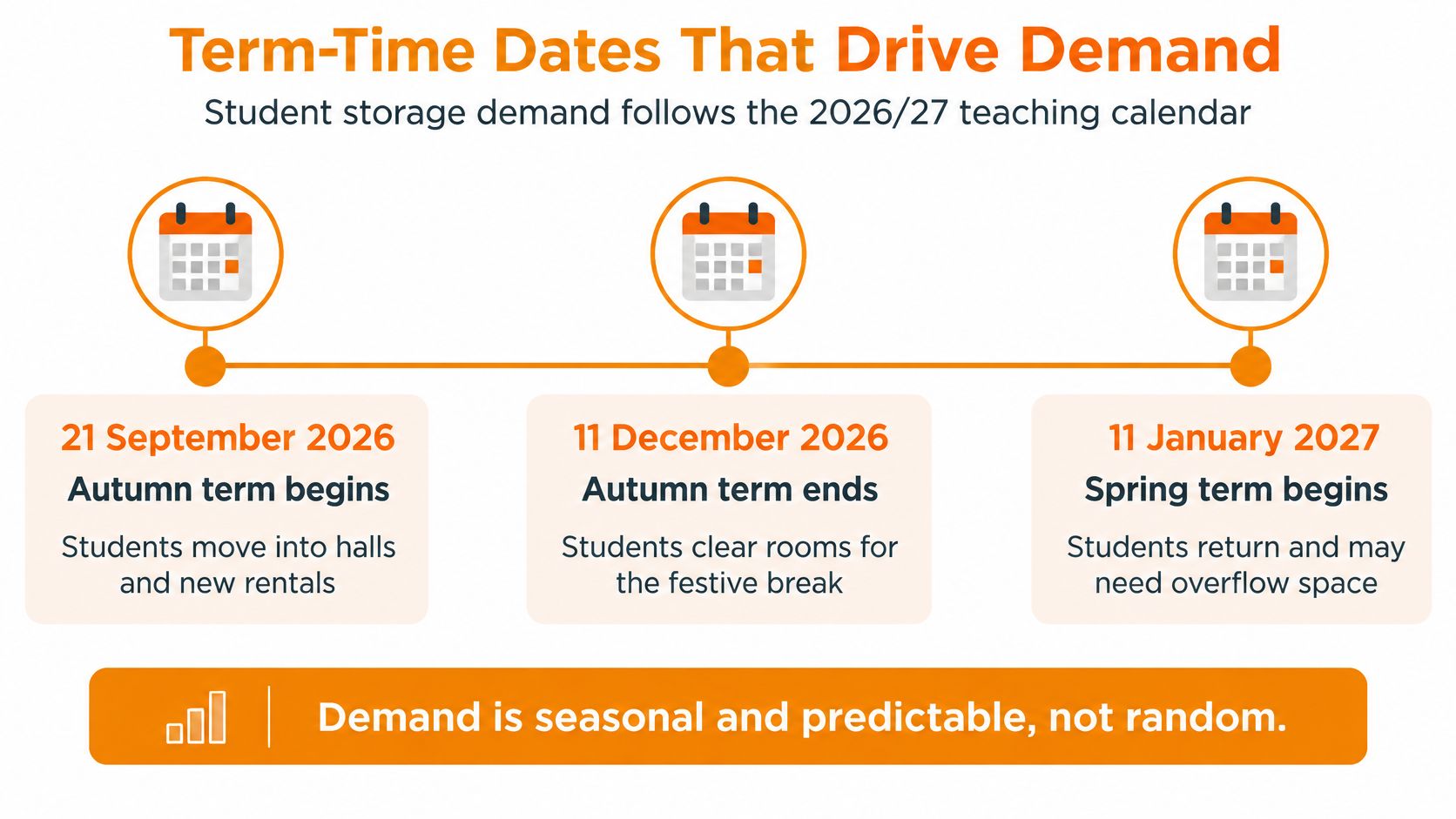
The University of Nottingham lists the 2026/27 autumn term as 21 September to 11 December 2026, the spring term as 11 January to 25 March 2027, and the summer term as 26 April to 18 June 2027 on its academic key dates page. The breaks around Christmas, Easter and summer are common points for clearing rooms and bringing belongings back. Late June and July deserve particular attention because students may need to leave accommodation at similar times.
Accommodation payment dates can help you plan earlier. The university's published schedule gives a reservation payment deadline of 11 September 2026, followed by instalments on 13 January and 28 April 2027, as listed in its accommodation payment information. Check whether your room or plans have changed around those dates, then reserve storage before the move-out rush rather than waiting until check-out.
| Date | Event | Storage implication |
|---|---|---|
| 11 Sep 2026 | Accommodation reservation payment deadline | Review your room plans and reserve storage before the September rush |
| 21 Sep 2026 | Autumn term starts | Arrange the return of belongings stored over summer |
| 11 Dec 2026 | Autumn term ends | Plan for a possible Christmas move-out |
| 11 Jan 2027 | Spring term starts | Arrange the return of belongings and review your unit needs |
| 13 Jan 2027 | Accommodation instalment date | Check for changes to your room or flat |
| 25 Mar 2027 | Spring term ends | Book early if storing belongings over Easter |
| 28 Apr 2027 | Accommodation instalment date | Review summer moves and collection windows |
| 18 Jun 2027 | Summer term ends | Arrange storage before the busy move-out period |
Some postgraduate and medicine-related courses may follow different dates from the general calendar. Check your course and accommodation dates directly, then confirm the collection slot with your provider. These ways to save space during student holidays can also help reduce how much you need to store.
Orange Box Sites Across Nottingham and Beyond
Choose a site by travel time from your last address or your next one, not by how close it looks on a map. A short journey with a car full of boxes can be easier than a longer cross-city drive, especially when you're working to a check-out time. Ask for the exact address and check the route at the time you expect to travel.
Orange Box Self Storage operates across Nottingham, Derby, Long Eaton and Beeston, with further sites listed as upcoming. The table shows the status described for 2026; confirm current opening details and unit availability directly before planning your move around a particular location.

| Site | Status in 2026 | Best for |
|---|---|---|
| Nottingham | Open | Students in and around the city; confirm the address and student-unit availability |
| Beeston | Open | Students living in Beeston and the west of the city |
| Long Eaton | Open | Students living east of Nottingham and near the Derby border |
| Derby | Open | Students living in Derby or travelling from the Derby area |
| Nottingham city centre | Upcoming | Students in city-centre flats; check the opening date |
| Ilkeston | Upcoming | Students living in Ilkeston and north-east Derbyshire |
| Grantham | Upcoming | Students returning to Lincolnshire between terms; check the opening date |
Before you pay, ask whether the site has your chosen size available and what its opening hours are for drop-off and collection. Check for a loading bay, too. Carrying boxes from a distant parking space can turn a simple unload into a long job, particularly if you're moving a desk or several heavy boxes.
The Nottingham city-centre site is listed as upcoming, so don't build your move plan around it until you've confirmed that it's open. A site outside Nottingham may work better if you return to Derbyshire or Lincolnshire between terms, provided the journey suits your collection plans.
Security and Climate Protection Worth Checking
Your parent's laptop, course notes or vintage guitar may be sitting in a unit for months. Before storing them, check what the facility provides and what the contract covers. Security features and insurance are separate questions: one doesn't automatically replace the other.

Check how the site protects stored belongings
| Feature | What to ask | Why it matters |
|---|---|---|
| 24/7 CCTV monitoring | Are cameras operating around the clock, and where? | Monitoring can deter theft and help clarify what happened if a dispute arises |
| Controlled site access | Does entry require a code, key fob or another access method? | Limits access to people authorised to enter |
| Climate-protected units | Is temperature or humidity controlled in the unit or storage area? | Helps protect textiles, paper and electronics from damp and mould |
| Insurance cover | What losses or damage are included, and what exclusions apply? | Shows whether your stored goods are covered and under what terms |
CCTV and access controls help protect the site, but they don't establish that every item is insured. Read the policy wording, including any item limits, exclusions and requirements for proof of ownership. Ask how to report a problem and whether you need to provide your own cover.
A padlock on your unit is still worth fitting if the provider permits it. Take photos of your belongings before storage, including close-ups of existing marks on valuable items, and keep a digital inventory with the images. That gives you a record of what went into the unit and its condition.
Choose climate protection for belongings that would be difficult to replace after damp exposure. Paper notes, textiles and electronics are obvious candidates; if you wouldn't want the item left in a damp room for a month, don't assume an ordinary unit will suit it. Confirm the facility's specific conditions instead.
Compare Plans and Discounts, Then Book Early
If your accommodation payment date falls before move-out, storage may need booking before you know every detail of the next move. Compare live quotes for the same unit size and dates, and ask for the total cost through your planned end date. A low monthly figure can hide a longer minimum rental period or continued billing after you leave.
| Option | How it is charged | Best for |
|---|---|---|
| Standard flexible contract | Month to month or fixed term; request a live quote | Open-ended storage with no set end date |
| Term-time and holiday plan | Monthly, sized to the break; request a live quote | Students moving between halls, flats and home |
| Collection and return service | Ask whether it is available and how each trip is charged | Students without a car or van |
| Student discount | Ask whether a discount is available and which plans qualify | Students checking ways to reduce the cost |
A term-time and holiday plan can suit students with known departure and return dates. A flexible contract gives more room when the next move is uncertain, but check whether charges continue until you give notice. If you need collection, ask whether the provider offers it and compare any trip charges with arranging transport yourself.
Use the same dates and storage needs when checking cheap storage-unit options in Nottingham. For a comparison framework, the Get n Go Removals Melbourne pricing guide outlines cost factors to look for. It is a general pricing guide, not a Nottingham quote.
Before paying, ask about the minimum rental period, payment frequency, notice required to end the contract, and any access or handling charges. Check whether a student discount applies to your chosen plan and whether student ID is needed. If you may need collection or a return trip, confirm availability and the full charge rather than assuming either service is included.
Match the booking to your university calendar and accommodation payment dates. For a defined holiday or term gap, ask about a term-time plan first. If your end date is unclear, compare flexible contracts. Reserve two to four weeks before move-out, and earlier for the September and late-June peaks, when demand can rise.
Book, Access and Return Your Unit
A smooth booking depends on matching your contract dates to the actual move, then keeping a record of what you store. Follow the steps in order so you don't pay for unnecessary time or arrive without the right access details.
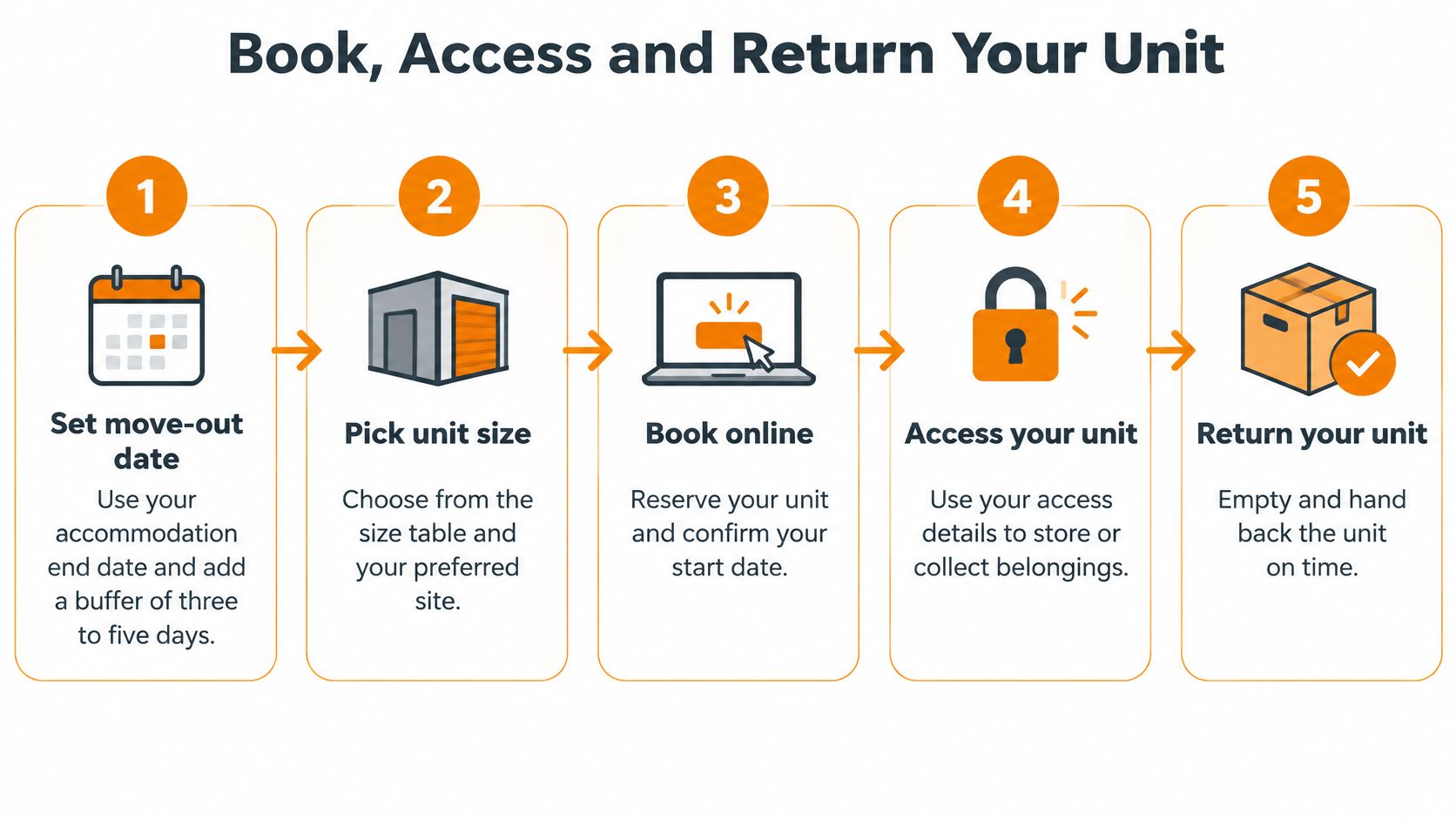
Set your move-out date. Start with the accommodation check-out date or tenancy end date, then add a buffer of three to five days. That gives you time to pack and move if the room isn't ready on the first day you planned.
Choose the unit and site. Use your inventory to select a size, then compare travel time from your current address and where you'll be living next. Ask the provider to confirm the unit's dimensions and availability rather than relying only on the size label.
Book the right contract. Reserve online or by phone, checking the start date, contract length and whether the plan is billed monthly or designed around a term-time break. Read the rules for notice, prohibited goods, access and charges before paying.
Confirm how you'll move items. Ask whether you're arranging your own drop-off or booking collection, and confirm the appointment window. Check whether a car is sufficient or whether bulky furniture needs a van, then reserve two to four weeks before move-out, earlier for busy periods.
Record what goes into storage. Before anything leaves your room, photograph each item and make a digital inventory of every box. Include condition notes for valuable or fragile belongings, so you have a clear record if you need to check a claim later.
Check the unit before loading. Arrive during confirmed opening hours with the required ID and access details. Look for signs of damp, dirt or damage before you unload, and raise any concern with staff while the unit is still empty.
Label boxes for retrieval. Write the room and term on each box, and keep items you'll need first near the front. That simple system is more useful than stacking everything according to box size alone.
Close the contract carefully. At the end, remove all belongings, follow the provider's key or access-code return process and check the final invoice. Confirm that the account has ended on the date you expected.
Accommodation decisions can shift after you've booked. The University of Nottingham's published accommodation schedule lists a reservation payment deadline of 11 September 2026, followed by instalments on 13 January and 28 April 2027, on its accommodation frequently asked questions page. Use those milestones to check whether your room or move plans have changed, and contact the storage provider promptly if you need to amend a collection date.
Student Storage Questions Answered
What can't I store?
Check the contract's prohibited-items list before loading. Common exclusions include perishable food, flammable liquids and anything that could leak or attract pests. If an item isn't clearly covered by the rules, ask the site before you bring it in.
Can I leave a unit empty for the whole summer?
Yes, if your contract allows it. Check the end date and notice requirements so you don't continue paying once you've moved your belongings out.
What if my accommodation changes after I book?
Contact the provider to amend the collection or drop-off date. Keep your unit choice flexible until the new room is confirmed, and leave a buffer in your plan so a change doesn't force a last-minute move.
Can I store a bike or an instrument?
Usually, but check that the unit has enough room for your bike, including space to remove a wheel if needed. Photograph an instrument before storing it, confirm suitable climate protection and check whether your insurance covers it.
Orange Box Self Storage offers student storage across Nottingham and nearby locations, with flexible rental options for term breaks and accommodation moves. Compare a live quote for your dates and unit size, then visit Orange Box Self Storage to check availability and plan your booking.