


The cleaner needs fresh bedding, the next guests are on their way, and your spare duvet covers are somewhere behind a dismantled bedside table. Meanwhile, the hallway cupboard won't close because the hoover shares it with toiletries and replacement kitchenware. You don't need another storage ottoman. You need a reliable way to move stock between the property, the laundry and somewhere guests never have to see.
Why Nottingham Airbnb Hosts Run Out of Space
A turnover day exposes every weakness in your storage arrangements. Damp linen occupies the bathroom, spare pillows fill the wardrobe, and the cleaner has to move boxes before reaching the mop. Nothing is necessarily excessive in isolation. The problem is that everything competes for the same space.
In a Nottingham terrace or city-centre flat, buying more storage furniture can relocate the obstruction. A bigger cupboard still occupies floor space, and an under-bed box still needs someone to lift the mattress or move the bed. Guests shouldn't have to negotiate around the equipment you use to prepare their accommodation.
Separate the accommodation from the operation
Treat the property as guest-facing space, not your entire business premises. Keep what guests need and what the cleaner needs for the immediate changeover. Assess everything else according to how quickly you might need it.
That means distinguishing useful reserves from abandoned purchases:
- Immediate essentials: Keep the working cleaning kit and the next changeover's supplies accessible in a designated host cupboard.
- Operational reserves: Move replenishment stock, replacement bedding and serviceable spare equipment into organised off-site storage.
- Unresolved clutter: Sell, donate or dispose of unsuitable furniture and damaged items rather than paying to postpone the decision.
Practical rule: Every stored item needs a purpose, a location and a reason you'd retrieve it.
Consider a spare bedside lamp. If it matches the property and can replace a broken lamp promptly, it's operational stock. If it belongs to an old furnishing scheme and you wouldn't put it back in the flat, it's clutter, even when it works.
The distinction matters before you rent anything. Airbnb storage in Nottingham should support the accommodation, not become an overflow room for indecision. Start by identifying the equipment that keeps a booking deliverable, then give that equipment a controlled home outside the guest's living space.
What the Nottingham Short-Term Rental Market Tells You About Storage
Occupancy alone is a poor stock-ordering tool. A longer booking and a succession of short bookings can produce similar occupied nights but very different demands for cleaning, laundry and welcome supplies. Your booking pattern matters as much as how full the calendar looks.
AirROI's Nottingham market report records 989 active listings, 33.8% occupancy, an average stay of 4.3 nights, an average booked-night price of £116 before fees and a 43-day booking lead time for October 2025 to September 2026, with approximately three-quarters of listings accepting one- or two-night stays. Those figures describe a market, not a stock prescription for your property.
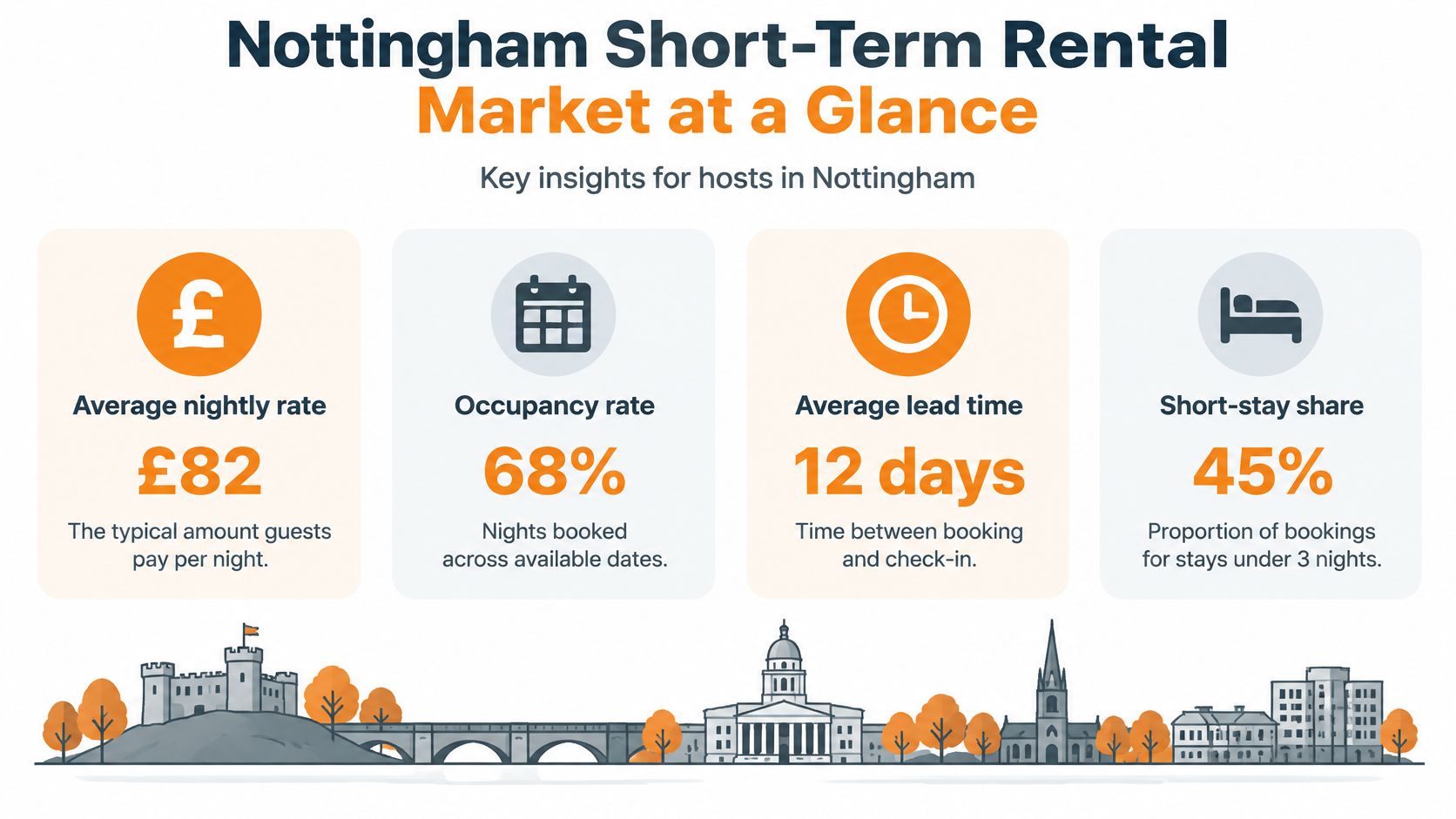
Use the linked report rather than the figures displayed in this graphic for planning. The graphic's figures don't match that dataset.
Translate demand into replenishment decisions
A booking lead time gives you an opportunity to prepare against confirmed arrivals. Review the calendar, identify concentrated changeovers and replenish before those dates. Don't use a citywide average as a promise that every guest will book well ahead.
Likewise, a nightly rate isn't money available to spend on storage. Evaluate the rental charge alongside transport, handling and the value of the stock you're protecting.
| Hosting pattern | Sensible storage priority |
|---|---|
| Occasional hosting | Keep a modest, clearly defined reserve rather than a permanent bulk-stock operation |
| Regular short-stay hosting | Prioritise ready-to-collect turnover supplies and laundry circulation |
| Multi-property operation | Pool compatible consumables while separating property-specific linen and equipment |
Different market reports need careful handling. Airbtics' Nottingham analysis reports median occupancy of 54%, active-listing growth of 65.4% and median nightly-rate growth of 6.7%. Don't combine its median with AirROI's occupancy figure or infer a single trend from unlike measures.
My recommendation is straightforward: size your operation from your own booking calendar, laundry turnaround and consumption records. Market data provides context. Your actual turnover schedule determines what needs to be ready.
Choosing the Right Unit Size, Type and Location
Don't choose a unit from bedroom count alone. Bedrooms help you identify bedding requirements, but they say little about whether you're storing boxed towels or a replacement sofa. The shape and accessibility of the inventory determine the space you need.
Start with a floor-level layout at home. Group the goods you intend to store, measure their packed dimensions and sketch where shelving, bulky furniture and a retrieval route would go. Usable space isn't the same as theoretical packing capacity.
Match the unit to the inventory
Matching Nottingham Airbnb hosts to the right unit type
| Host profile | Typical inventory | Recommended unit type | Approx. size |
|---|---|---|---|
| Occasional host | Boxed bedding, decorations, small replacements | Compact personal-storage option | Locker or small unit, subject to measured fit |
| Regular operator | Linen crates, consumables, cleaning equipment | Shelved business-storage unit | Walk-in space with an accessible picking area |
| Multi-property manager | Property-labelled stock and replacement appliances | Larger business-storage unit | Zoned space based on the combined inventory |
| Host managing refurbishments | Furniture, tools and bulky equipment | Container or suitable larger unit | Furniture footprint plus safe handling clearance |
These are selection profiles, not quoted dimensions. Use a storage-unit sizing guide to prepare a shortlist, then ask the facility to check your inventory against the actual unit layout.
Personal storage can suit a simple reserve. Business storage is the better starting point when staff collect stock regularly and need clear organisation. Assess container storage for bulky equipment only after checking suitability for every item, particularly textiles and anything sensitive to environmental conditions.
Choose the route, not just the postcode
Test the journey you'll make: property to storage, then onward to the laundry or next property. Check parking, loading arrangements, stairs, lifts and whether you can manoeuvre the largest item through every doorway. A convenient-looking address isn't useful if collecting a crate requires difficult loading.
Before signing, ask:
- Access: Can authorised staff collect during your real operating hours?
- Handling: Are trolleys, loading space and suitable doors available?
- Conditions: What does climate protection mean for this particular unit?
- Contract: What notice, payment terms and size-change arrangements apply?
- Restrictions: Which cleaning products, batteries or other goods are prohibited?
Student-style storage may be an option for a temporary closure, but don't assume a holiday-storage arrangement permits frequent operational collections. Buy the service your workflow requires.
Packing, Labelling and Inventory Workflow That Actually Sticks
A storage system must work when you're tired and someone else is collecting the stock. If retrieving a duvet cover depends on your memory, you haven't finished organising.
Start a weekend reset by separating keep on site, store, donate and discard. Photograph the items you're moving, including their condition, and assign each container a unique identifier. Don't pack damaged or unsuitable goods because there's room.
Pack for the person doing the collection
Pack routine stock by property and room, then build complete changeover kits where practical. Keep shared replenishment supplies in a separate zone. That avoids a cleaner opening unrelated boxes to assemble a usable set.
Label visible faces of each container with its identifier, property, room and contents. Use reusable labels where stock changes frequently, and keep clean textiles separate from cleaning products.
For bedding preparation, consult Protect-A-Bed's guidance on how to store mattress protectors before packing. Check the product's own care instructions too, rather than treating every fabric and protective layer alike.
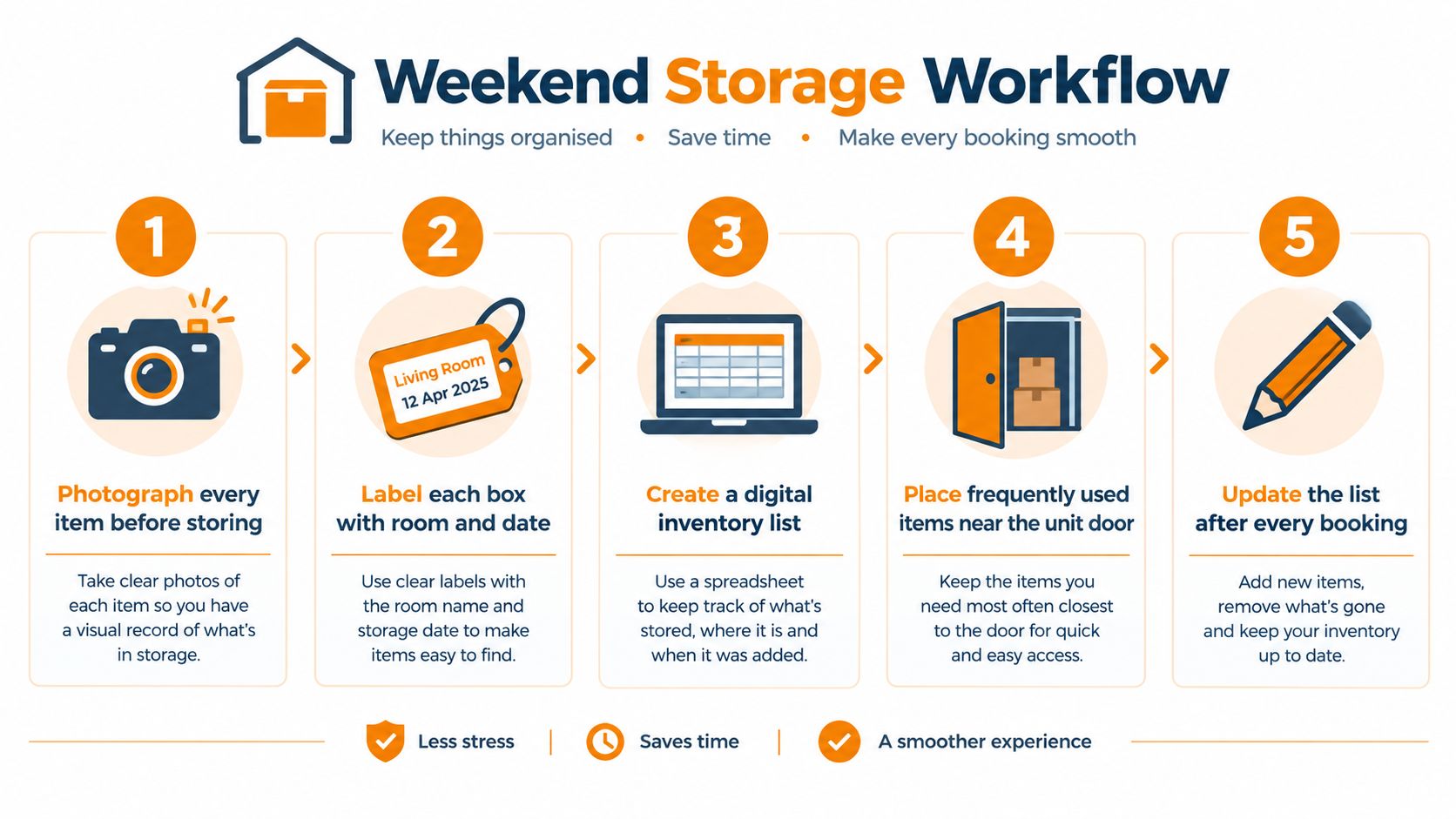
Build a shared inventory in Google Sheets or Microsoft Excel. Record the container ID, item description, quantity, property code, date stored, shelf location, condition and last movement. Use property codes rather than guest names.
Calculate stock from the laundry cycle
Use this planning formula:
Required linen stock = sets in use + sets expected to enter laundry before clean stock returns + contingency sets.
Estimate the laundry component from expected turnovers during the actual laundry turnaround window, multiplied by the sets used per turnover. Choose the contingency allowance according to your laundry reliability and replacement lead time, not a citywide occupancy average.
For consumables, use a separate calculation:
Reorder point = expected consumption before the next replenishment + contingency stock.
A monthly average is a starting point. A cluster of confirmed departures is the collection schedule you need to serve.
Keep the next changeover's kit at the property, and allocate the remaining clean reserve according to your collection plan. Review actual usage after bookings rather than repeatedly buying what appears to be running low.
A practical small-business inventory-management approach helps keep this manageable. Record every withdrawal, including emergency collections, and put returned goods through a condition check before marking them available again.
Security, Insurance and Access for Operational Stock
A secure unit that nobody can reach during an urgent collection is a poor operational choice. Equally, unrestricted sharing of access credentials isn't a sensible substitute for planning. Security and usable access must work together.
Separate the questions you ask about the premises, the unit and your own staff. CCTV concerns monitoring; access controls concern entry; your authorisation process determines who should be allowed to collect stock. Don't assume a facility offers individual alarms or access logs unless it confirms them.

Compare protection with practical access
| Arrangement | Operational advantage | What to verify |
|---|---|---|
| Host-only collection | Clear responsibility for withdrawals | Backup arrangements when you're unavailable |
| Named co-host access | Delegated emergency collection | Individual permissions and revocation process |
| Cleaner collection | Stock movement can follow the cleaning route | Loading time, authorisation and collection records |
| Delivery to storage | Less handling by the host | Acceptance rules and responsibility for deliveries |
Give each authorised person a defined role. A cleaner might collect labelled turnover kits without having permission to remove furniture or equipment. Review access when someone stops working with you.
Insure the inventory you actually hold
Don't assume your existing property or business insurance extends to goods in storage. Ask the insurer about the location, business use, replacement basis, limits, excess and exclusions. Use a guide to insurance for contents in storage to prepare your questions, then rely on the policy wording and written confirmation.
Ask specifically about theft, fire, water damage and accidental damage rather than assuming a standard package covers them. Also check whether goods are covered during transport, not just while inside the unit.
Keep purchase evidence, condition photographs and a current replacement-value schedule. Record appliance model details where relevant, and update the schedule when you replace stock.
Access test: Before committing, walk through an emergency collection with the person who would actually make it.
The right arrangement protects usable inventory without making retrieval unnecessarily difficult. Match the protection to the goods and the consequences of losing access, not to the cheapest advertised rental.
Records, Compliance and What Should Never Sit in a Storage Unit
Don't put confidential paperwork beside the spare towels and call it archiving. Guest information, financial documents and access details need a separate records system with deliberate permissions and retention decisions.
Digitising paperwork can make retrieval easier, but it doesn't justify keeping everything indefinitely or destroying originals indiscriminately. Use encrypted digital storage, controlled access and a documented retention policy. Check whether an original needs preserving before disposal.

Separate business evidence from guest information
Keep booking dates, nights available, nights let, invoices, cleaning records and authorisation documents organised by property. Restrict guest-identifying information to people who need it. A stock spreadsheet shouldn't become a second guest database.
Nottingham short-term-rental guidance discusses differing licensing interpretations alongside planning and property-specific requirements. Treat that as a reason to verify your own arrangement with the relevant authority and review your lease, mortgage or landlord permission, not as blanket clearance to operate.
Your evidence should answer the question being asked:
- Financial review: Keep income and expense records connected to the relevant transaction.
- Property-use query: Preserve the letting calendar, availability history and relevant permissions.
- Operational dispute: Retain dated cleaning records, maintenance evidence and authorisation correspondence.
For coordinating those responsibilities, CS Outsource's vacation rental management playbook is a useful management resource to consult alongside property-specific advice.
Store retained non-sensitive originals in a clearly indexed file box if physical storage is appropriate. Keep confidential originals in an arrangement designed for restricted document access. Shred material securely when your retention policy permits disposal, rather than accumulating paperwork because nobody owns the decision.
Scheduling Pickups, Guest Access and a 30-Day Host Playbook
Run the storage operation from the booking calendar, not from messages announcing that something has run out. Assign a collection owner, a stock-check owner and a backup person. Guests shouldn't need access to operational storage.
Turn the reset into a working routine
During the opening part of your 30-day playbook, finish the inventory and confirm collection permissions. Next, test a normal replenishment run and an urgent replacement collection, including loading and handover. Use the rest of the cycle to compare planned withdrawals with actual use, then adjust the stockholding.
Schedule seasonal rotation alongside a planned stock check. Compare the complete cost of alternative unit arrangements, including journeys and handling, rather than assuming either consolidation or separate units will always be cheaper.
Keep presentation standards in view when deciding what deserves replacement stock. The Sofa Cover Crafter hosting tips provide a relevant reference when reviewing guest-facing furnishings.
Quick answers before you settle into the routine
- Should guests collect replacements themselves? Keep operational collections with authorised staff. Deliver the item to the property instead.
- Can a cleaner manage replenishment? Yes, if the role, permissions, payment and withdrawal recording are agreed.
- When should you downsize? Review the unit when stock remains untouched, properties leave your portfolio or your supply arrangements change.
- What belongs near the door? Put the next scheduled collections within easy reach, while keeping the access route clear.
Your final test is simple: someone other than you should be able to collect the correct stock without a phone call.
Orange Box Self Storage offers flexible short-term and long-term storage with 24/7 CCTV monitoring, secure access controls and climate-protected units for your Airbnb's operational reserves. Visit Orange Box Self Storage with your measured inventory and collection requirements, and ask which unit will accommodate your stock without paying for space you won't use.