

A Grantham studio typically needs around 25 sq ft, a one-bedroom home around 35–50 sq ft, and a full three-bedroom move can push towards the 160 sq ft offered by a 20ft container. Most households shouldn't start by booking a full container, they should start by measuring what they own.
You're probably standing in a hallway surrounded by boxes, dismantled furniture and one awkward item that seems to dictate the whole move. The temptation is to hire the biggest container available and solve the problem in one go. That's convenient, but it can leave you paying for floor space and volume you'll never use.
Grantham has a substantial local customer base for storage. Its population reached 38,952 in the 2021 Census, compared with 34,592 in 2011 and 31,908 in 2001, an increase of about 22% since 2001 according to the Grantham population data. More households create more situations where temporary space helps, from removals and renovations to downsizing, student transitions and business stockholding.
The right answer to “how much space do I need in a storage container in Grantham” depends on the load, not the label. Measure first, allow room to access your belongings, then compare a smaller unit with the much larger footprint of a 20ft container.
Sizing Up Your Storage Needs in Grantham
A 25 sq ft unit is the sensible starting point for a studio flat or a tightly packed declutter. A one-bedroom home usually needs 35–50 sq ft, while a two-bedroom home often sits around 75 sq ft. A full three-bedroom household move is where a 100 sq ft unit or a 20ft container around 160 sq ft becomes easier to justify, based on UK storage-size benchmarks from Store Size Guide.
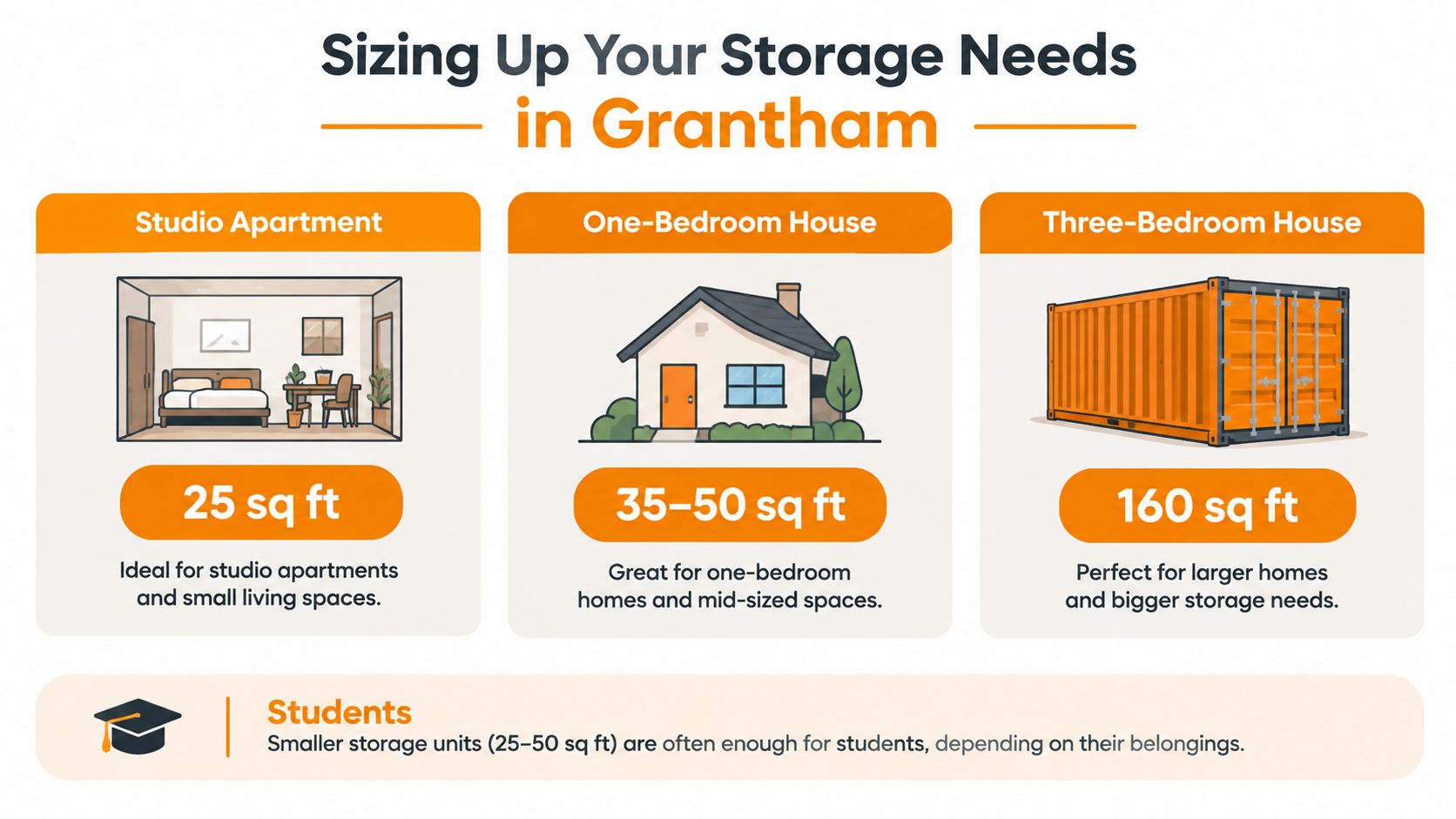
That size ladder matters because a 20ft container is commonly around 160 sq ft, well above the usual requirement for most one-bedroom and two-bedroom household contents. A 25 sq ft space resembles a garden shed, while 100 sq ft is broadly comparable with a single garage, giving you a more useful mental picture than the word “small” or “large”.
Measure before choosing a tier
Start with a room-by-room inventory. List every box, appliance, piece of furniture, bicycle, tool and business item. Record the largest dimensions of bulky objects, and note long items separately because a worktop, bed frame or sofa may need a particular floor position even when its total volume looks modest.
Disassemble tables, bed frames and flat-pack furniture wherever possible. Closed drawers, dismantled wardrobes and evenly sized cartons create a denser, safer load than furniture left assembled with empty voids inside.
Practical rule: Choose storage for the load you need to retrieve, not merely for the load you can force through the door.
Add a packing and access allowance rather than calculating a perfect wall-to-wall fill. The UK storage sizing guidance supports matching space to household contents, while practical calculator guidance recommends allowing extra room for gaps, awkward shapes and access. For a Grantham flat move, that discipline often keeps you in a 25–75 sq ft range instead of jumping straight to a full container.
Building an Inventory and Converting to Cubic Footage
A 20ft container can swallow a full household, but many Grantham moves need far less. Build the inventory first, then choose the smallest unit that holds the load with safe access.
Floor area shows only part of the capacity. A container also has height, so careful stacking can store items without covering the entire floor.
Start with the largest items. Record each piece's length, width and height, multiply those dimensions to find cubic inches, then divide by 1,728 to convert to cubic feet. For repeated cartons or totes, measure one representative item and multiply by the quantity.
Use the storage calculator from Orange Box Self Storage to select rooms and add individual items. Its result is a planning estimate, not a guarantee that every object will fit without rearranging.
Common storage item volume guide
| Item | Typical Space Needed | Sizing Note |
|---|---|---|
| Two-seater sofa | 36 cu ft | Measure the full outside dimensions, including arms |
| Three-seater sofa | 46 cu ft | Long length can affect the floor layout |
| Washing machine | 18 cu ft | Protect the drum and keep it upright |
| Filing cabinet | 20 cu ft | Count these separately for business storage |
| Bicycle | 12 cu ft | Handlebars and pedals may dictate orientation |
| Upright piano | 47 cu ft | The shape makes it harder to stack around |
| Mixed archive boxes | Add by batch | Use one measured box as the repeatable baseline |
These item volumes come from the Storage.co.uk space calculator. The upright piano shows why counting items can give the wrong answer. Its shape cannot be compressed, stacked on or pushed into every gap, so it may consume more usable space than several cartons.
A concrete check helps. Adding a washing machine at 18 cu ft and a three-seater sofa at 46 cu ft to a 25 sq ft plan can push the load beyond that tier, especially once boxes and access space are included. That is how a household moves from a smaller unit towards 50 sq ft without needing a full container.
Record shelving and racking too. They increase vertical capacity, but occupy floor space and may block items behind them. For business storage, list tools, stock, files and packaging together instead of estimating each category by eye.
Finish with an allowance for packing gaps, protective materials and an access route. The Gorilla Storage calculator guidance treats estimates as approximate. Use the measured total to choose a practical tier, then allow room to load, retrieve and protect the contents.
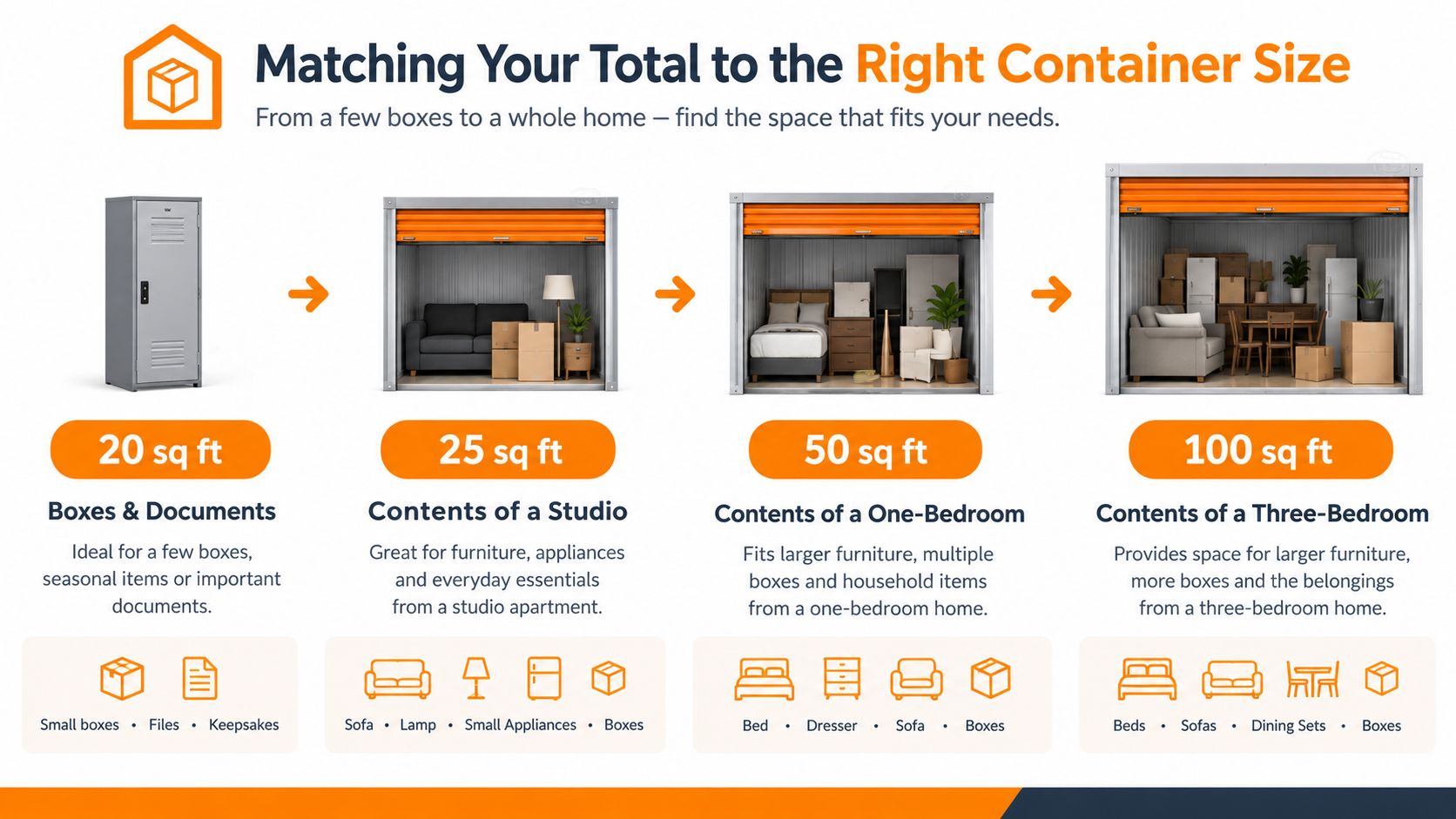
Matching Your Total to the Right Container Size
Use your cubic-foot total as a starting point, then test whether the shape of the load works in the unit. A locker may handle documents, a few cartons or student belongings, but a sofa, mattress or assembled wardrobe can change the decision even when the total item volume looks moderate.
| Storage need | Sensible starting point | What usually changes the answer |
|---|---|---|
| Documents, cartons and small appliances | 20 sq ft | Extra shelving or frequent access |
| Studio contents | 25 sq ft | A sofa, bike or bulky appliance |
| One-bedroom flat | 35–50 sq ft | Wardrobes left assembled or many boxes |
| Two-bedroom home | 75–100 sq ft | Dining furniture, large appliances and access needs |
| Full three-bedroom move | 100 sq ft or 160 sq ft | Bulky furniture, unfinished packing or retrieval access |
These comparisons follow UK storage benchmarks from Find My Storage's size calculator. A 20ft x 8ft container at about 160 sq ft is a substantial step above the space most one-bedroom and two-bedroom moves require. Grantham customers should reserve it for a genuine whole-home load, commercial inventory, bulky equipment or a move where safe access is more important than maximum density.
Check the internal length, width, height and door opening before booking. A bed frame or worktop may fit by volume but fail at the doorway if it can't turn through the opening. If you're comparing providers in different areas, a practical guide to storage units near me can help you compare unit descriptions, access arrangements and pricing structures, although the final decision still needs to match your measured load.
For a broader explanation of how storage footprints translate into household contents, use this storage unit size guide. Choose the larger option only when it gives you a safer stack, a usable aisle or room to retrieve important items.
Real Scenarios for Grantham Homes, Students and Businesses
The easiest way to size storage is to test your load against a familiar situation. Household labels provide a useful starting point, but the contents inside the home decide whether you stay in that range or move up.
| Scenario | Typical Contents | Recommended Unit | Approx. Floor Area |
|---|---|---|---|
| Studio flat | Bed, sofa, boxes, bike and a small appliance | Small unit | 25–35 sq ft |
| One-bedroom flat | Dismantled double bed, dining set, wardrobes and around 25 boxes | Medium unit | 50–75 sq ft |
| Student belongings | Boxes, clothes, books and small possessions, with bulky furniture left behind | Locker | 15–20 sq ft |
| Small business | Trade stock, tools, archive boxes or e-commerce overflow | Business unit | 75–100 sq ft |
A studio can often remain in the 25–35 sq ft range when the bed frame comes apart, boxes use consistent footprints and the bike is positioned along the longest wall. The load moves upwards when the sofa is oversized, the mattress must lie flat or several appliances stay in their original packaging.
A one-bedroom flat is where customers most often over-order. A dismantled bed, compact dining set and organised cartons can sit around 50–75 sq ft, rather than automatically requiring a 20ft container. Wardrobes left assembled, a large sofa, a piano or a sizeable storage cupboard are the usual reasons to reassess.
Students commonly need less than a household move because they can leave beds, desks and shared furniture behind. A carefully packed locker can handle clothes, books, kitchen items and personal boxes during a break. The choice changes when the student is clearing an entire furnished room or storing equipment for several people.
Small businesses should separate stock volume from access requirements. A tradesperson may need 75–100 sq ft for tools, materials and archive boxes, but frequent retrieval means the unit needs an aisle and sensible zoning. Commercial loads can justify a 20ft container when stock arrives in bulky packaging or equipment cannot be stacked safely.
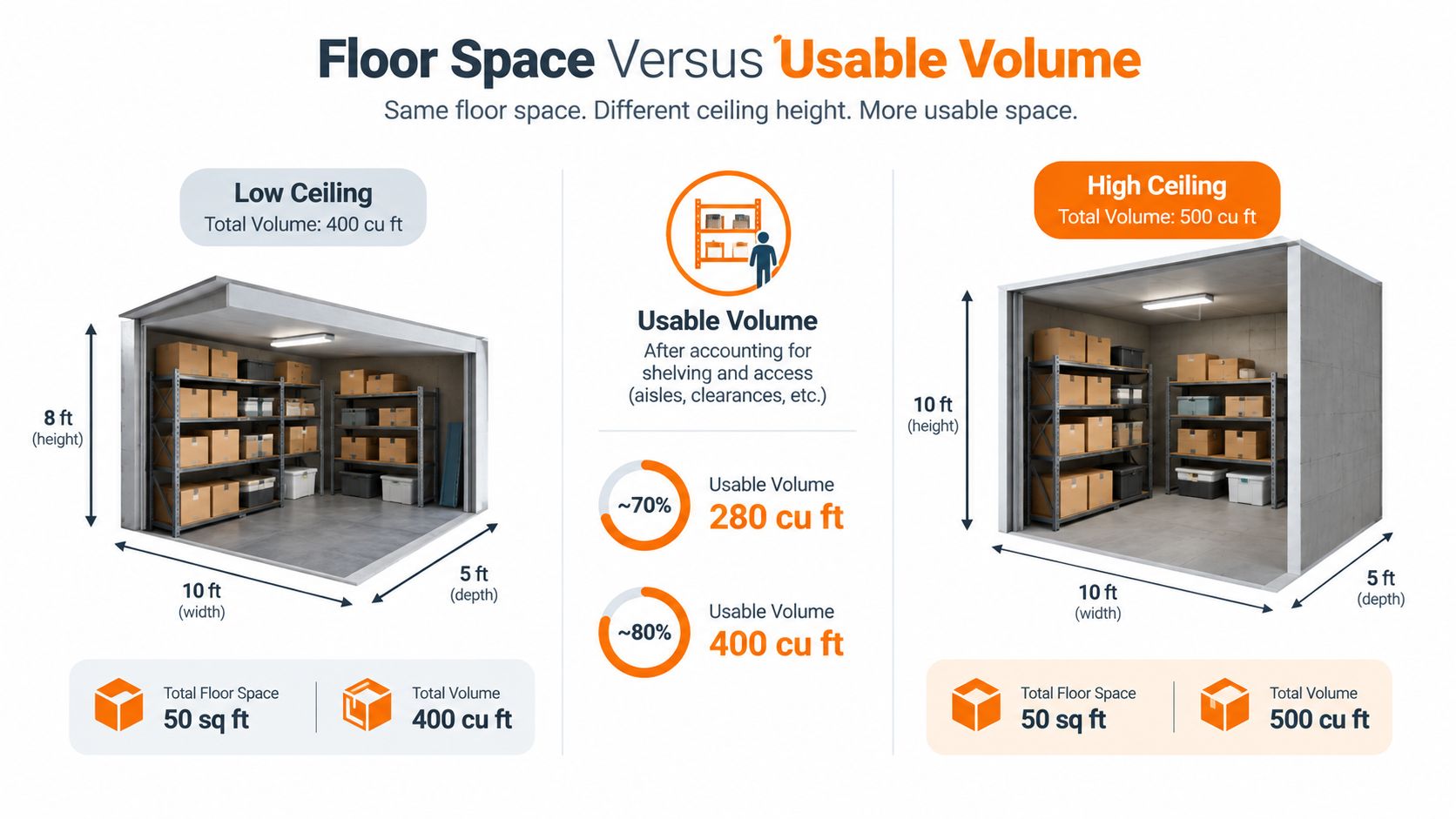
Floor Space Versus Usable Volume
Two units with the same floor area can behave very differently. The ceiling height, door position, shape of the contents and access route determine how much of the stated capacity you can use.
A 50 sq ft footprint multiplied by an 8ft ceiling gives roughly 400 cubic feet of theoretical volume. That figure isn't the same as usable storage because you need a route to the rear, can't stack every object to the ceiling and must leave room around fragile or awkward pieces.
The same issue affects larger units. A 100 sq ft space does not automatically hold twice the practical load of a 50 sq ft space, because both units lose capacity to access and irregular shapes. The useful comparison is not just floor area multiplied by height. It's the amount of stable, reachable volume left after the load has been arranged.
One Grantham storage guide lists a 10ft container at 563.3 cu ft and a 20ft container at 1,173 cu ft, demonstrating why cubic capacity deserves attention alongside the headline footprint. You can review those container figures in the Grantham container size information.
Why stacking changes the decision
Heavy cartons belong at the bottom. Soft goods can fill higher gaps, while furniture and unstable shapes often impose a lower practical stack. Shelving can improve access and make vertical space useful, but it also occupies floor area.
A 20ft container around 160 sq ft can therefore look enormous beside a one-bedroom load. Its volume is valuable for a full household or business inventory, but it becomes wasted capacity when a few rows of boxes and a sofa occupy only part of the floor. That's the central sizing gap in Grantham. Customers often need a well-packed mid-sized unit, not the biggest container on the forecourt.
Packing and Stacking Tips That Protect Your Size Choice
Good packing protects the unit decision you've already made. Poor packing turns a suitable space into a cramped one, then forces an avoidable upgrade.
Use containers with consistent footprints wherever possible. Uniform plastic totes stack more predictably than mixed cardboard cartons, and they protect clothing, paperwork and household goods more effectively in a storage environment. Don't create tall stacks from weak boxes, especially when you'll need to reach the back.
Load the floor in a deliberate order
Dismantle bed frames, tables and shelving. Wrap hardware in labelled bags and attach each bag to the relevant item. Store mattresses on their edge where the facility's rules and the mattress construction allow it, and run long objects along the longest dimension of the unit.
Keep a clear access route along one side, ideally around 60 cm, so you can reach the rear without unloading the front. Put documents, seasonal items and rarely needed stock behind the load. Place tools, daily business stock and essentials close to the door.
- Heavy first: Put dense cartons and stable appliances low down.
- Soft goods in gaps: Use cushions, bedding and towels to fill voids without crushing fragile items.
- Labels on every side: Mark all four sides so you can identify a carton without moving it.
- Photograph the layout: Take a doorway photo after loading, then keep it with the inventory.
- Protect fragile goods: Use covers and padding, and don't rely on a stack to support delicate items.
For a practical way to find the right storage labels, choose labels that remain readable and attach securely to the surfaces you're using. Clear labelling saves space because you won't need to pull apart a stack to identify one box.
Access matters: A unit that fits everything but leaves no retrieval route is the wrong size for a long storage period.
Booking, Security and Final Checks at Orange Box
Book the measured size, not a vague description such as “small” or “large”. Tell the operator that you need a specific footprint, such as 35 sq ft, and provide the main bulky items that could affect the loading plan.
Before signing, confirm the weekly rate, minimum stay, deposit and any administration charge. Ask whether you can change units if the actual load proves smaller or larger, and establish whether the new unit would be available when you need it. A flexible arrangement can prevent a rushed decision on moving day.
Inspect the unit before loading
Walk inside the space and check the features that matter to your belongings and routine:
- Door and turning space: Measure the opening and confirm long furniture can enter.
- Locking method: Ask whether the unit uses a disc or cylinder lock rather than relying on a basic padlock.
- Surveillance: Check that CCTV covers the corridor, entrance and main gate.
- Access hours: Confirm when movers, tradespeople or business staff can enter.
- Condition record: Photograph floors, walls, doors and any existing marks before loading.
Orange Box Self Storage's storage facility information for Grantham can help you review the available storage approach before you commit. Treat the online description as a starting point, then verify the actual dimensions, access arrangements and contract terms with the facility.
Update your inventory after the move. Record what entered the unit, where it sits and which items need regular retrieval. That final list gives you a reliable basis for future adjustments and prevents the next visit from becoming a search through unmarked cartons.
Orange Box Self Storage offers storage options for household contents, student belongings, business stock and larger equipment, with unit sizing supported by an online calculator. Visit Orange Box Self Storage with your measured inventory and ask for a space that fits the load without paying for an unnecessary 20ft container.