


The boxes are stacked in the hallway because the new tenancy doesn't start until the 12th. Or the landlord wants the flat back before the sale completes. Or a housemate has moved out and left a bed nobody wants to claim. Whatever the trigger, the decision lands on you in about a week, and the wrong unit costs money every month until you fix it.
Nottingham has a lot of people making that decision at once. The city's population reached approximately 323,600 at the 2021 Census, up 5.9% from just under 305,700 in 2011, according to the ONS census area profile for Nottingham. Households also change shape: couples with dependent children rose from 14.7% to 15.9% across the two censuses, and couples without children from 13.7% to 14.4%. Same city, different amounts of stuff.
Size the unit by usable volume rather than floor area, choose the type by how you'll load it, and check security on site with your own eyes. A storage unit is a temporary fix for a real transition, not a spare room you keep forever.
Unit Sizes at a Glance and What Fits
Sizes in the trade are quoted in square feet, and no table can see inside your flat. Use these as starting points.
| Unit size | Typical contents | Usually suits |
|---|---|---|
| Under 25 sq ft | A few boxes, seasonal decorations | Students between tenancies |
| 25 sq ft | One room of boxed items, a small armchair | Student moves, one-room clear-outs |
| 50 sq ft | Contents of a studio flat | A short gap between tenancies |
| 100 sq ft | Contents of a one-bedroom flat | Couples moving, one-bed clear-outs |
| 150 sq ft | Contents of a two-bedroom home | Renovations, a stalled house sale |
| 200 sq ft | A three-bedroom home, or a small office's files | Family moves, business archives |
| 300 sq ft | A large household, or trade stock on pallets | Stock-heavy traders, big clear-outs |
Every row is a rough guide rather than a guarantee. The 50 sq ft unit that swallowed one studio flat won't swallow another that contains a bed-settee, two bikes and 30 boxes of books. Measure and count before you book.
Why floor area is not usable volume
Boxes need safe stacking height, ventilation clearance from the walls, and a path so you can reach the items at the back without emptying the unit. A space with a wide door and high ceiling takes far more than its floor plan suggests, provided you plan the stacking. A tall unit with a narrow door and a low ceiling can be worse than a smaller one you can walk into.
Nottingham's student market shows why usable volume matters. Local authority monitoring reported approximately 24,100 student bedspaces in the city, with its survey covering 92% of available capacity, per the Nottingham Authority Monitoring Report 2019-20. That many bedspaces produce a seasonal rush in late June and mid-September, when short gaps open between tenancy end dates and the next term. The same report notes the council's expectation that university student numbers may grow by approximately 2.8% annually in line with demographic trends, which compounds to roughly 14.8% over five years if sustained. More students, same narrow summer window.
From a list to a size
- Count boxes. Everything packed goes in a numbered list by room.
- Measure the largest pieces. Sofa length, wardrobe height, mattress width. These set the footprint.
- Mark what you need weekly. Work kit, winter coats, paperwork. These go near the door.
- Allow a walkway. Roughly the width of your shoulders plus a trolley, down one side.
Practical rule: if you can't walk to the back of the unit with the door shut behind you, take the next size up. The extra cost is smaller than a second move.
Small, shelved and labelled beats large and chaotic every time. Books, electronics, textiles and kitchen equipment are the items that suffer most from condensation, so keep them off the floor and leave air gaps at the walls.
Storage Types Compared by Access and Use
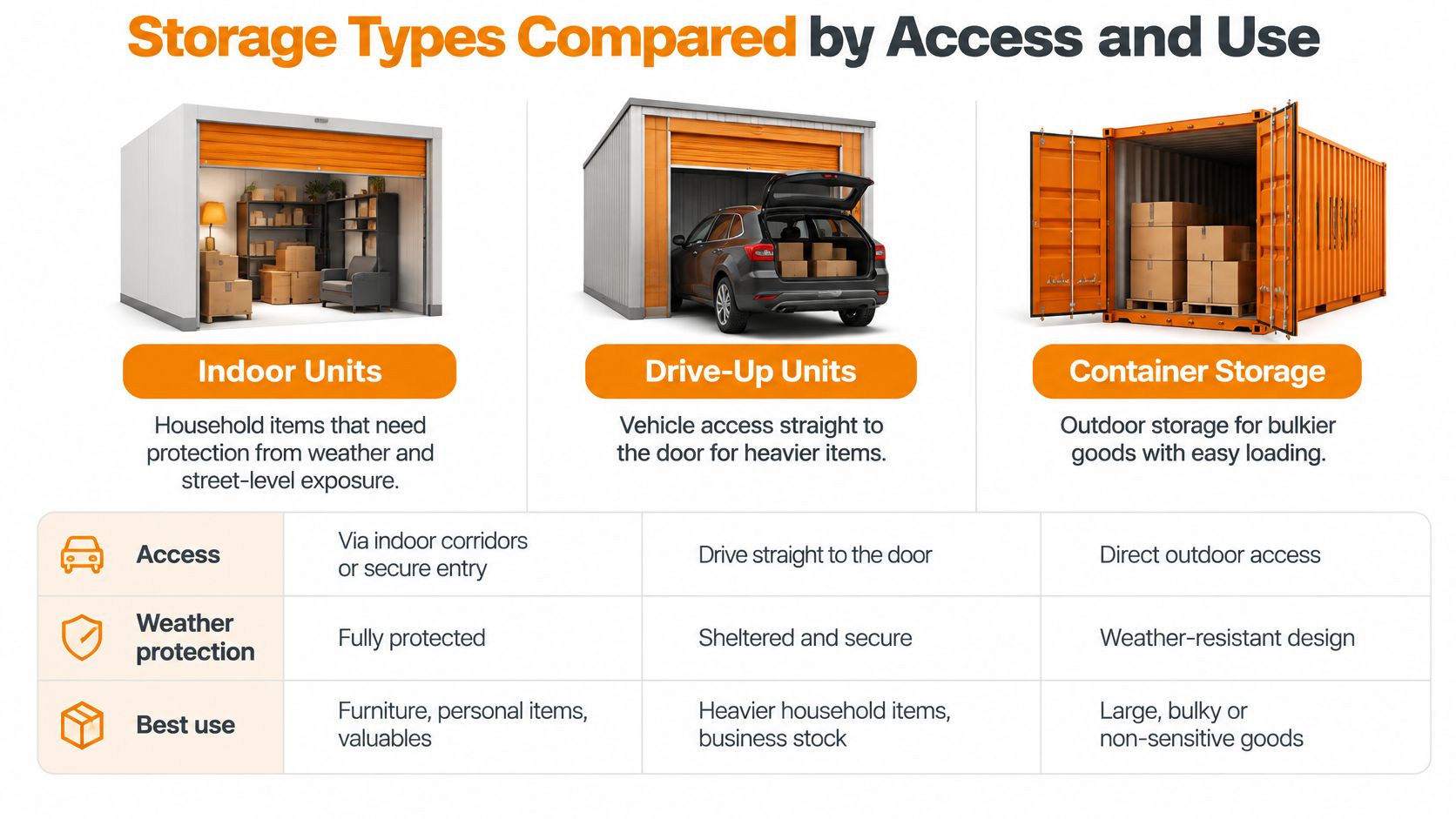
The type of unit matters more than the square footage for many users. Here's how the options line up.
| Storage type | Best for | Access | Typical contents |
|---|---|---|---|
| Indoor unit | Household items needing protection from weather | Inside the building, via corridor or lift | Furniture, boxed clothing, textiles, electronics |
| Drive-up unit | Bulky items and frequent loading | Vehicle parks at the unit door | Sofas, mattresses, trade stock |
| Container | Secured bulky equipment and tools | Lockable steel box | Power tools, garden equipment, seasonal stock |
| Workshop unit | Working on projects while storing tools | Space to work inside | Tools, bikes, workshop equipment |
| Business enterprise unit | Business stock and document archives | Business access during site hours | Stock, files, pallets |
Not every type exists at every site, so confirm availability before you plan the van.
Two rules that settle most decisions
If it's heavy or awkward, get vehicle access to the door. A three-seater sofa through two fire doors, a lift and a corridor takes four people and an hour. Through a drive-up door it takes two people and ten minutes. When you're paying by the hour for a van, that difference is the whole budget.
If it's damp-sensitive, get it indoors. Paper, fabric, photographs, cardboard-packed electronics and wooden furniture all suffer in unheated outdoor conditions where the temperature swings. An indoor unit gives you a stable building, and for anything irreplaceable it's the only sensible choice. Our guide to indoor versus container storage walks through the trade-off if you're weighing the two.
Tradespeople usually need the opposite of what households need. You want a container or workshop with room to swing a ladder, lockable steel, and enough height for a van's roof bars to clear. A household customer wants a corridor, a trolley and a lift.
Ask yourself one question before you compare prices. How often will I come back, and what am I putting in it? Frequency decides access. Contents decide whether the unit needs to be indoors. Everything else, including size, follows from those two answers.
Security Checks Before You Rent
Cameras are the cheapest security feature to install and the easiest to overrate. An independent 2024 sector report found that one in three operators had experienced a break-in during the preceding year, and noted that unmanned sites may require stronger deterrence than passive surveillance, according to the PKF Smith Cooper self-storage report 2024. The same report describes how operators run LED lighting with passive infrared detection to keep corridors lit only when occupied, and how that pairs with electronic access control to create an auditable record of every entry.
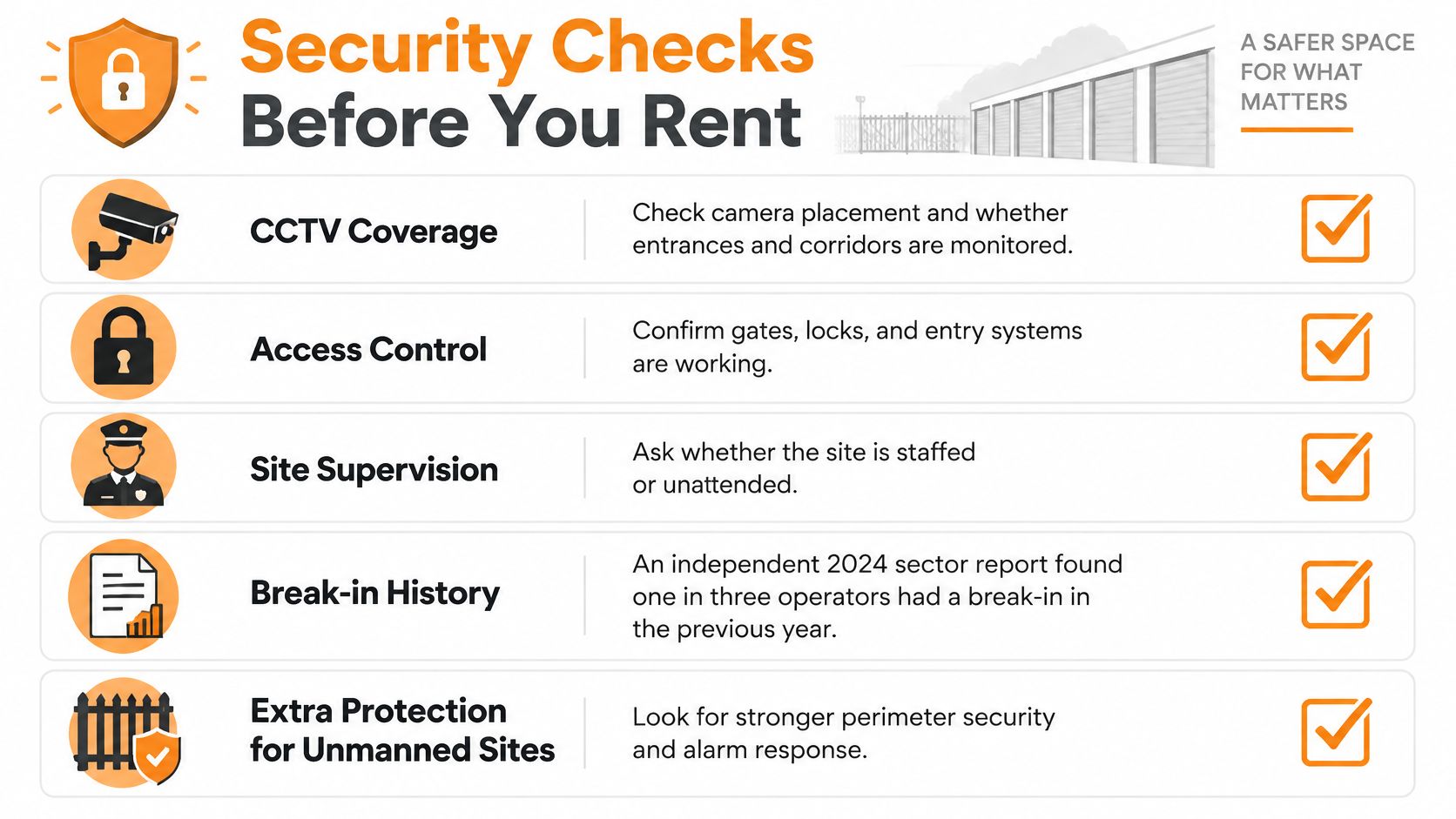
Run these checks on site, in this order.
- CCTV coverage. Ask where the cameras point. You want the entrance, the corridors and the loading bay, not just the front desk.
- Access control. Individual codes or cards, so every entry leaves a record. A shared keypad code tells you nothing after an incident.
- Individually secured units. Your own lock on your own door. One forced entry shouldn't expose the whole floor.
- Alarm escalation. Ask who gets alerted when a door is forced, and how quickly they respond. A bell with nobody listening is noise.
- Lighting at gates and loading areas. Visit after dark once before you commit. You should be able to see your feet and your van.
- Weather seals. Roofs and doors should be sealed, especially on container and drive-up units where driving rain finds gaps.
- Site hours that match your visits. A unit you can only reach during office hours is useless if you work shifts.
Then deal with the insurance question before you sign. Some policies require you to declare a value, some require a specific type of padlock, and some exclude certain goods entirely. Keep a written inventory with dated photographs of everything, including serial numbers on tools and electronics.
Ask one direct question about the building itself: is the unit internal or container-based? The answer changes the risk from water, temperature and forced entry. Then ask to see the access point and the actual unit, not the show unit near reception. Any operator offering secure storage near me should be happy to walk you round before you pay.
Storage Options for Students in Transition
Halfway through the autumn term, the accommodation falls through. A tenancy start date slips by three weeks, a studio turns out to cost more than the maintenance loan covers, or a landlord withdraws an offer after the deposit is paid. This is the storage need most guides ignore, because it doesn't follow the tidy June-to-September pattern.
The numbers explain why it happens. Nottingham's official accommodation data shows PBSA vacancy rising sharply from 3.5% in 2023-24 to 11.2% in 2024-25, with the council reporting a further increase to 12.7% for 2025-26, including studio vacancy at 16.1% against 11.6% for cluster flats, per the Nottingham student accommodation update report. The same report puts the fall in students requiring accommodation at about 7,450 between 2022-23 and 2024-25.
Meanwhile the underlying population stays large. The University of Nottingham recorded 34,549 students based in Nottingham in 2019-20, including 25,122 undergraduates and 9,589 EU or other international students, according to its student statistics for 2019-20. International students in particular tend to need a unit for a few weeks or a summer, not a year.
The four questions students actually ask
Can I book for a few weeks? Yes, if the contract allows short terms. Check the minimum period and the notice required to leave, because a one-month minimum with 14 days' notice behaves very differently from a three-month lock-in.
What if my tenancy date moves? Ask before booking whether the start date can shift and what cancellation costs. Get the answer in writing, including the deadline.
Can housemates share one unit? They can split the cost, but agree who holds the access and who keeps paying if someone drops out mid-term. Put it in the group chat so there's a record.
How do I pack for a move between halls, home and a shared house? Label sealed cartons by room, not by person. Keep a bag out of storage with keys, chargers, documents, medication and one change of clothes.
Heavy items go on the floor, light textiles on top, and nothing rests against the walls where condensation forms. Photograph the unit on the day you leave it, with the door open and the lock visible. Our student storage in Nottingham page covers term-time contracts and summer collection if your dates are already tight.
Storage for Renters in Crowded Homes
A shared house where the hallway is already a second wardrobe is a familiar Nottingham rental. Storage can clear that floor while you wait on a move, and the gain is walking space plus fewer trip hazards. It will not turn a box room into a proper bedroom, dry a damp wall, or push a landlord to repair what they have ignored.
Just over 7% of privately rented homes in Nottingham were overcrowded at the 2021 Census, and the rate had changed little since 2011, according to the Nottingham social impact of housing licensing report. Overcrowding is more common in some rented homes than others. A unit is a temporary hold for the overflow, not a housing fix.
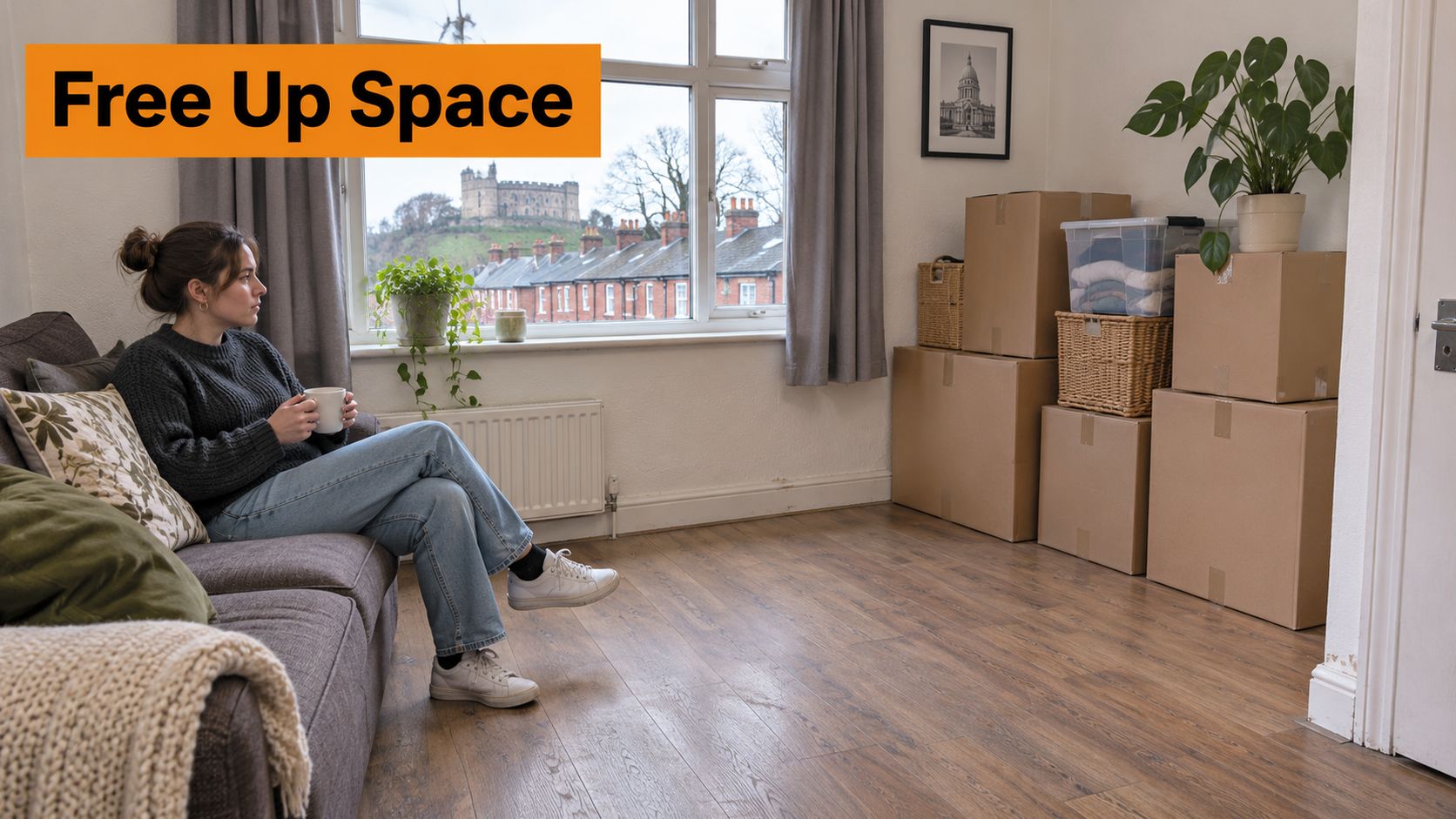
The distinction that matters: voluntary space management is a choice you make to live more comfortably. Overcrowding is a housing condition with legal weight. Storage helps with the first and does nothing about the second.
What goes off-site and what never does
Choose by how often you use an item and by the volume it takes once packed, not by the patch of floor it covers today. A spare sofa can look compact in a room and still swallow a tall slice of a unit when you stand it on end. Seasonal clothing, furniture nobody sits on, archived documents, business stock, holiday decorations and sports gear used twice a year are the first things to move.
Keep at home anything you touch weekly: daily medication, identity documents, keys, tenancy paperwork, work equipment, school items, phone chargers, and the pans for meals you cook. If getting an item back means a midweek trip you will skip, it stays in the house. Access you will not use is not access.
Paper, photographs and textiles go in sealed boxes rather than bin bags, stacked on shelving off the floor in a climate-protected unit. A cheap outdoor container looks cheaper until damp reaches a box of documents, and then the saving is gone.
If the home itself is unsafe, dated photographs and a written message to the landlord create a record that matters later. Contact the council's housing team where repairs stall. Do not send essential belongings off-site just to make a dangerous room look tidier.
Where to Store Near Nottingham and How Collection Works
Pick a site by route and access, not by brand. The right question is which one you can reach in 15 minutes at 7pm on a Friday with a loaded van.
| Site | Postcode | Details |
|---|---|---|
| Beeston | NG9 | Closest to the city centre alongside Long Eaton; drive-up access; 7-day opening; indoor units from 11 to 308 sq ft |
| Long Eaton | NG10 | Closest to the city centre alongside Beeston; indoor and drive-up units plus business enterprise space |
| Ilkeston | DE7 | Workshop units and containers, plus business enterprise units and offices |
| Derby | DE24 | Indoor, drive-up and container storage, plus business enterprise units and offices |
| Grantham | NG31 | Drive-up units and business enterprise units |
| Colsterworth | NG33 | Container storage, workshop units and drive-up units |
For a city-centre address, Beeston and Long Eaton are the practical pair. Beeston's range runs from compact indoor units up to mid-sized rooms, which covers both a student with six boxes and a family clearing a two-bed terrace. Long Eaton suits anyone loading furniture direct from a van.
Three checks when two sites look identical online
Drive time at the hours you'll travel. A 12-minute run at 10am becomes 35 minutes at 5pm on the ring road. Test it once before you sign.
Parking at the unit door. Some sites have generous loading bays, others have a narrow turning area shared with other customers. Ask, or drive over and look.
Whether your unit type exists there. Container, workshop and drive-up space isn't universal across every location, so confirm before you book the van.
If the move-out date is fixed and you'd rather not hire a van at all, collection is offered in the Nottingham area for summer storage, and the team books a time that fits your move-out date.
Booking and account management happen online, so you can reserve a unit, check your balance and extend a contract without driving over. That matters most in the week when everything else is moving.
Book Your Nottingham Unit Before Your Move Date
The decision takes about 20 minutes if you work through it in order.
- Count and measure. Boxes plus largest furniture, then choose a size from the table with room for a walkway.
- Pick the type by access and contents. Heavy furniture points to drive-up, paper and textiles point to indoor.
- Run the security checklist. Confirm access control, alarm response and insurance conditions, and photograph your inventory.
- Compare two nearby sites on route, parking and hours. Then commit to one.
- Book before the move date. Confirm the start date, minimum term and cancellation terms in writing, and keep the inventory list with the contract.
Same-day drive-up move-in is available at the Derby, Long Eaton and Grantham sites, which turns a panic into an afternoon. Orange Box Self Storage is a family-run company that has been storing the East Midlands since 2014, so the questions you're asking have been answered many times before.
Work out the size from usable volume, match the unit type to how you'll load it, and check the site with your own eyes before you pay. Orange Box Self Storage runs sites at Beeston, Long Eaton, Ilkeston, Derby, Grantham and Colsterworth, covering household moves, student transitions and business stock with indoor, drive-up and container options. Visit Orange Box Self Storage to compare units and reserve yours before your move date lands.