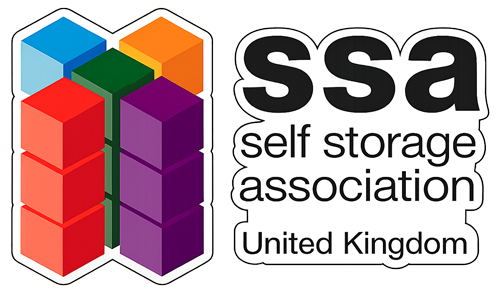


Your tenancy ends on Friday, but the new keys won't be ready until the following week. A student is travelling home for the summer with more belongings than will fit at a parent's house. A tradesperson has furniture and equipment sitting in the way while a Grantham renovation runs behind schedule. In each case, the problem isn't a permanent lack of space. It's a timing gap.
That's why short term storage in Grantham needs a practical approach. The right unit, access arrangement and contract can make a move straightforward. The wrong choice can leave you paying for unused space, arranging extra removals or discovering that you can't reach your belongings when you need them.
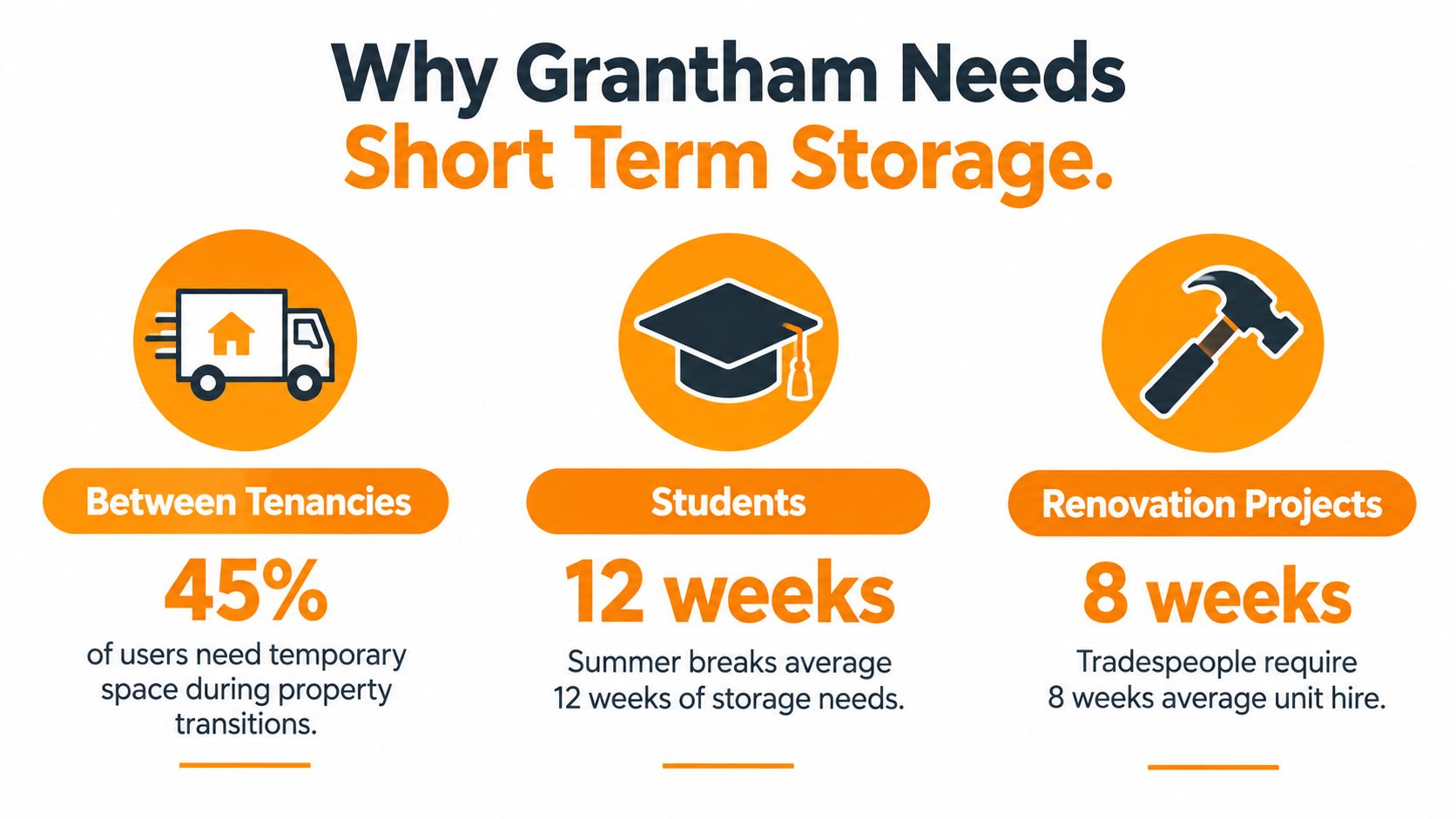
Why Grantham Needs Short Term Storage Right Now
A renter in Grantham may have packed every box, booked a removal van and still have nowhere to put the contents when the tenancy handover shifts by a few days. A student may need somewhere for boxes, bedding and kitchen equipment between terms. A shop or trades business may need temporary room while stock, tools or furniture are displaced by refurbishment.
Those situations all have one feature in common. The storage period is uncertain, but the need is immediate. You may need the unit for a few weeks, then extend it because a completion date changes. You may need access at a specific time because your removal van is booked around work or public transport.
Grantham has an estimated 46,183 usual residents and 20,040 households, based on the town's built-up-area geography in the 2021 Census. Those figures are a historical benchmark, not a live population estimate, but they show that local providers are serving a substantial residential market. The household figure is especially useful because storage demand usually concerns furniture, possessions and personal effects rather than population alone. Census data for Grantham provides the underlying local context.
Nationally, household numbers across England and Wales rose from 23,366,044 in 2011 to 24,783,199 in 2021, an increase of 6.1%, according to the Office for National Statistics household and population estimates. That doesn't forecast occupancy in Grantham, but it does show the broader pool of households whose possessions may need temporary space during moves, renovations and changes in accommodation.
Security matters too, particularly when several people need controlled access to a site. If you're assessing a facility for a business or managed property, guidance on commercial gate access control is useful because it explains how entry permissions can be managed rather than relying on an open yard and a padlock.
What Short Term Storage Really Means in Grantham
Short term storage is best understood by the reason for the stay, not by an arbitrary contract label. If you need space while moving between properties, waiting for renovation work or holding stock during a temporary interruption, you're looking for flexibility rather than a low long-term rate.
Most suitable arrangements run for a short initial period with a rolling weekly or monthly renewal. The important questions are whether you can leave without a long notice period, extend without restarting the agreement and change unit size if your volume changes.
Long-term warehousing works differently. It may suit a business with stable inventory and predictable storage needs, but it can be poorly matched to a household move or student break. A cheaper advertised rate won't help if you're committed after the belongings have already gone to the new property.
Situations that fit short term storage
- Between tenancies: Store furniture and boxes when your old tenancy ends before the next one begins.
- Delayed property completions: Keep possessions secure when a sale or purchase timetable moves.
- Home refurbishment: Clear rooms before flooring, decorating or structural work begins.
- Downsizing and house clearance: Sort furniture gradually instead of making rushed decisions.
- Bereavement: Create breathing space while the household contents are assessed and distributed.
- Student breaks: Store belongings during a summer or semester absence without transporting everything home.
- Small business overflow: Hold seasonal stock, project materials, tools or display equipment without taking a larger permanent premises.
For businesses, regional East Midlands logistics activity reinforces the case for scalable arrangements. Year-end take-up reached 7.03 million square feet across 26 units, which was 47% above the 2007 to 2019 pre-pandemic average, while third-party logistics providers accounted for 37% of total activity, according to Savills' East Midlands logistics research. That regional figure isn't a Grantham occupancy forecast. It is a reason for local businesses to favour unit sizes and contracts that can expand or contract as stock changes.
Unit Sizes and Pricing You Can Actually Plan Around
The most expensive mistake is usually choosing space by guesswork. A unit that is too small forces awkward stacking, extra trips and sometimes a second unit. One that is too large gives you a comfortable aisle but charges you for air.
Ask the provider to describe the unit in terms of actual contents, not just floor area. A small locker may suit a few labelled boxes and personal items. A unit around 25 to 50 square feet can work for the contents of a compact flat, depending on furniture and packing discipline. A unit around 75 to 100 square feet or more is more appropriate for a larger household, bulky furniture or business overflow.
The figures below are planning examples, not verified Grantham market prices. Providers set rates according to location, access, availability, insurance and contract terms, so obtain a written quote before booking.
| Unit size | Best for | Indicative monthly price | Weekly equivalent |
|---|---|---|---|
| Locker or compact unit | Boxes, documents and small personal items | Confirm with provider | Monthly rate divided by four |
| 25 to 50 sq ft | Smaller flat, room contents or student belongings | Confirm with provider | Monthly rate divided by four |
| 75 to 100+ sq ft | Larger household, renovation contents or business overflow | Confirm with provider | Monthly rate divided by four |
For a short stay, convert the quote yourself. Divide the monthly price by four to get a rough weekly planning figure, then divide that weekly figure by seven for a daily comparison. It won't always match the provider's billing method, but it exposes the actual cost of extending by a week.
Check the total, not the headline
Your quote should identify:
- Administration charges: Ask whether setup, account or reservation fees apply.
- Deposit requirements: Confirm the amount, when it's payable and how it is returned.
- Insurance: Check whether existing home or business cover is accepted, and whether a top-up is required.
- Access costs: Find out whether out-of-hours access, additional keys or vehicle access carry separate charges.
- Unit changes: Ask whether moving into a smaller unit later is permitted without a fresh administration charge.
People downsizing often need temporary room while they decide what stays, goes or gets sold. A specialist guide to storage for downsizing moves can help you think through that transition, although you should still check local terms and availability.
For a smaller requirement, compare the provider's description against a small storage unit rather than assuming that the first available room is suitable. The right choice is the smallest unit that still leaves safe access to the items you'll need.
Practical rule: Price the storage period, transport, access and possible extension together. The lowest monthly figure can become the most expensive option if it creates extra trips.
Security and Access Features That Actually Matter
A polished website doesn't make a storage facility secure. Look for controls you can understand and test before signing.
Controlled entry comes first. Personal PIN access, an electric gate and a properly maintained perimeter tell you who is allowed onto the site. CCTV should cover entrances, vehicle routes and common areas, with recording and monitoring arrangements explained clearly. Good external lighting matters because loading often happens in poor weather or after daylight hours.
Your unit should have its own lock, and you should know who controls the key or code. A facility that leaves customers dependent on a shared key system gives you less control over access. Business customers should also ask how access can be handled when an employee, cleaner, removal team or contractor needs entry. Clear key management for cleaners principles apply here too, especially when more than one person needs authorised access.

Separate essentials from useful extras
Essential for most customers
- CCTV covering the site and access points
- PIN-controlled entry or another individual access method
- Adequate lighting around gates, corridors and loading areas
- A lockable unit with access controlled by you
- Clear rules for reporting damage, lost access details or suspicious activity
Useful for particular loads
- Climate monitoring: Important for sensitive documents, photographs, instruments and some electronics. It isn't automatically necessary for ordinary furniture and sealed household boxes.
- Drive-up access: Helpful when loading heavy equipment, tools or bulky furniture.
- Extended access hours: Valuable for shift workers, students arriving by train and customers whose removal van can't attend during office hours.
- Covered loading: A practical advantage during wet weather, especially when cardboard boxes are involved.
The National Archives recommends stable conditions for mixed archival materials, including 13 to 20°C and 35% to 60% relative humidity, with monitoring and protection from floors, ceilings, external walls and direct light. Its environmental management guidance is aimed at records rather than everyday household storage, but the principle is clear. A secure lock-up isn't automatically suitable for sensitive paper.
Before booking, ask one direct question: Can you access the unit at the exact time your move, shift or collection is likely to happen?
Packing and Move-In Tips That Save Time and Money
Good packing reduces the unit size you need and makes the final collection faster. Don't arrive with loose bags, unlabelled cartons and a vague idea of where everything went. That approach turns every visit into a search.
Pack for retrieval, not just transport
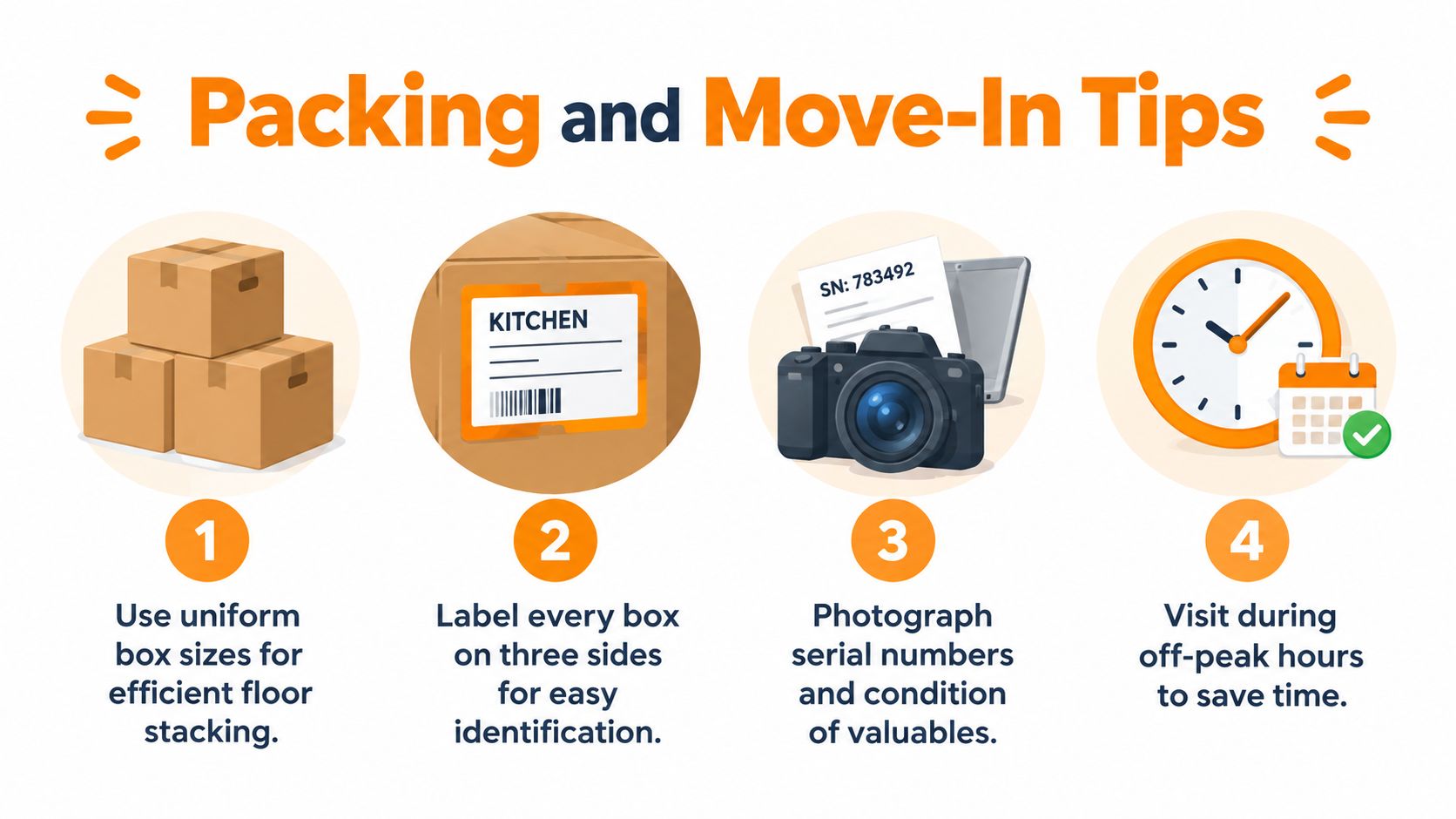
Use sturdy boxes in a few consistent sizes. Uniform cartons stack more securely and use the floor area efficiently, while random shapes create gaps and unstable piles. Avoid relying on bin bags for anything that needs protection from crushing, dust or punctures.
Label every box on three sides, not just the lid. Write the room, a short contents description and a priority mark such as “open first” or “winter clothes”. Put the labels high enough to read after stacking.
Keep a simple inventory in a phone note or shared document. Record the box number, contents and location in the unit. Photograph valuable items before storage, including serial numbers and visible condition. Those images can help with an insurance query and make it easier to prove what was stored.
A reliable loading sequence looks like this:
- Prepare the base: Use pallets or raised shelving for paper records and anything vulnerable to moisture.
- Load heavy items low: Put furniture and strong, sealed boxes at the bottom.
- Use vertical space: Stack stable boxes upwards, but don't create leaning towers.
- Keep an aisle: Leave a narrow route to the rear or to boxes you may need.
- Protect edges: Use blankets or old towels around furniture corners and soft items instead of treating bubble wrap as a universal solution.
- Record the layout: Take one wide photograph when the unit is complete.
The house-moving packing guide offers further practical ideas, but the main rule is simple. Pack each box so you can lift it, identify it and retrieve it without dismantling the whole unit.
Don't ignore insurance
Check your home contents or business policy before accepting a provider's insurance add-on. Ask specifically whether it covers off-site storage, the full rental period and the total replacement value of the items. If the existing policy excludes storage or the limits are too low, compare the provider's cover and exclusions before paying for it.
For documents, HMRC's default retention approach is six years plus the current year, after which records should be reviewed and securely destroyed or retained only where justified. The policy is described in the National Archives guidance above. Set a review date at intake so a temporary archive doesn't become an unmanaged permanent one.
How to Choose the Right Provider in Grantham
Choose the provider that makes the whole move easier, not the one with the smallest number in an advert. Four factors usually decide whether short term storage works well.
Compare the real operating cost
Location: Calculate the drive from home, work or the property being cleared. A unit that saves money but requires repeated cross-town trips may not be cheaper in practice.
Access: Match the hours to your actual schedule. A weekday-only facility may suit an office move but frustrate a shift worker or student arriving with a van at the weekend.
Contract flexibility: Ask about notice periods, extensions, unit changes and cancellation. A completion date can move, so you need a provider that won't treat a one-week extension as a brand-new booking.
All-in price: Request the monthly charge, deposit, administration fee, insurance requirement and any access costs in writing. Compare like with like.
The latest English Housing Survey recorded approximately 1.8 million household moves in 2024 to 2025. Around half involved private rented homes, including 640,000 households moving from one privately rented property to another and 182,000 new households entering the private rented sector, according to the government's housing history and future housing findings. Those figures are national, but they explain why tenancy gaps and short-notice extensions are normal storage problems rather than unusual exceptions.
A one-week notice period can be worth more than a promotional monthly rate when your completion date is uncertain.
Visit before signing if possible. Check the gate, loading area, corridors, lighting and the unit itself. Confirm that the room shown is the room you'll receive, not a larger display unit. Read reviews for comments about billing, access and staff responsiveness, not just general praise.
For a local comparison point, Orange Box Self Storage's Grantham facility information can be reviewed alongside other providers. Check its current unit sizes, access arrangements and contract terms directly, because facilities and availability can change.
Your Next Steps for Booking Short Term Storage
Start with the date, not the unit. Write down when the belongings leave the current property, the earliest likely collection date and the latest realistic move-in date. If either date is uncertain, ask for the provider's extension and notice rules before discussing price.
Estimate the volume from what you're storing. As a rough planning measure, allow 15 cubic feet per box, then add furniture, appliances and any awkward items separately. Don't pack the unit to its absolute limit. You need a safe route and enough room to retrieve essentials.
Shortlist two or three Grantham providers and compare:
- access hours that fit your routine
- distance and loading arrangements
- notice and extension terms
- insurance and administration costs
- the specific unit you'll receive
Reserve earlier than feels necessary if your dates fall near a busy student period or an end-of-month move. A 2025 survey of 348 students found that 24.07% felt overwhelmed by managing belongings during moves, with demand commonly building in May, peaking in June and rising again in August and September. The same evidence indicates that students often store about five boxes for roughly four months, so box-based pricing and collection options may be more suitable than a large room-sized unit. The student moving survey provides that context.
Book a visit or call, confirm the unit, label everything before arrival and set a calendar reminder for the extension review. Short term storage should remove pressure. If the plan becomes complicated, reduce the volume, simplify the inventory and start again.
Orange Box Self Storage offers flexible short-term units for household moves, student belongings and business stock, with Grantham options listed at Venture Way and Colsterworth. Visit Orange Box Self Storage to check current availability, unit options and booking terms before your move date.