
You don't usually start by thinking, “I need a small storage unit.” It's more often a spare room that no longer works as a spare room, a hallway lined with boxes, a stock cupboard that's taken over the kitchen, or a student move-out date that arrives faster than expected.
That's when a small storage unit becomes useful. Not as a luxury, and not as a dumping ground, but as extra breathing room you can control. The right unit solves a very immediate problem. It gets bulky things out of the way, keeps them secure, and gives you back part of your home or work space without forcing you into a bigger property or a rushed clear-out.
Why You Might Need a Small Storage Unit
Individuals who ask about a small storage unit are often dealing with one of three situations. They're moving, they're trying to reclaim space at home, or they need a tidy overflow area for business items that no longer fit where they're working.
That's not a new problem. The idea of securely storing goods goes back to the British banking industry in the 1850s, and the modern self-storage industry emerged in 1958, which shows this need for compact, flexible space has been around for generations, as noted in this history of self-storage.
A small storage unit works well when the issue is real but contained. You don't need warehouse space. You need somewhere for the bikes, winter bedding, archived paperwork, tools, furniture between tenancies, or the contents of a room while decorators are in.
Common situations where small units help
- Moving house: You've exchanged dates, but the timing isn't neat. A few weeks of storage can stop every room becoming a packing zone.
- Renovating or decorating: Keeping furniture in the house while work is going on usually slows the job down and raises the risk of damage.
- Student breaks: Taking everything home for summer often costs more in time and hassle than people expect.
- Small business overflow: Stock, equipment, and records need to be accessible, but not necessarily kept in your main working space.
If you're sorting belongings before a move, a solid stress-free packing guide can help you decide what should travel with you, what should go into storage, and what should be sold or donated before you pay to keep it.
Practical rule: If clutter is stopping you from using part of your home or running part of your business properly, storage can make sense. If you're paying to store things you don't want, use, or value, it usually doesn't.
Plenty of people also use storage for more specific needs, such as student transitions, seasonal items, and household overflow. You can see a wider range of everyday examples in these uses for self-storage.
Decoding Small Storage Unit Sizes
“Small” sounds straightforward until you're standing in front of a unit with a van full of furniture. In practice, small units cover a few very different capacities. The difference between a compact room-sized unit and a larger small unit can mean the difference between storing seasonal clutter and fitting the contents of a flat.
The two most useful benchmark sizes are 5×10 ft and 10×10 ft. A 5×10 ft unit offers about 50 sq ft, while a 10×10 ft unit gives about 100 sq ft. In common storage sizing, the smaller one suits the contents of a studio flat, and the larger one can typically hold the furnishings of a one or two-bedroom flat, according to this storage unit size guide.
Small Storage Unit Size Guide
| Unit Size (ft) | Approx. Area (sq ft) | What It's Like | What Typically Fits |
|---|---|---|---|
| 5×5 | Small locker or large cupboard | Good for overflow rather than full-room storage | Boxes, suitcases, sports kit, seasonal decorations, small side tables |
| 5×10 | 50 | A compact shed-sized space | Contents of a studio flat, boxed kitchenware, mattress, chairs, shelving, bikes |
| 10×10 | 100 | About double a 5×10 | Furnishings from a one or two-bedroom flat, sofas, beds, appliances, stacked boxes |
What people often get wrong
The usual mistake is choosing by floor space alone. A unit might hold the right number of items on paper, but access matters just as much. If you'll need regular access to files, stock, tools, or seasonal products, packing a unit tightly from floor to ceiling can make a decent-sized space feel unusable.
A better way to judge a unit is to ask:
- Will bulky furniture need to stand upright safely
- Do I need a walkway to reach the back
- Am I storing mostly boxes, awkward items, or both
- How often will I visit the unit
A cheap unit becomes expensive if you have to unpack half of it every time you need one box from the back.
For a practical sense of which room contents line up with which unit dimensions, this self-storage unit size guide is useful when you're trying to match a list of belongings to an actual space.
Who Benefits from a Small Storage Unit
A small storage unit isn't a niche product. People use them when life gets messy in ordinary ways, and they often keep them longer than expected. Self-storage is commonly tied to moving, downsizing, and business inventory, with an average rental duration of 14 months, and nearly half of tenants rent for over a year, according to these self-storage industry statistics.
That tells you something important. Small units aren't only for a frantic weekend move. They often become a medium-term extension of home or work space.
Students between terms
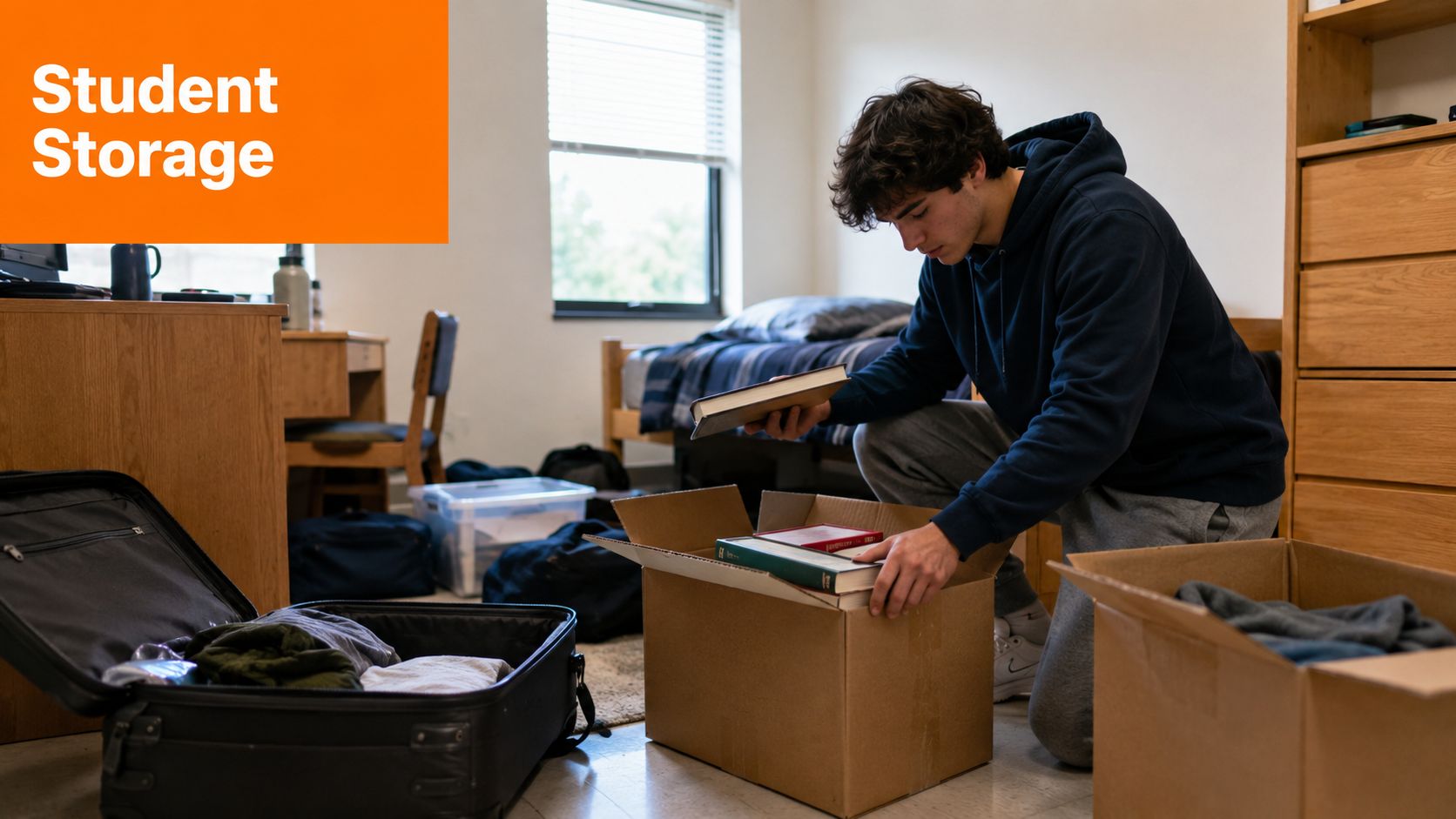
Students are some of the clearest examples. If you're leaving halls or a rented flat for the summer, you probably don't want to drag bedding, books, kitchen gear, and small furniture back home, then bring it all again a few months later.
A small unit works best here when the contents are practical and stackable. Storage tends to go smoothly when students use sturdy boxes, label by room, and keep documents and chargers separate from bulkier items like duvets and clothes.
Homeowners and renters reclaiming space
At home, the typical trigger is one room doing too many jobs. The guest room becomes an office. The dining area fills with renovation supplies. The loft is full, but nothing in it is packed in a way that makes access easy.
That's where a small unit can create breathing room without forcing a major decision straight away.
- Decluttering: Useful when you need to clear visible space first, then sort properly.
- Renovation: Better than shifting furniture from one room to another every few days.
- Moving and downsizing: Helps when timelines don't line up neatly.
For people in flats or compact homes, this often mirrors the same challenge covered in these storage solutions for small apartments.
Small business owners and tradespeople
A small business doesn't need to be large before space becomes a problem. Product stock, sample materials, paper files, tools, and spare equipment can quickly take over a spare bedroom, garage, or shop back room.
Small units tend to work well for:
- Online sellers needing overflow stock space
- Tradespeople storing tools and materials between jobs
- Office users keeping archived documents out of the main workspace
The key is discipline. The businesses that get the most value from a small unit organise it like a stockroom, not a cupboard.
Is a Small Unit Your Best Financial Choice
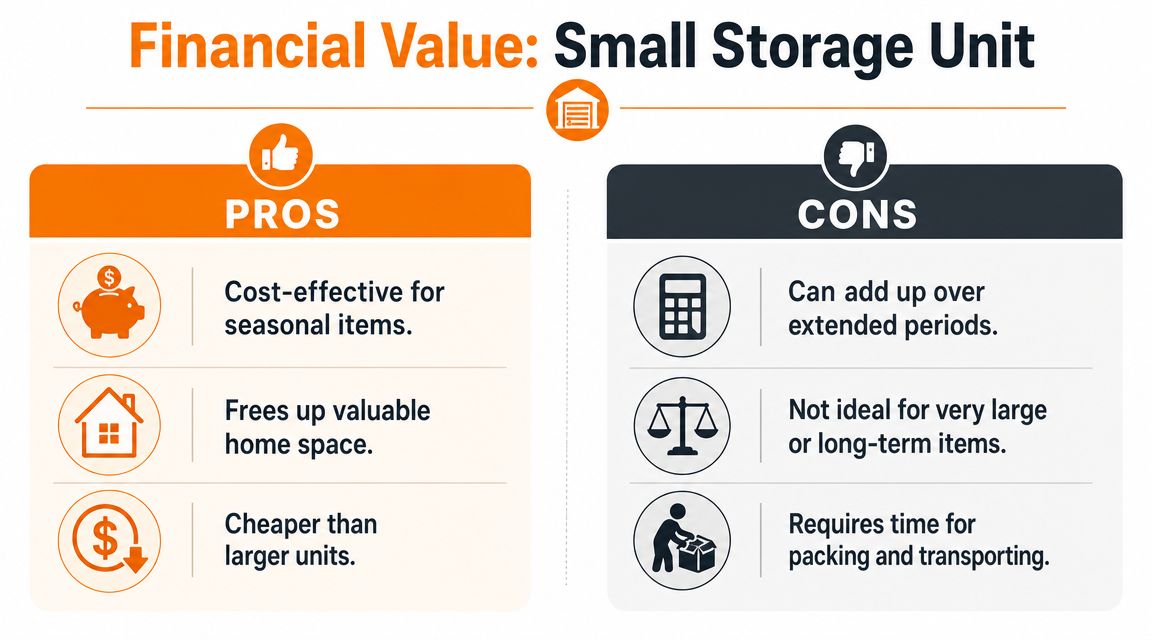
Convenience matters, but cost matters more. A small storage unit only makes financial sense when the value of the space, access, and security outweighs the full cost of keeping your items there.
That full cost isn't just the monthly fee. It also includes insurance if required, packing materials, your travel time, fuel, and how often you expect to access the unit. This matters even more in the UK right now, with 63% of adults saying the cost of living increased in the previous month, according to the ONS figure discussed in this UK storage market gap analysis.
When a small unit is good value
A small unit is often a sensible choice when you're storing items that are costly to replace, difficult to keep safely at home, or actively getting in the way of daily life.
Examples include:
- Furniture during a renovation
- Business stock that needs to stay clean and organised
- Student belongings between tenancies
- Seasonal equipment that takes up too much room year-round
It can also be cheaper than upgrading to a larger unit if your needs are modest. For some people, the financial gain is indirect. Reclaiming a room at home can be more valuable than squeezing every item into the property.
When storage is the wrong answer
Storage is a poor-value option when you're using it to postpone decisions about low-value items. If you haven't used something in years, rarely think about it, and wouldn't miss it if it were gone, paying monthly to keep it may not be sensible.
Watch for these warning signs:
- You're storing duplicates you could easily replace
- You won't access the items, but they also have little resale or practical value
- Travel is awkward, making every visit expensive in time
- The rental period is drifting, with no clear review date
If the stored items are worth less to you than the running cost and effort of keeping them, decluttering is the cheaper option.
A simple break-even check
Before you rent, write down three lists:
- What must be kept
- What could be sold, donated, or recycled
- What you're keeping only because you don't want to decide yet
Then compare storage against alternatives:
- Keeping it at home: What room or usable area are you giving up?
- Buying more furniture: Would shelving, a bed base, or fitted storage solve the same issue?
- Clearing out properly: Could reducing volume remove the need entirely?
- Using another format: For very infrequent access, another storage arrangement may suit better.
Read the agreement carefully too. Check notice periods, access terms, insurance expectations, and any minimum stay. If you're comparing providers, Orange Box Self Storage is one UK option with online booking, flexible contracts, and locations across Nottingham, Derby, Long Eaton, and Beeston.
Maximising Your Small Storage Space
A small storage unit works well when it's packed like a system, not a pile. The best-packed units aren't the ones filled fastest. They're the ones you can still use properly after the first month.
One of the biggest misunderstandings is the difference between advertised size and usable internal space. A 10-foot container-sized unit may offer about 80 sq ft externally, but the internal dimensions can be closer to 9'4" × 7'8" × 7'10", which leaves less usable room than people expect, as shown in these 10ft storage unit specifications.
Pack for access, not just volume
If you only remember one rule, make it this one: leave yourself a way in.
Use these habits from the start:
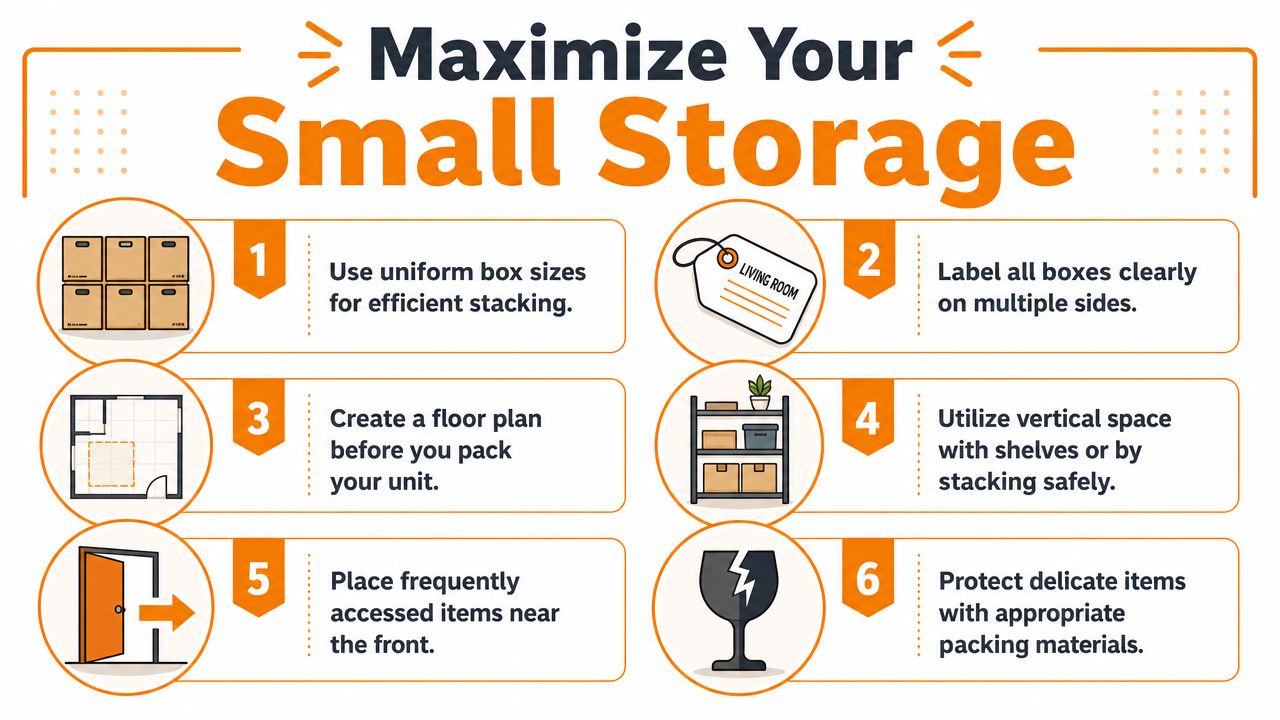
- Build upwards carefully: Stack sturdy boxes, lighter ones on top, and use shelving if your items need frequent access.
- Leave a narrow aisle: Even a small walkway saves a lot of frustration later.
- Put heavy items at the bottom: This sounds obvious, but rushed move-ins often ignore it.
- Keep essentials near the door: Documents, tools, seasonal stock, or anything you'll want first.
Use the right containers
Soft bags slump. Mixed box sizes waste vertical space. Loose items create dead areas you can't stack around safely.
A better setup looks like this:
- Uniform boxes: Easier to stack and label
- Clear labels on multiple sides: So you can spot what you need without shifting everything
- Wrapped furniture: Especially corners, legs, and tabletops
- Disassembled items where possible: Bed frames, tables, and shelving usually store far better taken apart
If part of your problem is seasonal clutter, especially decorations that are awkwardly shaped and fragile, this guide to organizing festive display items has some sensible ideas for grouping delicate items before they ever reach the unit.
Store by category, not by the order things came out of the house. That one decision saves time every single visit.
Book Your Small Storage Unit Today
Once you know the size you need and you've checked the numbers properly, booking a small storage unit should be straightforward. You want a location that's practical to reach, terms that match your timeline, and security that gives you confidence about leaving your items there.
For customers in the East Midlands, Orange Box Self Storage provides small-unit options for personal, student, business, and container storage in Nottingham, Derby, Long Eaton, and Beeston. A key benefit is simplicity. You can compare unit options online, book without a long back-and-forth, and choose a contract that fits a short-term or longer stay.
This helps if your storage need is immediate. You may be clearing a room before decorators arrive, moving out of student accommodation, or trying to get business stock out of your living space before it takes over completely.
Here's the booking interface customers use when they want to sort space quickly.

A good small storage decision is usually a calm one. Measure your larger items, make a keep-or-clear list before you book, and choose a unit that matches how often you'll need access. That's what keeps a useful extra space from turning into an expensive holding pen.
If you need secure extra space without overcommitting, Orange Box Self Storage is a practical place to start. You can check unit options online, compare locations, and book a small storage unit that fits your home, student, or business needs.