

You're usually one missed delivery away from the problem becoming obvious. Stock starts living in corridors, archive boxes creep into meeting rooms, and the van has become the only place where tools, returns, and spare fittings still fit without a fight. For a growing firm in Derby, business storage stops being a nice extra at exactly that point, because it gives the operation somewhere to breathe without forcing an expensive move into larger premises.
The best way to think about business storage for growing companies in Derby is as an active part of the workflow, not a dead-end holding bay. Used properly, it can absorb seasonal stock, protect tools, and give e-commerce teams a controllable buffer between buying inventory and shipping it out. Used badly, it becomes a second cupboard, which is just a more expensive version of the first problem.
Why Growing Derby Businesses Are Turning to External Storage
A local firm rarely realises it has outgrown its space all at once. The warning signs are small at first, a pallet left in a corridor, files stacked under a desk, a pallet jack squeezed between office furniture and stock. Then the team starts losing time moving things twice, and the office begins to feel like it is working against the business instead of supporting it.
That is the point where external storage makes sense as a growth tool. It lets a company keep trading in the space it already has, while shifting slow-moving stock, archived paperwork, or bulky equipment into a separate, organised location. For many Derby businesses, that is a more practical step than rushing into a bigger lease before the numbers justify it.
What usually triggers the move
Different businesses reach that point for different reasons. An online retailer may need somewhere to hold fast-turning inventory before a sales push. A contractor may need a secure place for tools and materials between jobs. A professional services team may need archive space once filing cabinets start taking over meeting rooms.
Practical rule: if staff are spending time moving goods to make room for work, the space has stopped serving the business properly.
That is why storage works best when it is treated as a pressure valve. It takes the strain off the premises you already occupy, and it does so without forcing a long-term property commitment at the wrong moment. For a growing team, that flexibility often matters more than raw square footage.
The other useful sign is inconsistency. If your stock, tools, or records swing up and down through the year, you do not want fixed space that sits empty half the time. External storage gives you a way to scale capacity around actual demand, which is a far better fit for growth-stage businesses than guessing at a permanent size too early.
The Local Business Landscape Driving Storage Demand
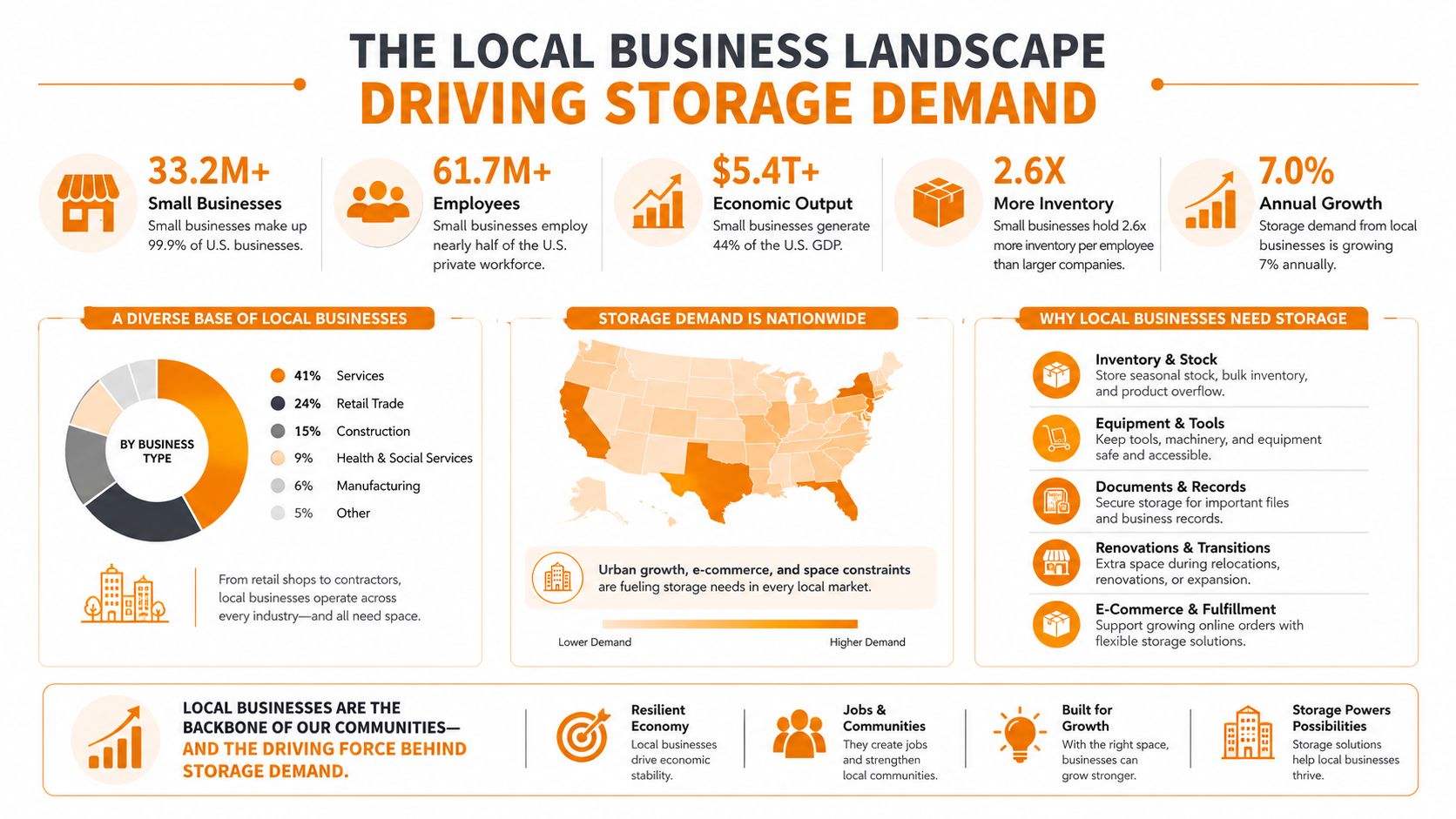
Derbyshire's business base gives a clear reason why storage demand stays relevant. The county had 30,535 active businesses in 2020, with 3,335 business births and 2,845 business deaths, producing a net increase of 1.6% in 2021, slightly above England's 1.0% net increase, according to the Derbyshire economy business demography report. That matters because new and growing firms usually need space before they are ready to commit to larger premises, especially when stock, files, and tools start multiplying faster than the office can handle. Derbyshire business demography report
The local sector mix adds another layer. The same Derbyshire data highlights Construction and Professional, Scientific and Technical activity among the larger business-unit shares in Derby. Those are exactly the kinds of businesses that collect equipment, archived records, samples, consumables, and seasonal materials. A construction team does not just need space for one type of kit, and a professional practice rarely needs only a desk and a chair.
Why that mix matters in practice
Construction firms tend to need storage that can handle tools, site materials, and overflow stock without cluttering vans or workshops. Professional and technical firms often need clean, orderly space for files, prototypes, or specialist supplies that should not sit in a busy office. Both groups benefit from storage that feels operational rather than accidental.
The UK market reinforces the point. The self-storage sector increased its stock by 5% last year to 67.5 million square feet, annual turnover reached £1.3 billion, and average occupancy remained high at 74.5%. Those figures show a mature market with sustained demand across the country, which helps explain why Derby companies are using storage as part of normal operations rather than as a backup plan. UK self-storage annual report
Earlier UK reporting also found that 42% of self-storage space was for commercial use compared with 39% in 2012, which shows business demand has become a major part of the market. That is important for Derby because it means firms are not leaning on a niche service, they are using an established operational tool.
Choosing the Right Unit Type and Service Level
The wrong storage format costs more than the right one. It wastes time, creates handling friction, and often forces staff to work around the unit instead of through it. For business storage for growing companies in Derby, the key decision is not just unit size, it is whether the storage architecture matches the goods.
A standard self-storage unit suits boxed stock, documents, and light equipment that can be moved without machinery. Racked warehousing works better when pallets need vertical organisation and fast retrieval. Bulk storage suits awkward, larger items that do not benefit from shelving. Temperature-controlled storage is the better choice for items that need a more stable environment, especially if you are protecting documents or sensitive goods.
Operational test: if an item needs a pallet, a rack, or a controlled environment, don't force it into a generic unit and hope the workflow stays smooth.
Derby providers also describe business features such as forklift handling, trolleys, document racking, clean and dry units, and temperature-controlled options. Those details matter because they change how quickly goods move in and out. A unit that is easy to access but hard to work from is a storage bay, not a logistics asset.
For businesses comparing storage formats, it helps to think in terms of use case rather than price alone. If you need advice on business-friendly unit types, the self-storage for businesses page is a useful place to compare what a service-led setup looks like. If you are also dealing with boxed product or archive material, even something as simple as choosing the right storage containers for warehouses can improve stacking, protection, and retrieval speed.
| Storage Unit Type | Best For | Key Features | Typical Business Stage |
|---|---|---|---|
| Standard self-storage unit | Boxed stock, files, light equipment | Simple access, flexible footprint, easy organisation | Early growth and overflow control |
| Racked storage | Palletised goods, repeat picks, labelled stock | Better vertical use, faster retrieval, clearer stock separation | Growing inventory operations |
| Bulk storage | Large tools, fixtures, awkward items | Open space, easier placement of oversized goods | Trades, fit-out, and equipment-heavy firms |
| Temperature-controlled storage | Sensitive documents, regulated goods, delicate stock | More stable conditions, better protection for vulnerable items | Compliance-heavy or sensitive stockholding |
| Container storage | Tools, seasonal stock, drive-up loading | Ground-level access, fast loading, practical for bulky items | Mobile teams and fast-moving stock |
For firms that need a hybrid approach, one unit type rarely solves everything. A smaller archive space plus a drive-up container for tools often works better than one oversized room trying to do both jobs.
Assessing Cost and Scalability for Your Growth Stage
Storage looks cheap until it is compared with the cost of being locked into the wrong premises. A bigger lease often brings extra overheads that sit outside the monthly rent, including business rates, utilities, fit-out work, and insurance considerations. External storage keeps the cost more variable, which is useful when revenue and stock levels are still moving around.
The cleanest way to assess value is to ask whether the storage spend is buying flexibility or just buying emptiness. A unit that is half full because your business only needs part of it is not wasted money if it helps you avoid a bigger fixed commitment. A bigger space in a leased unit, by contrast, can stay expensive even when it is underused.
How to right-size the commitment
Start with your real inventory pattern, not your best-day estimate. If stock peaks around campaigns, contracts, or seasons, choose a setup that can expand without punishing you when demand drops. That is where modular storage beats a rigid expansion plan.
A useful companion to that thinking is a structured space review. If you want a methodical way to assess what is being used, how to analyze space utilization is worth reading alongside your own stock counts and movement logs. The point is simple, measure what is active, what is dormant, and what is only being kept because nobody has audited it.
The same logic applies to e-commerce stock swings. A business that sells more heavily at certain times of year should not pay year-round for space sized to the peak if a smaller core unit plus flexible overflow works better. That kind of setup keeps cash available for inventory, marketing, and fulfilment instead of locking it into empty floor area.
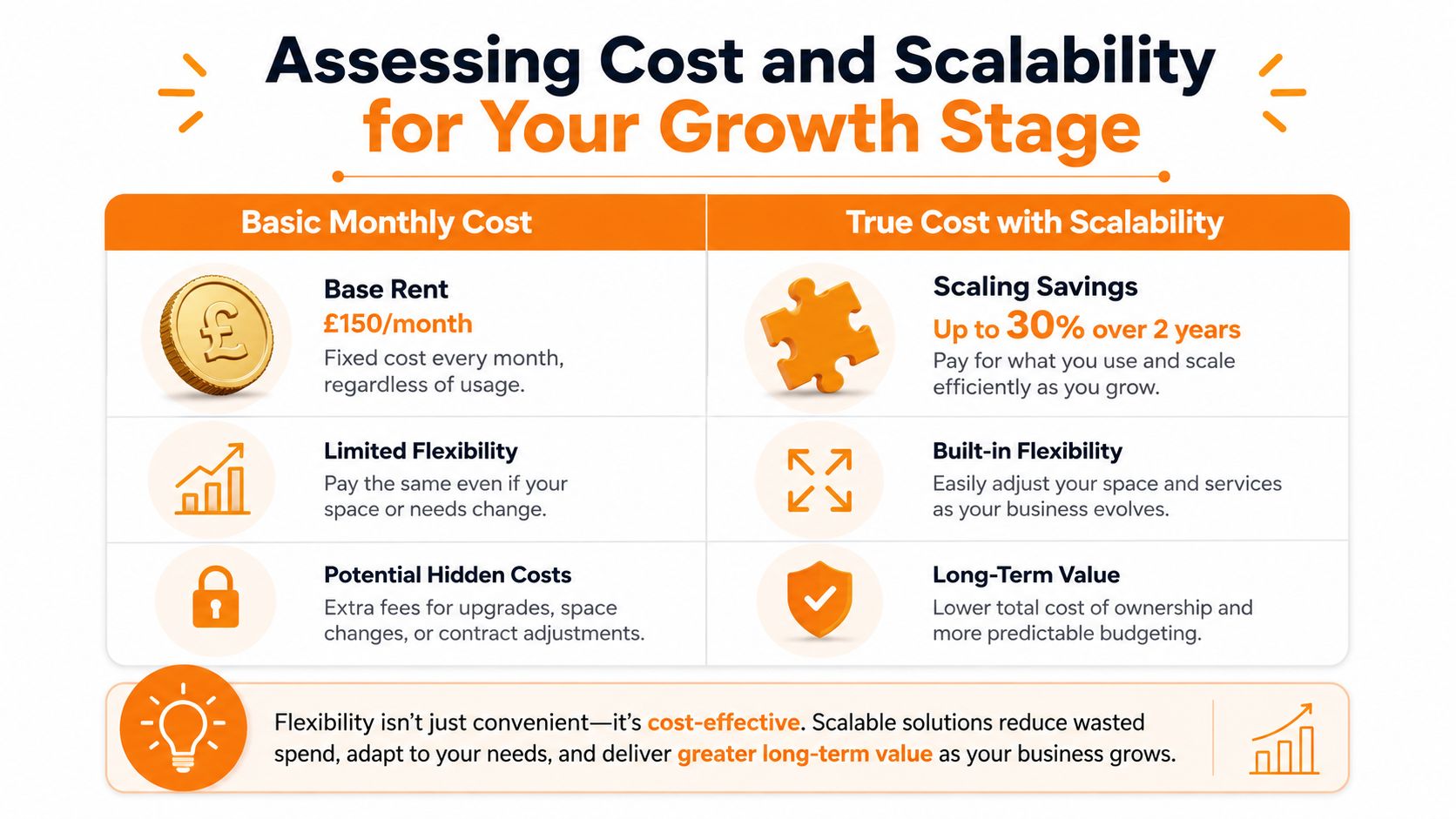
A practical pricing mindset helps here. If a provider offers a simple, scalable arrangement, treat that flexibility as part of the value, not a bonus. The cheapest monthly figure is not always the lowest-cost choice if it leaves you paying for space you cannot use well.
Security, Insurance, and Compliance Essentials
Security is not a brochure feature, it is a business continuity issue. If stock, records, or tools disappear or are damaged, the true cost is not only replacement, it is delay, missed orders, and staff time spent untangling the mess. Derby business-storage providers describe 24/7 CCTV, intruder alarms, secure access controls, clean and dry units, forklift handling, trolleys, and document racking as standard business features, and those details are worth checking closely before you sign anything. Derby business storage features
What to verify on a site visit
A proper check starts at the gate and ends at the unit door. Ask how access is controlled, who can enter the site, how cameras are monitored, and whether the facility uses individual access controls rather than a loose shared system. If the provider cannot explain how the site is protected in ordinary terms, keep looking.
Insurance needs equal attention. Facility security is not the same thing as cover for your contents, so you need to know what the site covers, what your own business policy covers, and where the gap sits. High-value inventory and irreplaceable records should never be left to assumption.
Good practice: if a document, pallet, or tool would be painful to replace, check the insurance wording before the goods go in, not after something goes wrong.
For records, compliance matters as much as protection. If you are storing archived files, you need a space that keeps paper clean, dry, and easy to retrieve without damage. UK document-storage services also offer humidity-controlled environments and next-day box or file retrieval, which shows how records handling can be built into storage rather than treated as an afterthought.
If your business also depends on fire systems or regulated premises checks, it can help to speak to a provider such as choose a fire alarm monitoring provider so the wider building risk picture is clear. Storage does not replace your compliance obligations, it should sit comfortably alongside them.
For businesses that need structured document handling, the business document storage service page gives a useful sense of how archive storage can be framed as an operational service rather than a lock-up.
Logistics Best Practices and Local Access Considerations
Storage only pays for itself if goods move in and out without friction. A badly organised unit costs time every time someone needs a box from the back, a tool from the floor, or a pallet from behind something else. The most effective setups use a simple rule, high-turnover stock goes near the front, slow-moving items go deeper in, and everything is labelled so nobody has to guess.
Shelving is usually the first upgrade worth making. It stops boxes from becoming unstable piles and makes the unit easier to scan visually. Clear labels, bin locations, and a basic inventory log help too, especially when more than one person is picking from the same space.
Derby access realities that affect workflow
Location matters because it changes how often the unit gets used. If the storage site sits on a route your team already drives, it feels like part of the working day. If it is awkward to reach, staff start batching visits, and retrieval time gets longer.
Vehicle access matters just as much. A drive-up setup is useful for tools and bulky stock because it reduces manual handling. If your business runs vans, uses pallets, or receives regular supplier deliveries, a layout that allows easier loading can save far more time than a marginally cheaper unit buried behind long corridors.
That is also where storage can become a mini-fulfilment node for e-commerce businesses. Returns can be checked, stock can be picked, and dispatch items can be staged in the same space if the workflow is organised properly. It is not a warehouse replacement, but for a growing seller it can bridge the gap between home-based trading and full-scale fulfilment.
The key is access control. Decide who can visit, when they can visit, and what they are allowed to move. A shared sign-in sheet, a simple pick list, and a clear rack map are usually enough to stop small errors from turning into repeated stock issues.
Real Business Use Cases Across Derby
A Derby construction firm I'd expect to lean on storage in a very specific way. Tools, fixings, and site materials move between jobs, and the team needs a secure place to stage kit without leaving it scattered across vans or a cramped workshop. In that setup, the win is not just security, it is faster morning loading because the same kit lives in the same place every day.
An e-commerce retailer has a different problem. Stock comes in waves, returns arrive unexpectedly, and product lines expand faster than the house or office can absorb them. That is where a flexible unit can act as a stock buffer, and a structured online-retail setup like storage for online retailers in Derby makes sense as a reference point for handling the movement between receiving, sorting, and dispatch.
A professional services firm usually needs a quieter answer. Archive boxes, old client files, and compliance records do not need constant access, but they do need order and protection. For that kind of business, the storage win comes from retrieval discipline, not volume, because staff should be able to find the right file without opening every box in the room.
What these examples have in common
Each business used storage to protect the main workplace from becoming a catch-all. None of them got value from treating storage as spare space. They got value from assigning a job to it, tools, stock, or records, and then organising the unit around that job.
The best setup is the one that makes the next retrieval easier than keeping the item in the office ever was.
That is a key lesson for Derby firms scaling up. The right storage choice supports movement, not just ownership, and that difference decides whether the space helps growth or merely hides clutter.
Your Next Steps to Securing the Right Storage Solution
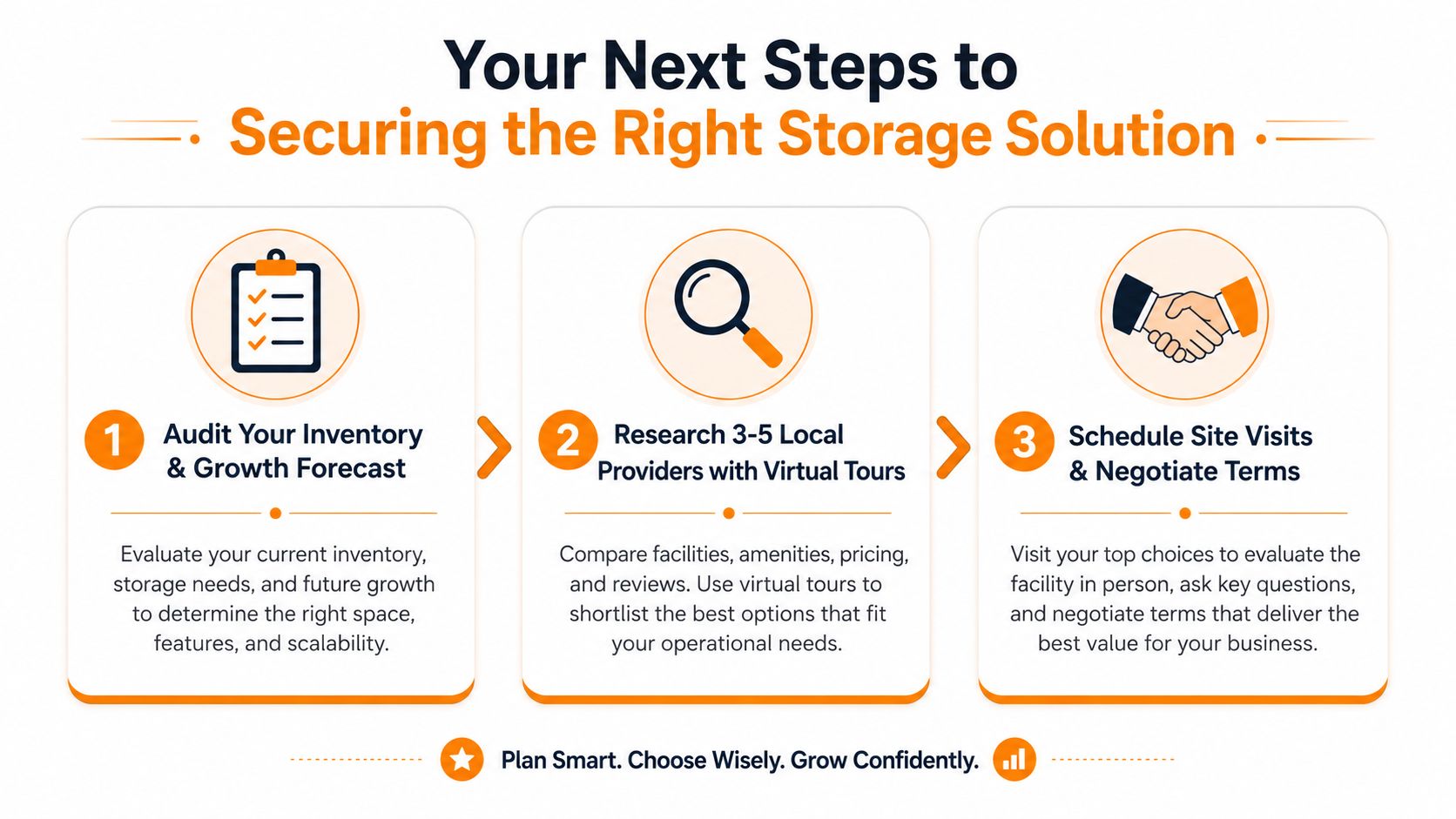
Start with a hard inventory audit. Count what needs daily access, what needs occasional access, and what can move out of the primary workspace without hurting operations. Then shortlist providers whose unit types and access arrangements match those patterns, not just their headline prices.
After that, visit the site and test the workflow. Open the gate process, check the loading route, look at the lighting, and ask how retrieval works if two staff members need the same area at once. The provider should be able to explain access, security, and insurance without making it sound improvised.
The two mistakes to avoid
The first is buying too much space too early. The second is choosing a unit that fits the stock physically but not operationally. Both errors waste money, and both are avoidable if you think about how the unit will be used on an ordinary Tuesday, not only on your busiest day.
For Derby businesses that need a flexible, practical setup, Orange Box Self Storage offers business storage, document storage, and container storage options that can be matched to stock, records, or equipment handling needs. If your team is hitting the limits of desks, cupboards, or van space, visit Orange Box Self Storage and compare a storage setup against the way your business works.