


Orders are coming in. The dining table disappeared under mailers weeks ago. Spare-room shelves are bending under cartons, returns are mixed in with fresh stock, and every courier collection turns into a last-minute dig through boxes.
That stage feels messy, but it usually means the business is working.
For many sellers, the core issue isn't just lack of space at home. It's that the business has outgrown a home setup. Once stock starts affecting pick speed, packing accuracy, delivery cut-offs, and how quickly you can react to a sales spike, storage stops being a household problem and becomes an operations decision. That's where storage for online retailers in Derby starts to matter.
Your Derby E-Commerce Business Is Booming Now What
A lot of Derby retailers hit the same wall. They start small, keep costs lean, store stock in the spare room, and pack orders in the kitchen. That works for a while. Then one product line becomes three, packaging supplies take over the hallway, and every stock delivery creates a fresh problem.
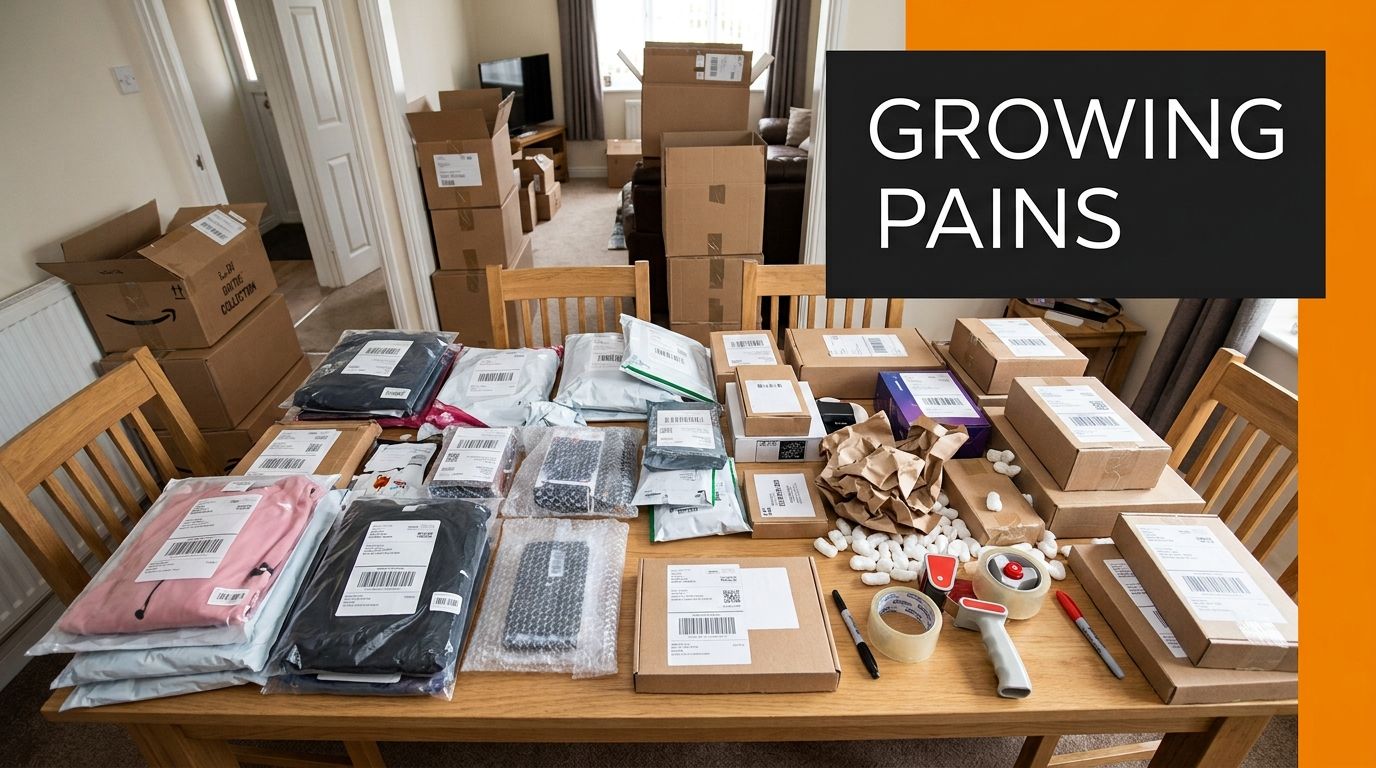
The main mistake at this point is treating overflow as a temporary inconvenience. It usually isn't. Once you're selling consistently, you need a place built for stock movement, replenishment, and daily handling. A proper unit gives you room to separate live inventory from dead stock, set up a packing bench, and stop running your business around domestic space.
Growth creates new operational problems
The wider market points in the same direction. The UK's Warehousing & Storage industry reached a market size of £38.6 billion in 2026, with revenue projected to rise at a 1.9% compound annual rate through 2027, driven by e-commerce growth and demand for scalable inventory space according to IBISWorld's UK warehousing and storage industry data.
That matters because Derby sellers aren't operating in isolation. You're competing in a market where buyers expect quick dispatch, clear stock availability, and reliable delivery windows. If your stock control depends on what you can stack in a spare bedroom, you're already creating friction for yourself.
Practical rule: Move into dedicated storage before your stock starts controlling your day.
A dedicated business unit also changes how the brand feels internally. Teams work better when inventory has a fixed home. Returns can be processed properly. Packaging stays dry and organised. Courier collections become routine instead of chaos.
What dedicated storage actually solves
A good storage setup should help with more than square footage. It should give you:
- A clean split between home and business so stock, admin, and personal life stop colliding
- Room to build a repeatable pick and pack process instead of improvising around furniture
- A path to scale when your best-sellers need deeper stock holding
- Better access for deliveries and collections compared with a residential address
If you're comparing local options, Derby retailers can start by reviewing available Derby storage units for business stock. The key is choosing space that supports fulfilment, not just somewhere to put boxes.
How to Accurately Assess Your Storage Requirements
Retailers often guess wrong in both directions. Some rent too small and recreate the same bottleneck in a unit. Others take too much space, then pay for air while still working inefficiently.
Start with how stock moves, not with a rough visual estimate.
Audit by stock behaviour, not just box count
Split your inventory into three groups:
Fast-moving lines
These need the easiest access. Put them closest to the door or packing area because they'll be touched every day.Slow-moving lines
These can sit higher up on shelving or further back. They still need labels, but they don't deserve prime space.Seasonal or campaign stock
Gift sets, event-led products, promotional inserts, and limited packaging need a separate zone. If you mix them into everyday inventory, staff waste time hunting for them when volume rises.
A storage unit works best when it reflects order flow. Best-sellers should be easy to replenish. Returns should have a quarantine area. Packaging should never sit in the same pile as saleable stock.
Measure your workflow footprint
Most sellers only calculate shelf space. They forget the working space around it.
You need room for:
- Racking depth so cartons aren't stacked in unstable piles
- A packing bench for order assembly, labelling, and quality checks
- Aisles wide enough to move safely with totes, tape guns, and parcels
- Overflow space for inbound deliveries before goods are checked in
- Returns handling so opened items don't end up back in active stock by mistake
If you can't walk in, find a product, pack it, and stage it for collection without moving three other things first, the unit is too small or badly laid out.
A simple test helps. Take your busiest recent week and map what happened physically. How many cartons arrived? How many orders went out? How much packaging did you get through? Which items were picked repeatedly? That gives you a more honest picture than standing in your spare room and guessing.
Plan for ugly weeks, not average weeks
Average volume doesn't break operations. Peaks do.
Black Friday, Christmas, payday campaigns, influencer mentions, or a successful product launch all create pressure in the same places. Access routes clog up. Packing materials run out. New deliveries arrive before the previous intake has been put away. If your storage plan only works on a quiet Tuesday, it isn't a plan.
Use a practical checklist before signing for any space:
| Area to assess | What to ask |
|---|---|
| Stock volume | Can current inventory fit on shelving without floor stacking? |
| Pick frequency | Are high-volume SKUs reachable in seconds, not minutes? |
| Packing area | Is there room for benches, labels, void fill, and completed parcels? |
| Seasonal reserve | Can extra stock sit separately until needed? |
| Receiving space | Where will inbound cartons go before they're counted and shelved? |
Leave room for process maturity
A unit shouldn't only fit today's stock. It should also fit a better way of working.
That means leaving room for printed location labels, returns bins, photography props if you use them, and a basic workstation for stock counts or booking in deliveries. Sellers who plan for that usually run calmer operations than sellers who fill every inch on day one.
Choosing the Right Storage Type in Derby
Not all storage solves the same problem. Some options are good for holding stock cheaply. Others are better for daily access. Some work for rugged tools and packaging supplies but are wrong for sensitive retail inventory.
For Derby e-commerce sellers, the practical choice usually comes down to traditional self-storage units, external steel containers, or managed warehousing.
A side-by-side comparison that reflects actual use
| Storage type | Works well for | Watch-outs | Best fit |
|---|---|---|---|
| Traditional self-storage | Daily picking, organised shelving, regular courier prep | You need to check access terms and internal conditions carefully | Small to mid-sized online retailers |
| External steel containers | Bulk stock, durable goods, tools, backup packaging | Less suitable for delicate stock or a polished pick-pack setup | Sellers storing hardy inventory or overflow |
| Managed warehousing | Palletised stock, outsourced handling, more formal logistics support | Less hands-on control and often less flexibility for small sellers | Larger operations or brands moving beyond self-managed fulfilment |
Traditional self-storage
This is usually the most flexible route for a growing retailer. You can install shelving, build a simple packing station, and keep control of your stock. It suits businesses that still want to pick and pack themselves but need more professional space than home can offer.
It's also the easiest option if your SKU mix changes often. You can reconfigure bays, move best-sellers forward, and keep campaign stock separate without asking a warehouse team to do it for you.
One local option sellers may look at is e-commerce storage in Derby, which is geared toward stock holding rather than general household overflow. That distinction matters because business use creates different access and workflow needs.
External steel containers
Containers make sense when the priority is sturdy, straightforward storage for goods that aren't sensitive to temperature swings or presentation. If you're storing boxed supplies, trade materials, or durable packaged products, they can do the job well.
They're less effective when your unit also needs to function as a mini fulfilment centre. Picking small items from deep stacks in a container is slower than working from racked shelving in a cleaner internal unit. For brands shipping every day, that friction builds quickly.
The cheapest storage option often becomes the expensive one if it adds labour time to every order.
Managed warehousing
Managed warehousing can be the right move once order volumes are high enough that self-handling starts to drag on growth. You get more formal receiving, storage, and sometimes fulfilment support. That can reduce the time founders spend handling stock personally.
The trade-off is control. Small retailers often find managed warehousing too rigid when they're still changing packaging, launching test products, or making frequent assortment changes. It's a better fit when operations are stable and product flow is predictable.
Match the option to your product and operating style
Choose based on the way you trade:
- Sell fashion, beauty, gifts, or small-pack products daily? Traditional self-storage is usually the most practical.
- Store heavy, rugged, or weather-tolerant goods? A container may be enough.
- Need less hands-on stock handling and more logistics support? Managed warehousing deserves a look.
The right choice isn't the one with the biggest footprint. It's the one that lets you receive stock, find products fast, and dispatch without creating extra work.
Key Features for Protecting Stock and Streamlining Operations
At 9:30pm, the problem usually is not stock levels. It is whether anyone can get to the stock.
That matters for Derby e-commerce retailers because orders often land outside standard business hours, especially after paid social pushes, email sends, or marketplace activity in the evening. A storage unit that looks fine on a viewing can still slow dispatch if access ends at 6pm, delivery intake is awkward, or staff cannot work safely and efficiently after hours.
Security and climate control protect margin, not just stock
Security features affect more than peace of mind. They shape how much high-value stock you are willing to hold off-site, how often you need to cycle inventory back to home or office space, and how much risk sits in every carton. Safestore's guidance for online retailers highlights the value of CCTV, secure access, and suitable internal conditions for business stock.
Climate control also has a clear operational use. Cosmetics, supplements, candles, printed inserts, electronics, and branded packaging can all degrade in damp or unstable temperatures. Sometimes the product is still technically usable, but the outer packaging is marked, warped, or soft. For an online retailer, that still creates refunds, discounting, and avoidable customer complaints.
Look for features that support day-to-day handling:
- 24/7 CCTV covering entry points and internal access areas
- Controlled entry systems with clear user access rules
- Clean, dry internal units suited to consumer goods and packaging
- Loading access that works for vans and supplier drop-offs
- Good road links for runs across Derby and toward the M1
Access hours often decide whether a site works for e-commerce
Many retailers underestimate this until the first busy week exposes it. If your orders build after dinner but your storage access ends in the early evening, same-day packing is off the table and next-day dispatch starts to slip.
Research from the Self Storage Association UK on the UK self storage market shows that access terms vary widely by operator and site type. In practice, many facilities still offer staffed-hour access or extended hours rather than true 24/7 entry. That gap matters far more to online sellers than it does to someone storing archive boxes or household goods.
I would treat access as an operating constraint, not a nice extra. Ask the site manager direct questions. Can you enter at midnight without prior notice? Can a member of staff or a trusted picker use the unit early morning on a Sunday? Are there cut-off times for delivery acceptance, gate codes, or lift access? Those details decide whether the unit supports growth or just stores overflow.
Common problems caused by restricted access include:
- Orders placed in the evening sitting untouched until the next day
- Missed courier collections after stock receipts run late
- Founders doing rushed early-morning picking before the day job starts
- Promised dispatch windows slipping during peak periods
A lot of facilities market “extended access” as if it solves the issue. It often does not. For a retailer shipping daily, routine 24/7 availability gives far more control than access by request.
Site features should reduce handling time
The strongest setup supports the full chain from inbound delivery to packed parcel. That includes delivery acceptance, easy trolley movement, lighting that is good enough for accurate picking, and enough room near the unit to load without blocking traffic or carrying cartons across half the site.
It also helps to connect storage decisions with dispatch performance. If you are tightening courier cut-offs and handover times, practical guides on how to improve last mile operations can help you spot delays between picking, packing, collection, and final delivery.
Good storage should make order fulfilment easier at 10pm, not only at 10am.
Packing Racking and Organising for Peak Efficiency
At 9:30pm, poor layout costs money. That is when a fast-moving SKU goes missing behind refill cartons, tape has wandered to the back wall, and a simple three-order batch turns into twenty minutes of avoidable walking. For Derby retailers using storage as a live fulfilment space, organisation has to support evening and weekend picking, not just keep stock off-site.
Industry demand has pushed more retailers into smaller, harder-working storage footprints, and the UK self storage sector's turnover for the year 2025 reached £1.2 billion, according to the Self Storage Association UK industry report. That makes layout discipline more important because many growing brands are operating from units that need to store stock, hold packaging, process returns, and support packing in the same room.
Build upward and leave room to work
Fit shelving before the first carton arrives. Once stock is on the floor, bad habits set in quickly.
Racking should match how the business ships:
- Eye-level shelves for repeat picks and current best-sellers
- Lower levels for heavier cases, refill stock, and items picked less often
- Upper shelves for seasonal lines, archive SKUs, and backup packaging
- Clearly separated bays for returns, damaged stock, and supplier intake
Many retailers often get the balance wrong. They chase maximum storage density, then lose time every evening because staff cannot reach products cleanly or move a trolley through the aisle. A slightly smaller usable footprint usually outperforms a packed unit that forces constant rehandling.
If the unit is doing daily fulfilment rather than passive storage, a warehouse self storage setup for online stockholding and picking is usually a better fit than trying to force warehouse routines into a basic lock-up.
Set up a packing line that works after hours
Packing needs its own fixed zone. If the bench becomes overflow storage, accuracy drops and dispatch speed follows it.
A practical station includes:
- A stable bench with space for at least two open orders
- Labels, tape, void fill, and mailers stored within one arm's reach
- A finished parcels area that stays separate from live picks
- A returns container for checks, quarantine, or repacking
- A charging point and printer position that do not block the bench
Good packing lines reduce decision-making. Staff should not have to hunt for labels at 11pm or clear a space before they can tape a box shut.
Standardising consumables helps too. Using the same bin sizes, shelf labels, and outer cartons makes replenishment easier and speeds up training. Suppliers of wholesale storage boxes can help if you want consistent packaging formats across shelving, packing benches, and reserve stock.
Label for handover, not memory
Even owner-led brands need a system that someone else can follow without explanation. Memory works until peak week, sickness cover, or a late courier collection puts another pair of hands in the unit.
Use simple shelf codes, clear SKU labels, and printed location references. Keep product families together, but separate near-identical variants far enough apart to stop mispicks. Colour labels can help, but only if the coding stays simple.
A workable layout often looks like this:
| Zone | Purpose |
|---|---|
| Front | Fast-moving stock and same-day picks |
| Centre | Packing bench, printer, and consumables |
| Side shelving | Slow-moving lines and replenishment stock |
| Rear | Seasonal reserve, empty cartons, and bulk overstock |
One rule matters more than the rest. Keep the aisle clear enough for a quick pick run during the hours other businesses are closed. If your competitive edge depends on fulfilling orders after normal trading hours, the unit has to stay easy to work in when you are tired, under time pressure, and loading the last batch of the day.
Contracts Pricing and Scaling Your Derby Storage
Growth usually breaks the storage plan before it breaks the sales channel. A retailer starts with a tidy unit and a simple monthly rate. Then a product launch lands, stock turns speed up, courier collections run later, and the contract starts dictating how the business works.
That is why contract terms matter as much as floor space.
Terms that deserve close attention
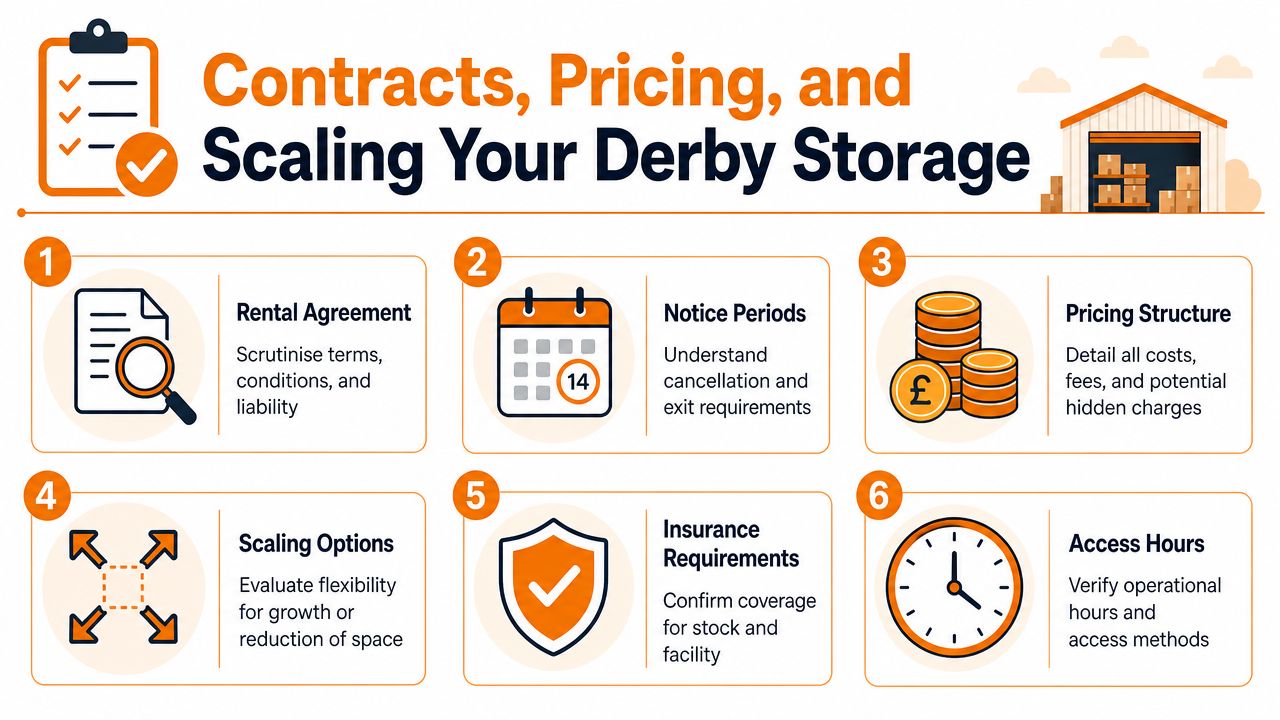
Read the agreement like an operations document. The headline rate matters, but the clauses around access, notice, deliveries, and insurance usually have a bigger effect on day-to-day fulfilment.
For Derby e-commerce businesses, access hours deserve extra scrutiny. Orders keep coming in well after normal trading hours, and many owner-managed brands do their pick and pack work in the evening or early morning around the rest of the business. If the unit only allows limited access, dispatch speed drops fast. A provider saying they can "usually help" after hours is not the same as contractually permitted 24/7 entry.
Check these points before signing:
- Notice periods for leaving, downsizing, or moving into a larger unit
- Insurance terms including whether your stock value changes the cost month to month
- Access rules and whether out-of-hours entry is guaranteed or only available by arrangement
- Price review clauses so you know when rates can change
- Delivery restrictions on pallets, courier vans, and supplier drop-offs
- Loading access including shutters, lifts, and whether you can work from the unit outside staffed hours
A short contract with poor access can still hold back fulfilment. A slightly higher rate with reliable 24/7 entry often gives better operational value, especially if late-day orders are part of your offer.
Pricing without surprises
Storage pricing is rarely as simple as the first number on the website. Introductory offers end. Insurance gets added. Locks, admin fees, and unit moves can all change the monthly cost.
Ask for the full trading cost, not just the starting rent. That means getting clear answers on:
- What is included in the monthly fee
- Whether there are setup, lock, or account charges
- How insurance is handled if you already insure stock elsewhere
- How long any introductory price lasts
- What happens to the rate if you move to a different unit size
- Whether access outside staffed hours changes the price
I also look for pricing logic that makes scaling practical. If moving up one size means signing a fresh long term agreement or accepting a sharp rate jump, the provider may be cheap at the start and awkward later.
Choose a provider you can grow with
Scaling storage is not only about getting more square footage. It is about expanding without disrupting your pick path, delivery routine, and after-hours workflow.
That is where flexible formats help. If stock levels are likely to outgrow a standard unit, review options such as warehouse self-storage for larger business inventory. The aim is to create a path from shelves and cartons to palletised stock without rebuilding the whole operation every quarter.
Use this final check before you commit:
- Confirm 24/7 access in writing if evening or weekend fulfilment affects your service level
- Test the loading setup for the vehicles and stock profile you use
- Ask how fast you can move up or down a unit size
- Check every fee that can appear after month one
- Make sure the contract supports your busy periods, not just your quietest month
If your current setup is slowing dispatch or taking over your home, Orange Box Self Storage is one option to review for Derby business stock. Look for a unit that matches your workflow, gives you dependable access, and lets your operation grow without constant rework.