


Mid-June in Derby has a way of exposing the problem fast. Your tenancy runs out, the next place doesn't start for weeks, and suddenly you're staring at a desk, a bike, a suitcase of winter clothes, textbooks, and kitchen bits that don't belong in a corridor or a mate's spare room. That's why summer storage for university students in Derby isn't a nice extra, it's the bridge between one home and the next.
The city has the student turnover to make this a regular headache. Derby's resident population was 274,100 in 2024, with 114,900 properties in 2024/25 and 138,000 total employee jobs, according to Derby City Council's official statistics based on ONS and VOA data, so the local market isn't tiny or static, it's active and seasonal. Student-storage guidance for Derby also points to a demand spike from May through September, which is exactly when contracts end and belongings need somewhere to go.
If you're already wondering whether you've left it too late, you probably have. The students who sort storage early get the unit they need, the move date that matches their tenancy, and a much calmer handover week. The rest end up fighting for van space, lift access, and whatever unit size is still left.
When Storage Suddenly Becomes Urgent
The moment usually lands on a boring day. You open your tenancy agreement, read the end date properly, and realise your new house, new halls, or September move-in doesn't line up with it. Now the room contains a desk, bedding, a bike, three suitcases, and the kind of half-used kitchen kit that nobody wants to haul back and forth.
That gap is a major issue. Academic-year contracts end, summer sublets don't always work out, and Derby students often split time between halls, shared houses, and temporary places around the Cathedral Quarter and university areas. When that happens, storage stops being a luxury and becomes the only sensible holding pattern.
A decent short-term storage guide should make that obvious. The Gentle Giant Removals short-term storage guide is useful because it treats storage as a practical pause between move-outs, not some abstract storage-buying exercise. That's the mindset you want here, a place for the stuff you're not using, while you sort the next address.
Practical rule: if it won't be needed for lectures, interviews, travel, or your first week back, it belongs in storage, not in your car boot or under someone's bed.
Derby's pattern is predictable, and that's the point. You are not the only one trying to bridge June, July, and August. The city sees the same student cycle every year, which means the people who act early get the smoothest move-out, and the people who wait usually pay for the mistake in time, money, or both.
Booking Your Unit Before the Peak Hits
Book before June if you can. Derby's student-storage rush runs from May to September, and the smaller units near the university areas disappear first because everyone wants the same thing, a cheap space that is close and easy to unload into. Once June starts, the choice narrows fast, and your move date becomes harder to match with the handover you have.
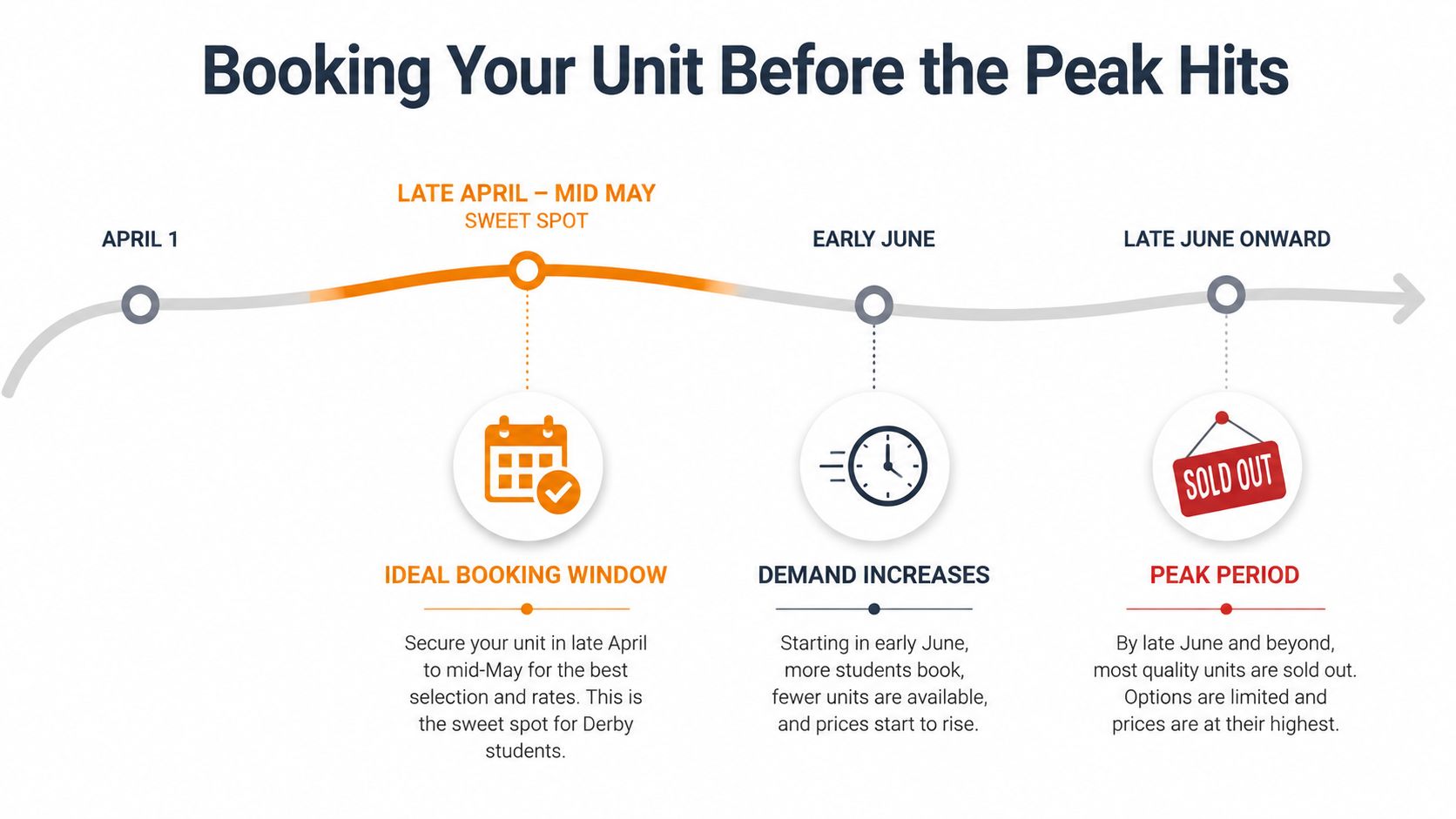
Lock the dates first
Start with your tenancy end date, your next move-in date, and any overlap between the two. If those dates are still moving, speak to your landlord or accommodation office before you compare units. Students who book storage without fixed dates end up paying for days they do not need, or missing the move-out slot they wanted in the first place.
The practical order is simple. Confirm the dates, then book the storage, then build the rest of the move around that reservation. If you reverse that order, you end up trying to squeeze collections, van hire, lift access, and key handover into a timetable that was never realistic.
Reserve the unit, then organise the move
Treat the reservation as part of the move, not a separate bit of admin. Short-term storage works best when the collection time, van hire, lift booking, and key handover are all set together. Leave those details floating and you waste time on the day, which is how furniture gets scratched and useful items get left behind because there is no room for another trip.
Check the small print before you confirm anything. The how to compare storage prices guide is a useful reference for working out what is included and what is extra. Use that approach early, then book the date that fits your move, not the one that only looks convenient on paper.
Book early, then stop shopping. The cheapest unit is useless if it is not available on the day you need it.
Choosing the Right Unit Size for Student Life
Most Derby students guess on size and regret it. They either book too much space and pay for air, or cram everything into a unit that looks affordable until the last box won't fit and the bike has to be left out. The right answer comes from inventory, not instinct.
| Derby Student Unit Size Guide | Best For | Typical Student Inventory |
|---|---|---|
| Locker or very small unit | Minimal kit, one person, light summer gap | A few boxes, bedding, documents, a suitcase |
| Small unit | One student with a normal room's worth of items | Boxes, clothes, kitchenware, books, a bike if packed neatly |
| Medium unit | Shared student load or a fuller room setup | Boxes, desk items, bedding, bike, small furniture, larger kitchen kit |
| Large unit | Flatmates combining items or a student with bulky furniture | Multiple room contents, several bikes, shelving, more than one large item |
Use two questions, and you'll get close fast. How many boxes do you have, and is the bike coming too? If the answer to the second one is yes, you've already moved up a size in practical terms, because bikes eat space in a way that people underestimate.
The small storage unit guide is worth checking if you're trying to visualise what “small” really means in storage terms. That's where a lot of students trip up, because the word sounds tiny, but a neat stack of boxes and one awkward item can fill it quickly.
Match your living situation to the unit
A master's student with a laptop, some books, bedding, and a few boxes needs a different unit from a third-year moving out of a four-bed house. The shared-house student usually has more volume, more loose items, and more need for access because flatmates never pack in the same rhythm. If you're splitting storage with other people, go up a size rather than trying to play unit Tetris.
My rule of thumb: if you need to ask whether the bike fits, the unit is probably too small.
Packing and Protecting What You Store
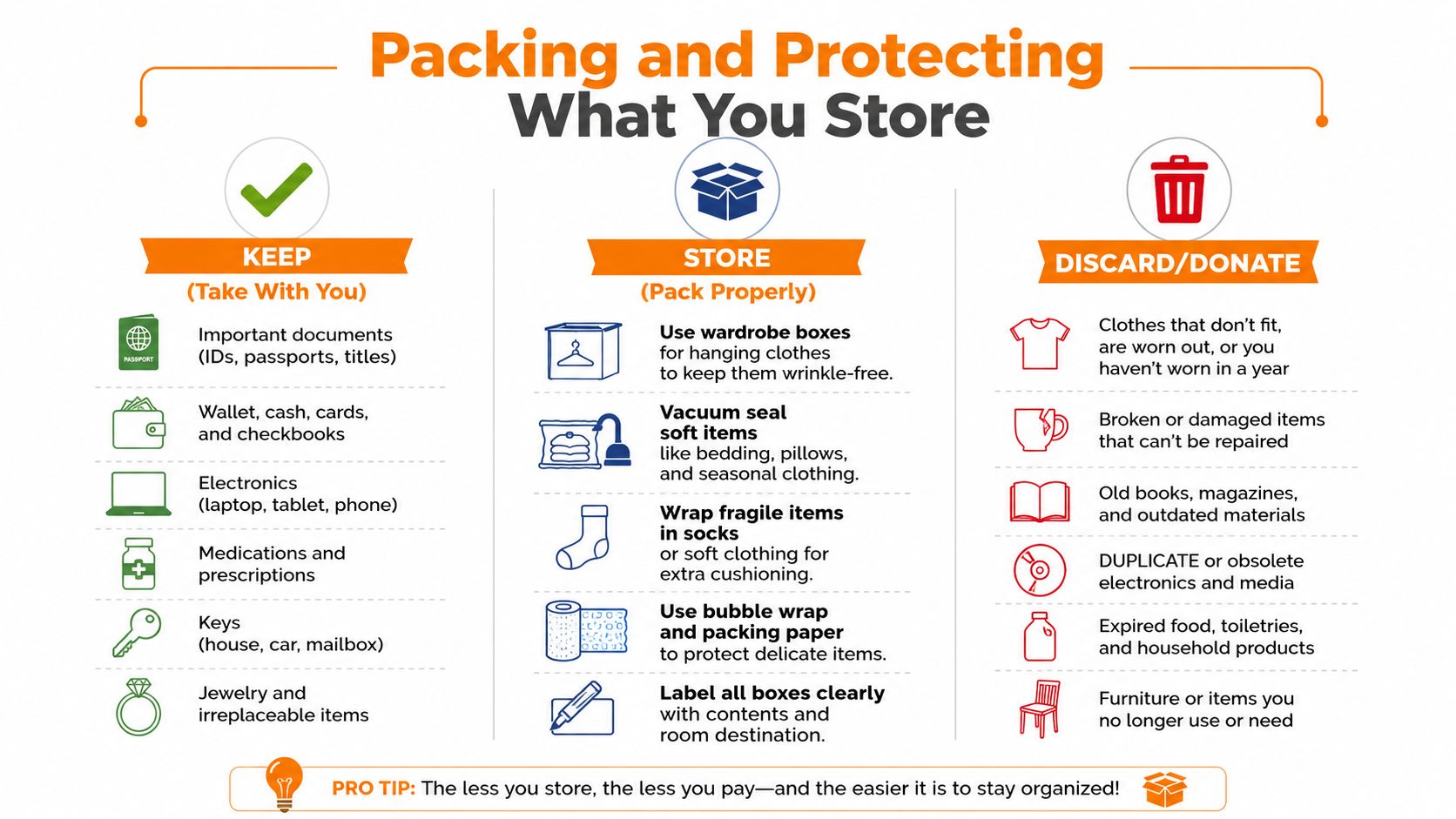
Start with a three-bin sort, keep, store, donate. If you skip that step, you'll spend move-out day making decisions in a hallway, and that slows everything down. Keep the passport, laptop, current-module notes, charger, and anything you know you'll need over summer out of storage from the start.
Pack for the layover, not the room
A 10 to 14 week gap is long enough for lazy packing to go wrong. Use sturdy boxes, keep heavy items at the bottom, and split books across several smaller boxes instead of making one brute-force box that's miserable to lift. The packing tips for moving house guide is useful here because the same basic rules apply, especially if you're loading and unloading more than once.
Soft items need to be fully dry before they go in. That matters more than students think, because damp bedding or clothes in a closed unit is a recipe for smell and mildew, even if the storage site itself is perfectly clean. If you've got jumpers, duvets, or towels going into storage, dry them properly and use simple silica-gel sachets where you can.
Buy the cheap stuff yourself
Don't waste money on storage-site markup for basic supplies. Buy tape, marker pens, and decent boxes from a discount shop in Derby, then use wardrobe boxes only if you've got hanging clothes worth keeping crease-free. Wrap fragile items in socks, tea towels, or T-shirts, that saves space and reduces waste at the same time.
- Keep out of storage: passport, laptop, medication, current notes, phone charger.
- Store properly: books split across boxes, clean textiles, kitchenware wrapped tightly.
- Leave behind or donate: broken desk lamps, duplicate mugs, anything you won't use next term.
If an item still holds moisture, don't seal it in plastic and hope for the best. That's how summer storage turns into autumn regret.
Real Costs and How to Budget a Derby Summer Let
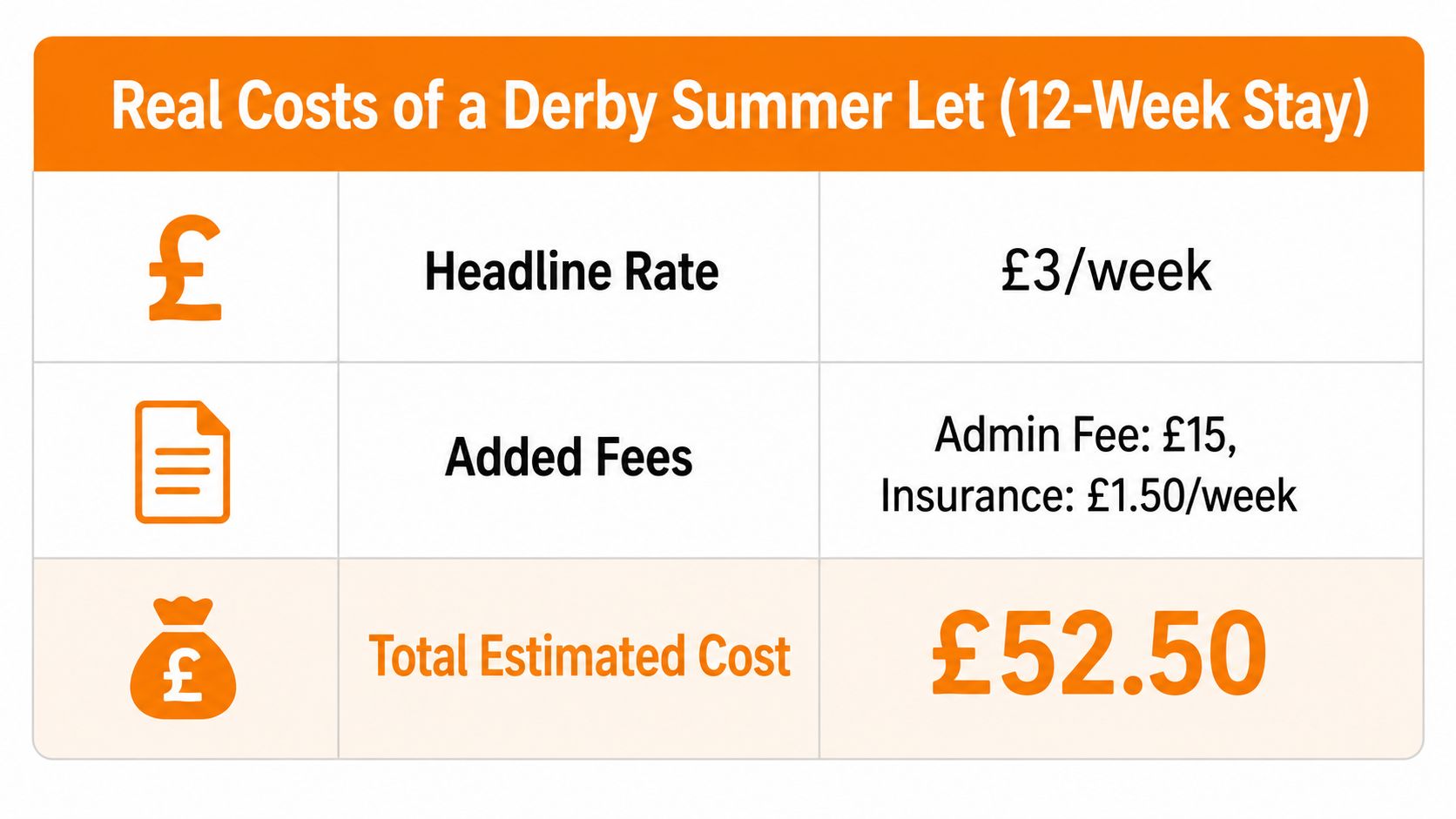
The headline rate is only the starting point. In the UK student market, Safestore says student units start from around £3 per week with a 50% discount for the first 8 weeks, which looks cheap until you add the fees, access rules, and transport planning around it. Derby students should budget for the whole move, not just the space inside the unit.
Calculate the total cost
Start with the base weekly price, then add insurance, any admin fee, and the bits students always forget, like a padlock. The how much does self storage cost UK guide is a useful reminder that a “from” price is never the final bill. Read the full terms before you reserve, because the small charges are often what change the total.
A simple example makes the point. If you pick a short let with a headline rate, added insurance, and a basic admin fee, compare that total against your transport cost and the number of weeks you need storage for. That gives you a cleaner answer than chasing the cheapest advert and finding the access terms do not fit your move-out day.
Compare value, not just price
A cheaper site can cost more once you add the journey there and back. Derby students should weigh location, access hours, and unit size together, because the lowest quote is pointless if it creates extra trips or awkward collection times. For a practical way to weigh those trade-offs, how to compare storage prices is useful because it pushes you to look at the full bill, not just the headline number.
Cheap storage that needs a long detour or a second van trip is not cheap anymore.
Getting Your Stuff There Without a Car
This is the bit most Derby guides skip, and it's the bit students struggle with. If you live in halls, a city-centre flat, or a shared house, the problem usually isn't storage itself, it's how to get a mattress topper, a desk, and six boxes there without a car or a parent with a van.
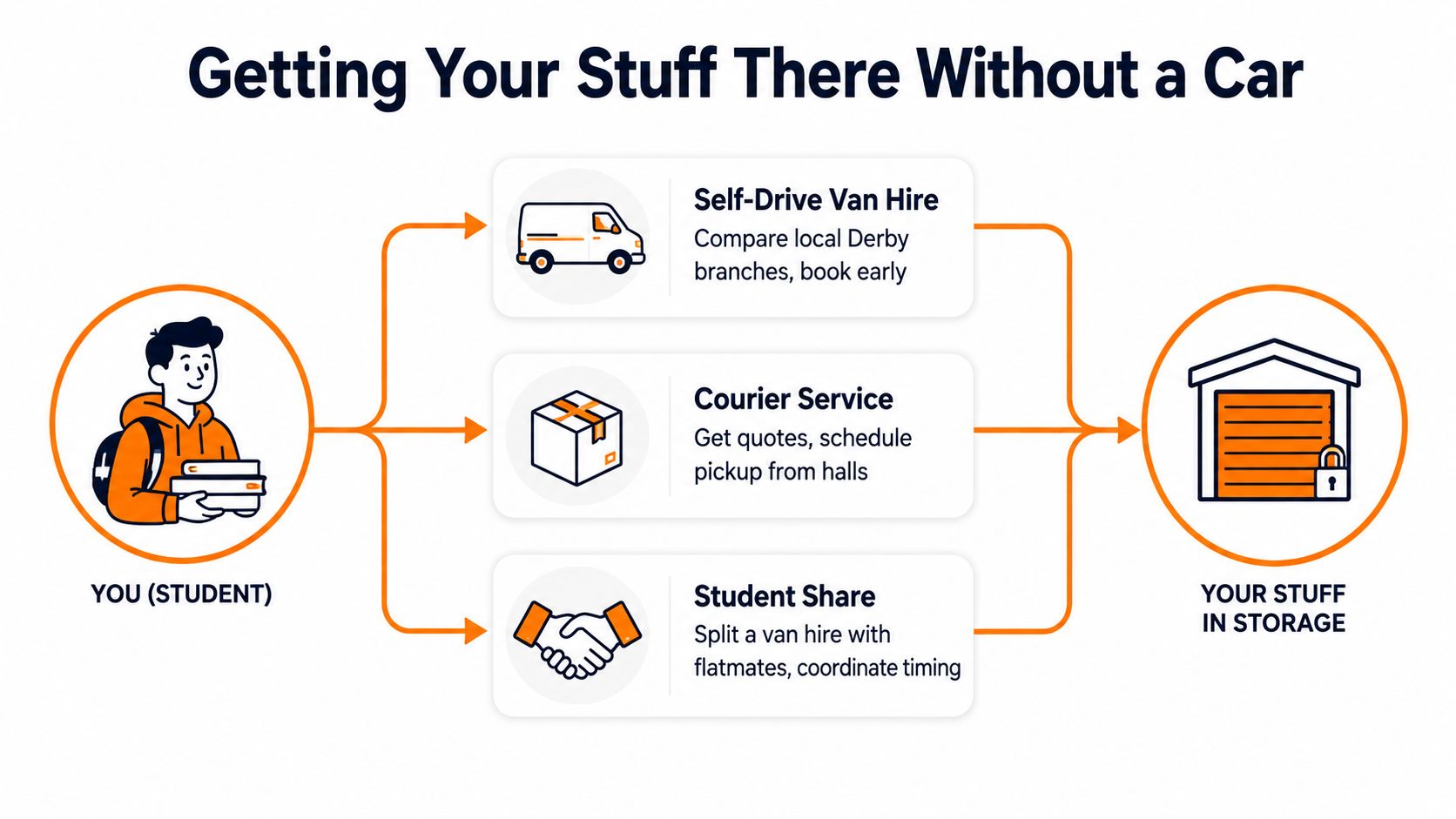
Pick the transport that matches your load
If you've got one person's room worth of stuff, self-drive van hire makes sense. If you're splitting a flat load, a shared van between housemates is usually the cleanest option, because everyone gets a slice of the cost and one clear loading window. If you're an international student or you don't have a UK driving licence, collection and redelivery services are the more realistic answer, especially for halls and central accommodation.
The guide to booking UK transfers is worth a look if you need to think beyond standard van hire and want a driver-led option. That approach matters for students who have awkward access, no lift, or bulky items that need more than one trip from the building to the vehicle.
Work backwards from move-out day
In Derby, narrow June windows disappear fast, so book any collection slot early. If the lift in halls is already reserved, or the loading bay is blocked, you need a backup plan, not optimism. Two trips in a friend's hatchback can work for light loads, but be honest, it's a compromise, not a strategy.
Orange Box Self Storage offers storage in Derby, so if you're comparing local options, keep the transport question at the front of the decision rather than as an afterthought. A nearby unit only helps if you can get your things there and back without chaos.
Best move: choose the transport first, then book the unit size around it.
Derby Student Storage FAQs
Do I need contents insurance for student storage?
If you're storing low-value bedding and a few boxes, maybe not. If you've got a bike, laptop accessories, or anything expensive, ask what cover is included and decide based on the value of what's inside, not on habit.
Can I get to my stuff in July if I need a textbook?
Yes, if the site's access hours suit you. Storage King's Derby student-storage site advertises 7-day access with reception hours of Monday to Friday 8:30am to 6pm, Saturday 10am to 4pm, and Sunday closed, so check the exact access pattern before you book, especially if your summer schedule is irregular.
What if I stay enrolled and need storage longer?
Tell the provider early. Most short lets are easy to extend if space is available, but you should not leave that decision until the week before your new term starts.
Can I share a unit with a flatmate?
Yes, and it often makes sense. Just be strict about labels, box stacks, and who owns what, because mixed units become messy fast when everyone comes back at different times.
The cleanest storage job is the one where you know exactly what's inside, who it belongs to, and when it comes back out.
If you want straightforward summer storage for university students in Derby without the usual faff, Orange Box Self Storage can help you compare unit options, think through access, and plan around your move-out dates properly. Take a look at Orange Box Self Storage and book early, before the student rush eats the convenient slots and leaves you sorting the hard way.