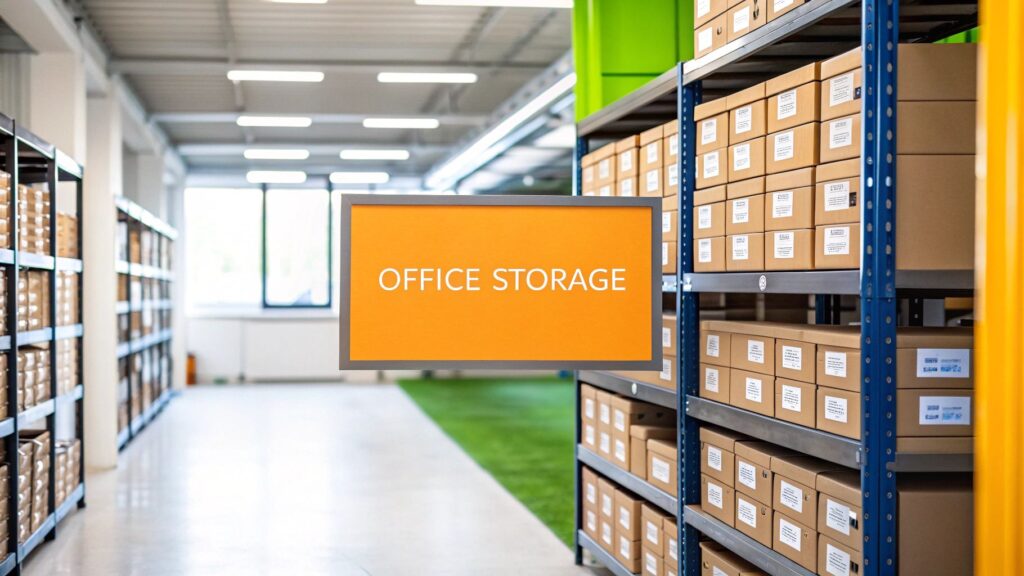
Office storage units are a smart, flexible way for businesses to handle their physical assets without being locked into expensive commercial property leases. They give you a secure, off-site space for everything from excess furniture and seasonal inventory to critical archived documents, helping you stay nimble as your needs change.
Why Smart Businesses Use Office Storage Units
The old-school office model is changing fast, and with it, the need for smarter space management. For many modern businesses, fixed, long-term commercial leases just don't make sense anymore. This is where an office storage unit becomes a strategic asset, not just a place to stash old filing cabinets.
The move towards hybrid and remote work has left a lot of companies with spare desks, chairs, and IT equipment. Instead of selling off valuable assets for pennies on the pound or cluttering up a downsized HQ, businesses are using storage to hold onto these items for future growth or rotating teams. That kind of agility is a massive competitive advantage.
Adapting to Modern Business Demands
The boom in e-commerce has also thrown a new set of logistical curveballs. A small online retailer probably doesn't need a full-blown warehouse but still requires a secure, easy-to-access spot for inventory. An office storage unit can act as a mini-fulfilment centre, allowing them to scale up their stock without the hefty overheads of a large industrial space.
You can see this trend in the market's growth. The wider UK warehousing and storage industry has been expanding steadily, growing at a compound annual rate of 5.7% between 2020 and 2025. This surge is heavily driven by e-commerce, which fuels the demand for adaptable storage for both stock and essential business documents.
A storage unit stops being just a simple box and becomes a dynamic operational hub. Think of it as a flexible extension of your office that grows or shrinks with your business cycle, giving you stability in a pretty unpredictable market.
Gaining a Financial and Operational Edge
At the end of the day, using off-site storage often comes down to the numbers. Renting a storage unit is significantly cheaper than leasing extra office square footage. It lets a business keep a lean, efficient footprint while making sure necessary assets are always within easy reach.
Figuring out the best business storage solutions is the key to getting the most out of these benefits. The right choice gives you more than just space; it delivers real operational efficiency, financial savings, and the flexibility you need to thrive. By moving non-essential items off-site, you free up prime office space for collaborative work, client meetings, and employee wellbeing—all of which directly boost productivity and your bottom line.
Finding The Right Size For Your Business Needs
Picking the right size for your office storage unit is probably the most crucial decision you'll make. Get it wrong, and you're either stuck playing a frustrating game of Tetris with your company's assets or just throwing money away on empty space every month. The sweet spot is finding that perfect balance: enough room for everything you have now, plus a little extra for what's to come.
Think of it like booking a delivery van. You wouldn’t hire a massive lorry to move a single box, but you also wouldn't try to cram an entire office's worth of furniture into a small car. Matching the vehicle to the cargo saves you money and makes sure everything arrives in one piece. The exact same logic applies to choosing a storage unit for your office.
This chart shows what's really driving the need for flexible business storage today.
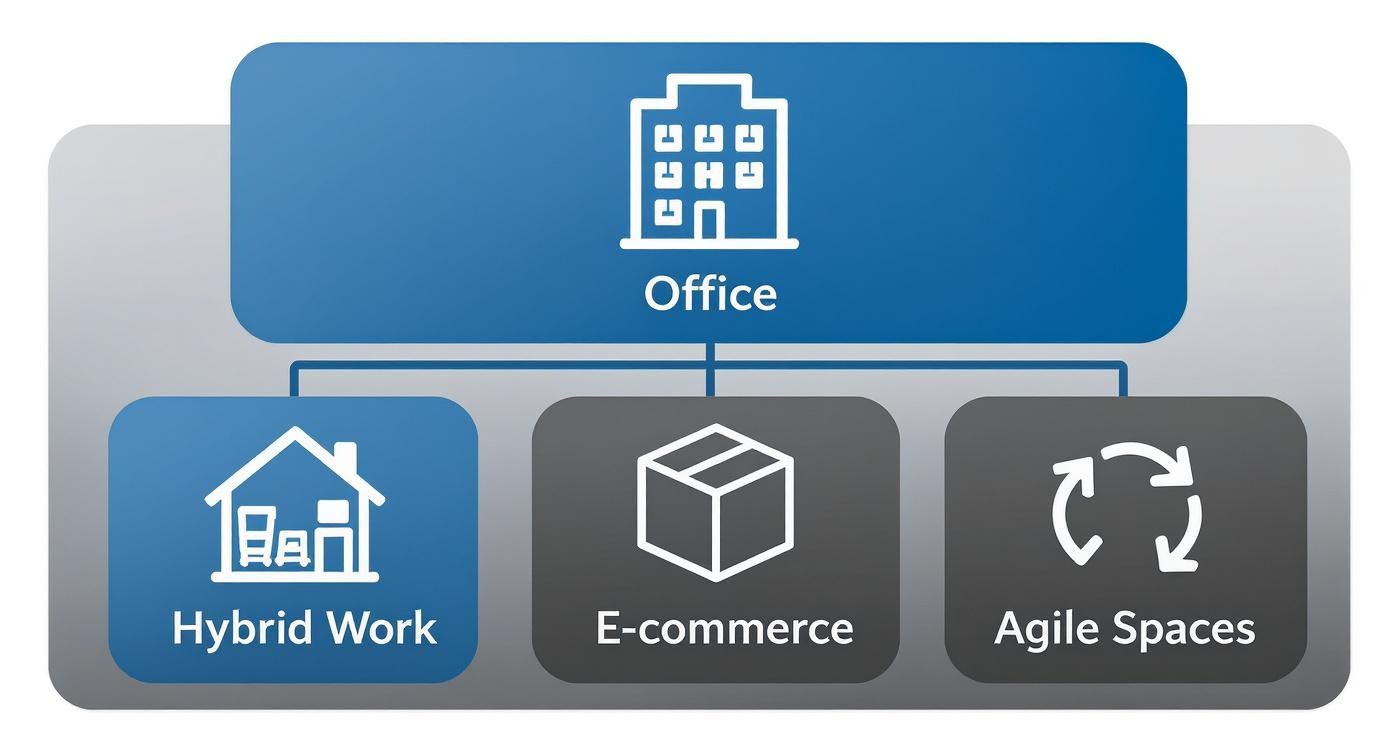
As you can see, modern ways of working—like hybrid models, e-commerce fulfilment, and agile office layouts—are all pushing businesses to look for smart, off-site solutions. Let's break down the common unit sizes and see how they fit into these real-world business scenarios.
A Practical Guide to Office Storage Unit Sizes
To help you visualise what each size can do for you, we've put together this quick comparison table. It matches common unit sizes with real-world analogies, making it easier to select the most cost-effective option for your business.
| Unit Size (sq ft) | Real-World Analogy | What It Can Hold | Ideal Business Use Case |
|---|---|---|---|
| 25 sq ft | Large walk-in wardrobe | Dozens of archive boxes, marketing materials, or a small product line. | A law firm archiving files, a sales team storing event stands, or a startup holding stock. |
| 50 sq ft | Large garden shed | Furniture for a 1-2 person office (desks, chairs, cabinets). | Holding furniture during a minor office reshuffle or for an incoming new hire. |
| 100 sq ft | Half a single-car garage | Seasonal stock, tools and equipment, or furniture from a small department. | A retail business storing seasonal displays or a tradesperson keeping equipment safe. |
| 150 sq ft | Standard single-car garage | Contents of a medium office (up to 10 employees) or significant e-commerce inventory. | A growing e-commerce brand or a business renovating a departmental office space. |
| 200+ sq ft | Double garage or warehouse | Palletised goods, large machinery, or contents of an entire corporate office. | A company managing large-scale inventory, storing bulky equipment, or undergoing a major relocation. |
Choosing the right size isn’t just about making things fit; it's about making them accessible. A well-chosen unit lets you create aisles and install shelving, turning a simple box into a highly efficient, off-site stockroom or archive.
Small Units For Targeted Needs
The smaller units, usually between 25 to 50 square feet, are the real unsung heroes of business storage. They’re perfect for companies needing a compact, easy-to-access spot for specific items without the commitment of a huge space.
A 25 sq ft unit is like a generous walk-in wardrobe. It's the ideal size for a law firm to stash dozens of archive boxes, or for a small e-commerce seller to hold a particular line of products. It’s also a fantastic solution for a remote sales team needing a central hub for marketing materials and portable display stands.
Step up to a 50 sq ft unit, and you’re looking at something closer to a large garden shed. This can comfortably take the contents of a small office—a couple of desks, chairs, filing cabinets, and several boxes of documents or IT gear. It’s a brilliant choice for a minor office re-jig or for holding onto furniture ahead of a new hire starting.
Medium Units For Growing Operations
When your needs outgrow a few archive boxes and a desk or two, medium-sized units are the answer. Ranging from 75 to 150 square feet, they give growing businesses the breathing room they need.
A 100 sq ft unit is about half the size of a standard single-car garage. This space is a game-changer for:
- Retailers: Stashing seasonal stock, festive decorations, or old point-of-sale displays.
- Tradespeople: A secure home for tools, specialist equipment, and supplies for plumbers, electricians, or builders.
- Office Expansions: Holding all the furniture and tech for an entire department during a renovation.
Moving up to a 150 sq ft unit gets you the full space of a single garage. This is a serious amount of room, capable of storing everything from a medium-sized office or a three-bedroom house. It’s the go-to for businesses managing a decent amount of e-commerce inventory or storing all the kit from an office of up to ten people.
Large Units For Substantial Storage Demands
For businesses with large-scale inventory, mountains of archives, or bulky equipment, the larger units of 200 sq ft and up are the only way to go. These can be anything from double-garage-sized spaces to small warehouses, offering serious capacity for commercial needs. They’re perfect for storing palletised goods, heavy machinery, or the entire contents of a large corporate office during a major relocation.
It can be tough to visualise these spaces, which is why a proper guide is so helpful. To see these sizes broken down even further, take a look at our comprehensive storage unit size guide and find the perfect fit for your business. Getting it right from the start means your storage solution will be both cost-effective and perfectly suited to your needs.
Key Features That Protect Your Business Assets
When you're looking for an office storage unit, you're doing more than just finding spare square footage. You're entrusting a partner with your company's physical assets—valuable inventory, sensitive documents, and expensive equipment. The truth is, not all storage is created equal, and the features on offer are what really determine how well those assets are protected.
A professional business storage solution really comes down to three things: rock-solid security, proper asset protection, and seamless access. Think of them like the legs of a stool—if one is weak, the whole setup becomes unreliable. A facility that nails all three isn't just storing your items; it's actively safeguarding them from risk, damage, and disruption.
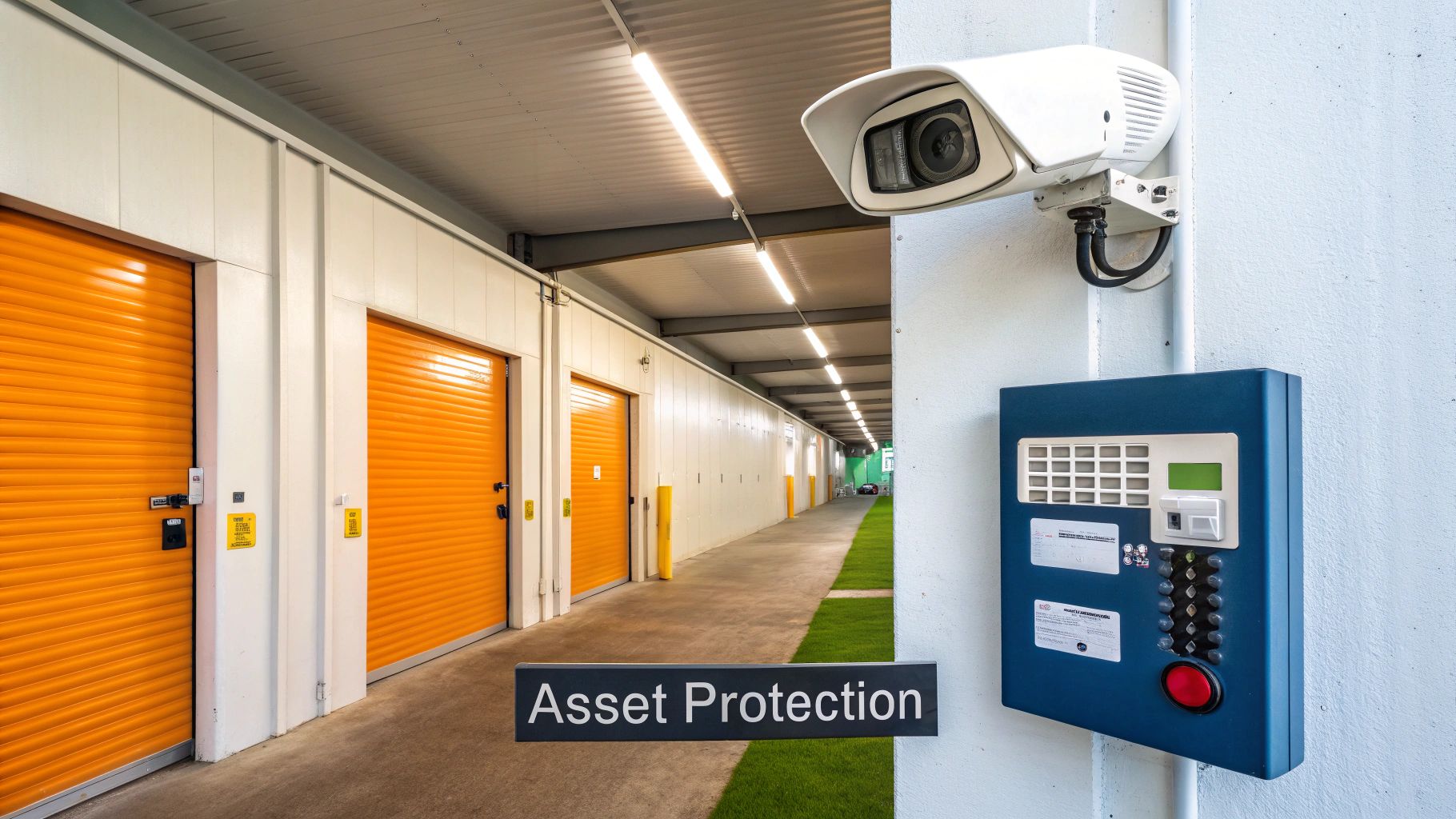
Advanced Security: A Digital Fortress
Modern security is so much more than a simple padlock on a door. Top-tier facilities build layers of protection that work together, creating a digital fortress around your unit. This defence starts at the perimeter and extends all the way to your individual space, leaving no weak points for potential threats.
The most crucial security elements include:
- 24/7 CCTV Monitoring: High-definition cameras are strategically placed everywhere—entrances, exits, hallways, and loading bays. This constant surveillance is a powerful deterrent and provides a detailed record of all activity on-site.
- Secure Gated Access: Entry to the facility should be controlled by electronic gates requiring a unique PIN code or key fob. This ensures only authorised customers and staff can get onto the grounds, stopping unauthorised entry in its tracks.
- Individually Alarmed Units: This is a real game-changer for business clients. Each unit has its own alarm system, which you arm and disarm with your personal access code. If anyone tries to tamper with your unit, the alarm triggers immediately, alerting the on-site team.
Climate Control for Asset Protection
For many businesses, the biggest threat isn't theft, but the environment itself. Wild temperature swings and humidity can wreak havoc on sensitive materials, causing irreversible damage to electronics, warping wooden furniture, and encouraging mould growth on vital paper documents.
This is where climate-controlled storage becomes a non-negotiable. Unlike a standard garage or lock-up, these specialised units maintain a stable temperature and humidity level all year round.
A climate-controlled unit acts like a preservation chamber for your most vulnerable assets. It shields them from the damaging effects of extreme heat, cold, and moisture, ensuring that items come out in the same condition they went in.
This feature is absolutely essential for storing:
- Electronics: Computers, servers, and other tech can be fried by condensation caused by temperature shifts.
- Documents & Archives: Paper and cardboard are sponges for moisture, leading to mildew and degradation over time.
- High-Value Inventory: Things like pharmaceuticals, cosmetics, or fine art often need stable conditions to maintain their quality.
While these features provide physical protection, financial security is just as important. To truly safeguard your valuable items, ensure your office storage solution is backed by a comprehensive guide to commercial property insurance, which is vital for protecting your business assets against unforeseen events. You can also explore detailed information about the specific cover you might need with our guidance on insurance for contents in a storage unit.
Seamless Operational Access
Finally, a great business storage solution should function as a seamless extension of your own operations. This requires more than just a key; it demands flexibility and services that support your workflow, even when you're not physically at the unit.
The UK self-storage sector is evolving quickly to meet these commercial demands. In 2024, the total available space grew to 64.3 million square feet—a 7.2% increase from the previous year—with facilities increasingly adopting technology to better serve business clients.
Key access features to look for include 24/7 access, which allows you to retrieve stock or documents outside of traditional office hours, and delivery acceptance services. With this service, the facility staff can sign for packages on your behalf and place them securely in your unit. That alone can save you countless hours and ensures your supply chain never stops moving.
A Clear Look at Contracts and True Costs
Figuring out the financial side of renting an office storage unit is just as crucial as picking the right size or features. The monthly price you see is only the beginning of the story; the real value comes from a transparent contract that fits your business's budget and operational rhythm. Get this right, and you can plan your expenses accurately, with no nasty surprises down the line.
The base cost of your unit boils down to a few straightforward factors. Size is the biggest driver—the more square footage you need, the higher the rent. Location also plays a big part; facilities in prime, easy-to-reach urban centres will naturally cost more than those further out. Finally, premium features like climate control will add to the monthly bill, but for protecting sensitive assets, it's an essential investment.
Short-Term Flexibility vs Long-Term Savings
Business needs can change on a sixpence, so storage contracts are designed with different levels of commitment in mind. It's a bit like a mobile phone plan: you can pay as you go for total flexibility or sign up for a longer term to lock in a better rate. Each approach serves a different business purpose.
A flexible monthly contract is perfect for short-term projects with a clear finish line. This is the ideal solution if you're:
- Going through an office renovation and just need to store furniture for a few months.
- Handling a one-off large inventory order for a specific event.
- In a transitional phase while moving to a new commercial property.
On the flip side, a long-term lease—usually for six months or more—is built for ongoing needs. Businesses often go this route for archiving documents, stashing essential equipment, or managing consistent e-commerce stock. The main draw here is cost-efficiency, as facilities nearly always offer significant discounts for longer commitments, which helps trim your monthly overheads.
The choice between a short-term or long-term contract is a strategic one. It's all about matching your financial commitment to your operational timeline, ensuring you're not paying a premium for flexibility you don't need or getting locked into a contract that outlives its usefulness.
Uncovering Potential Hidden Costs
Any reputable storage provider will be upfront about all charges, but it’s still smart to know what to look for beyond the advertised monthly rent. Being proactive here helps you craft a truly accurate budget and sidestep common pitfalls that can inflate the total cost of your office storage.
Keep an eye out for these additional expenses that might pop up on your invoice:
- Mandatory Insurance: Almost all facilities require you to insure your stored goods. While many offer their own policies for convenience, it's worth checking if your existing business insurance already covers off-site assets—this could save you a bit of cash.
- Administrative Fees: Some providers charge a one-time "set-up" or "admin" fee when you first sign on the dotted line. Always ask about this before you commit.
- Security Deposits: A refundable deposit is standard practice. It protects the facility against potential damages or missed payments and is returned when you move out, as long as the unit is left in good nick.
- Late Payment Fees: Get clear on the payment due date and the penalties for missing it. These fees can add up quickly if you're not careful.
- Locks: You'll almost always need to bring your own high-quality lock or buy one directly from the facility.
Organising Your Unit for Maximum Efficiency
Treating your office storage unit like a forgotten cupboard is a massive mistake, and a costly one at that. A well-organised unit isn't just a dumping ground; it's a dynamic, off-site extension of your workspace. With a bit of strategic thinking about how you pack and track everything, you can transform a simple storage space into a seriously efficient hub for your operations.
The first step? Think like a warehouse manager. Before you even move a single box, sketch out a quick floor plan. Carve out designated zones for different categories—'Archived Documents' here, 'Marketing Materials' there, 'Surplus Furniture' in the back. Most importantly, map out a clear central aisle. This simple trick ensures you can always get to the items at the back without having to play a frustrating game of Tetris with your entire unit.
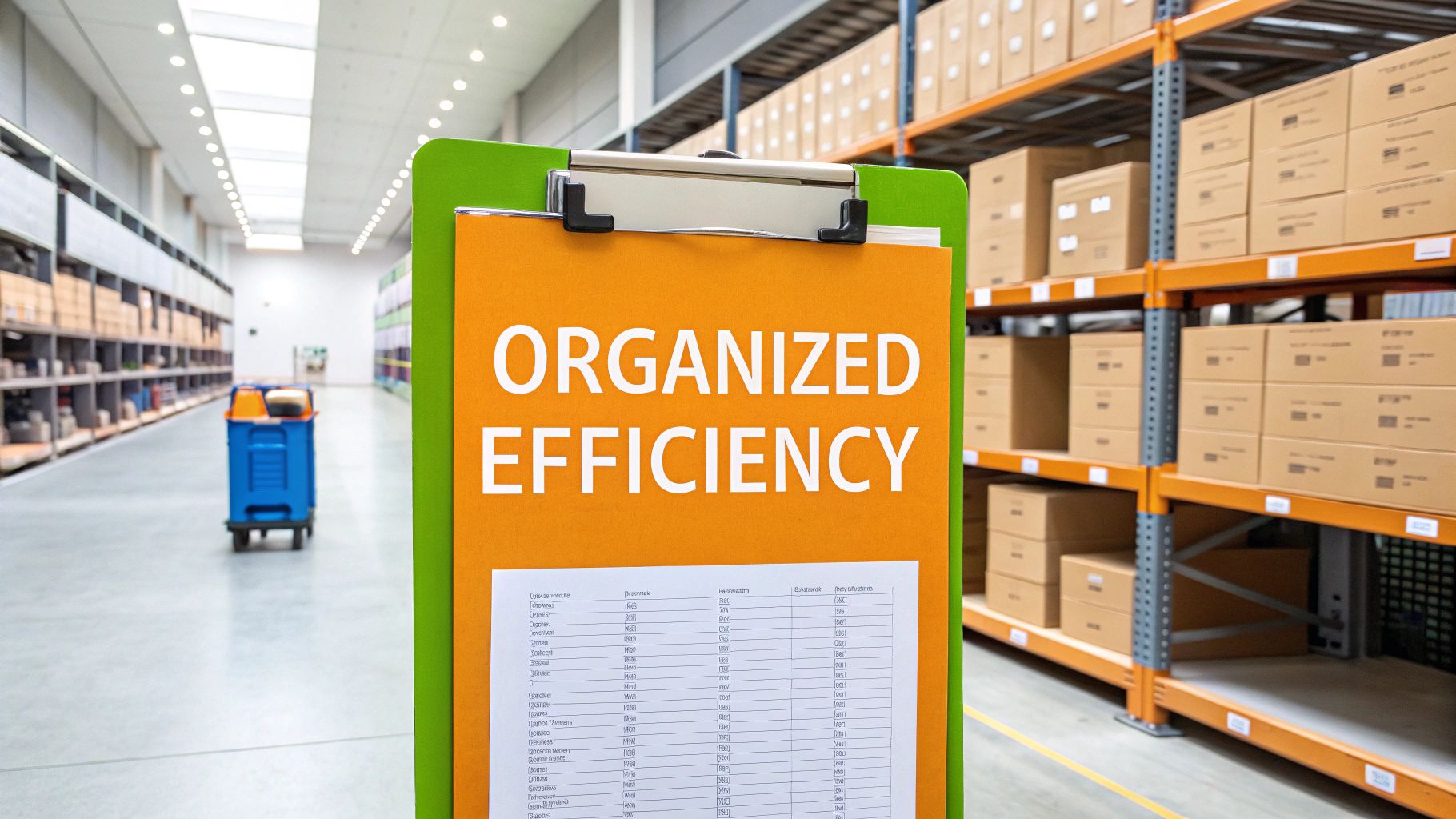
Establish a Robust Inventory System
Without an inventory list, finding one specific item is like searching for a needle in a haystack. A solid inventory system is completely non-negotiable, not just for saving your sanity but for insurance purposes too. Honestly, a simple spreadsheet is often all you need to get the ball rolling.
Of course, you can take this a step further with digital tools. Many modern businesses are finding that simple inventory management software streamlines the whole process. For a deeper dive into what's out there, check out our expert guide on inventory management for small businesses. The real key is to create a system you'll actually stick with.
This focus on organisation is a big deal. The UK office storage and organisation sector hit a market size of around USD 1.006 billion in 2024 and is only expected to grow. While old-school filing cabinets still make up the biggest slice of that pie, the core principles of clear, accessible storage apply to everything. You can discover more insights about the UK's office organisation market on deepmarketinsights.com.
Master the Art of Packing and Labelling
How you pack is every bit as important as where you put things. Just throwing items into boxes is a recipe for damaged goods and wasted space. A methodical system, on the other hand, helps you get the most out of your unit’s capacity while keeping your belongings safe.
Here are a few essential packing strategies to get you started:
- Uniform Boxes: Stick to sturdy, high-quality boxes of the same size. They are so much easier to stack securely than a random jumble of containers, letting you build stable walls of storage.
- Clear Labelling System: Label every single box on at least two sides. Give each one a unique number and a short, clear description of what's inside. Your inventory spreadsheet should match these numbers perfectly.
- Heavy Items on the Bottom: This one's a classic for a reason. Always place heavier boxes at the bottom of a stack to stop them from crushing the lighter stuff. Lighter boxes that you won't need as often can go right on top.
- Protect Your Valuables: Wrap fragile electronics in anti-static bubble wrap. Make sure important documents are stored in sealed, waterproof archive boxes to shield them from dust and any potential moisture.
An organised unit is an accessible unit. The goal isn't just to store things, but to be able to find and retrieve any specific item within minutes. This disciplined approach will save you countless hours and turn your storage space into a genuine asset for your business.
Partner with Orange Box for Your Business Storage
Choosing the right storage for your office isn't just about finding extra space—it's a smart move that boosts your business's flexibility, security, and efficiency. Now that we’ve covered what makes a great storage solution, let's look at how we put that knowledge into practice at Orange Box Self Storage. Across Nottingham, Derby, and the surrounding areas, we've built our facilities to be more than just rooms with doors; they're operational partners for local companies just like yours.
We get that no two businesses are the same. That's why we offer everything from compact lockers, perfect for a remote team’s marketing materials, all the way up to large-scale warehouse spaces that can handle a mountain of e-commerce inventory or the contents of an entire office during a move.
A Service Built for Business
When it comes to protecting your assets, our commitment is absolute. Every Orange Box facility is kitted out with 24/7 CCTV surveillance, secure gated access, and individually alarmed units. It’s about creating multiple layers of defence, so you can have complete peace of mind. For sensitive items like electronics, archives, or high-value stock, our climate-protected units maintain a stable environment, shielding them from the damaging effects of temperature and humidity swings.
We also know that business doesn't always happen between 9 and 5. Our flexible, rolling contracts are designed for the fast-paced nature of modern commerce. You can scale your storage space up or down as your needs change, without getting tied down by long, rigid agreements.
At Orange Box, we do more than just rent out space. We provide business-focused services that make your workflow smoother. A great example is our delivery acceptance service—our on-site team can securely sign for and store your parcels, saving you time and ensuring you never miss a critical shipment.
Your Local Storage Partner
With convenient, easy-to-reach locations in Nottingham, Derby, Long Eaton, and Beeston (and new sites on the way), finding a local Orange Box facility is simple. This proximity means your assets are always close by, making your storage unit a genuine extension of your main workspace. Our goal is to offer a seamless, supportive experience that lets you focus on what you do best: running your business.
Ready to find the perfect storage solution for your office? Our team is here to help you every step of the way. You can get an instant, no-obligation quote online, book your unit in minutes, or contact our friendly experts for a personalised chat. Let us show you how Orange Box Self Storage can support your business’s growth and success.
Frequently Asked Questions
When you’re thinking about commercial storage, a few questions are bound to pop up. To help you move forward with confidence, we’ve put together answers to the queries we hear most often from businesses like yours.
First things first, it’s crucial to know what you can and can’t keep in a unit. Getting this right from the start ensures everyone’s safety, keeps things above board, and protects your assets, the facility, and other customers. It’s a non-negotiable part of using storage responsibly.
What Items Are Prohibited in a Business Storage Unit?
For safety and legal reasons, some items are a definite no-go. This usually includes anything hazardous like chemicals or flammable materials, perishables like food, illegal goods, and living things—sorry, no office plants or pets!
It’s always a smart move to double-check the facility’s specific list of prohibited items before you sign up. That way, you know you’re fully compliant.
Another big question is about financial protection. A secure facility is great for physical safety, but insurance is the safety net you need for those completely unexpected moments. It gives you peace of mind that your business assets are covered from every angle.
Do I Need Separate Insurance for My Stored Items?
Yes, insurance is almost always required. While many facilities offer their own policies—which is incredibly convenient—it’s worth checking your existing business insurance first. Some policies already cover off-site storage.
This coverage is vital. It protects your valuable business assets from unexpected events like fire, theft, or damage, giving you essential financial breathing room. Honestly, getting the right cover is a non-negotiable part of using storage units for offices.
Finally, many businesses wonder how an off-site unit actually fits into day-to-day operations, especially when it comes to logistics and deliveries. Modern facilities have really stepped up, offering services designed to make this link seamless.
The ability to have deliveries accepted on your behalf transforms a simple storage unit into a dynamic operational hub. It saves valuable time, streamlines your supply chain, and ensures your business keeps moving, even when you're not on-site.
This feature is a game-changer for e-commerce businesses or teams that are always on the move.
Can I Get Business Deliveries Sent to My Storage Unit?
Absolutely. Many modern facilities that cater to businesses offer this handy service. The on-site staff can accept packages and stock deliveries for you and will place them securely in your unit.
This is a huge plus for e-commerce companies or businesses with teams out on the road, as it saves time and means you never miss an important shipment. Just be sure to confirm this service is available when you enquire about their office storage solutions. Choosing a provider that offers this can make a massive difference to how smoothly your business runs.
Ready to find a flexible, secure, and efficient storage solution for your business? At Orange Box Self Storage, we offer a range of unit sizes and business-focused services to help your company grow. Find your perfect office storage unit today.