

The builders start ripping out the kitchen on Monday, or your completion date just slipped by six weeks, and you've got a three-seater sofa, a solid oak dining table, and two wardrobes that need somewhere safe to sit until life settles down. At that moment, it's tempting to race to book the cheapest room, stack everything tight to the ceiling, and snap a heavy padlock onto the hasp.
That padlock won't stop a damp mattress from blooming with mildew by week eight, nor will it keep veneer from lifting off a sideboard wedged tight against a cold wall. Too many households treat paid units the way they treat their roofs. A 2025 Censuswide survey of 2,000 UK adults commissioned by Attic Storage found that 36.5% of UK adults mainly used their loft to hold clutter and belongings without permanent homes.
Bringing that same habit to furniture in storage gets expensive fast. Two decisions determine whether a piece comes back looking like it left: first, whether it earns the cost of paid space at all, and second, whether you get preparation, breathable coverings, and airflow right before the shutter comes down.
Decide What Deserves to Go Into Storage
A £120 flat-pack desk and a £900 solid-wood dining set can sit side by side in the same unit, paying the same monthly rate per square foot. Only one of them earns it. The renter who stores a budget chipboard bookcase between tenancies often finds, six months on, that the fees, van hire and insurance add up to more than a brand-new replacement, and two cam-lock joints sheared during loading anyway.
Run a quick cost test before you hire a van. If a piece's replacement value sits below the combined storage fees, transport costs and cover it will rack up during its stay, sell it, pass it on or donate it rather than paying rent on it.
Six Criteria That Separate Keepers From Disposals
Weigh every larger item against six practical filters before it earns floor space:
- Replacement cost against total stay: Add up your expected monthly unit fee, van hire and cover cost across the full holding window.
- Structural condition: Check wobbling legs, frayed webbing and swollen particleboard before paying to move them.
- Repairability: Solid timber frames and quality upholstery justify minor fixes, whereas split melamine rarely survives a second assembly.
- Sentimental or inherited value: Family heirlooms sit outside pure pounds-and-pence maths, provided you protect them properly.
- Expected duration: Holding everyday pieces for eight weeks between house moves makes sense; holding them indefinitely rarely does.
- Local reuse demand: Good second-hand furniture moves fast in the UK, so selling early can offset your moving costs.
That last filter carries real weight now. According to the British Heart Foundation's 2025 Gen R report, 45% of surveyed people in the UK had delayed buying furniture they needed because they couldn't afford it, while 35% planned to buy pre-owned furniture in 2025. Reuse charities and networks across the country rehome large volumes of furniture and electrical items every year, so a decent piece you no longer need is unlikely to go begging.
Three scenarios show the rule working. Storing that £900 dining set for four months during a renovation clearly pays, because replacing hardwood joinery costs far more than a short-term booking. A full year of fees on the flat-pack desk fails instantly: sell it second-hand now and buy another when you need one. An inherited armchair with a sound beech frame sits in the middle, and I'd have loose joints reglued and the springs checked before wrapping it, so nothing deteriorates while it sits out of sight.
The Six-Stage Plan Before the Shutter Drops
Once the low-value pieces are culled, every survivor follows six stages in order:
- Decide and photograph every keeper from multiple angles in good daylight.
- Measure and book a floor area built around actual dimensions and a walkway, not a rough guess.
- Clean and dry every surface completely so dirt and trapped moisture never enter the unit.
- Dismantle and protect only what comes apart cleanly, using breathable coverings matched to the material.
- Load with an access path so weight sits evenly off the concrete and air circulates around all four walls.
- Inspect every week so small shifts in humidity or stacking get caught before they become claims.
Before the door closes on move-in day, write a review date in your calendar and a rough exit plan beside it. Keep every item covered, because pieces left bare pick up dust and condensation long before you spot the damage on a weekly check. Knowing when you'll retrieve, sell or donate each piece stops a temporary holding strategy from drifting into years of forgotten rent.
Choosing a Unit Size for Your Furniture
A 2022 survey of more than 2,900 UK adults published by Surewise found that over two-thirds of self-storage users stored furniture or household goods, and 49.4% used storage during a house move. Most personal storage customers stay between 1 and 6 months, which means picking the smallest workable footprint usually beats paying for dead air, provided you still leave room to breathe and inspect.
That's where whole-room planning comes in. Guessing a size by cubic volume encourages people to cram every corner wall to wall, which blocks inspection points, traps stagnant moisture against cold surfaces, and causes scuffs or snapped legs the first time you try to pull a dining chair from the back row.
Measure Your Load in Four Steps
Grab a steel tape measure, squared paper, and a pencil before looking at unit prices:
- Measure maximum dimensions of every piece. Record the widest point across sofa arms, the deepest curve of a wingback chair, and the full length of dismantled bed rails rather than relying on mattress sizes alone.
- Add handling and covering clearance. Allow extra centimetres around padded blankets, cardboard corner guards, and the clearance needed to pivot bulky frames through doorways.
- Sketch a scaled floor plan with a walkway. Draw the unit footprint and reserve a continuous central strip so you can reach the back wall without unstacking half your home.
- Group by room and plan vertical space. Place sturdy, flat-topped wardrobes and chests along the edges, then see which lightweight boxed items can safely sit above low hard furniture without touching upholstered cushions or veneered tops.
When you're comparing layouts across UK facilities, whether you're checking out storage units in London for a city relocation or booking closer to home, look past the headline square footage. Corridor turns, lift heights, and door frame widths decide how easily a super-king mattress or tall oak dresser reaches its bay. Indoor corridors and doorways at our sites are designed for wardrobes, sofas, and mattresses, yet checking your single longest item against doorway clearance before move-in day still prevents awkward surprises on the trolley.
Unit Size by Furniture Load
Use the lookup table below to match a realistic household load to floor area and access style, or cross-check tricky rooms against a detailed storage unit size guide before reserving.
| Floor area | What it holds | Furniture example | Access notes |
|---|---|---|---|
| 10-25 sq ft | Boxes, a chair, small flat-pack | Two dining chairs, a bed base, 10 boxes | Locker or indoor unit, carried by hand |
| 25-50 sq ft | Part of a one-bedroom flat | Mattress set, chest of drawers, 15 boxes | Indoor corridor; check door width for a mattress |
| 50-75 sq ft | Whole one-bedroom flat | Sofa, bed frame, wardrobe, dining table, 20 boxes | Trolley route from the loading bay |
| 100-150 sq ft | Two- to three-bedroom home | Large sofa, dining set for six, white goods, 40 boxes | Drive-up unit shortens a heavy carry |
| 150-250 sq ft | Three-bedroom house | Sectional sofa, three beds, wardrobes, 60 boxes | Ground-floor drive-up preferred for heavy items |
For larger four-bedroom properties or combined house and garage loads, units step up into the 250 to 308 sq ft bracket, where ground-floor drive-up access saves hours of lifting heavy white goods and three-piece suites.
Size rule that prevents claims: Never book a footprint so tight that you have to wedge furniture flat against the perimeter walls or stack heavy cartons onto cushions just to get the door shut.
Before you lock up a freshly measured load, pair your floor plan with an itemised list recording serial numbers, pre-storage condition photos, and exact shelf or corner positions. Those records do double duty: they let you find a box of winter coats in two minutes, and they provide clear evidence of pre-storage condition if an insurer ever asks when a mark or break occurred.
Prepare and Protect Furniture by Material
Security cameras and steel shutters keep intruders out, yet they have zero effect on moisture, pests, or surface pressure inside your bay. Covering choice and environmental control decide far more damage claims than locks ever do.
According to the Institute of Conservation (Icon) furniture care guidance, the UK conservation benchmark for furniture is 40 to 60% relative humidity (RH), while RH above 70% materially increases the risk of woodboring insects, mould, and fungal attack. English Heritage guidance cited in the same conservation framework links successful woodworm life-cycle completion to wood environments above 60% RH and notes that temperatures of 20°C or higher encourage insect breeding.
Aim for a practical inspection ceiling below 60 to 65% RH, checked with a calibrated digital data logger (such as a Govee or Tinytag hygrometer) weekly during the first month and right after sharp seasonal weather shifts. Don't mistake "dry" for automatically safe either: rapid RH swings shrink, swell, split, and loosen joints in solid wood, veneer, and marquetry even when the monthly average looks harmless. Keep delicate timber well away from external walls, radiators, vents, windows, and doors where localised microclimates fluctuate fastest.
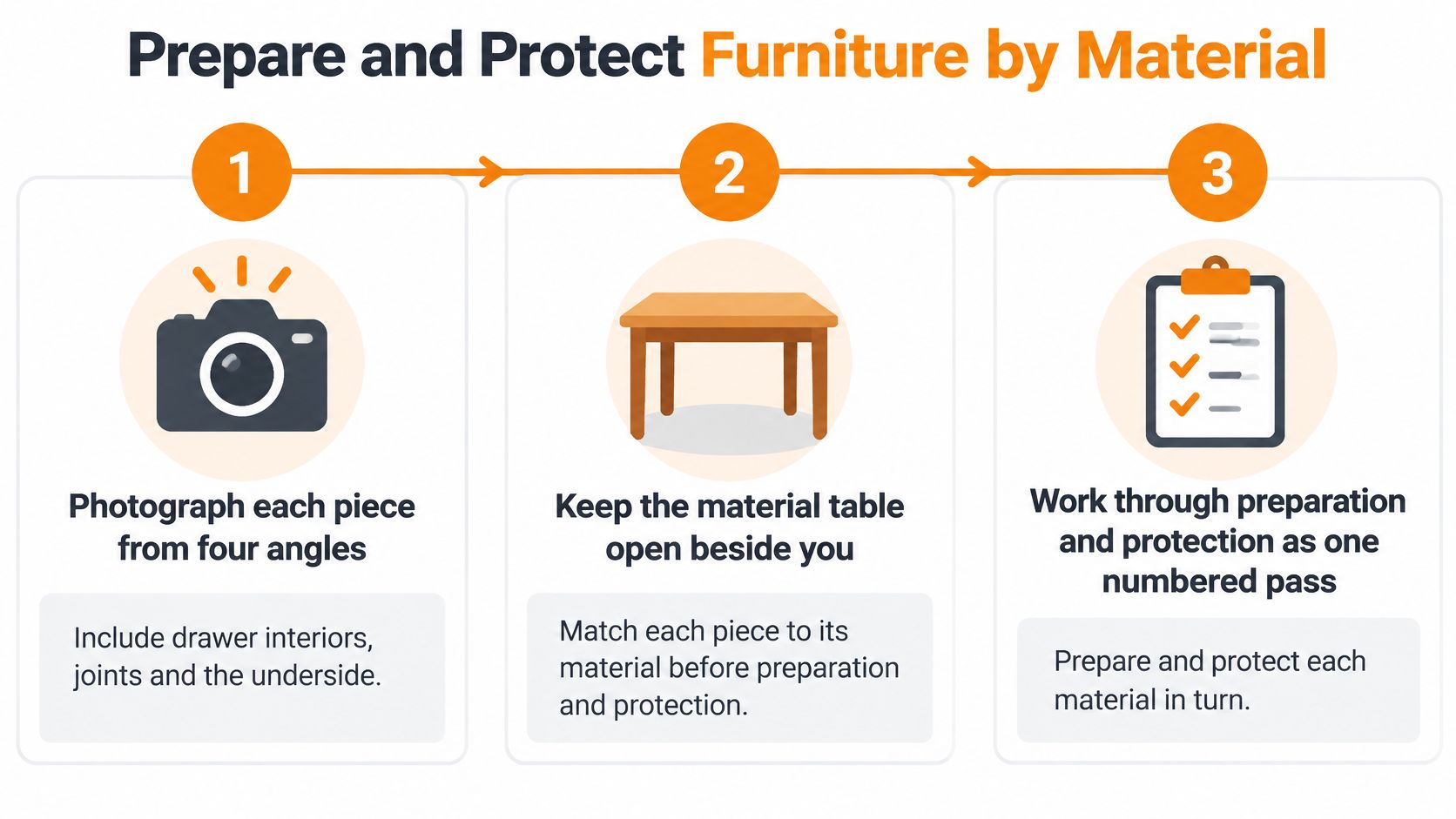
The visual workflow below shows how to move from condition checks straight into material-specific preparation without missing a step.
Eight-Step Preparation Pass
Work through every piece in one continuous sequence with the material table open beside you so you aren't unwrapping finished items to fix something you missed:
- Photograph every piece from four angles. Capture tops, sides, legs, drawer interiors, mortise joints, and undersides in natural daylight, logging overall measurements and any pre-existing scuffs.
- Clean thoroughly without waxy build-up. Run a soft brush nozzle along upholstery seams and under seat cushions, then wipe solid wood with a microfibre cloth wrung nearly dry in mild soapy water. Skip silicone sprays, waxes, and oils before storage because sticky residues attract airborne dust and darken finishes over months in the dark.
- Dry for a full 24 to 48 hours. Never rush a shampooed sofa or wiped-down dining table into covers; residual damp sealed inside fabric becomes a mould incubator within days.
- Inspect carefully for pests. Shine a torch into drawer backs, joint cracks, and underneath upholstery webbing to check for fine powdery frass, fresh flight holes, live beetles, or musty odours. Treat any suspect piece professionally or leave it out of the unit altogether so an infestation can't spread to neighbouring timber.
- Dismantle only clean mechanical joints. Unbolt bed frames, unscrew dining table legs, and flat-pack cam-lock wardrobes where the fixings release cleanly. Leave traditional glued tenon joints and antique dowels untouched, because forcing them splits timber.
- Bag, label, and tape fixings to the frame. Drop every bolt, washer, barrel nut, and Allen key into a heavy zip-lock bag marked with a permanent Sharpie ("Oak bed, headboard bolts") and tape it directly to the matching rail with low-tack painter's tape.
- Guard corners first, then drape breathable covers. Tape corrugated cardboard edge protectors and bubble wrap onto sharp timber corners, glass rims, and carved legs, then cover the main body in washed cotton sheets or breathable dust covers rather than cling film.
- Update your inventory as each piece wraps. Tick off the item number, dimensions, box of matching fixings, and photo batch before lifting it onto the trolley.
Tightly wrapped plastic sheeting doesn't protect a wooden table or leather armchair from damp; if the slightest trace of moisture lingers in the timber or foam, sealed plastic locks condensation straight against the finish.
Coverings and Warnings by Furniture Material
Match each material to its covering before you buy packing supplies, paying special attention to mattresses and washable protectors. Reading up on storing bedding without damaging waterproofing helps keep polyurethane membranes intact if you're packing fitted protectors alongside your bed, and pairing them with choosing breathable covers for mattresses in storage stops condensation from staining ticking fabric.
| Material | Cover with | Avoid | Watch for |
|---|---|---|---|
| Upholstered sofa and fabric chairs | Clean cotton sheets or purpose-made breathable covers | Shrink wrap, plastic sheeting, bin bags | Musty smell, crushed cushions, pests in seams |
| Leather sofa and chairs | Loose cotton sheet over a padded moving blanket | Tight plastic, direct contact with cardboard | Cracking, mould bloom, dye transfer |
| Solid wood tables and chairs | Breathable dust sheet with cardboard corners on edges | Oil and polish before storage, airtight wrap | Joints loosening, splits, white bloom, woodworm |
| Veneer and marquetry | Soft blanket plus a rigid board across the top | Weight on the surface, heat, rapid humidity swings | Lifting veneer, bubbling, chipped edges |
| Mattresses | Breathable mattress bag or a clean sheet | Storing flat under heavy items, damp floors | Mould, sagging, bed bugs |
| Metal frames and legs | Dry cloth, light oil on bare steel only | Damp covers, standing directly on concrete | Rust spotting, blistering paint |
| Glass tops and mirrors | Cardboard plus bubble wrap on edges, stored upright | Storing flat, stacking anything on top | Edge chips, distortion, cracking |
Notice the small material traps that catch careful packers off guard. Plain brown cardboard pressed directly against aniline leather can leach acids and transfer dye under humid air, so always put a clean cotton sheet between leather and any moving blanket or box. Similarly, bare steel table bases benefit from a whisper-thin wipe of light machine oil to block flash rust, whereas painted steel only needs a dry cloth and elevation off concrete.
Loading So Weight and Airflow Both Work
Good preparation unravels fast if you stack heavy cartons on top of a velvet sofa or push a chest of drawers flush against an outer bay wall. Mid Devon District Council's damp and mould guidance warns that high humidity and mould can permanently damage furniture, carpets, and soft furnishings, recommends leaving an air gap of at least three inches (roughly 75 mm) around furniture, and advises choosing plastic boxes rather than cardboard in damp conditions.
Indoor storage naturally suits soft furnishings such as sofas, mattresses, and rugs that don't cope with damp, yet the microclimate right inside your bay still depends on how you place every piece.
Seven Steps to Load Your Unit Safely
Follow this loading sequence in order so heavy loads sit solidly and air circulates freely from floor to ceiling:
- Raise everything off the concrete. Lay heat-treated timber pallets, slatted duckboards, or dry wooden battens across the floor area first. Bare concrete stays colder than room air and transfers chill straight into timber feet and mattress edges.
- Position heavy items first along the back and sides. Set wardrobes, sideboards, washing machines, and heavy sofas down first to anchor the layout and spread weight evenly across the floor slab.
- Stand sofas and mattresses upright only when frames allow. Store pocket-sprung mattresses vertically on their long edge inside a breathable bag, leaning gently against a flat board or wardrobe side so they don't bow. Stand solid-framed sofas on their end if space is tight, but keep loose seat cushions boxed separately and never pile heavy cartons onto upholstery or veneered tops.
- Maintain a three-inch perimeter gap. Pull every cabinet, bed head, and sofa at least 75 mm clear of all unit walls so ambient air moves behind cabinet backs where damp hides first.
- Crack drawers and cupboard doors open. Wedge wardrobe doors and chest drawers slightly ajar using folded cardboard spacers (where safe and stable) so trapped air doesn't grow stale inside dark interiors.
- Build a continuous walkway to the back wall. Keep an unobstructed aisle straight through the middle so you can read your hygrometer, inspect cabinet backs, and reach items at the rear without dismantling stacks.
- Cover every item and log final positions. Drape your breathable sheets over every exposed surface, mark each piece's bay location against your inventory sheet, and set your calendar for weekly visits.
Swap standard cardboard cartons for lidded polypropylene crates (such as Really Useful Boxes) for anything sitting on the bottom tier or holding textiles. Cardboard wicks ambient moisture over a damp British winter, loses wall strength, and collapses sideways onto adjacent timber legs, whereas rigid plastic crates keep their geometry under stacked weight.
Weekly Checks and Your Recovery Routine
Our storage terms require you to cover up all items left in storage and check your stored items on a weekly basis. Treat that ten-minute visit as active maintenance rather than a formality. Step down your walkway, check your hygrometer log, sniff for earthy or musty air, look behind drawer backs, and check whether any stack has leaned.
Catching a faint white mould bloom on day seven means wiping it down and drying the piece in daylight; finding it on day ninety usually means calling a skip.
If a weekly check turns up condensation beads, mould spotting, fresh woodworm frass, or a collapsed carton, run a fast recovery routine immediately:
- Move the affected piece out into open air and daylight so spores or moisture don't migrate to neighbouring upholstery.
- Dry the surface thoroughly and ventilate both the item and your unit before returning anything inside.
- Photograph the issue right away alongside your hygrometer reading so your condition timeline stays complete.
- Replace softened cardboard with lidded plastic crates and increase pallet airflow beneath that corner.
- Re-check the bay within three days to confirm humidity has settled and no fresh spotting has appeared.
What Climate Protection Does and Does Not Guarantee
A climate-protected indoor facility moderates ambient temperature and moisture swings across the wider building, protecting soft furnishings from freezing winter snaps and boiling summer peaks. It doesn't override physics inside a wet mattress sealed in plastic, nor does it dry out a steam-cleaned rug packed damp on move-in morning. Keeping goods dry before arrival, choosing breathable coverings, preserving airflow gaps, and declaring accurate insurance values stay firmly in your hands.
Storage Plans for Homeowners, Students and Businesses
Every customer runs through the same core process, yet timelines, space footprints, and weak points shift sharply depending on why you're storing. Comparing how homeowners, students, and commercial teams adapt their checklists makes it obvious where each group gets caught out.

Homeowners Renovating, Moving or Downsizing
Homeowners usually book storage for a kitchen knock-through, a chain break between moves, downsizing, or clearing an inherited property. Expect stays of one to four months and footprints around 75 to 150 sq ft for a full kitchen and living room clear-out, with veneered sideboards, solid timber tables, and upholstered suites sitting highest on the risk list.
Holding good household furniture makes strong financial and environmental sense. According to WRAP's 2010/11 national study of local-authority bulky-waste collections and recycling centres reported by Waste to Wonder, furniture made up around 42% of the roughly 1,590,000 tonnes of UK bulky waste (about 670,000 tonnes), yet more than 20% of furniture collected at the kerbside was reusable as it stood and a further 25% needed only slight repair. If you're downsizing into a smaller rental while deciding what fits long term, check exact folded and open footprints on multi-use pieces, for example when you compare click clack sofa bed sizes, before committing your main three-piece suite to long-term storage.
Students Between Terms or Studying Abroad
Students face two distinct clocks: an eight-to-twelve-week summer gap needing 10 to 25 sq ft, or a nine-to-twelve-month placement or year abroad stepping up to 25 to 50 sq ft. Bedding, mattress toppers, and desk chairs dominate these loads, and the biggest failures come from rushing out on checkout morning with damp laundry, forgotten snacks, or houseplants tucked inside boxes.
Pack strictly dry, food-free items on raised platforms, never allow unauthorised friends to drop extra bags into your unit, and nominate one trusted family member or contact with authorised access in case a check or collection needs handling while you're overseas.
Businesses Managing Refits, Moves or Stock Overflow
Commercial teams turn to storage during phased office refurbishments, lease handovers, or seasonal inventory spikes. The potential value at stake is enormous: a UK Government value-for-money note for the updated Government Buying Standard for furniture, summarised by Best Bedroom Products, estimated that British businesses discard approximately 165,000 to 200,000 tonnes of office furniture each year, with more than half thought reusable (a potential reuse pool of roughly 82,500 to 100,000 tonnes annually).
Most business units on our sites are pallet-ready and designed to hold stock, archives, equipment, and e-commerce inventory. Label every desk, pedestal, and task chair by department, stack chairs securely on pallets, and log asset tags or serial numbers on a master spreadsheet so redeployment after the refit takes hours rather than days.
Storage Requirements by Situation
| Situation | Typical duration | Unit size guide | Protection priorities | Extra steps |
|---|---|---|---|---|
| Home renovation | 2-4 months | 75-150 sq ft | Dust sheets, sealed boxes for drawers, zip-front covers | Photograph rooms before dismantling, label by room |
| Between house moves | 1-3 months | 50-250 sq ft | Mattress bags, sofa covers, moisture control | Keep an essentials box out of the unit |
| Downsizing or bereavement | 3-12 months | 50-150 sq ft | Breathable covers, climate protection for veneer | Set a review date, share access with family |
| Students over summer | 8-12 weeks | 10-25 sq ft | Washed and dried bedding, mattress topper bags | Book before term ends, split a unit with flatmates |
| Students on a year abroad | 9-12 months | 25-50 sq ft | Damp control, nothing perishable, items off the floor | Nominate someone with access |
| Small business stock or archives | Rolling | 25-150 sq ft | Palletised stock, boxed archives, pest checks | Inventory list, insurance at replacement value |
| Office move or refit | 1-6 months | 100-308 sq ft | Desk tops protected, chairs stacked on pallets | Label by department, record serial numbers |
Insure Your Furniture and Book the Unit
Even the best-prepared sofa needs proper financial backing before you lock the door. We do not insure stored goods; every customer must keep their items insured at all times for their full Replacement Value as set out on the Cover Sheet.
Check your existing home contents policy carefully before assuming you're covered, because many UK household policies exclude off-site storage or cap payouts far below the cost of replacing a dining room and bedroom suite. If your insurer won't extend full off-site cover, you can add affordable contents cover directly at checkout, and our guide to insurance for contents in a storage unit walks through how to calculate realistic replacement values without underinsuring.
Keep your condition photos, serial numbers, and bay map backed up in cloud storage. Because we give no warranty that any unit is suitable for particular goods and accept no liability for this, your own preparation records and pre-storage images form the backbone of any insurance claim.
Site Rules That Catch People Out
Reading the standard storage rules before move-in day avoids avoidable fees and disputes:
- Corridors must stay completely clear: Items left unattended in common areas or outside your unit are treated as abandoned and may be moved, sold, or disposed of immediately with no liability to us.
- Unpaid balances halt access: If an account falls into arrears, we can refuse access to you and your agents and overlock the unit until the debt is paid in full.
- Leftover goods trigger disposal costs: Goods not removed when an agreement ends are treated as abandoned and may be sold or disposed of (following written notice by registered or recorded delivery), with storage fees remaining payable until sale or disposal.
- Hand the unit back clean and intact: Leaving rubbish, spills, or bay damage behind can result in retaining your deposit, a cleaning charge, or recovery of reasonable repair costs.
Booking Path and Your Exit Checklist
Once your inventory is measured and insured, personal storage units at Orange Box Self Storage run from 11 sq ft to 308 sq ft across our sites in Nottingham, Derby, Long Eaton and Beeston, offering indoor access suited to sofas, mattresses, and wardrobes. Booking takes three clear steps: get a quote, reserve online, then move in.
When your review date arrives and it's time to bring your furniture home, close the stay as cleanly as you started it:
- Give advance notice: Contact the site team at least two weeks before your planned move-out date so billing timelines align cleanly.
- Book transport ahead of inspection: Line up your van, trolleys, and extra hands before your final walk-through so nothing gets rushed or dragged across thresholds.
- Empty and sweep the bay thoroughly: Remove every pallet, cardboard offcut, and dust sheet so the floor is completely bare.
- Photograph the empty unit: Take quick time-stamped photos of the swept floor and walls before leaving the site.
- Get written confirmation of closure: Confirm in writing that your agreement has ended and your padlock is off so future billing stops immediately.
Whether you're clearing rooms for a renovation, bridging a house move, or holding household pieces until you're ready for them, we offer secure indoor, drive-up, and climate-protected units from 11 sq ft to 308 sq ft across Nottingham, Derby, Long Eaton, and Beeston. Measure your load, check your coverings against our material guide, and get an instant online quote with Orange Box Self Storage to reserve the right space for your furniture today.