


On a Friday evening outside a Nottingham city-centre venue, the kit rarely moves in a neat line. One van is being unloaded, another is heading back through West Bridgford with speakers and lighting, and a third is being sent out because the original two are still full of staging, cable trunks and cases. The event coordinator isn't dealing with clutter. She's trying to keep equipment safe, find the right items quickly and get everything to the next load-in without losing track of a supplier handover.
That's the practical meaning of event equipment storage in Nottingham. A unit or warehouse space should operate as a live logistics control point, not a spare room where cases disappear. It may need to receive goods from several suppliers, hold equipment overnight near a venue, stage an event-specific dispatch and support a fast return after de-rigging.
Nottingham has a useful base for this kind of operation. A live business directory lists 108 warehouses in Nottingham, around 1% of 10,748 warehouses recorded across the UK in 2026, while a local event-logistics operator describes a 32,000 sq ft high-bay warehouse with 8 to 10 metre ceiling heights and three separate loading doors for short- and long-term event storage (warehouse data and Nottingham facility details). The right choice still depends on your workflow, access windows, equipment profile and responsibilities at the venue.
When Event Gear Starts Outgrowing the Van
The warning sign usually isn't a completely full warehouse. It's the third van, the missing cable trunk or the case that has to stay overnight in a vehicle because nobody has time to return it to base.
A coordinator working around Nottingham might finish a city-centre load-in, send part of the kit back through West Bridgford, then discover that the next morning's event needs the same lighting fixtures. If the equipment has no defined holding point, the team starts making decisions under pressure. Cases get left in the wrong vehicle, suppliers deliver to different addresses and the first person on site spends the load-in searching instead of supervising.
A properly organised storage location changes that sequence. Supplier deliveries can arrive at one address, the team can check and label them against the job, and the crew can build an event-specific dispatch before the vehicle arrives. The space may also provide a controlled overnight holding point when a venue can't accept equipment until the next access window.
Operational rule: Treat storage as a handover point between suppliers, vehicles and venues. If the next person can't understand what is ready to move, the space isn't doing its job.
Storage is only useful when access matches the event
Self storage can solve a secure address, basic organisation and convenient vehicle loading. It doesn't automatically solve early venue access, crew availability, traffic restrictions, equipment testing or the responsibility for kit left at an event site.
That distinction matters around venues such as the Motorpoint Arena, conference locations and marquee sites. A unit might be accessible during the day, but an early load-out can depend on whether the operator permits out-of-hours entry, whether a vehicle can reach the loading area and whether staff are available to deal with a delivery. A low-cost unit with poor access can create more handling work than it removes.
Use the space to control the job
The strongest setup gives every event a defined status:
- Received: supplier goods have arrived and are being checked.
- Staged: the complete event allocation is together, labelled and ready to load.
- Dispatched: the outbound inventory has been signed off against the vehicle or crew.
- Returned: equipment is back, inspected and placed in its normal zone.
That approach prevents storage from becoming a static pile of flight cases. It also makes client reporting easier because the coordinator can identify what arrived, what left and what remains at the venue.
Mapping Your Equipment, Access and Storage Windows
Start with an equipment audit before looking at unit sizes. A floor area figure means little if you haven't separated a lightweight cable trunk from a tall truss bundle or a fragile LED panel.
Group the inventory by handling profile, then record how often each group moves. Truss and staging usually need clear floor access and vehicle-friendly loading. Lighting needs protection from knocks, heat and moisture. AV racks, control desks and screens need more careful handling than cable cases, while signage rolls, drapes and props need protection from crushing and damp.
Access frequency should reflect the calendar rather than an average month. A team may need daily access during a run of venue changes, then only a weekly restock when equipment is between hires. If a job involves a dawn load-in, confirm whether the facility opens early enough or whether the kit needs to be collected the previous evening.
Build a usable equipment brief
Use a worksheet that captures volume, movement and handling restrictions. The aim isn't a perfect stocktake. It's a booking brief that helps you reject unsuitable space before paying for it.
| Kit Group | Typical Volume | Access Frequency | Handling Notes |
|---|---|---|---|
| Truss and staging | Bulky bundles and panels | Frequent around load-in and de-rig | Keep upright where appropriate, allow vehicle-side handling |
| Lighting fixtures | Cases with delicate equipment | Regular during event runs | Protect from impact, heat and moisture |
| AV and control desks | Fragile cases and racks | Job-specific access | Keep stable, avoid heavy stacking overhead |
| Cable and consumables | Multiple trunks and boxes | Frequent replenishment | Group by event, label every case and return items consistently |
| Signage, fabrics and props | Long, soft or crush-sensitive items | Seasonal or job-specific | Keep dry, prevent bending, separate from dirty equipment |
Record the heaviest case, the tallest item, the items requiring two people and anything that must not share a floor with fuel, gas or batteries. Also mark items that need to stay upright. A unit can be large enough on paper and still fail because the door, corridor or loading bay can't accommodate the longest case.
A durable equipment labelling system can help crews identify cases consistently across storage, vans and venues. Use a label format that names the equipment family, event allocation and return zone, then keep the same identifier in the dispatch sheet.
A storage plan should answer three questions quickly: what is here, where is it, and when does it need to leave?
Map the route from the unit to the vehicle as well. Check loading-bay height, turning space, distance from the motorway and whether courier drivers can find the entrance without calling the event coordinator. Those details often matter more than an extra section of floor.
Choosing the Right Unit Type for Event Kit
Not every event business needs a warehouse lease. Nottingham organisers are usually choosing between internal units, drive-up containers, climate-protected space, lockers or a managed warehouse arrangement. The sensible choice follows the kit profile and the number of handling steps, not the advertised floor area.
Internal units suit sealed road cases, AV accessories, cable trunks and stock that benefits from an indoor environment. They're easier to keep clean, but corridors, lifts and loading bays can slow a busy dispatch. Drive-up container storage is more practical for truss, staging flats and bulky cases because the vehicle can load directly beside the space. The trade-off is greater exposure to outdoor temperature and dust, so the packing standard has to be higher.
Climate-controlled space is the safer option for equipment affected by humidity or condensation, including some LED panels, sensitive fixtures, printed signage and electronics with exposed power supplies. It can cost more than basic space, but the relevant comparison is the cost of protecting the kit and avoiding a failed load-in. Small lockers work well for radio microphones, cable accessories, consumables and compact props, though they won't replace a staging area.
Match the unit to the handling profile
| Equipment profile | Suitable option | Main advantage | Main limitation |
|---|---|---|---|
| Truss, staging and bulky cases | Drive-up container or warehouse area | Direct vehicle access and easier loading | Less environmental control |
| AV consoles and fragile electronics | Indoor or climate-protected unit | Cleaner, more stable handling environment | May involve corridors or restricted loading |
| Printed graphics and soft goods | Climate-protected indoor space | Reduces moisture and condensation concerns | Usually a higher-cost specification |
| Cables, small props and consumables | Locker or small internal unit | Fast picking and compact organisation | Limited capacity for bulky cases |
If you're considering a purpose-built external store rather than rented space, a guide to shed construction costs for PA provides useful context for comparing construction, access and fit-out decisions. For most event teams, however, a flexible rented unit avoids committing capital before storage demand is predictable.
Ask about access hours, roller-door dimensions, vehicle restrictions, lighting and power. A container that looks economical can become inefficient if every case has to be carried across a yard. An indoor unit can protect AV better but may be unsuitable when a van needs to load directly at the door.
Packing and Layout Tips That Protect AV and Staging
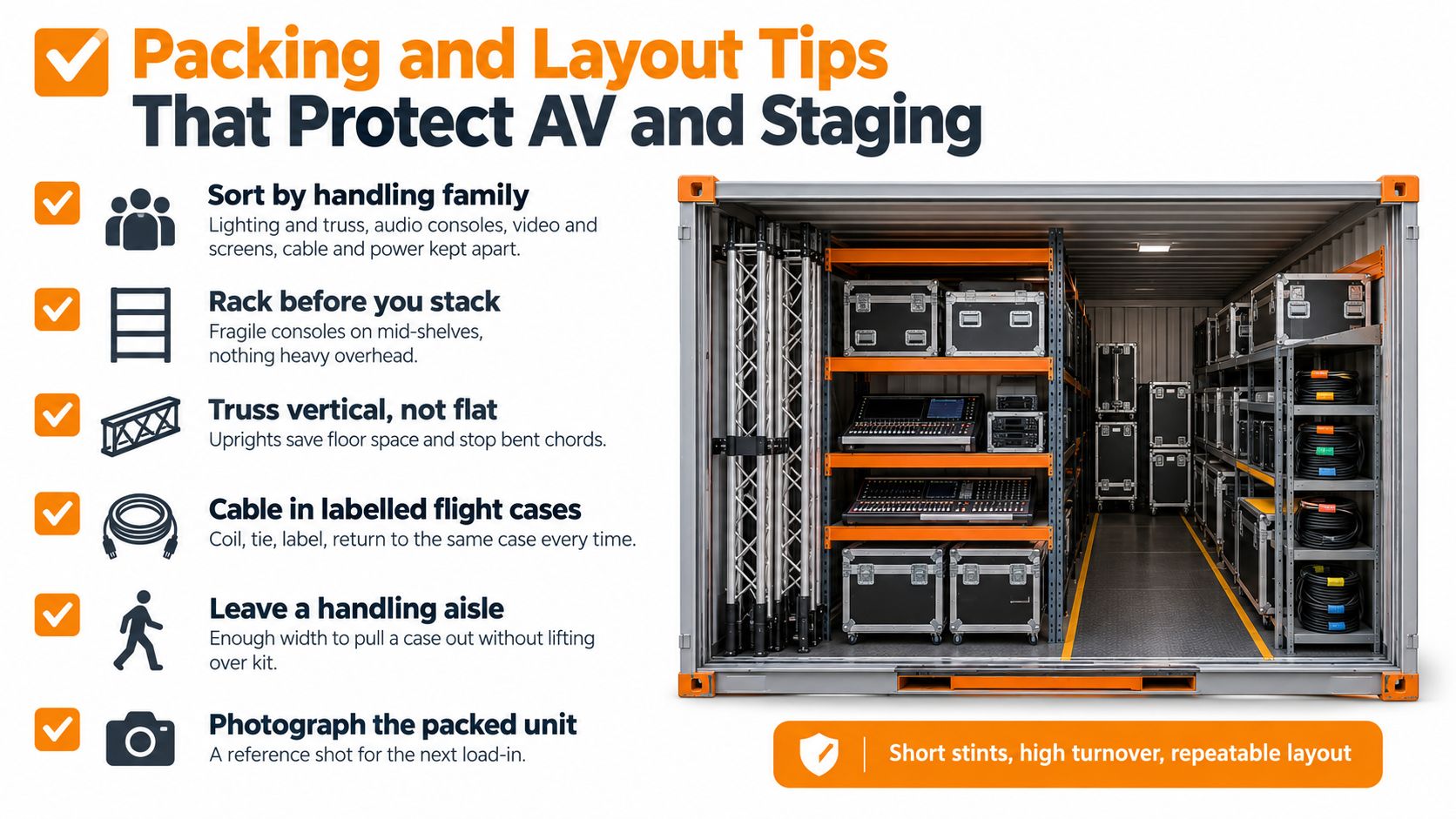
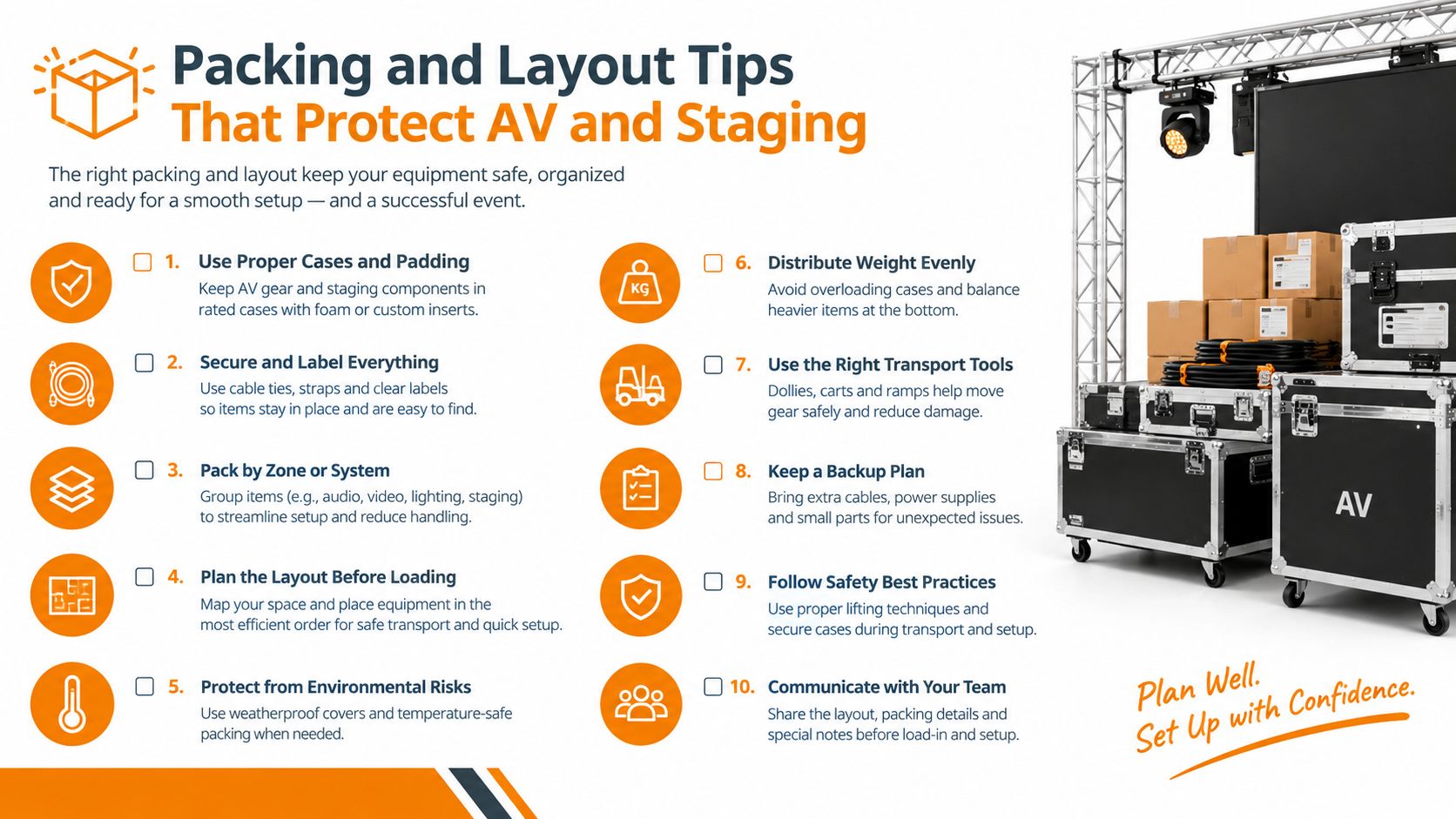
Short-term event storage has a high turnover rate, so the layout must work for the next person as well as the person who packed it. Start by creating handling families: lighting and truss, audio consoles, video and screens, staging, cable and power, then soft goods and props. Give each family a visible zone and don't allow returned kit to drift into the nearest empty corner.
Use flight cases for fragile AV and mark cases that need careful handling. Speaker cabinets should remain upright, heavy cases should stay on the floor and delicate consoles should sit where another case can't fall onto them. Stacking cases flat may appear space-efficient, but it can force the crew to lift over equipment and makes the bottom case difficult to reach.
Make every return repeatable
Cable handling determines whether a storage room feels controlled or chaotic. Coil cables to a consistent size, secure them without crushing the sheath and return them to the same labelled case after each job. Group cables by event or system where possible, but don't create labels that only one crew member understands.
Long truss should be stored vertically when the unit permits it and when the manufacturer's handling guidance supports that arrangement. That protects floor space and reduces the temptation to stack cases against it. Use shelving for smaller accessories, but keep fragile equipment at a reachable height rather than above head level.
A clear central aisle is more valuable than squeezing in one extra case. Place the next dispatch nearest the roller door, keep returned equipment in a marked inspection area and use sealed totes for drapes, masks and table linen. Nottingham weather can turn an otherwise clean load into a damp one if soft goods are left exposed during transfers.
For electronics and moisture-sensitive stock, compare the facility specification with the requirements of the equipment rather than relying on marketing language. An overview of climate-controlled storage units can help you identify the questions to ask about temperature protection and unit conditions.
Take a photograph after each full pack. Include the door, aisle and main zones in the frame, then save the image against the inventory record. The photo won't replace a stock check, but it gives the next crew an immediate reference and makes it obvious when returned equipment has been left in the wrong place.
Security, Access and Insurance Checks Before You Book
Visit the facility at the time your crew would use it. A site can appear secure during a daytime tour and still be awkward for an early collection, a courier handover or a late return after a venue de-rig.
Start with surveillance. Ask whether CCTV runs continuously, how long recordings are retained and whether cameras cover the roller doors, corridors, entrances and any outdoor container yard. Motion-only coverage may detect movement without giving you a useful record of a loading incident. Confirm whether alarms are monitored and who receives an alert outside staffed hours.
Access control needs the same scrutiny. Individual PINs or fobs are preferable to a shared code because the facility can identify who entered and when. Ask whether entry and exit logs can be exported for client reporting, what happens when a fob is lost and whether the agreement permits early or late access.
Compare the promise with the site
| Check | What to Ask | Acceptable Standard |
|---|---|---|
| CCTV | Are entrances, doors, corridors and yards covered? | Coverage relevant to every route your equipment takes |
| Recording | Is footage recorded and retained? | A clear retention policy and named contact for incidents |
| Entry control | Does each crew member receive an individual credential? | Logged access rather than an unshared code |
| Perimeter | How are outdoor containers and vehicle areas protected? | Controlled entry, secure doors and maintained fencing |
| Unit lock | Who supplies the lock and who holds the key or code? | Clear responsibility, with lost-lock procedures |
| Vehicle access | Can a van reach the loading point at the required time? | A practical route without avoidable lifting or transfers |
| Insurance | What does the facility policy exclude? | Written limits and exclusions, checked against your own cover |
Insurance deserves a separate conversation. Facility cover may not include equipment in transit, equipment left overnight at a venue, hire charges or the full replacement value of specialist AV. Before booking, compare the storage agreement with your event policy and review guidance on rules for venue liability coverage as part of that wider check.
The storage contract should say who is responsible for the unit, the building and the contents. Check the provider's contents-cover requirements and exclusions, including whether your equipment needs separate protection through a policy such as contents insurance for self-storage. Don't assume a secure door transfers responsibility for every stage of the job.
Local Compliance and Overnight Storage Duties
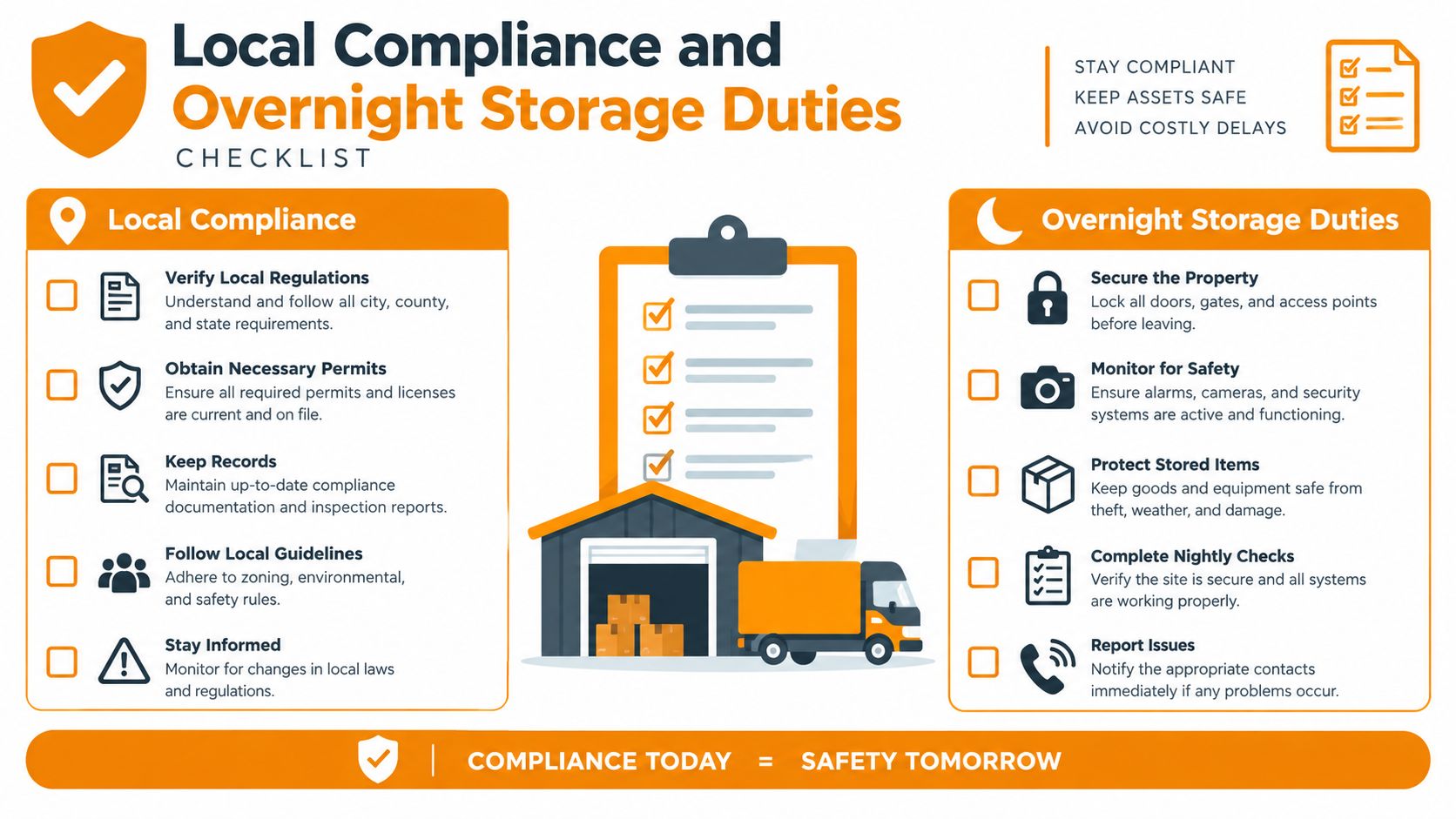
Event equipment storage becomes a safety issue when the inventory includes fuel, gas, batteries, generators or materials that can burn quickly. The coordinator needs to know what is stored, where it is stored and who controls it at every stage, including the period after the venue closes.
Nottingham City Council guidance states that overnight equipment storage should be reflected in event bookings and that suitable security is the organiser's responsibility. The same guidance calls for a fire risk assessment, appropriate extinguishers and safe storage of fuel and gas cylinders (Nottingham outdoor event booking guidance).
Separate incompatible risks
LPG shouldn't be stored indoors. Cylinders should remain upright and be caged where possible, while spare cylinders should be kept at least 12 metres from cylinders in use, as set out in the council guidance linked above. A tent, trailer or indoor room is not an acceptable substitute for a properly controlled LPG store because gas build-up and carbon-monoxide risks can develop quickly.
The practical sequence is straightforward:
- List the hazards: Include LPG, generator fuel, charging batteries, cables, heat-producing fixtures and combustible fabrics.
- Define the storage location: Confirm what the facility permits before anything arrives. Never place prohibited materials in a self-storage unit because the unit seems convenient.
- Separate and secure: Keep gas and fuel away from ignition sources, provide the required ventilation and prevent unauthorised handling.
- Check emergency controls: Confirm extinguisher coverage, access routes and the person responsible for responding to an incident.
- Record the decision: Keep the risk assessment, storage confirmation and event booking documents together.
Lithium batteries need their own control process. Store them according to the manufacturer's instructions, inspect for damage and use an approved charging arrangement rather than treating a storage unit as an unattended charging room. Outdoor electrical equipment that isn't weatherproof should have suitable covers or shelters, also in line with Nottingham's event guidance.
Road closures and altered access around areas such as the Old Market Square, Sneinton, Lenton and the Creative Quarter can change the practical dispatch window. Check the venue instructions and council requirements early, then make the storage plan reflect the actual route and handover time.
Booking Logistics and a Pre-Event Checklist
Book around movement dates, not just event dates. The useful storage window may begin when the first supplier delivers and end only after the last case has been inspected and returned to its normal zone.
Confirm the venue's load-in and de-rig windows before reserving space. Graduation periods at the universities, the build-up to the Goose Fair and busy city-centre calendars can tighten vehicle access and crew availability, so a storage plan that depends on a last-minute collection is fragile. If the venue won't accept equipment overnight, the storage site needs to be close enough and accessible enough to support the agreed handover.
Confirm the booking details
Get the practical specification in writing:
- Unit and layout: Confirm the usable space, door dimensions, ceiling clearance and whether your planned shelving or racks are permitted.
- Loading arrangements: Ask about vehicle access, loading-bay availability, yard rules and the route from vehicle to unit.
- Opening times: Check normal and out-of-hours access, including what happens during late returns or early load-outs.
- Account controls: Confirm online account access, named users, payment arrangements and invoicing documents.
- Site contact: Record the manager's details and the procedure for urgent access or a security incident.
- Equipment rules: Obtain the list of prohibited materials and confirm how the facility handles batteries, fuel, gas and other restricted items.
A short-term storage option near Nottingham can suit an event with a defined delivery and dispatch period, but the unit still needs to be assessed against the inventory and access plan. Flexible duration doesn't compensate for a poor loading route or unsuitable environmental conditions.
Run the final dispatch check
The day before load-out, confirm the inventory against the event sheet and photograph the packed space. Mark the cases that must leave first, place them nearest the access door and give the driver a written sequence rather than relying on memory.
Ask the coordinator to verify:
- supplier deliveries have been signed in;
- fragile cases have been inspected;
- cable trunks and consumables match the event allocation;
- the vehicle, driver and venue contact are confirmed;
- the site manager can be reached during the collection window;
- overnight venue responsibilities are documented;
- returned kit has a separate inspection location.
Orange Box Self Storage offers business storage, container storage and larger warehouse-style spaces in and around Nottingham, with flexible rental arrangements and facilities that include access controls, CCTV and climate-protected options. Visit Orange Box Self Storage to check live availability and pricing, then compare the available space with your actual dispatch, receiving and overnight-holding requirements.