


A successful online shop can outgrow its storage before its owner realises what's happening. One week, cartons fit neatly beside the packing bench. The next, fast-moving products are stacked behind slower stock, returns wait in an unopened pile, and every dispatch involves searching through boxes that were meant to be temporary.
That middle stage creates the hardest decision. Home fulfilment feels cramped, but a dedicated warehouse lease may bring too much cost, unused capacity and contractual commitment. For many Nottingham sellers, ecommerce storage in Nottingham works best as a staged solution, with flexible overflow space, organised picking areas and a proper process for returns.
Growing Pains in the Online Retail Game
A Nottingham-based seller might start by keeping stock in a spare room, garage or small office. That arrangement can work while the catalogue is narrow and orders are predictable. It becomes far less practical when cartons block access, packaging materials take over the workspace and the person packing orders has to move three other products before reaching the right SKU.
The warning signs aren't limited to a lack of floor space. Stock counts become harder to trust, replenishment takes longer and returned goods get mixed with products ready for sale. A business may still be able to fulfil orders, but the owner is spending time on avoidable handling rather than buying stock, improving listings or serving customers.
Practical rule: If you can't explain where sellable, reserved and returned stock is located, you don't just need more storage. You need better storage design.
The awkward stage between home and warehouse
A full warehouse isn't automatically the next sensible step. Rent, utilities, racking, insurance, handling equipment and minimum lease terms can make a large premises expensive before the business has consistent demand for it. On the other hand, adding another domestic cupboard rarely solves the underlying workflow problem.
Flexible overflow capacity gives growing sellers room to separate their operations. Reserve inventory can sit away from the daily packing area, while active stock stays close to the dispatch point. Seasonal or promotional stock can move into the additional unit temporarily, rather than forcing the business to operate from a permanently oversized premises.
The East Midlands already has a strong connection with ecommerce warehousing. In 2018, the region accounted for 31% of all new warehouse space taken up by dedicated e-fulfilment facilities, the largest regional share reported in the Midlands freight analysis, as recorded in Nottinghamshire's local economic indicators. That regional infrastructure doesn't mean every seller needs a major distribution centre. It does mean local businesses can consider storage as an operational tool, not merely a place to hide excess boxes.
Why Location and Local Logistics Matter
Location affects more than the drive to collect stock. A storage unit becomes part of the fulfilment process, so access, vehicle suitability, collection windows and the distance to couriers all influence the actual cost of using it. A cheap unit that requires awkward loading or long detours can create more handling work than its advertised rate suggests.
Nottingham benefits from its position within the East Midlands logistics network. The region supports distribution infrastructure, transport activity and ecommerce fulfilment, giving local sellers access to a wider ecosystem of storage and delivery services. The scale of that network also helps explain why a storage search should consider the operating pattern of the business, not just the unit's monthly price.
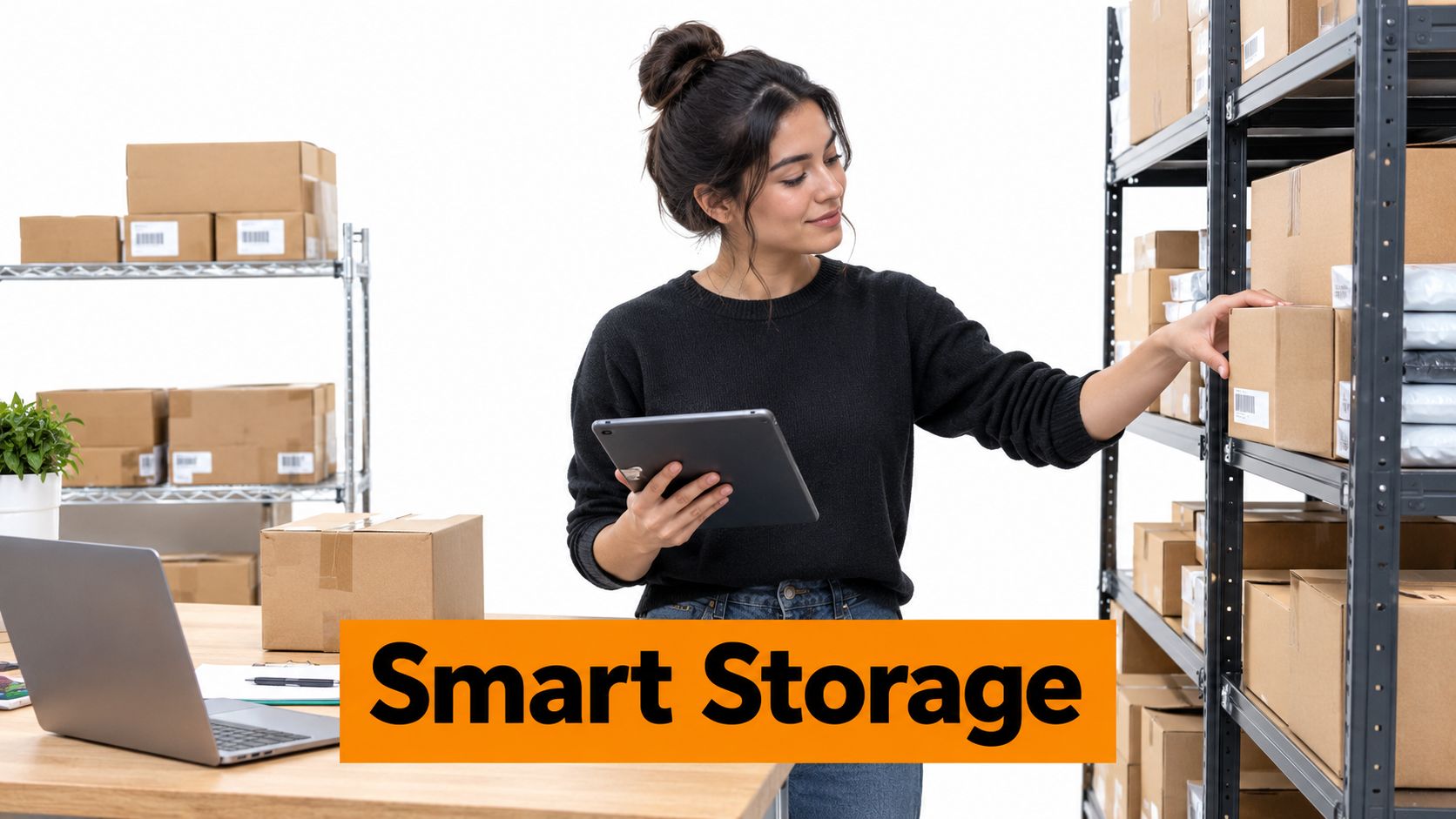
What local access changes
UK online shopping represented approximately 8% of all retail sales at the beginning of 2011 and nearly 38% in January 2021. Over the same period, the number of UK business premises classified under transport, logistics and warehousing was 88% higher in 2021 than in 2011, according to Office for National Statistics analysis of the UK warehouse sector.
That shift has increased the importance of dependable inventory access. Sellers need somewhere to receive deliveries, hold packaging, prepare orders and manage stock fluctuations. A Nottingham unit may be particularly useful when it lets the owner replenish active stock without bringing every carton back to the house.
Before signing, check the practical details:
- Vehicle access: Confirm whether a car, van or larger delivery vehicle can reach the loading point.
- Collection hours: Match access times to supplier deliveries and courier collection arrangements.
- Handling space: Make sure there is enough room to move cartons safely without blocking the unit entrance.
- Location pattern: Choose a site that supports regular visits rather than one that looks cheaper but is inconvenient to reach.
For a broader comparison of local pricing and unit formats, review cheap storage units in Nottingham alongside the operational requirements above. The lowest headline price isn't always the lowest total cost.
Comparing Storage Unit Types for Businesses
The right unit depends on how stock moves, not just how much stock exists. A compact space may suit high-value products with a small footprint, while a larger unit becomes worthwhile when cartons need to be separated into active picking, reserve inventory and returns. Businesses should leave enough room to work safely, but shouldn't pay to heat, light or maintain capacity they don't use.
Nottingham's industrial and logistics stock is estimated at approximately 67 million square feet, with ecommerce growth identified as a major driver of demand for warehousing and home-delivery capacity in the Bassetlaw Council logistics assessment. That broad market supports a range of options, from small business units to substantial warehouse accommodation.
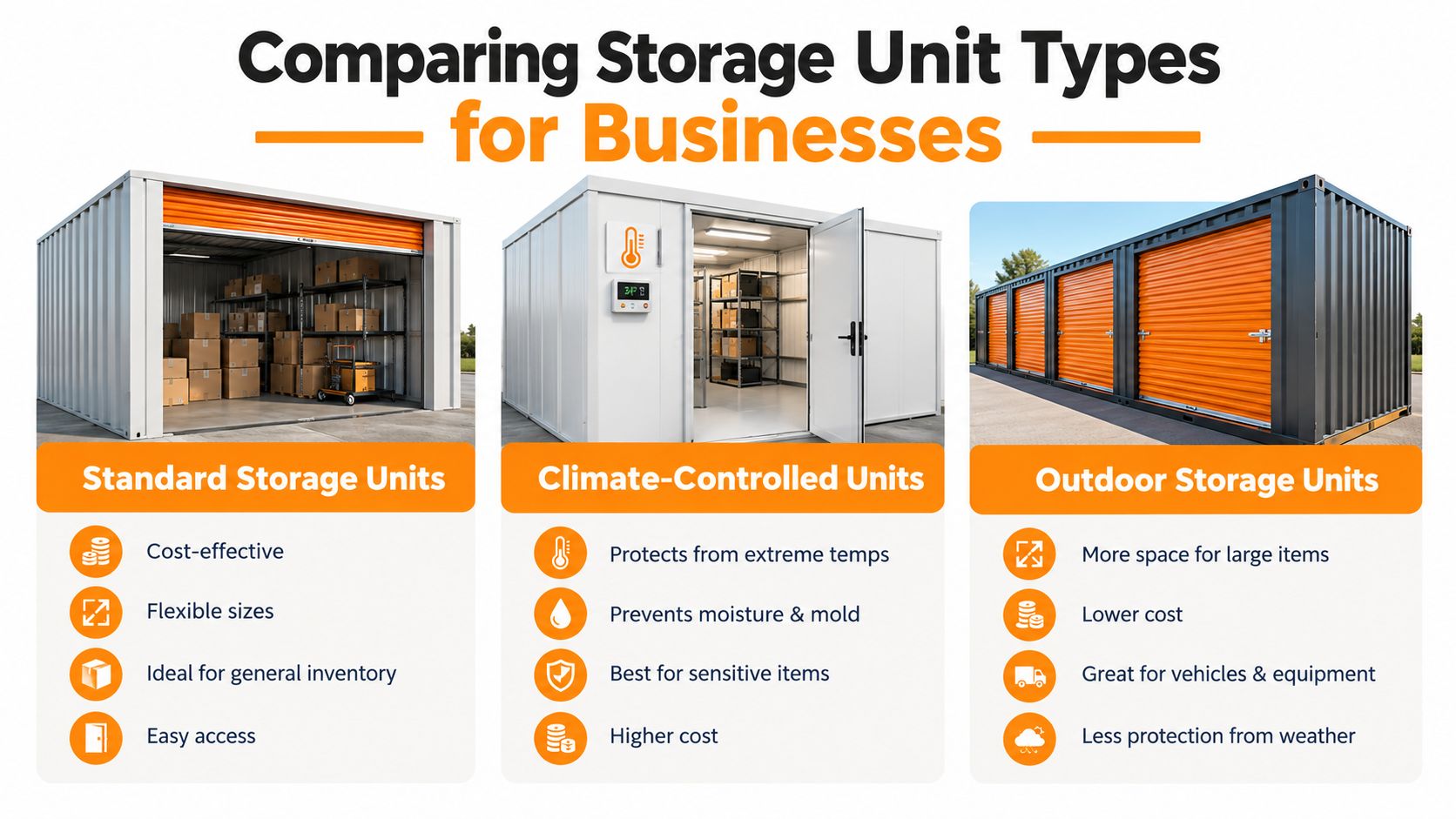
Match the space to the stock
| Storage format | Works well for | Main trade-off |
|---|---|---|
| Compact locker or small unit | High-value, low-volume products, documents and small packaging supplies | Limited working room and little opportunity to separate stock categories |
| Standard business unit | Reserve cartons, active inventory and routine picking | May need shelving or a packing bench added by the user |
| Larger warehouse space | Bulky products, frequent receiving and several stock zones | Higher cost and more capacity to manage |
| Outdoor or container storage | Robust equipment, tools and weather-tolerant goods | Poor fit for delicate products or stock needing a controlled environment |
| Climate-protected space | Goods affected by humidity, temperature variation or sensitive packaging | May cost more than basic storage, so product requirements should justify it |
A seller shouldn't choose a unit based on carton volume alone. Measure the usable pick-face capacity, the clearance needed to handle incoming goods and the space required for packing. Count shelving, benches and walkways as part of the operating footprint.
Keep expansion reversible
Flexible storage works best when a business can add or reduce capacity without rebuilding its entire process. Ask whether a neighbouring unit can be added, whether the contract supports short-term use and whether stock can be moved without disrupting order processing. Businesses researching temporary or modular retail accommodation may also find this overview of custom storage for retail needs useful when thinking about specialist space.
A small seller may begin with active stock in one unit and overflow in another. That arrangement can work if every location has clear labels, a reliable stock record and a defined replenishment routine. Splitting inventory without those controls creates duplicate purchases, missed orders and unnecessary journeys.
Fulfillment and Pick-and-Pack Solutions
Storage only creates value when people can find and move products efficiently. A workable pick-and-pack setup starts with a receiving process, a location system and a clear handover from order receipt to dispatch. It doesn't require an advanced warehouse management system on day one, but it does require consistent SKU labels and one agreed source of stock information.
Begin by assigning each product a fixed location. Put fast-moving items where they can be reached without moving reserve cartons, and keep similar-looking products apart if they create a risk of picking errors. Record goods in when they arrive, move stock into its assigned location and update quantities after every dispatch, return and adjustment.
Build a repeatable dispatch flow
A simple workflow can run as follows:
- Release the order: Bring paid and approved orders into a picking queue.
- Pick by location: Use shelf or bay references rather than memory.
- Check the item: Confirm SKU, variant and quantity before packing.
- Pack to specification: Use the correct packaging, inserts and protection.
- Record dispatch: Update the inventory system and place the parcel in the correct collection area.
| Benefit | Impact on Business |
|---|---|
| Defined picking locations | Staff spend less time searching for products |
| Dedicated packing space | Orders are less likely to be packed on stock shelves or walkways |
| Receiving checks | Damaged or incomplete deliveries are identified before sale |
| Dispatch cut-off routine | The team can prioritise orders consistently |
| Stock visibility | The business can make purchasing decisions using a more reliable record |
Outsourcing some or all of this work can make sense once the owner's time is more valuable elsewhere, but compare the service carefully. Ask who receives deliveries, who owns stock discrepancies, how returns are processed and whether the provider can support your packaging requirements. A practical fulfillment guide from AgentCentral can help frame questions about process design and automation before you speak to a provider.
For businesses that want storage without immediately committing to a full third-party arrangement, e-commerce storage options in Nottingham provide a useful starting point for comparing space and access requirements.
Security and Climate Control Essentials
Inventory represents tied-up cash, so security should be assessed as part of the operating model rather than treated as a bonus feature. A suitable facility should control who enters the site, protect access points and provide a clear process for authorised users. Individual alarms, gated access and continuous CCTV can reduce exposure, but the business should still maintain its own stock records and insurance checks.
Ask practical questions during a viewing:
- Who can enter the building and the individual unit?
- How are access events recorded?
- What happens if an alarm activates?
- Can staff or couriers collect goods on the business's behalf?
- Does the insurance arrangement cover the type and value of stock stored?
Businesses handling cosmetics, food-related packaging, paper goods, electronics or products with sensitive finishes should also assess environmental conditions. Temperature swings and humidity can affect packaging, labels, adhesives and product quality, even when the cartons look intact from the outside. Climate protection isn't necessary for every SKU, but it should be considered before goods are stored for an extended period.
Protect the stock and the workflow
Climate control won't solve poor organisation. Leave air circulation around stored goods where required, keep cartons off the floor and separate damaged packaging from sellable inventory. Use shelving that suits the load, label every location and avoid placing frequently handled products in awkward corners.
For businesses comparing protection measures, this guide to CCTV and alarms for South Wales warehouses offers useful context on warehouse security considerations, even though the location differs. Nottingham sellers should then confirm the actual controls at the facility they intend to use. Details of climate-controlled storage units can also help when deciding whether environmental protection is relevant to the products being held.
Tackling Returns and Reverse Logistics
Returns shouldn't be pushed into an empty corner and dealt with whenever someone finds time. A returned item has a status that needs to be decided. It may be ready for resale, require repackaging, need repair, belong in a quarantine area or be unsuitable for sale altogether.
The scale makes this a core storage issue. UK online return rates are estimated at around 17.5% overall, while fashion returns can reach 25–40%, according to Mordor Intelligence's UK reverse logistics market information. Those figures make a dedicated returns zone more sensible than mixing returned parcels with clean outbound stock.
Create a returns zone
The zone doesn't need to be elaborate, but it should be physically and digitally distinct. A basic layout might include an intake shelf, an inspection bench, separate locations for approved and held goods, and a packing area for products being returned to sale.
Use SKU-level labels and record the condition of each item. A weekly inspection cycle may suit a lower-volume seller, while a business with frequent returns needs a more regular routine. The important point is to define who checks the product, what condition codes mean and when the inventory record changes.
A useful process looks like this:
- Receive: Match the parcel to the original order and record its arrival.
- Inspect: Check the product, packaging, accessories and signs of use.
- Grade: Assign a clear status such as resale, repackaging, repair, quarantine or disposal.
- Restore: Return approved goods to the correct pick location, not merely to the nearest shelf.
- Resolve: Trigger a refund, replacement or customer-service action according to the business policy.
Don't choose storage on price alone
A low-cost unit may become expensive if lighting is poor, the entrance is difficult to use or there is no space to inspect and repack goods. Returns require handling room and a surface where products can be checked without contaminating or damaging other inventory.
Keep held returns away from active stock. That single separation prevents a common mistake, where an item with missing parts or damaged packaging is accidentally sent to another customer. It also gives the business a more accurate view of available stock, because returned goods aren't counted as sellable until someone has approved them.
Making the Right Choice A Practical Checklist
Compare storage providers by observing how the space will work on an ordinary receiving and dispatch day. A tour should include the entrance, loading area, corridors, unit interior and any shared working space, not just a clean empty room.
Use this checklist before committing:
- Capacity: Measure cartons, shelving, packing benches and returns space, then leave room for safe movement.
- Access: Confirm opening hours, vehicle access, collection arrangements and the process for authorised staff.
- Contract: Check notice periods, renewal terms, deposits and whether capacity can be increased without moving far away.
- Security: Ask about CCTV, alarms, gates, individual access control and incident procedures.
- Environment: Decide whether the stock needs climate protection, raised shelving or specific handling conditions.
- Operations: Confirm whether receiving, picking, packing or courier handover is included, permitted or entirely your responsibility.
- Cost: Compare the full monthly cost, including insurance, transport, equipment, packaging work and the time spent travelling.
- Stock control: Make sure the layout supports SKU labels, cycle counts and separate locations for active, reserve and returned goods.
A provider that offers only floor area may be suitable for static stock. A growing seller needs to understand how the arrangement will cope with replenishment, promotional peaks and returns. Ask for a short trial or flexible starting term where possible, so the business can test the workflow before taking on more capacity.
Next Steps for Your Ecommerce Growth
The best storage decision usually follows the stock rather than the other way around. Start by listing every category of inventory, including reserve cartons, packaging, returned products and goods awaiting inspection. Then map how each category moves from delivery to picking, packing, dispatch or resale.
Use recent order records to identify fast-moving products and replenishment patterns. Keep active picking stock close to the working area, while reserve inventory can occupy a less accessible part of the unit. If two locations are necessary, write down which products belong in each one and schedule replenishment instead of relying on memory.
A staged route to more capacity
For many Nottingham sellers, the practical progression is:
- Home or office fulfilment: Suitable while inventory remains manageable and the workflow is controlled.
- Flexible local overflow: Useful for seasonal stock, marketplace promotions, imported consignments and reserve inventory.
- Dedicated warehouse or outsourced fulfilment: Appropriate when receiving, picking and dispatch demand justifies the additional operational commitment.
The middle stage deserves careful attention. It can protect working space at home, keep reserve stock accessible and delay a warehouse decision until the business understands its order profile. It also creates a useful test of stock discipline, because split inventory exposes weak labelling and unreliable records quickly.
Before moving anything, contact local providers with a specific brief. Include the stock type, carton dimensions, expected access pattern, need for a returns zone, vehicle requirements and preferred contract flexibility. Request a viewing, test the loading route and calculate the total cost of using the space, not just the advertised unit rate.
Orange Box Self Storage offers flexible business storage in Nottingham, with unit sizes ranging from compact spaces to larger warehouse areas, plus secure access, 24/7 CCTV and climate-protected options. Visit Orange Box Self Storage to compare suitable storage for ecommerce stock, overflow inventory and organised returns handling.