Choosing the right self-storage unit is simpler than it sounds. It really just comes down to matching what you’ve got with a standard-sized space, like a 5×5 ft unit for a few boxes or a 10×20 ft unit for everything from a three-bedroom house. This guide will walk you through the options so you only pay for the space you actually need.
Find Your Perfect Storage Unit Size Instantly
Feeling a bit lost in all the different storage options? You’re not the only one. The first step in any storage journey is figuring out exactly how much room you'll require. Getting this right from the start is genuinely the most important decision you can make—it saves you both money and a whole lot of hassle later on.
Forget trying to guess based on square footage alone. A few other factors play a massive part in finding your perfect fit. To keep things straightforward and make sure you land the ideal space, have a look at our comprehensive UK storage unit size guide.
At a Glance: Find Your Best Fit Fast
To give you a quick starting point, here’s a look at our most popular unit sizes and what they can typically hold. This should help you narrow down the options right away.
| Unit Size (sq ft) | Roughly Equivalent To | Ideal For Storing |
|---|---|---|
| 25 sq ft | A large walk-in wardrobe | Boxes, small furniture, seasonal items, student belongings |
| 50 sq ft | A garden shed | Contents of a studio flat, including some white goods |
| 75 sq ft | A small single garage | Contents of a 1-bedroom flat, including sofas and appliances |
| 100 sq ft | A standard garage | Contents of a 2-bedroom house, larger furniture, business stock |
| 150 sq ft | A large single garage | Contents of a 3-bedroom house, bulky furniture, and appliances |
| 200+ sq ft | A double garage | Contents of a 4+ bedroom house, large business inventory, vehicles |
This table is a great reference, but let's dig into a few other details that make all the difference.
Beyond Square Footage: Key Factors to Consider
Before you dive into specific dimensions, it helps to think about what you're storing and how you’ll need to get to it. A good storage experience is about more than just cramming everything inside; it takes a bit of planning.
Think about these points first to narrow things down:
- Item Shape and Stackability: Are you storing neat, stackable boxes, or are you dealing with bulky, awkwardly shaped furniture like sofas and mattresses? Stackable items let you use the full height of a unit, which often means you can get away with a smaller footprint.
- Access Needs: Will you need to pop in and grab things often? If so, you’ll want a slightly larger unit to leave an aisle. This stops you from having to unpack the whole thing just to get to a box at the back.
- Long-Term vs. Short-Term: For a quick move, you can pack things in pretty tightly. But for long-term storage, allowing for airflow and easy access becomes much more important to keep your belongings in good nick.
If there's one piece of advice I always give, it's this: choosing a unit that’s slightly too big is always better than one that’s slightly too small. A cramped space not only risks damaging your things but also makes getting to them a real pain.
Visualizing Your Space: From Small Lockers to Large Units
It’s one thing to see numbers like '50 sq ft' on a website, but it's another thing entirely to actually picture your belongings fitting inside. The key to picking the right self-storage unit is to stop thinking in abstract numbers and start comparing the space to familiar places you see every day.
This part of our guide is designed to help you do just that. We'll give you real-world analogies, like comparing a unit to a garden shed or a single garage, so you can mentally walk through the space and place your things inside before you even visit. Getting this right makes the whole process clearer and a lot less stressful.
Small Storage Units (25 to 50 sq ft)
Small units are the perfect answer when you just need a bit of extra room. They’re incredibly versatile and easy on the wallet, making them a popular choice for students, renters, or anyone looking to reclaim a single room from clutter.
Think of a 25 sq ft unit (usually 5×5 ft) as being about the size of a large walk-in wardrobe. It's ideal for stashing seasonal things like winter coats and Christmas decorations, a few dozen archive boxes, or everything from a university dorm room over the summer holidays.
Doubling that to a 50 sq ft unit (usually 5×10 ft) gives you a space comparable to a standard garden shed. This size is brilliant for holding the entire contents of a studio flat, including a double bed, a small sofa, a chest of drawers, and several boxes.
Medium Storage Units (75 to 100 sq ft)
When you're dealing with everything from a flat or a smaller house, medium-sized units strike the perfect balance between space and value. These are our most popular sizes for people in the middle of a move.
A 75 sq ft unit (typically 7.5×10 ft) is roughly the size of a small single garage. It can comfortably hold the furniture and appliances from a one-bedroom flat, such as a sofa, dining table, washing machine, and bed. It's an excellent choice if you're downsizing or need a temporary home for your things during a renovation.
Stepping up to a 100 sq ft unit (typically 10×10 ft) gives you the space of a standard single garage. This is often the go-to size for storing the contents of a two-bedroom house. You'll find there's enough room for larger items like king-size beds, bulky wardrobes, and major kitchen appliances, alongside all your boxes.
Remember to use the vertical height! Most of our units have high ceilings, around 8 ft, which dramatically increases your storage capacity. Stacking boxes and standing items like mattresses on their end is the secret to getting the most from your space.
Large Storage Units (150 sq ft and Above)
For major house moves, large-scale business inventory, or storing bulky equipment, our large units offer more than enough space to keep everything safe, secure, and organised.
- 150 sq ft Unit (10×15 ft): Imagine a large single garage. This size is ideal for the contents of a typical three-bedroom house. You can fit multiple sofas, bedroom furniture sets, garden equipment, and all your white goods with room to spare.
- 200 sq ft Unit (10×20 ft): Getting closer to the size of a double garage, this unit is designed for a four-bedroom house move or for serious commercial use. It’s perfect for storing business stock, pallets of goods, or even a vehicle.
- 250+ sq ft Unit: Our largest units are built for substantial storage needs, like the contents of a five-bedroom home or extensive business inventory. These provide maximum flexibility for storing oversized items and equipment.
It's no surprise that the UK's self-storage market has grown to an impressive 64.3 million square feet—so many of us rely on these spaces. Facilities like Orange Box are designed to offer this wide variety, from 25 sq ft lockers for personal items to 250 sq ft units for business stock. It's also interesting that 61% of UK storage is internal and climate-controlled, a feature that’s crucial for protecting sensitive items. You can read more about the UK's self storage industry trends.
By using these real-world comparisons, you can move from guesswork to a confident decision. This guide is all about giving you a clear mental picture, making it much easier to select the perfect space for your needs.
What Size Storage Unit Do You Actually Need? Let’s Look at Real-World Scenarios
Knowing the dimensions of a storage unit is a good start, but let's be honest, square footage on a screen doesn't always translate to the real world. The best way to figure out what you need is to see how these spaces work for people in situations just like yours.
This guide is designed to move beyond abstract numbers and put our storage units into a practical context. We’ll walk through a few common scenarios our customers in Derby, Nottingham, and beyond face every day. By exploring these relatable stories, you can connect our storage solutions to your own needs, making the whole decision process feel much more intuitive.
This diagram is a great way to visualise how the sizes scale up. Think of it as moving from a closet to a garden shed, and then to a full-sized garage.
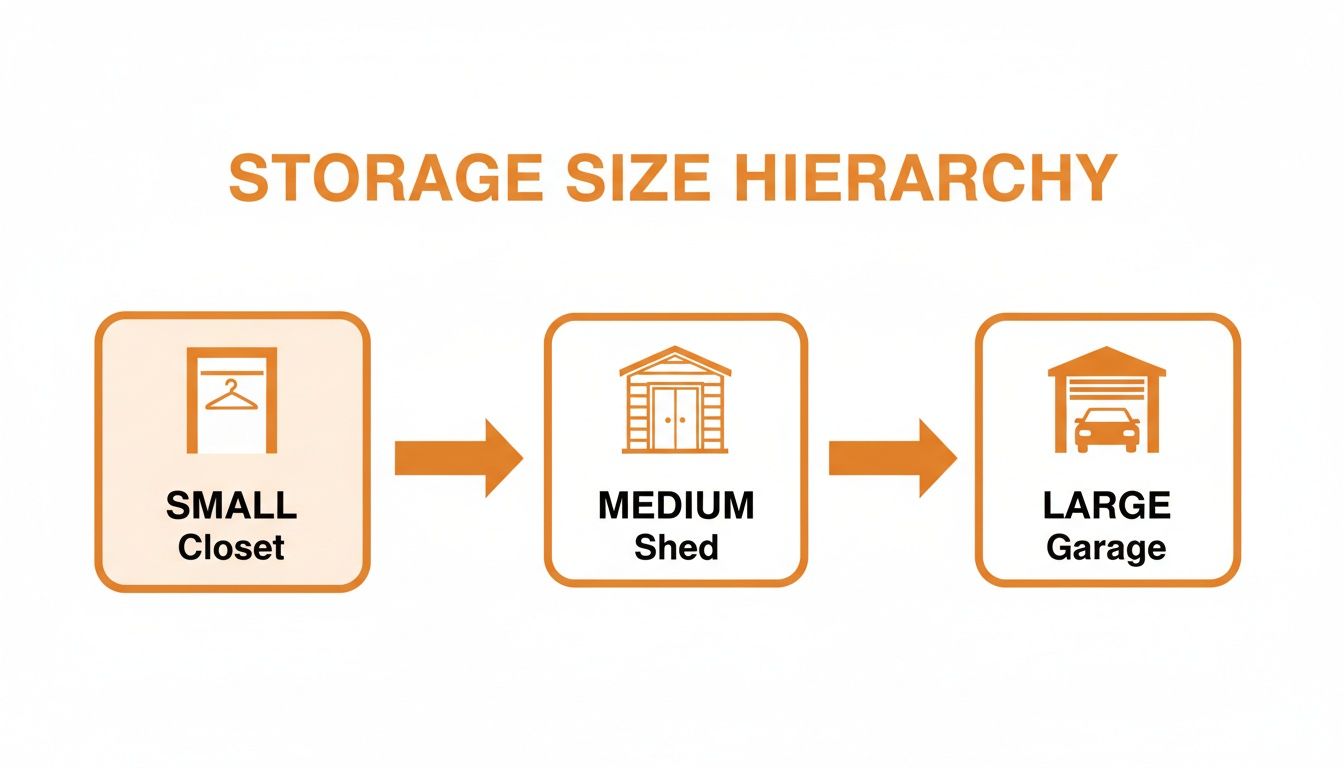
Each category—small, medium, and large—maps to a familiar space, which helps take the guesswork out of choosing the right unit.
The University Student Storing for Summer
Meet Chloe, a student at the University of Nottingham. She’s heading home for the summer and would rather not drag all her belongings across the country, only to bring them back again in a few months. She doesn’t have a house full of stuff, but it’s definitely more than what fits in the back of her parents' car.
Chloe needs somewhere secure and affordable that's just big enough for her essentials. A huge unit would be a waste of money, but a tiny locker might be too much of a squeeze.
- Recommended Unit Size: 35 sq ft (roughly 5×7 ft)
- Why It Works: This size is the sweet spot for student storage. It’s like a large walk-in wardrobe, offering plenty of room for everything from a typical dorm room without you having to pay for empty space.
- What She Stores:
- Single bed frame and mattress (stood on its side to save space)
- Desk and chair
- Mini-fridge and microwave
- Several boxes of books, clothes, and bedding
- A bicycle and a couple of suitcases
For students, the key is a smaller unit that’s well-organised. Chloe can easily stack her boxes, stand her mattress upright, and still have a bit of room to move around. It makes moving in and out quick, simple, and stress-free.
The Home Mover Preparing for a Sale
Now, let’s look at the Harrison family. They’re putting their 3-bedroom house in Long Eaton on the market. Their estate agent gave them a great piece of advice: declutter to make the space feel bigger and more appealing to potential buyers. That means temporarily storing bulky furniture, personal bits and pieces, and anything that makes the rooms feel cramped.
Their goal is to create that 'show home' feel, which involves storing about a third of their household contents for a few months. They need enough space to hold large items without having to play a frustrating game of Tetris every time they add something new.
- Recommended Unit Size: 150 sq ft (roughly 10×15 ft)
- Why It Works: This unit is about the size of a large single garage, giving them ample room for furniture from several rooms. Crucially, it allows them to leave an aisle down the middle for access. If they need to grab something, they can do it easily without unpacking the entire unit.
- What They Store:
- A three-seater sofa and two armchairs
- A spare double bed and other bedroom furniture
- Garden furniture and a barbecue
- Children's toys, cots, and out-of-season clothing
- Around 30-40 moving boxes filled with books, kitchenware, and personal effects
The Small Business Owner Managing Stock
Finally, meet David. He runs a growing e-commerce business from his home in Derby, but his spare room is overflowing with inventory. He needs a professional, accessible space to manage his stock more efficiently—a place where he can pick, pack, and ship orders without tripping over boxes.
For David, security and convenience are everything. He needs a unit that can function as a mini-warehouse, where he can install shelving and create a proper, organised system for his products.
- Recommended Unit Size: 100 sq ft (roughly 10×10 ft)
- Why It Works: A 100 sq ft unit strikes the perfect balance between space and cost for a small business. It’s large enough to hold a good amount of inventory and allows for shelving and even a small packing station. It’s a secure, scalable stockroom.
- What He Stores:
- Metal shelving units for organisation
- 50-70 boxes of product inventory
- Packing materials (boxes, tape, bubble wrap)
- A small desk and chair for admin tasks
- Archived business documents
With around 5,100 self-storage facilities, the UK is Europe's largest market. This means customers at Orange Box sites in Nottingham and Derby have fantastic access to sizes tailored for every need—from personal 35 sq ft spaces perfect for a bedsit's contents, to business-focused 100 sq ft units. Locally, we see smaller units (25-50 sq ft) making up about 45% of demand for decluttering, while tradespeople often go for 150+ sq ft containers for their tools and materials. You can dig into more data in the UK's self storage industry report for 2025.
How To Pack and Organise Your Unit Like a Pro

Picking out the perfect unit is a great first step. But the real magic happens when you start packing and organising. A cleverly organised unit does more than just protect your belongings; it turns a simple storage space into a functional, easy-to-use extension of your home or business.
Think of it like stocking a supermarket shelf. You don’t just throw everything in—you arrange it so you can grab what you need without causing an avalanche. With just a few proven strategies, you can make the most of every square inch and save yourself a ton of headaches later on.
Create Your Packing Blueprint
Before a single box goes into your unit, your success hinges on how well you prepare. The right materials and a clear plan will save you a world of frustration. It all begins with choosing your packing supplies wisely.
Here's one of the best tricks in the book: use uniform, high-quality boxes. It’s tempting to grab free boxes from local shops, but their mismatched shapes and sizes create wobbly, unstable stacks. Investing in same-sized boxes is a game-changer, allowing you to build solid vertical walls that use the full height of your unit safely and efficiently.
For a deeper dive into preparing your items for storage, check out these essential packing tips that cover everything from wrapping fragile items to protecting furniture.
Strategic Stacking and Aisle Creation
When you’re ready to start loading, think like a librarian organising shelves. Heavy items should always go on the bottom to create a sturdy base, preventing anything above from getting crushed. Lighter, more delicate items can then be placed safely on top.
But the single most important thing you can do is create a central aisle. Even if it means choosing a slightly larger unit, leaving a walkway from the door to the back wall is a game-changer. This simple path gives you access to everything without having to unpack half the unit just to reach a box tucked away at the back.
A well-planned unit should allow you to retrieve any item within minutes. If you have to move more than one or two things to get to what you need, it's a sign that your layout could be improved.
Label Everything and Map Your Space
Clear labelling is your best friend here. Be specific—instead of just writing "Kitchen," list the key contents like "Toaster, Blender, Cutlery." For extra credit, number each box and create a master inventory list that you can keep on your phone or taped just inside the unit door.
This simple system turns what could be a frustrating guessing game into a quick, precise operation. When you need that winter duvet or a specific folder of documents, you’ll know exactly which box to grab. Our guide with tips for packing when moving house has even more great advice on creating an efficient labelling system.
Here’s a quick checklist to get your unit organised like an expert:
- Disassemble Furniture: Take apart things like bed frames, tables, and shelving units. You’ll be amazed at how much space this saves. Just be sure to keep all the screws and small parts in a labelled bag taped securely to the main piece.
- Protect Your Valuables: Use bubble wrap, packing paper, or even old linens to cushion fragile items. Mirrors and artwork should be stored upright in specialty boxes or wrapped in blankets—never lay them flat.
- Maximise Vertical Space: Stand sofas and mattresses on their ends to free up precious floor space. Consider adding a sturdy shelving unit for smaller items or archive boxes to keep them organised and off the ground.
Choosing the Right Features for Your Belongings
Finding the perfect unit size is a huge step, but it’s only one part of the puzzle. The features of the facility itself are just as important for protecting your belongings and giving you genuine peace of mind.
Think of it this way: the unit is the house, but the security and accessibility features are the locks on the doors and the convenient driveway. At Orange Box Self Storage, we prioritise these details to act as a true partner in keeping your valuables safe.
Keeping Your Items Safe and Secure
The first thing on most people’s minds is security. You need to know that your items are protected around the clock, which is why we’ve invested in comprehensive measures that work together to create a secure environment.
These systems provide constant oversight, ensuring that only authorised individuals can access the facility.
- 24/7 CCTV Monitoring: Our high-definition cameras are always recording, covering key areas like entrances, exits, and hallways. This constant surveillance acts as a powerful deterrent and provides a complete record of all on-site activity.
- Secure Access Controls: You can’t just walk into our facilities. We use personalised access codes or key fobs, meaning only our customers can get past the gate. This system ensures that we know exactly who is coming and going at all times.
When to Choose Climate-Controlled Storage
Beyond security, the condition of the unit itself plays a vital role, especially for sensitive items. Standard units are perfect for many things, but some belongings can be damaged by the unpredictable British weather. This is where climate-controlled storage becomes essential.
These specialised units maintain a consistent temperature and humidity range, protecting your valuables from damp, extreme cold, or summer heat. You should strongly consider this option if you are storing:
- Wooden or Leather Furniture: Prevents warping, cracking, and mould.
- Electronics and Media: Protects delicate circuitry and stops moisture from ruining DVDs or vinyl records.
- Important Documents and Photos: Stops paper from becoming brittle or discoloured.
- Antiques and Artwork: Preserves the integrity of valuable and irreplaceable items.
If you're unsure whether your belongings need this extra layer of protection, you can learn more about the benefits of our climate-controlled storage units and see if it's the right choice for you.
A climate-controlled unit is like a museum archive for your personal treasures. It creates a stable environment that shields them from the elements, ensuring they come out in the exact same condition they went in.
Finally, think about how you’ll get to your items. For heavy furniture or bulky business stock, a ground-floor unit saves a lot of back-and-forth. If you need to load and unload frequently, a drive-up container offers unbeatable convenience, letting you park right at your door. Choosing the right features transforms a simple box into a solution that’s truly built around your needs.
Understanding Storage Costs and Finding the Best Value
Picking the right size unit is the biggest step you can take towards saving money, but it also helps to know how storage costs actually work. The price you pay isn't just a random number; it’s a clear reflection of the space and features you’ve chosen. This way, you only ever pay for what you genuinely need.
A few key things influence the monthly cost of a self storage unit. The most obvious is the size – bigger units naturally cost more than smaller ones. But the location of the facility also plays a part. Finally, special features like climate control will add to the price, but it’s often a worthwhile investment for protecting sensitive items.
What Determines Your Monthly Rate
Think of it like booking a hotel room: the size, location, and amenities all shape the final cost. A small locker is your budget-friendly option, while a large, climate-controlled unit is more like the premium suite, designed for your most valuable belongings.
At Orange Box Self Storage, we keep our rental contracts flexible to suit your timeline. Whether you just need a space for a single month during a house move or you’re after a long-term solution for business inventory, our terms are designed to match your needs without locking you into a lengthy commitment you don’t want.
How to Get the Best Value from Your Storage Unit
Getting the best value isn’t just about finding the lowest price—it's about finding the most cost-effective solution for you. One of the costliest mistakes people make is renting a unit that’s way too big. You literally end up paying for empty air every single month.
The goal is to rent the smallest unit that will comfortably and safely hold all your belongings. Overestimating how much space you need is the quickest way to overspend.
Another great way to get a better deal is to simply ask about discounts. Many facilities, including ours, might offer reduced rates for longer-term rentals or for paying for a few months in advance. It’s always worth enquiring, as a quick question could lead to some significant savings over time.
The UK self-storage market is pretty busy, with average occupancy hitting 75.1% and rental returns averaging £29.13 per sq ft. This financial reality means choosing a mismatched unit can easily lead to 20-30% higher costs for you. For instance, a 25 sq ft locker is perfect for a student’s holiday storage, but trying to cram a whole flat's contents in there is impossible. On the flip side, renting a huge 150 sq ft unit for just a few boxes is just wasteful.
By being a bit strategic, you can make an informed choice that fits your budget perfectly. For a more detailed breakdown, check out our guide on how much self storage costs in the UK to get an even clearer picture.
Got Questions? We’ve Got Answers
Even after going through a detailed guide, it’s natural to have a few more questions pop into your head. It happens all the time. This section is all about giving you quick, straightforward answers to the queries we hear most often from customers, so you can make your decision with complete confidence.
How Much Notice Do I Need to Give to Vacate?
One of the best things about modern self storage is the flexibility. Gone are the days of being locked into long, rigid contracts. Most facilities, including ours at Orange Box Self Storage, run on a monthly rolling basis.
This means you’re in control. While you should always double-check your rental agreement, the industry standard is usually a notice period of just 7 to 14 days before you plan to move out. No getting tied down for months on end.
Do I Need to Buy My Own Lock?
Yes, you’ll almost always need to bring your own padlock. This isn't just a quirk; it’s a crucial security feature. It guarantees that you are the only person with a key to your unit.
Think of it this way: not even our staff can get into your space without your permission. We recommend getting a good quality, weather-resistant disc lock or cylinder lock—it’s a small investment for total peace of mind.
Think of your lock as the final layer of personal security. While we provide 24/7 CCTV and secure gate access, your private lock ensures that your space remains exclusively yours.
Can I Change My Unit Size After I Move In?
Absolutely. Life happens, and storage needs can definitely change. You might sell off that big sofa you were storing, or maybe you underestimated just how many boxes you had.
If you find your unit isn't the right fit anymore—whether it's too big or too small—just have a chat with our on-site team. As long as we have another size available, we’re more than happy to help you move into a unit that better suits your needs. Our goal is simple: to make sure you’re only paying for the space you actually need.
Are There Any Items I Cannot Store?
Yes, for the safety of everyone at the facility, there are a few ground rules on what can be kept in a unit. These restrictions are pretty standard across the board and are there to protect you and your fellow storers.
Generally, you can't store:
- Hazardous Materials: Anything flammable, explosive, or toxic is a strict no-go. This includes things like petrol, chemicals, and fireworks.
- Perishable Goods: Food items that can spoil, rot, or attract pests are not allowed.
- Living Things: This one’s a given—no plants or animals.
- Illegal or Stolen Goods: It goes without saying that anything obtained illegally is prohibited.
This guide is here to get you started, but if any other questions come to mind, our team is always ready to help.
Ready to find the perfect space for your belongings? The team at Orange Box Self Storage is here to help you select the ideal unit and get you started. Book your secure storage unit online today