


You're probably standing in the kitchen looking at the fridge freezer and thinking a familiar thought. It's only one appliance. Empty it, wheel it out, job done.
That's where moves go wrong.
A fridge freezer is awkward, top-heavy, easy to mark, and expensive to damage. In UK homes, the problem gets worse because the route out rarely looks like the route in your head. There's a tight galley kitchen, a narrow hallway, a door that doesn't open fully, then a staircase that turns tighter than it should. If you're moving a newer eco model, the risk is greater again because modern compressors are less forgiving than many older units.
Why Moving a Fridge is a Serious Task
People underestimate moving a fridge freezer because it looks solid and simple. In practice, it's one of the easiest household appliances to damage during a move, and one of the easiest to hurt yourself with if you rush.
In the UK, fridge freezers account for nearly 25% of reported appliance-related damages or injuries, according to the British Association of Removers. The same source notes that improper handling leads to compressor oil displacement in 40% of cases, with repair costs of £200 to £500 per incident, and compressor failures rising by 35% post-move if the appliance isn't rested upright for 4 to 24 hours (British Association of Removers guidance).
That's the part many DIY movers miss. The danger isn't only dropping the appliance. It's also what happens after the move, when someone plugs it back in too soon and the fridge damages itself from the inside.
Practical rule: If you're asking how to move it quickly, you're asking the wrong question. Ask how to move it without tipping, scraping, leaking, or straining your back.
There's also the weight and shape to deal with. A fridge freezer doesn't carry like a washing basket or a chest of drawers. The bulk sits high, the grip points are poor, and the smooth finish makes it awkward to control once it starts shifting.
Treat it like a lifting and transport job, not a household chore. Plan the route. Prep the appliance. Use the right kit. Take longer than you think you need. That's what prevents the expensive mistake.
Phase One The Essential Preparation Checklist
Good moves start the day before, often earlier. If the fridge isn't properly prepared, you'll be fighting water, loose shelves, swinging doors and stale smells before you've even reached the front door.
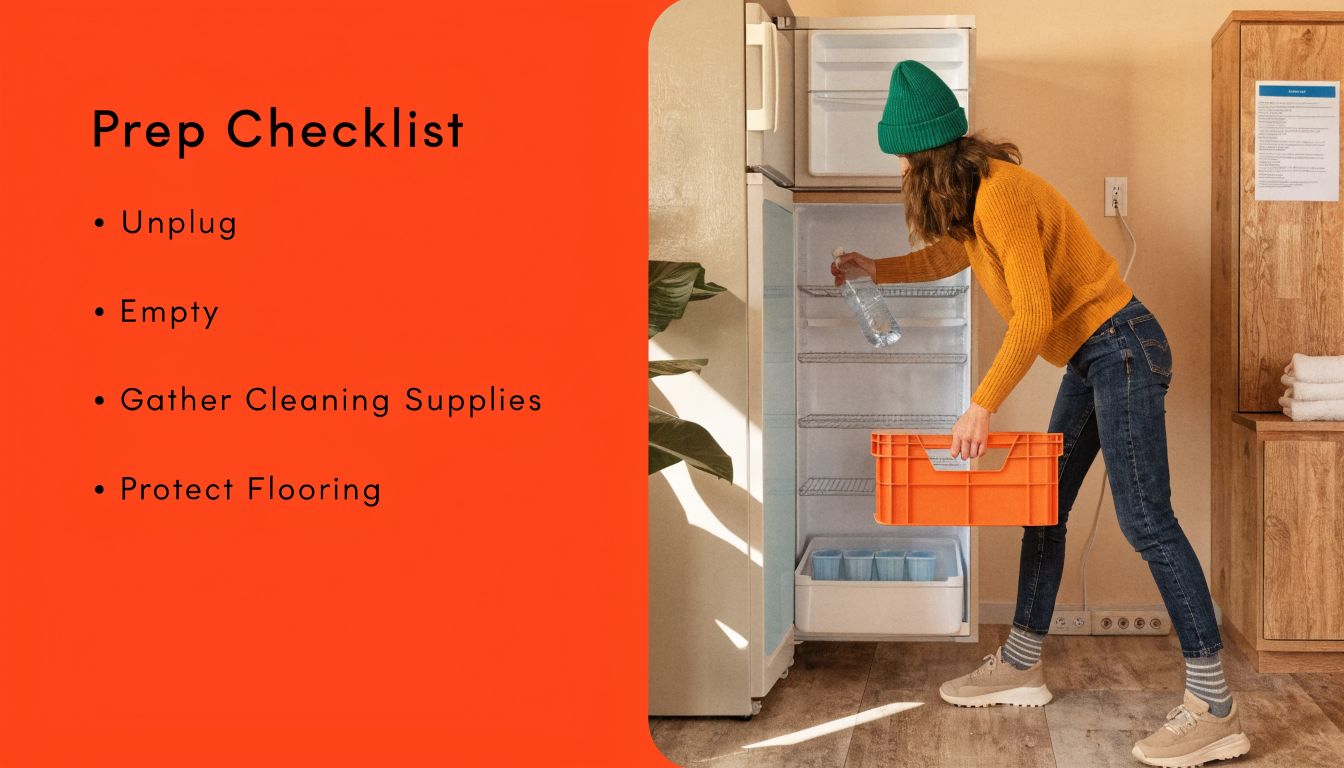
Empty it earlier than feels necessary
Start by taking everything out. Not just the obvious food, but the jars in the door, the ice trays, the bottle rack, the half-used sauces and the hidden bits at the back. A loaded fridge is harder to balance, and internal items shift when you tilt the appliance.
Use cool bags or a second fridge if you've got one. If you don't, plan your meals down in the days before the move so you're not trying to rescue a week's groceries at the last minute.
A simple written schedule helps. If you're coordinating a wider house move, a proper moving house checklist for the UK stops this sort of job being left until the night before.
Defrost and dry it properly
Defrosting isn't optional. For most fridge freezers, doing it 24 to 48 hours before the move is the safest approach. The reason is straightforward. Meltwater gets into seams, tray runners and door seals, then drips into the van or storage area later.
Use towels around the base and keep the doors open. Don't attack built-up ice with a knife or screwdriver. That's a quick way to puncture something you really don't want to puncture.
Once the ice has gone, wipe every surface dry. Pay extra attention to:
- Drawer channels because water hides in the runners
- Door seals because trapped moisture turns musty fast
- The drainage area where small amounts of water collect unnoticed
- Glass shelves which can stay slick even when they look dry
If you want a straightforward external checklist to compare against your own routine, this guide on moving a fridge in 8 steps is a useful reference.
Disconnect the extras
Water dispensers and ice makers catch people out. Turn off the water supply first, then disconnect the line carefully and have a towel ready underneath. Drain what you can. Don't leave a wet loose pipe swinging at the back.
Then unplug the power lead by gripping the plug, not yanking the cable. Coil the cord neatly and secure it to the rear of the appliance so it can't drag under a wheel or catch on a threshold.
Leave the doors open for a while after cleaning. A dry fridge is easier to move, and far less likely to smell foul when you open it again.
Secure everything that can move
Loose shelves and drawers should come out if possible. Wrap glass parts separately in blankets, towels or bubble wrap and box them. If some components stay inside, pad them so they can't rattle.
Use non-marking straps or soft ties to keep the fridge and freezer doors shut. Avoid aggressive tape directly on finished surfaces because some adhesives leave residue or pull at the coating.
A quick final check should cover these points:
- Interior emptied
- Freezer fully defrosted
- All surfaces dried
- Water line disconnected and drained
- Power cord secured
- Shelves and drawers removed or padded
- Doors fastened shut
That's the stage where the appliance stops being a kitchen item and becomes a move-ready load.
Gathering Your Gear and Crew
DIY moves usually split into two outcomes. One group hires or borrows the right kit and gets through the job with control. The other group tries to improvise with an ordinary sack truck, one friend, and a lot of optimism.
That second approach is where dents, leaks and strained backs come from.
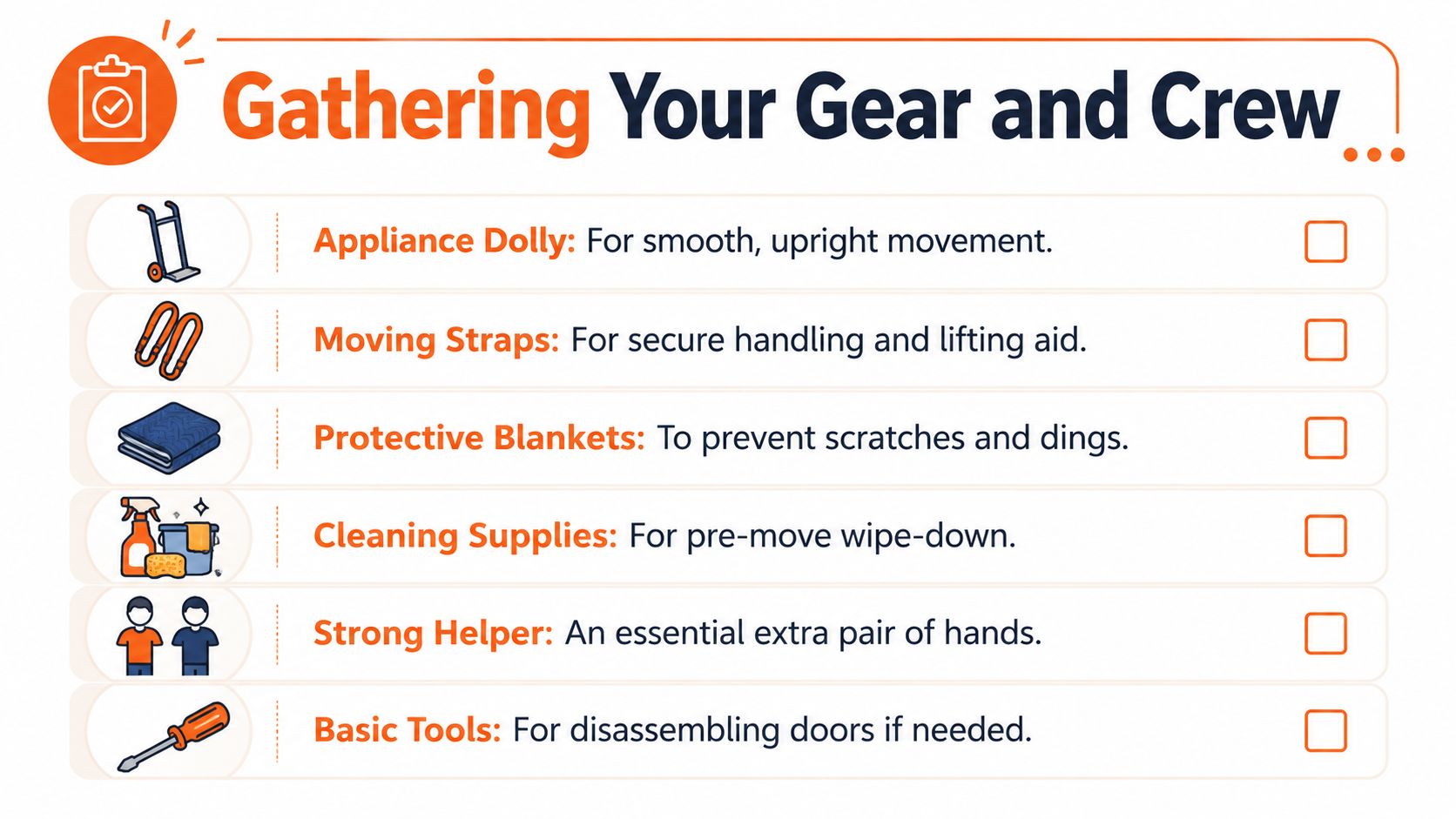
Using the proper gear matters. British Association of Removers guidance says using an appliance dolly and secure straps can reduce the risk of accidents and damage by as much as 75%, and 18% of UK moves involving fridge freezers result in dents or internal leaks. Those figures are especially relevant for the 27% of UK adults planning moves in 2026, as a projection cited in the same verified data. I'm keeping the BAR link earlier in this guide, but the point stands here too.
Measure before you lift
Measure the fridge freezer first. Then measure the route. That means:
- Appliance width, height and depth
- Doorways with the door open
- Hallway pinch points
- Stair width
- Low ceilings or awkward turns
- Van opening height
Don't guess. Use a tape measure. A Bosch laser measurer is handy if you've got one, but a standard tape is fine if you use it carefully.
For broader packing prep around the house, these packing tips when moving house help reduce clutter on the route before the appliance starts moving.
What you actually need
| Gear | Why it matters | What to avoid |
|---|---|---|
| Appliance dolly | Built for tall, heavy loads and keeping them controlled upright | A basic sack truck without proper support |
| Ratchet straps | Keeps the fridge fixed to the dolly body | Loose rope that shifts under tension |
| Moving blankets | Protects the finish, walls and bannisters | Thin bedsheets that slide off |
| Work gloves | Better grip and less chance of trapped fingers | Bare hands on smooth metal sides |
| Sturdy footwear | Protects feet if the load drops or rolls | Slippers, sandals, soft trainers |
| Basic tools | Needed if handles, doors or hinges must come off | Starting the move without checking fittings |
Don't do it alone
Two people is the minimum for a straightforward route. Three is better if there are stairs, tight turns or a heavy American-style model.
Give each person a job before you start. One controls the dolly. One spots corners, opens doors and watches clearances. A third person, if you have one, steadies from above or below on stairs. People get in trouble when everyone tries to do everything at once.
Good lifting teams don't rely on strength. They rely on clear roles and slow timing.
The Main Event Navigating Your Home
The hard part of moving a fridge freezer isn't lifting it off the kitchen floor. It's getting it through a British house without damaging the appliance, the walls, the stairs, or yourself.
Terraced and older homes are where generic advice falls apart. In some UK areas, terraced housing makes up 68% of homes, and these properties often have staircases less than 70cm wide. The UK Health & Safety Executive guidance in the verified data also notes that on very narrow stairs, a controlled sideways slide using blankets can reduce fall risks by 40% compared with using a dolly on a steep pitch (UK Health & Safety Executive).
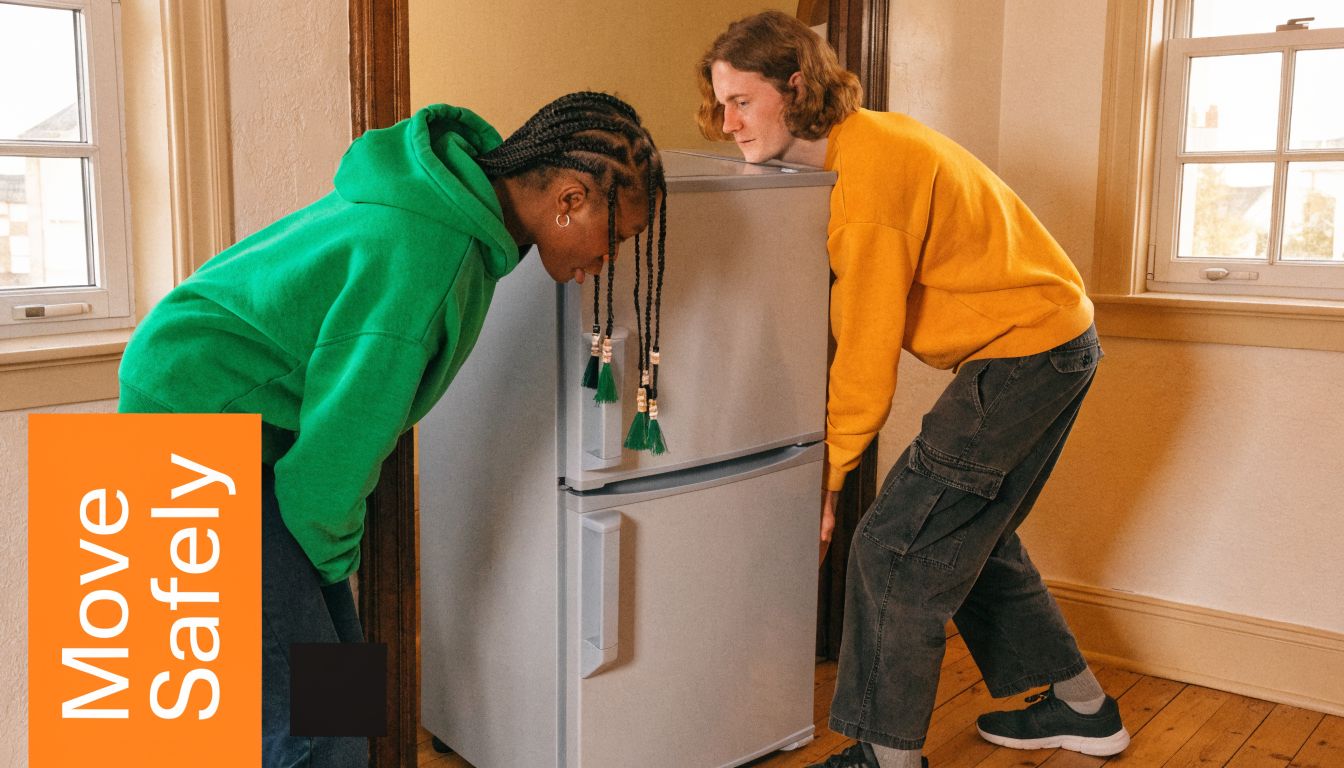
Getting it onto the dolly
Bring the appliance forward just enough to work safely. Protect the floor first with cardboard, hardboard, or proper floor protection if you've got delicate surfaces.
Position the appliance dolly against the side of the fridge freezer, not the front and not the back. Tilt the fridge slightly sideways only as much as needed, then slide the dolly's lip underneath. Strap it firmly so the body can't shift.
A few practical points matter here:
- Keep the straps around the main body, not over delicate trim
- Centre the weight over the wheels before moving
- Don't over-tilt to make it feel lighter
- Check the door side so hinges and handles aren't taking pressure
Through doorways and tight corners
This is where route planning pays off. Remove internal doors if the clearance is marginal. Sometimes taking a house door off its hinges saves far more trouble than trying to “just squeeze it through”.
For turns, think pivot, not shove. Move the bottom first in small increments while the spotter watches the top corners. If the fridge starts scraping one side, stop and reset. Forcing the angle usually creates a worse jam.
On narrow turns, the cleanest move is often slower and smaller. A rushed pivot is what gouges plaster and twists the load.
If handles are the widest point, remove them if the manufacturer allows it. Keep screws and fittings in a labelled bag. Don't trust memory after a long moving day.
Stairs in terraced houses
Steep stairs are the point where many DIY movers should reconsider whether they need professional help. If you are doing it yourself, slow and controlled beats strong and fast every time.
For standard stair use with a dolly:
- Position the main operator at the lower end to take the weight and control movement.
- Put the spotter at the upper end to steady and guide.
- Move one tread at a time.
- Pause briefly between steps so everyone resets grip and balance.
- Keep communication simple, such as “stop”, “down”, “hold”.
On very tight terraced stairs, a dolly can become more danger than help. In those cases, the controlled sideways slide method, with thick blankets protecting both the appliance and the staircase, can be the safer option. It's not elegant, but in narrow stairwells it often gives better contact and less chance of the load running away from you.
Common mistakes that make the job worse
These are the ones I'd watch for first:
- Tilting forward onto the fridge front instead of controlling the side load
- Trying to rush a landing turn with no one spotting the top edge
- Letting one person take too much weight rather than resetting the move
- Dragging it bare over flooring because “it's only a short distance”
- Leaving the route cluttered with shoes, boxes or doorstops
Moving a fridge freezer through a UK home is mostly a game of patience and geometry. Strength matters less than position, timing and control.
On The Road and After You Arrive
A lot of fridge damage happens after the house exit. The appliance gets into the van, everyone relaxes, and the most important handling rule gets ignored.
Keep it upright.
The verified manufacturer guidance says tilting a fridge freezer beyond 45 degrees causes compressor oil to migrate into the cooling system, which can lead to a 35% to 50% higher failure rate within 12 months post-move. After transport, the appliance should stand upright for at least 4 hours if kept vertical, or up to 24 hours if it was laid on its side for more than 30 minutes (Beko transport guidance).

Loading it into the van
Load the fridge freezer against a solid side wall of the van where you can strap it securely. Use moving blankets first, then straps to prevent sway. The goal is zero travel movement, not “that should probably hold”.
Don't stack boxes against the door side where they can shift and push into the appliance. Keep heavy items away from it. Fridge panels dent more easily than many people expect.
A good van loading check looks like this:
- Upright position maintained
- Strapped to anchor points
- Blankets between appliance and hard surfaces
- No loose items able to strike it
- Route for unloading kept clear
The waiting period matters
Once it's in place at the new property, resist the urge to plug it in straight away. Let it stand. This is the simplest part of the job, and one of the costliest to get wrong.
If the move involved heavy tilting, rough stairs, or any uncertainty about how upright it stayed, give it the longer rest time. There's no prize for reconnecting it fast.
If you're not sure whether it stayed upright enough, act as if it didn't. Waiting longer is cheaper than replacing a compressor.
Before switching it back on
Wipe the inside again if any moisture has appeared. Refit shelves and drawers only once the appliance is in its final position. Then check that doors open freely and seals sit cleanly.
If the room is cramped and you're still organising furniture, don't wedge the fridge into place too early. It's easier to settle large furniture first, especially if you're also trying to make a small room work. These MORALVE space-saving bedroom organization tips are aimed at bedrooms, but the layout thinking applies well when you're planning where bulky items should go in a tighter home.
If there's a gap between move-out and move-in, using short-term self storage can be a cleaner option than leaving the appliance in a damp garage or an overfilled van overnight.
Smart Storage For Your Fridge Freezer
Sometimes the smartest move isn't moving the fridge freezer all the way in one go. If keys are delayed, flooring isn't finished, or you're downsizing and sorting rooms in stages, storage can save a lot of trouble.
That matters even more with newer eco models. Verified data notes that eco-fridges with newer inverter compressors have seen a 15% market increase, that many now need a 24-hour upright settling period rather than the old 8-hour norm, and that climate-controlled storage units maintaining 15 to 25°C can prevent up to 90% of oil migration failures during extended storage periods (Defra organisation page).
Why a proper unit beats a garage or shed
A garage sounds convenient, but it often means temperature swings, damp, dust and awkward access. A shed is worse. If the appliance has just been moved, that's not the time to store it badly.
For storage, the basics are simple:
- Make sure it is fully dry
- Store it upright
- Leave the door slightly ajar
- Keep it protected from knocks
- Avoid unstable temperatures where possible
If you're comparing practical storage ideas during a move, these storage tips for Sydney movers are a decent reminder that the same principles apply whether you're between homes, renovating, or just trying to avoid a rushed setup.
When storage is the better call
Storage makes sense when the new property isn't ready, when a narrow access route means you need more time and fewer boxes in the way, or when you're juggling a larger move and need one less thing under your feet. It also helps if you're a student, renter or homeowner making a staged move rather than one clean same-day handover.
A fridge freezer is expensive enough that “temporary” shouldn't mean “left wherever it fits”.
Frequently Asked Fridge Moving Questions
Can you move a fridge freezer on its side
It's best avoided. If there is any way to keep it upright, do that instead. Side transport increases the risk of oil moving where it shouldn't, and modern units are not forgiving if you power them back up too soon.
How long should you defrost before moving
Give yourself enough time for full defrosting and drying. For most households, starting 24 to 48 hours before the move is the sensible window. The exact time depends on how much ice has built up and how quickly the unit dries out.
What's the biggest mistake people make
Plugging it in too soon after transport is high on the list. So is trying to move it with the wrong equipment. The move can appear successful, then the appliance fails later because it wasn't allowed to settle properly.
Should shelves and drawers stay inside
If they remove easily, take them out and wrap them separately. That reduces rattling, breakage and internal cracking. Heavy glass shelves can do a surprising amount of damage if left loose.
Is a normal sack truck good enough
Usually, no. A proper appliance dolly is the safer choice because it supports the height and shape of the load better and works properly with straps.
What about very narrow terraced stairs
If the stairs are especially tight, don't force a standard dolly method just because a generic online guide says to. Narrow UK staircases often need a more controlled approach, including protective blankets, slower repositioning, or in some cases professional help.
When should you stop and call movers
Stop if the route is too tight to control safely, if the load feels unstable, if anyone is overstraining, or if the stairs create a real risk of the appliance running away from you. Saving money on the move isn't worth an injury or a ruined fridge.
If you need breathing room during a move, Orange Box Self Storage offers secure storage across Nottingham, Derby, Long Eaton and Beeston, with flexible options for short-term and longer stays. It's a practical solution when your move dates don't line up cleanly, you need to clear space before navigating a bulky appliance, or you want to keep household items protected while you get the new place organised.