


You've finished exams, your tenancy is ending, and your room still contains everything you've accumulated since freshers' week. Bedding, pans, textbooks, winter coats, a desk chair you wish you'd never bought, and the electronics you definitely don't want to leave in a rushed pile on the pavement. That's the point where student storage between term times in Derby stops being a vague idea and becomes a practical fix.
The mistake most students make is waiting until the last few days. The second mistake is choosing on headline price alone. Storage can be straightforward and affordable, but only if you match the space to what you own, understand how access works, and book before the summer rush starts tightening availability.
Why Student Storage is Your End of Term Lifesaver
The end of term usually feels less like a clean finish and more like a compressed move. You've got check-out deadlines, travel plans, and a room that suddenly looks much fuller than it did when you moved in. For many students in Derby, the main problem isn't deciding whether to store things. It's figuring out how to do it without stress.
That's why storage has become a normal part of student life, not a last-resort option. In the UK, over 55% of college students use self-storage between term times according to Modern Storage Media's coverage of student self-storage demand. In a city like Derby, where student accommodation turns over quickly and term breaks interrupt housing plans, that makes complete sense.
What makes storage useful at term end
A good storage setup solves three practical problems at once:
- Space pressure: Student rooms rarely have enough room for everything across seasons.
- Travel plans: Going home, travelling, or starting a placement is much easier when you're not hauling everything with you.
- Security: Valuables are better in a proper unit than left in temporary accommodation, a friend's garage, or the boot of a car for days.
Practical rule: If you won't need an item during the break, don't move it twice. Store it once, properly.
Students often compare storage against taking everything home. Sometimes that works. Often it doesn't. If you're using trains, coaches, or lifts from friends, bulky items quickly become the problem. A mattress topper, kitchen kit, extra clothes, and academic materials don't seem like much until they all need to move on the same day.
A smarter way to handle the gap
Storage gives you breathing room. You can finish the term, clean your room, and leave knowing your belongings are in one place and ready for your return. If you're moving into a new flat next year, it also stops the awkward gap where your old tenancy ends before your new one starts.
If you're also setting up a new place after the break, the Quote My Wall tips for new homes are worth a look. It's a practical checklist for the things students and first-time renters often forget when moving into a fresh space.
Choosing the Right Storage Unit Not Just a Box
The biggest pricing trap in student storage is the small headline number. A per-box offer can look cheap at first glance, especially when you're scanning quickly on your phone. The problem is that most students aren't storing one box. They're storing the contents of a room.
According to Kit Keeper's Derby student storage page, some competitors advertise storage from £3 per month for a single box, but the average student volume is 10 to 15 boxes plus furniture for 70% of students moving out, and that's where people often underestimate costs by 30 to 40%. That's the primary budgeting problem.
Why per-box pricing often falls short
Per-box storage works best when you have a handful of small items and no urgency about access. It works less well when your list includes:
- Furniture: Desk chair, small table, shelves, mattress topper
- Bulky soft items: Duvet, pillows, winter clothes, laundry bags
- Kitchen equipment: Pots, pans, air fryer, plates, mugs
- Mixed essentials: Books, folders, shoes, sports kit, cables
Once collection fees, return fees, multiple boxes, and odd-shaped items enter the picture, the cheap headline can stop looking cheap.
One small quote for one small box doesn't tell you the cost of storing a student room.
Think in room volume, not item count
A better way to choose storage is to estimate the total volume of what you own. Stand in your room and split it into categories: stackable boxes, awkward furniture, fragile electronics, and soft goods. That gives you a more realistic starting point than counting cardboard boxes alone.
Here's a simple way to visualise it.
| Unit Size | Approx. Dimensions | What It Holds |
|---|---|---|
| Locker | Compact locker-sized space | A few boxes, bedding, small kitchen items, bags |
| Small unit | Walk-in personal storage unit | Several boxes, suitcases, clothing, small furniture |
| Medium unit | Larger walk-in unit | Typical room contents including boxes and furniture |
| Larger unit | Roomier unit for shared use | Full student room plus extra furniture or shared storage |
If you're unsure how unit sizes translate into real objects, this storage unit size guide is useful because it frames storage in terms of what people store rather than vague dimensions alone.
What works better in practice
A dedicated unit is usually clearer for students who want:
- One known price for one defined space
- Room for awkward items, not just neat boxes
- Direct access to their own belongings
- Less guesswork when budgeting
Orange Box Self Storage is one local option that offers student storage with flexible monthly terms in Derby, which suits the common term-break pattern better than services built around tiny starter prices.
Packing and Protecting Your Belongings
Packing well saves money, protects your things, and makes move-in week far less chaotic when you come back. Students usually focus on getting everything out quickly. The better approach is getting it out in a way that's easy to retrieve later.

Pack for retrieval, not just departure
Filling boxes is not the sole objective. The goal is to know where your essentials are when plans change.
Use this order:
- Start with the items you won't need first. Winter coats, spare bedding, extra books, and decorative items can be packed early.
- Keep one final-access bag aside. Chargers, travel documents, medication, a change of clothes, and toiletries should never disappear into storage by accident.
- Group by use, not by whatever is nearest. Kitchen items together, study materials together, clothes by season.
A box full of random items feels efficient on move-out day and becomes a nuisance when you need one cable or one folder later.
Protect the things students damage most often
The usual trouble spots are electronics, glassware, and overpacked boxes.
- Electronics: Use original boxes if you still have them. If not, wrap devices well and keep cables in labelled bags.
- Books and notes: Small boxes are better. Heavy boxes split.
- Plates and mugs: Wrap individually and fill gaps so nothing shifts.
- Soft furnishings: Vacuum bags can save space, but don't crush delicate fabrics or anything that might trap moisture.
Label the top and at least one side of every box. When boxes are stacked, front-facing labels are what you'll actually see.
A simple phone note or spreadsheet inventory helps more than people expect. Box 1 might be “Kitchen”, but “Kitchen” is still too broad if you come back needing one pan and your tenancy starts the next morning.
A packing checklist that actually helps
- Use sturdy boxes: Supermarket boxes are tempting, but they're often weakened already.
- Tape the bottom twice: Especially for books and kitchenware.
- Don't leave air gaps: Empty space leads to crushed contents.
- Wrap furniture edges: Chairs, mirrors, and desk parts scratch easily.
- Keep documents separate: Passport copies, tenancy papers, and university paperwork should stay with you.
If you want a practical refresher before move-out day, these packing tips for moving house are directly useful for students too. The same packing mistakes show up in term-end moves as in full house moves.
Budgeting and Booking Your Student Storage in Derby
Students usually ask the same question first. How much is this going to cost me? The honest answer depends on size, timing, and what service model you choose. The useful answer starts with a realistic benchmark and then strips out the common surprises.
According to Stop and Stor's guide to self-storage for students, the average monthly cost for student storage in the UK ranges from £50 to £100, and the average price in accessible markets has dropped by 24% since 2023, from £99 to £75. That's helpful context because it shows student storage can sit within a manageable budget if the quote is transparent from the start.
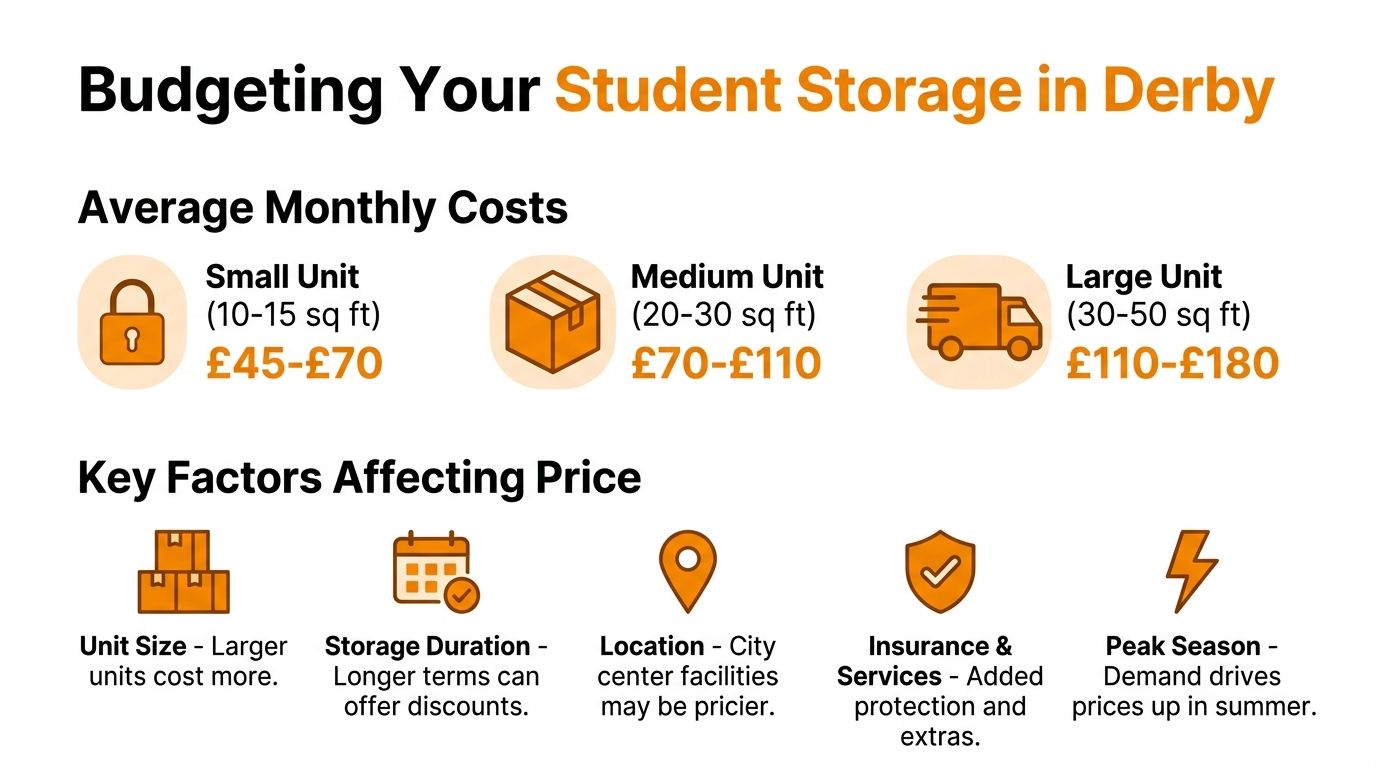
What changes the final price
The number you pay usually comes down to a few practical variables:
- Unit size: More space costs more, but too little space can force you into awkward add-ons.
- Storage duration: Short term and flexible monthly options suit many students, but always check what happens if you need to extend.
- Location: Convenience matters. A slightly cheaper unit farther away may cost more in transport and time.
- Insurance and extras: Protective cover, collection, packaging materials, and lock requirements all affect the total.
- Seasonal demand: Derby follows the wider student move cycle, so earlier booking usually means a calmer choice of unit.
Budget for the whole job
Students often budget for storage but forget the move itself. Make a list that includes:
- The unit
- Any move-in transport
- Packing materials
- Insurance if required
- Possible return trip costs
That's where transparent quotes matter most. If you're comparing offers in Derby, use total cost over the full break, not the cheapest opening figure on the advert. If one provider gives you a clean monthly unit price and another gives a very low starter number with unclear service charges, the cleaner quote is often easier to trust.
A simple way to stay organised is to book your moving help and timing in advance too. If you're coordinating friends, a driver, or a hired van, a tool with 24/7 moving appointment booking can make the scheduling side less messy.
Booking before everyone else does
The busiest period is predictable. Students leave around the same time, so the best units don't stay available forever. If you know your tenancy end date, don't wait for revision season to pass before sorting storage.
This cheap storage units in Derby guide is useful when you're comparing affordability by unit type rather than by marketing headline. That's the right way to approach budgeting for student storage between term times in Derby.
Transport Access and Security Considerations
Storage only works if you can get your things there without turning move-out day into a crisis. The right transport option depends on how much you own, how far you're travelling, and whether you've got help.

Comparing your transport options
Friend's car works well for a light load. A few boxes, bedding, and bags are manageable, but once furniture enters the plan, the car fills fast.
Taxi or ride-share can help in a pinch for central Derby moves, though it's rarely ideal for multiple trips or bulky items. You'll also want to be clear with the driver about luggage volume.
Small van hire usually makes the most sense for full-room moves. One trip is often easier than trying to save money through three stressful partial runs.
The access question students forget to ask
A lot of storage decisions get made around price and location. The question that matters just as much is simpler: if your plans change, can you get to your things without hassle?
According to Unimove's Derby student summer storage page, 15% of students encounter unexpected delays, yet many guides still don't explain emergency access or the cost of urgent retrieval clearly. That matters for students on placements, gap years, or study-abroad routes where dates can shift suddenly.
If you might need something back at short notice, ask about access before you sign, not after.
What to check before committing
Ask these directly:
- Access hours: Can you get in at times that match real student schedules?
- Retrieval process: Is it simple to collect items mid-term if needed?
- Security setup: CCTV, access control, locks, and monitored entry all matter.
- Contract flexibility: If your course dates move, can you extend without drama?
Security shouldn't be treated as a luxury extra. You're often storing laptops, documents, sentimental items, and furniture you'll need again. A proper facility with monitored access, clear entry procedures, and solid site security is worth prioritising over a vague bargain.
Your Derby Student Storage Questions Answered
Can I extend my storage if my plans change
Usually, yes, but the important part is how that extension works. Monthly flexibility is far easier to live with than a rigid fixed period if you're waiting on accommodation dates, travel changes, or course decisions. Ask how much notice is needed and whether your access stays the same during any extension.
Is it worth sharing a unit with a friend
Sometimes. Sharing can reduce individual cost if both of you are organised and trust each other. It works best when you list who owns what, agree how the bill is split, and make sure both people can access the unit if needed.
It works badly when one person needs frequent access and the other wants everything stacked floor to ceiling for maximum space.
What should I never put into storage
Rules vary by facility, but common prohibited items include hazardous materials, anything flammable, perishables, and illegal goods. If you're unsure about a specific item, ask before move-in day. Don't assume a storage unit is a place for paint tins, gas canisters, or food left over from halls.
How do I make retrieval easier when I come back
Keep the unit ordered from day one. Put the boxes you're most likely to need near the front, leave a small walkway if possible, and keep your inventory on your phone. Retrieval gets awkward when everything is packed as one dense wall.
What's the best booking habit for students
Book as soon as your move-out date is confirmed, then pack in stages. Last-minute bookings reduce your options, and last-minute packing is when breakages and missing items happen.
How do I claim a student discount
The simplest approach is to ask directly when requesting your quote or booking your unit. Have your student ID or university email ready so the provider can confirm eligibility quickly. If there's a student rate, it's usually easier to secure it upfront than to ask for it after the booking is already in place.
If you need a straightforward option for Orange Box Self Storage, check the Derby location, compare unit sizes against what you own, and ask for the total cost based on your full room volume rather than a teaser price. That gives you a clearer budget, more predictable access, and a much easier end-of-term move.