


The back room is full, the next delivery is due, and your best-selling Christmas lines are still arriving before the autumn rush has properly started. In Beeston, that creates a familiar operational mess. Staff move cartons to the shop floor, display furniture blocks access to everyday stock, and summer leftovers compete with new seasonal lines for the same limited space.
Storage for seasonal business stock in Beeston only works when it follows the retail calendar. You need the right capacity, access, security and stock rotation plan before the peak arrives, not a last-minute unit when every nearby facility is busy. This guide gives you a practical system for staging inbound stock, protecting sensitive goods and handling the returns wave after Christmas.
Why Seasonal Stock Is a Different Storage Problem in Beeston
Seasonal inventory creates pressure because it arrives in batches, sells in uneven bursts and often needs to move again quickly. A Beeston retailer may be clearing summer products while preparing for back-to-school demand, autumn promotions, Black Friday and Christmas. Those peaks can overlap, leaving the shop's back room acting as a receiving bay, picking area and returns department at the same time.
That makes seasonal stock different from archived paperwork or spare office furniture. You may be storing mixed-SKU cartons, fragile giftware, oversized point-of-sale props, candles, cosmetics, clothing, toys or equipment used only for a particular campaign. Each category has a different handling risk, retrieval frequency and environmental requirement.
Operational rule: Store stock by retrieval priority, not simply by arrival date.
The logistics context around Beeston supports this need for flexible capacity. A 2022 logistics study for the Nottingham Core and Outer HMAs reported that logistics space represented 70% of overall industrial stock in Nottinghamshire, with market activity that included a 31% increase in annual take-up in one recent year and an average delivery figure of 37,200 square feet. Those figures come from the Nottinghamshire logistics study.pdf), and they show why local businesses can use a wider commercial storage network rather than forcing every carton into a retail back room.
Why a normal domestic unit often fails
A basic household unit may give you floor space, but it won't automatically give you a workable stockroom. If boxes are stacked without zones, your team must unload half the unit to reach a single SKU. That wastes time precisely when staff should be serving customers and fulfilling orders.
Domestic-style storage also tends to be a poor fit for pallets, display plinths and bulky seasonal equipment. Before booking, check whether the facility offers ground-floor loading, suitable vehicle access, long enough opening hours and a layout that permits a clear retrieval aisle.
Plan around the full peak cycle
Don't treat Christmas as one isolated event. Black Friday creates an early sales surge, Christmas trading brings a different mix of gift and seasonal products, and January adds clearance work and returns. The right unit supports all three stages, including the awkward stock that remains after the main promotion has ended.
Your decision should answer four questions:
- Which items arrive first?
- Which SKUs must be reachable every day?
- Which products can remain sealed until collection or dispatch?
- Where will returns sit while saleable stock is checked?
A storage unit is useful only when it behaves like an organised extension of your operation.
Sizing Up Your Seasonal Stock Storage Needs
Start with a stocktake, not a unit size. Write down every SKU group, carton count, pallet footprint, display item and handling restriction. Then separate stock that needs frequent picking from stock that can stay sealed until the main seasonal launch.
Take a fictional Beeston gift shop preparing 180 Christmas SKUs alongside summer leftovers. The owner first records each product family, then measures the cartons rather than relying on supplier descriptions. Fragile ceramics go into one group, boxed decorations into another, and bulky display furniture gets its own measurement because it consumes useful access space even when it holds no saleable stock.
A practical sizing audit
Use this sequence during a stocktake morning:
- List the inventory: Record SKU group, carton count, pallet count and expected dispatch date.
- Measure the footprint: Note length and width for pallets, cartons, shelving and props.
- Mark handling needs: Separate fragile, moisture-sensitive, high-value and bulky items.
- Assign retrieval frequency: Put daily-pick lines near the entrance and reserve stock further back.
- Add circulation space: Allow a rotation and aisle buffer rather than filling every available corner.
- Check the peak date: Include inbound stock, clearance stock and expected returns at the same time.
The plan notes suggest a 20% aisle and rotation buffer, but this is a planning allowance, not a verified industry statistic. Use it as a disciplined starting point, then test the layout with actual cartons. A unit that fits on paper may still fail if staff can't turn a trolley or reach the rear stack.
For a small Etsy-style retailer holding compact, sealed products, a 40 square foot unit may be enough if cartons are uniform and picking is infrequent. A shop storing display furniture, freestanding signage or irregular packaging should look at a larger space, often around 100 to 150 square feet, because the access requirement matters as much as the stock volume.
Don't use invented pallet conversion rules or guessed carton capacities. Operators measure units differently, and packaging varies too widely for a universal square-metre conversion to be reliable. Ask the facility to test-fit your pallet dimensions and bring a sample carton list to the viewing.
Seasonal storage sizing reference
| Stock Volume | Recommended Unit Size | Typical Beeston Business |
|---|---|---|
| Compact cartons, limited display material and low-frequency picking | Around 40 sq ft | Small online seller or Etsy-style retailer |
| Mixed cartons with a dedicated retrieval aisle | Around 60 to 80 sq ft | Independent gift shop or boutique |
| Mixed-SKU stock plus shelving, props or display furniture | Around 100 to 150 sq ft | High Street retailer or event-focused seller |
| Palletised overflow and bulky seasonal equipment | Assessed by pallet footprint and vehicle access | Garden, leisure, trade or larger retail operation |
For a fuller business-storage comparison before you request a quote, review business storage options from Orange Box Self Storage. Treat the online size guide as a starting point, then confirm the layout in person.
Photocopy this checklist and use it during the audit:
- SKU group and product description
- Number of cartons or pallets
- Carton and pallet dimensions
- Fragile or moisture-sensitive status
- Expected first retrieval date
- Expected clearance or return date
- Required aisle and loading space
- Preferred unit floor and access type
- Insurance documentation required
- Named person responsible for stock control
Choosing the Right Unit Type and Security Features
Choose the unit around the stock, not the advertised price. A drive-up ground-floor unit is the clear choice for palletised cartons, festive props and heavy display furniture. You can move goods directly from a van to the door, which reduces handling and makes collection days faster.
An upper-floor unit can suit a smaller retailer with lightweight cartons and occasional access. It may be practical when the facility provides reliable lift access, but it becomes frustrating if staff need to move bulky stock repeatedly during November and December.
Containerised outdoor storage has a different advantage. Garden centres, businesses holding bulky seasonal equipment benefit from direct vehicle access and a generous floor layout. It isn't the right place for stock that needs close humidity or temperature control unless the operator can demonstrate suitable conditions.
Match features to the stock category
- Festive props and palletised cartons: Prioritise ground-floor, drive-up access and a wide loading approach.
- Giftware and fragile products: Choose a dry indoor unit with shelving or enough room for stable, low-level stacking.
- Candles, cosmetics, chocolate and leather goods: Pay for climate control where the operator can document the conditions.
- Sealed plastic goods: Avoid paying for climate control if the products aren't sensitive to ordinary indoor conditions.
- High-value electronics: Require controlled entry, monitored CCTV and clear access records.
Security isn't an optional add-on for valuable seasonal inventory. 24/7 CCTV, individual PIN or keypad access and on-site management should be your baseline. Biometric entry and dedicated intruder alarms can justify their cost for unusually valuable stock, but they're not automatically necessary for ordinary sealed retail cartons.
A useful technical reference is this warehouse security systems guide by Wisenet Security Ltd, particularly when you're comparing access control, surveillance and alarm arrangements.
Climate control deserves a measured decision. It matters for materials that can degrade with moisture or temperature changes, but it adds little value to durable, sealed plastic stock. For sensitive ranges, compare the facility's actual controls rather than accepting the label alone. You can review climate-controlled storage units when candles, paper packaging, cosmetics or leather form a meaningful part of the seasonal range.
Packing and Preparing Stock for the Storage Period
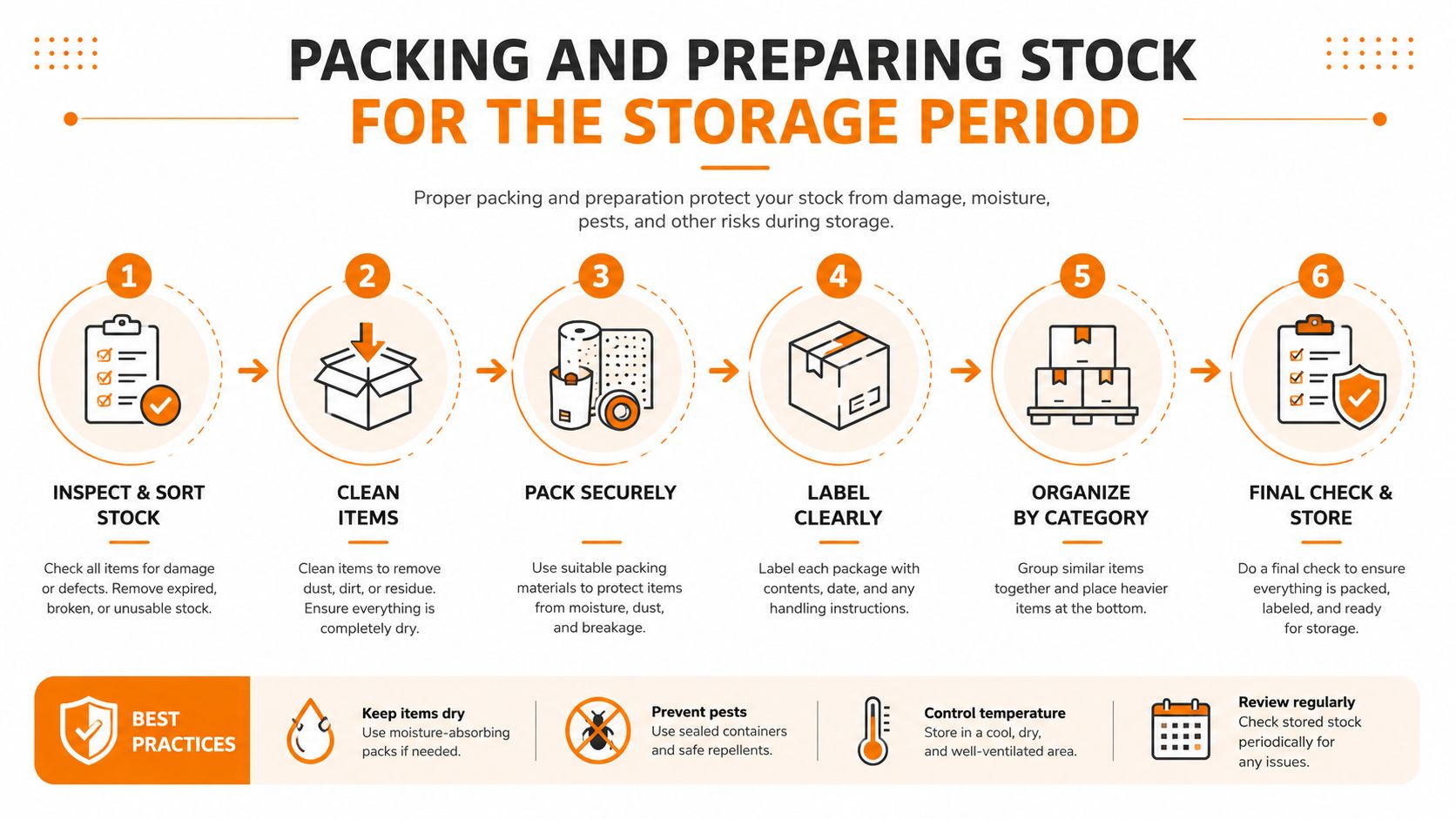
Brief the person packing the unit as if they're joining your warehouse team for the first time. The sequence matters because a dusty carton, missing photograph or vague label creates a retrieval problem later.
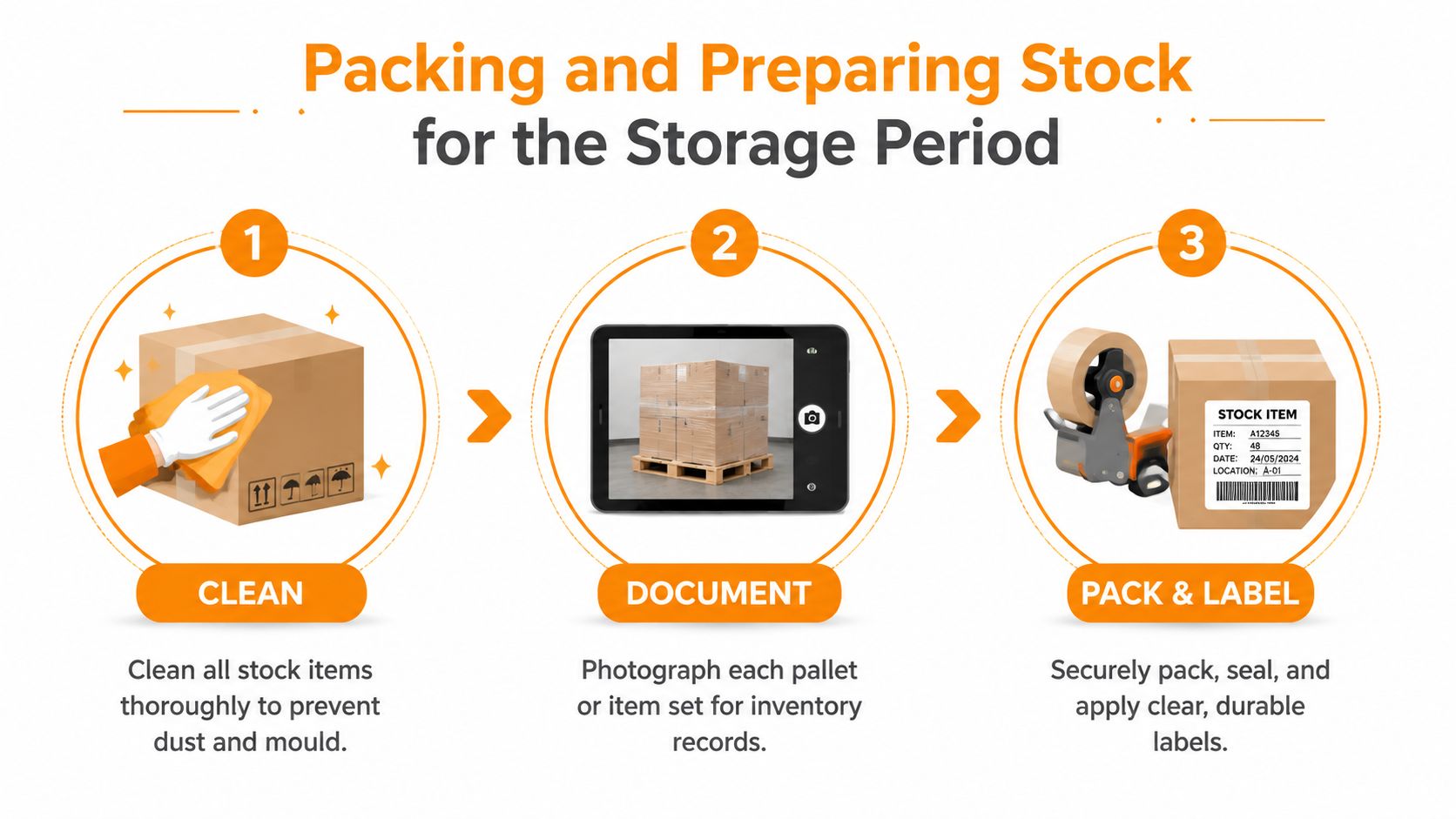
Start by cleaning stock and packaging surfaces. Remove loose dust, check for existing moisture and reject damaged cartons before they enter storage. The Red Cross warehouse guidance recommends fitting hygrometers, recording humidity daily and using temperature-recording devices, especially during rainy periods. Build those checks into the routine for sensitive seasonal lines.
Use this packing sequence
- Clean and inspect: Wipe products and cartons, then isolate anything damp, stained or damaged.
- Record the load: Photograph each pallet or shelf-load for insurance and inventory records. Include the label in the photograph where possible.
- Segregate valuable stock: Place high-value items in sealed crates and record the SKU range on the outside.
- Protect vulnerable materials: Use acid-free tissue for printed apparel and silica gel sachets for electronics or cosmetics.
- Seal properly: Use pallet wrap around complete pallet loads to keep dust out. Don't wrap every carton individually in cling film, because trapped condensation can create a problem.
- Label two sides: Put SKU group, carton count, handling warning and retrieval priority on at least two visible sides.
- Stack conservatively: Keep cardboard boxes no more than five high on standard pallets, unless the packaging and operator's handling guidance allow a different arrangement.
For a short seasonal let, cardboard is usually more practical than sealed plastic bins for ordinary dry goods. Cardboard can breathe, which helps reduce condensation risk in an unheated facility during a damp winter. Use plastic crates for vulnerable or high-value products, not as a default for every carton.
Retrieval rule: The label must tell a new member of staff what the box contains without opening it.
The UK fire guidance for factories and warehouses also warns that seasonal peaks such as Christmas require extra storage capacity and tighter monitoring. Follow the UK warehouse fire-safety guidance by reducing combustible stock in open areas, using a fire-separated storeroom or detached storage area where appropriate, keeping separation between stacks and maintaining controlled access routes.
Managing Costs and Avoiding Hidden Storage Fees
The headline rent isn't the whole cost. Ask for a written quote that separates the base unit price from insurance, deposit, administration, lock charges, payment penalties and any fee for changing unit size during the let.
Operators may include insurance in the monthly price, while others require you to provide separate evidence of cover. Don't assume your business policy automatically protects stock away from your premises. Confirm the position before the move, especially if the goods are imported, consignment-held or unusually valuable.
What to challenge before signing
- Base rent: Confirm whether the quote is monthly, pro-rated or subject to a minimum term.
- Insurance: Ask what cover is included and whether the declared stock value matches your inventory.
- Deposit: Check the amount, refund conditions and timing.
- Access charges: Establish whether extended or 24-hour access costs extra.
- Unit changes: Ask about availability and fees if inbound stock exceeds the forecast.
- Payment penalties: Confirm late-payment charges and notice requirements.
- Lock and administration costs: Request every mandatory charge in writing.
I would pay for extended access during the busiest trading period if your team restocks early or late. I wouldn't pay for climate control for sealed plastic goods, and I wouldn't automatically buy a premium insurance upgrade for ordinary low-risk inventory without comparing the exclusions.
The UK self-storage market reached 67.5 million square feet of total floorspace after stock grew by 5% over the previous year, according to the UK Self-Storage Annual Report. The same source reports occupancy around 74.5%, so space can become harder to secure during demand spikes. Book ahead, but don't rent a larger unit indefinitely just to avoid a short-term capacity issue.
Seasonal storage cost breakdown per 10 sq ft unit
| Cost Line | Typical Beeston Price | Worth Paying? |
|---|---|---|
| Base rent | Request a written operator quote | Yes, compare like for like |
| Included insurance | Confirm limits and exclusions | Usually, if adequate |
| Deposit | Confirm before signing | A normal contract condition |
| Administration or lock fee | Ask for the full amount upfront | Avoid surprises |
| Extended access | Facility-specific | Worth it during peak trading if used |
| Climate control | Facility-specific | Only for sensitive stock |
| Unit change fee | Confirm the operator's policy | Avoid frequent mid-let changes |
Don't set an invented universal price-per-pallet target. Use the operator's quote to calculate your actual monthly cost per pallet, then compare it with the cost of blocked retail space, rushed transport and lost selling capacity. Clear slow-moving seasonal stock by February where possible. Paying to preserve leftovers that no longer justify shelf space is poor stock control.
Transport, Insurance and Access Logistics
Transport, insurance and access must be planned as one move. Start with the storage facility, not the van. Confirm opening hours, loading-bay height, turning space, lift limits and whether pallet trucks or forklifts are available.
If the stock is palletised, book a vehicle with a tail-lift only after checking that the receiving site can handle the load. For cartons and shelving, a standard van may work, but you still need to measure the loading route and protect fragile goods from movement.
Reverse-plan the move
- Confirm the facility first: Record access hours, gate process, loading arrangements and any Beeston traffic constraints.
- Book the vehicle second: Match the van to pallet dimensions, carton volume and loading equipment.
- Pack and document third: Allow 48 hours for photographs, inventory records and insurance paperwork before move-in.
- Schedule the move last: Choose a collection window that leaves time to inspect the unit before loading.
Read the policy wording, not just the cover summary. Good operator-arranged protection should address risks such as theft, fire and water damage, while exclusions may include vermin, deterioration caused by ambient temperatures and damage to perishables. Confirm whether replacement is new-for-old, whether stock is covered at cost or selling value, and whether individual high-value items need to be declared.
For a structured approach to finding warehouse insurance coverage, compare the storage operator's policy with your existing business cover. Then check the specific insurance terms for contents in a storage unit before you sign.
Access determines whether the unit helps or hinders the shop. Drive-up space suits forklift transfers and heavy props. Upper floors work for light cartons when the lift is dependable. PIN-controlled entry is valuable when staff need early-morning or late-evening access during peak trading, but give codes only to named team members and remove access when roles change.
Book transport two weeks before the storage date. Never leave a palletised seasonal move until the day before.
Your Seasonal Storage Action Plan
Use this as the working calendar for your Beeston stock move. Assign one person to each deliverable and record the decision in your inventory system.
- 10 weeks before peak: The stock controller audits SKU groups, expected inbound volume and returns capacity.
- 8 weeks before peak: The owner confirms unit size, floor level, loading method and access hours.
- 6 weeks before peak: The warehouse lead packs, cleans, labels and zones stock by retrieval priority.
- 4 weeks before peak: The buyer checks sensitive lines and confirms whether climate-controlled space is required.
- 2 weeks before move-in: The operations lead photographs inventory, confirms insurance and books transport.
- Collection week: The driver and stock controller verify carton counts, loading access and the unit condition.
- During peak trading: Staff log withdrawals, keep aisles clear and return unused stock to its assigned zone.
- After January returns: The returns lead separates saleable, damaged, clearance and supplier-return stock before renewing space.
Check any site-specific issue before booking, including vehicle approach, loading arrangements and flood exposure near low-lying or Trent-side routes. The objective is a clean handover, not merely a full unit.
UK e-commerce demand can change the stock mix quickly. Q2 2025 order volumes grew 18% year over year, with garden and outdoor products up 48%, homewares up 46%, fashion and toys up 33%, and sports equipment up 31%, according to UK e-commerce data reported by PowerCommerce. The same source also reports that 27% of storage renters use storage for business purposes and that small firms represent 61% of business-storage customers, so review your category mix rather than assuming Christmas gifts are the only pressure point.
Use the peak-season calendar as your deadline. UK guidance for the 2025 peak season recommends completing final inventory moves by early October because cross-border redistributions can take 4 to 6 weeks, while Black Friday through New Year now contains several micro-peaks rather than one Christmas event. Book a Beeston walkthrough with Orange Box Self Storage before October, bring your carton list, and secure a short seasonal arrangement that matches the stock you need to move.
Orange Box Self Storage offers flexible business units, seasonal storage and container options in Beeston, with access controls and monitored facilities suited to staged inventory. Visit Orange Box Self Storage to discuss your stock mix, inspect the available space and book a walkthrough before your peak-season move.