

You're probably reading this because your spare room has stopped being spare, your move date has shifted, your business stock has spilled into the hallway, or you've realised that “just for a few months” is likely to turn into a year or more.
That changes the decision.
Short-term storage is mostly about finding space. Long term storage units are about protecting value over time. A unit that works for six weeks can be the wrong unit for eighteen months if it's too damp, too cramped, too awkward to access, or tied to a price that stops making sense after the promotion ends.
The people who do best with long-term storage usually get four things right early: size, environment, security, and contract terms. Get those right and storage feels simple. Get them wrong and you pay for it in damaged belongings, wasted rent, or avoidable hassle.
What Are Long Term Storage Units and Who Needs Them
Long term storage units are rented spaces used for months or years rather than days or weeks. People use them when life or business no longer fits neatly inside one property. That might mean a family moving abroad, a couple downsizing but not ready to part with furniture, a student leaving halls between terms, or a small business holding stock and records off-site.
The big difference from temporary storage is what matters most. For short use, convenience often wins. For long use, preservation, predictable access, and contract stability matter more.
The UK market is large enough now that this isn't a fringe service. The country had around 2,076 self-storage facilities in 2024, offering roughly 63.5 million square feet of space, with sector turnover of about £1.2 billion, according to UK self-storage market data. That matters because it tells you long-term storage is a mainstream solution for households and businesses, not a stopgap idea.
Who usually benefits most
Some storage decisions are obvious. Others only become obvious after your home or workplace starts to feel unmanageable.
- Households in transition: moving, renovating, downsizing, dealing with probate, or clearing space for a new baby
- Students and graduates: summer breaks, placement years, study abroad, or post-tenancy gaps
- Small firms and trades: overflow stock, archived files, tools, marketing materials, and seasonal equipment
- People between properties: chain delays, temporary lets, or a long wait for completion
Practical rule: If you won't need regular hands-on access and replacing the items would be expensive, long-term storage is usually a better option than keeping everything in a loft, garage, or damp outbuilding.
If you're comparing providers and want to see how moving and storage can be coordinated in one place, TLC Moving storage solutions are a useful example of how some operators package the service around real-life transitions rather than just empty units.
Selecting Your Unit Size and Format
People usually make one of two mistakes. They rent too small and pack the unit like a rubbish skip. Or they rent too large and pay for empty air month after month.
A good storage unit should feel like a well-organised garage, not a game of furniture Tetris. You need room to stack safely, leave some airflow, and reach the items you may need later.
Think in floor space first
For long stays, usable floor space matters more than optimistic volume estimates. A wardrobe might technically fit if you wedge it in diagonally, but that doesn't mean the unit is the right size.
A simple way to think about it is this:
- Small units are like a garden shed or boxed-up spare cupboard
- Mid-size units are closer to a single garage
- Large units begin to behave like a double garage or container bay
Standard guides show that a 10×20 ft unit gives about 200 sq ft and commonly suits the contents of a 3 to 4 bedroom home, while a 40 ft container offers roughly 320 sq ft of ground-level space for bulkier commercial stock or equipment, according to technical storage unit specifications.
Which storage unit size do you need
| Unit Size (sq ft) | Equivalent Space | What It Holds |
|---|---|---|
| 25 | Small cupboard or locker area | Boxes, luggage, a few small furniture items, student belongings |
| 75 | Large shed or small garage section | Contents of a studio flat or a light one-bed setup |
| 150 | Single garage style space | Furniture and boxes from a typical flat or small house move |
| 200 | Large garage | Contents of a 3–4 bedroom home |
| 300 | Oversized garage area | Whole-house contents, bulky stock, or large mixed storage loads |
| 320 | 40 ft container footprint | Commercial inventory, heavy tools, bulky equipment, or large household overflow |
For a more visual comparison, a self storage unit size guide can help you match common household loads to a realistic footprint.
Choose the right format, not just the right size
Indoor units and container storage solve different problems.
Indoor units usually suit furniture, boxed household contents, textiles, records, and anything that benefits from a cleaner, easier-to-manage environment. They're often easier to organise vertically with shelves and clearer aisles.
Ground-level container storage works well for tradespeople, heavier tools, bulky equipment, and stock that needs direct loading. If you're moving pallets, long items, or awkward machinery, a container can save time and back strain.
If you need to carry everything down a corridor on day one, think hard about whether the access setup still works on day three, or six months later when you need one item from the back.
A quick sizing method that works
Walk through your property or workspace and group items into three categories:
- Needs climate protection
- Can stack safely
- Needs easy access or ground-level loading
Then add a margin for access. Long-term renters who pack wall-to-wall often regret it. Tight packing traps moisture, crushes weaker boxes, and turns every future visit into a full unload.
The Climate Control Decision Is It Necessary in the UK
You lock a sofa, a few boxes of files, a TV, and your grandmother's oak cabinet into storage in October on a cheap introductory rate. By spring, the bill has gone up, the cabinet drawers stick, the files smell musty, and you are left wondering whether climate control would have cost less than replacing the damage. That is the real decision.
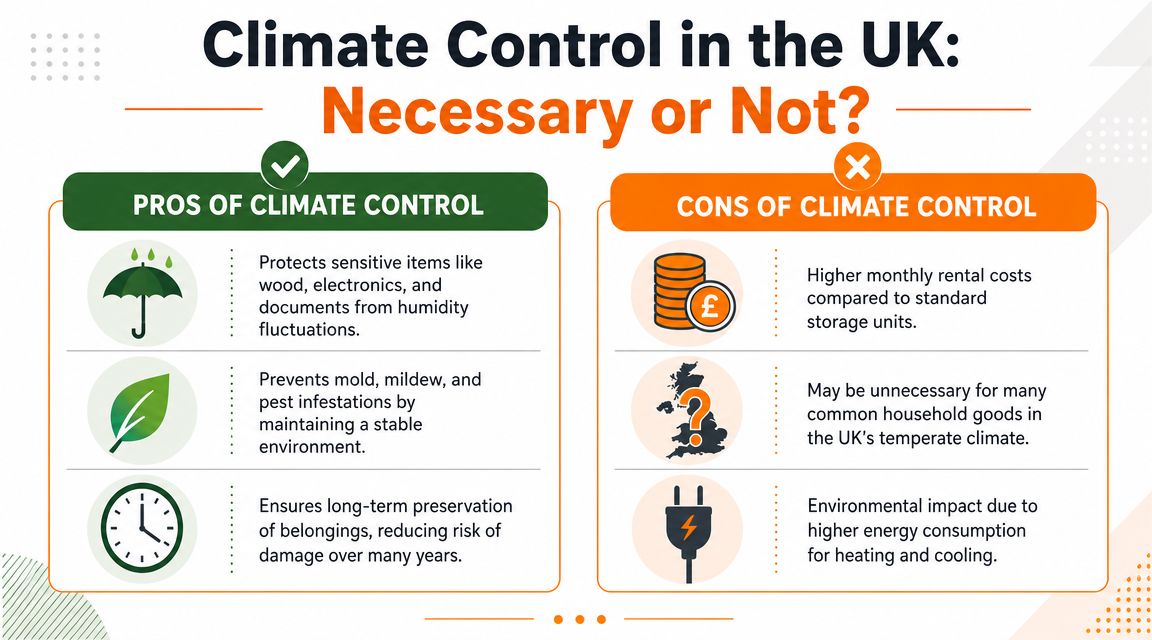
In the UK, climate control is rarely about protecting items from extreme heat or deep frost. It is about managing damp air, condensation, and repeated swings in temperature and humidity. A standard unit can be perfectly fine for some goods. Others slowly deteriorate in conditions that feel harmless on the day you move them in.
What climate control actually does
A climate-controlled unit keeps conditions steadier than a basic storage space. The goal is not comfort. The goal is stability.
That matters because long-term damage often comes from cycles, not one bad day. Wood absorbs moisture and releases it again. Paper softens, curls, and can pick up mould. Metal parts can sweat and start to corrode. Electronics do not like condensation any more than they like a spilled drink. The Self Storage Association UK guidance on preparing items for storage supports the same practical point. Dry, stable conditions reduce avoidable damage over time.
Climate control works like the difference between storing belongings in a spare room and storing them in a garage that reacts to every wet week and cold snap.
Why the UK changes the calculation
A lot of generic storage advice comes from hotter or colder countries, so it can miss the UK problem. Here, the bigger risk is prolonged damp and fluctuating conditions over many months.
That does not mean every customer needs to pay extra.
It means the right question is: what are you storing, how long is it staying, and what would it cost if it came out warped, rusty, or smelling stale? For a six-week stopgap, standard storage is often enough. For a year or more, the maths can shift quickly, especially if the unit contains furniture, documents, stock, or anything difficult to replace.
Promotional rates muddy this decision. A cheaper headline price can look attractive until the standard unit needs extra moisture protection, better packing materials, or replacement items later. The monthly difference only tells part of the story.
Items that usually justify the extra cost
Climate control usually earns its keep when the contents are sensitive, valuable, or hard to restore:
- Wood furniture, especially solid wood, veneer, antiques, and anything with glued joints
- Paper items, including books, records, legal files, photographs, and artwork
- Electronics, such as TVs, computers, consoles, speakers, and office equipment
- Textiles, including clothing, rugs, curtains, mattresses, and upholstered furniture
- Metal tools or parts that may rust during long periods in damp air
For business storage, the same logic applies to stock reliability. This guide on protecting inventory with climate control is useful if you are weighing spoilage, presentation, and replacement cost rather than only monthly rent.
When standard storage is usually enough
Standard storage often works well for durable items that are clean, dry, and not especially moisture-sensitive. Plastic household goods, sealed equipment cases, some garden items, and general low-value overflow can sit in a standard unit without much trouble if they are packed properly.
The catch is duration. Six months is different from two years.
If you are comparing sites, check what operators mean by climate control. Some manage temperature only. Others manage humidity as well. A clear explanation of climate controlled storage units should tell you exactly what conditions are being maintained and which items benefit most.
Ask a simple question: if this item is damaged by damp, would I rather pay a bit more each month now, or pay to clean, repair, or replace it later?
That usually gives first-time renters a more honest answer than the sales label alone.
Understanding Security for Long Term Peace of Mind
For long-term storage, security isn't one thing. It's a chain. A solid lock on your unit matters, but it only works properly if the rest of the site also does its job.
People often judge a facility by the reception desk and the gate. That's too shallow. You need to know how the whole place behaves when you're not there.
What good site security looks like
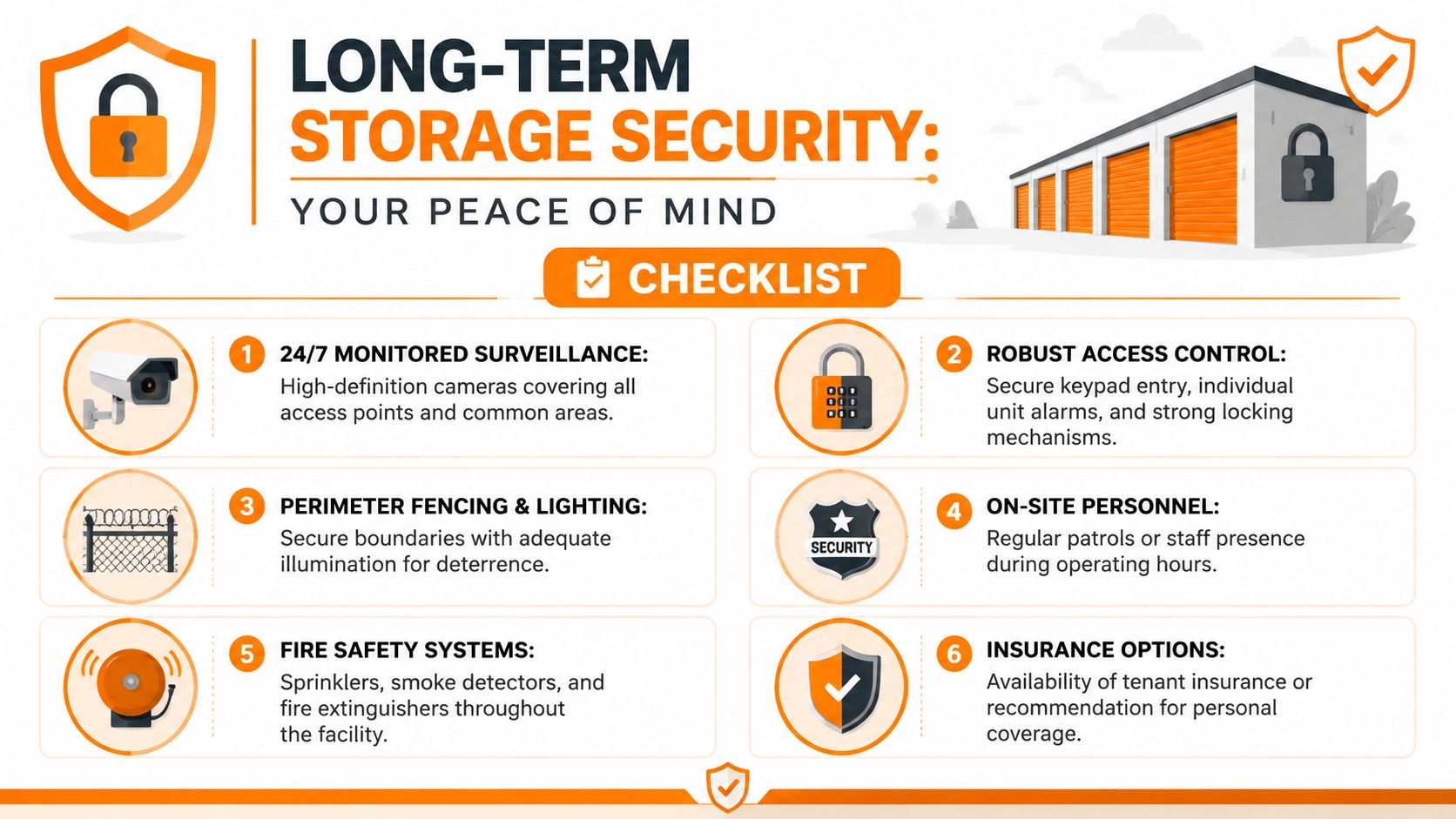
Think of the best facilities like a well-secured block of flats. You don't rely on one front door lock. You rely on layers.
- Controlled entry: keypad or managed access at the main gate or building entrance
- CCTV coverage: not only entrances, but corridors, loading areas, and key movement points
- Lighting: good external and internal lighting discourages unwanted behaviour and helps legitimate users move safely
- Staff presence: visible staff during operating hours adds oversight that cameras alone can't provide
- Perimeter protection: fencing, gates, and clear site boundaries matter more than glossy branding
Ask better questions on your visit
A first-time renter should always ask what the cameras cover. Some sites say they have CCTV, but only monitor the entrance and office area. That leaves blind spots where it matters.
Also ask whether units are individually alarmed, what happens after hours, and how visitors are authorised. If you want a direct way to think about surveillance basics, this guide to DIY CCTV for home security is useful because the same principle applies at a facility level. Coverage matters more than just owning cameras.
A secure site should make you feel slightly inconvenienced in all the right ways. Controlled access, recorded movement, and clear rules are good signs, not annoyances.
Fire safety and insurance still matter
Security isn't only about theft. Ask about smoke detection, extinguishers, fire procedures, and whether staff can explain the site's response process clearly. A vague answer is usually a bad sign.
And remember this. Even the best-run facility reduces risk. It doesn't erase it. That's why insurance belongs in the same conversation as locks, gates, and cameras.
Decoding Contracts Pricing and Insurance
The headline rate is almost never the actual rate.
That's the mistake that catches first-time renters. They compare two quoted prices, pick the cheaper one, and only later realise the cheaper option had a short promotion, extra admin charges, restricted access terms, or insurance costs that changed the true monthly spend.

Ask for the all-in monthly cost
Many guides skip this point, but it matters more than almost anything else for long stays. In 2024 the UK market had 107 million sq ft of space and 75.4% occupancy, which suggests customers often have room to negotiate or switch. The practical advice is simple. Ask for the full monthly figure including fees and insurance, not just the teaser rate, as highlighted in this overview of how to compare storage costs beyond the promo price.
That single question cuts through most confusion.
Contract clauses that deserve a close read
Some terms matter far more in month twelve than they do on move-in day.
- Promotional end date: Know when the opening rate stops and what replaces it
- Notice period: Check how much notice you must give before leaving
- Access terms: Some sites charge differently for broader access or special arrangements
- Late payment rules: Understand what happens if a payment is missed
- Price review language: Read how and when rates can be changed
A fair contract isn't necessarily the cheapest one. It's the one you can still live with after the first attractive offer has gone.
Insurance is not optional thinking
A lot of renters assume the facility's cover protects the contents automatically. Sometimes there is a basic arrangement in place. Often it isn't enough for what people are storing.
You need to know:
- what value you're declaring
- what items are excluded
- whether proof of value would be needed after a claim
- whether accidental damage, damp-related issues, or theft have conditions attached
If you're not sure what a sensible policy should cover, this page on contents insurance for storage units is a helpful starting point.
Key check: If replacing the contents would hurt financially, don't treat insurance as a box-ticking extra. Treat it as part of the real storage price.
A simple way to compare two offers
Take the quote and write down the amount you'd ultimately pay after the offer expires. Then add any recurring charges, required insurance, and the cost of the unit size you need rather than the size you hope to squeeze into.
That is the figure worth comparing. Not the banner on the website.
How to Pack and Preserve Your Belongings
Six months from now, the quality of your storage experience will come down to what happened on packing day. I see the same avoidable problems over and over. A sofa wrapped while slightly damp. A fridge closed before it had aired out. Cheap boxes at the bottom, heavy boxes on top, and everything squeezed so tightly that moisture has nowhere to go.
Pack for storage length, not just for the drive to site. A short journey only tests whether a box can survive being moved. Long-term storage tests whether it can hold its shape, keep contents dry, and stay organised after months of weight and still air.
Pack for storage conditions, not removal day
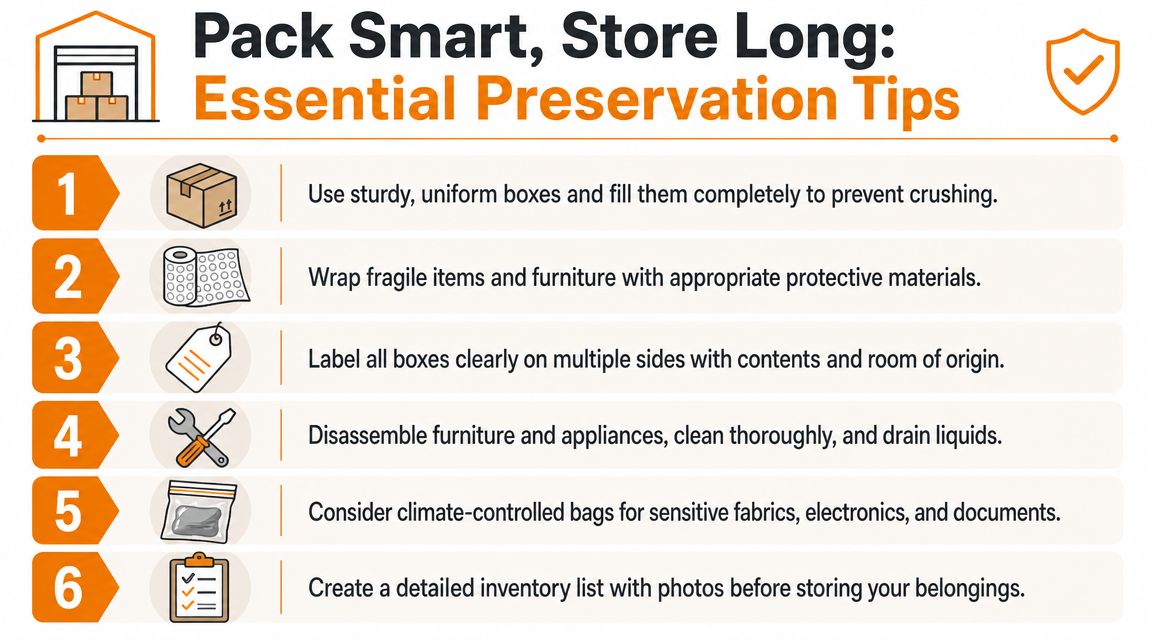
Strong, stackable boxes or plastic containers are usually the safer choice for long stays. Uniform sizes stack cleanly and keep weight more predictable. Random supermarket boxes tend to fail at the corners first, especially if they are carrying books, tools, or kitchenware.
The other mistake is overpacking the unit. Airflow matters. In the UK, long-term storage problems often come from slow moisture build-up rather than extreme heat. That is why breathing room inside the unit matters almost as much as the wrapping itself.
The British Association of Removers' storage advice also recommends using clean, dry packing materials and protecting furniture properly for storage rather than transit alone.
Before anything goes into the unit
Do the prep work at home, where you have light, space, and time to fix mistakes.
- Clean items properly: dust, food residue, and hidden moisture cause mould, odours, and pest problems
- Dry white goods fully: drain washing machines, defrost fridges and freezers, and leave doors open for a while before packing
- Take large furniture apart where practical: beds, tables, and shelving store better in smaller parts
- Bag and label fittings: tape or tie the bag to the relevant item so nothing goes missing
- Photograph higher-value contents: it helps with finding things later and supports any insurance claim
- Label every box on more than one side: top-only labels disappear the moment boxes are stacked
Use materials that protect without trapping moisture
Furniture needs covering, but not mummifying. Breathable covers usually work better than wrapping everything tightly in plastic for months. Plastic has its place for short transport or for keeping dust off specific surfaces, but if moisture is already present, tight wrapping can hold it against wood, fabric, or metal.
Wood furniture needs a little space around it. Mattresses should be stored flat if the manufacturer recommends it, or upright if that is the safer option for the model, but never bent to force a fit. Sofas and chairs should not carry heavy boxes on the arms or cushions. Pressure marks that develop over months can be hard to reverse.
Leave access space on purpose
A narrow walkway through the unit feels inefficient on day one. It saves time and reduces damage later.
If you need one document box, one suitcase, or one tool case in month eight, you do not want to unload half the unit to reach it. That is when corners get crushed, labels get torn off, and furniture gets scraped by hurried handling.
A practical checklist by item type
- Documents: use sealed plastic containers, keep them raised off the floor, and avoid overfilling archive boxes
- Electronics: remove batteries if suitable, use original boxes if you still have them, and keep cables with the device
- Clothes and fabrics: wash and dry them first, then use breathable garment covers or clean boxes
- Wood furniture: clean it, avoid direct contact with outside walls, and do not trap it in airtight wrapping
- Metal tools: wipe them down, dry them fully, and use light protective covering if condensation is a concern
- Appliances: clean, drain, dry, and store with doors slightly ajar where safe to do so
Good packing lowers the risk of damage. It also lowers your real long-term cost, because replacing one warped table, mouldy mattress, or ruined box of paperwork will wipe out any saving you thought you made by rushing the job.
Why Orange Box Self Storage Is Your Partner for Long Term Storage
If you've read this far, you already know what separates a useful long-term storage setup from an expensive mistake. You need the right size, the right environment, credible site security, and contract terms that don't become frustrating after the first month.
Orange Box Self Storage is built around those basics.
Across Nottingham, Derby, Long Eaton and Beeston, Orange Box Self Storage offers a broad mix of storage types for different long-term needs. That includes compact personal units, larger spaces for household moves, business storage for documents and stock, student storage for term breaks, and container options for bulky tools or equipment. That range matters because long-term renters rarely all need the same format.
What makes the fit practical
Security has to be routine, not decorative. Orange Box Self Storage facilities feature 24/7 CCTV monitoring and strong access controls, which is exactly the kind of layered setup long-term customers should look for when they won't be checking on their unit every week.
The service also includes climate-protected units, which is important if you're storing paper records, wood furniture, electronics, or other contents that don't cope well with moisture fluctuation. For business users, that can mean steadier protection for inventory and archived materials. For households, it reduces the risk of opening the unit months later to find odours, mould, or warped finishes.
Built for flexibility
Long-term storage often starts with uncertainty. You may not know whether you'll need six months or much longer. Orange Box Self Storage offers flexible rental contracts for both individuals and businesses, which helps when plans shift.
The booking process matters too. An easy online reservation system means you can secure space quickly without dragging the decision out for another week while your spare room, office corner, or garage gets worse.
If you want storage that matches the practical advice in this guide rather than just the marketing version of it, Orange Box Self Storage is set up to deliver exactly that.
Frequently Asked Questions About Long Term Storage
What items are usually prohibited in long term storage units
Most facilities won't allow flammable materials, explosives, perishable food, illegal goods, hazardous chemicals, or living things. Many also restrict items that can leak, rot, attract pests, or create a fire risk.
If you're unsure about a specific item, ask before move-in day. That's especially important for fuels, paints, gas bottles, batteries, and any stock with shelf-life issues.
How much notice do you usually need before moving out
This depends on the contract. Some facilities are straightforward and flexible. Others require a formal notice period and specific move-out steps.
Don't assume you can empty the unit and stop paying that same day. Check the written terms for notice, billing cut-off, and how keys or access credentials must be returned.
Can someone else access your unit for you
Usually yes, but only if the facility's authorisation process allows it. Most sites will want the named customer to approve that person in advance.
For long-term renters, this is worth setting up early if there's any chance a partner, colleague, family member, or employee may need access while you're away. It avoids delays and awkward calls later.
Should you check on the unit during a long stay
If the contract and your schedule allow it, occasional check-ins are sensible. You're not looking for drama. You're looking for early warning signs such as shifted stacks, packaging failure, moisture smell, or anything that shows your packing plan needs adjusting.
A quick visit can prevent a small problem becoming a big one.
Is the cheapest unit usually the best choice
Not for long-term use. The best value usually comes from the unit that protects the contents properly, stays workable after the promotion ends, and doesn't create access or packing problems.
Cheap storage becomes expensive when it causes damage, wasted time, or a move into a second unit later.
If you're looking for secure, flexible Orange Box Self Storage in Nottingham, Derby, Long Eaton or Beeston, the team can help you choose the right unit size, explain climate-protected options, and give you a clear view of costs before you commit. That's the kind of long-term storage decision that saves money and stress later.