

Stock has a way of spreading before you notice it. A few extra cartons sit under a desk, then the back room fills, then the van becomes overflow storage, and before long your working space is doing two jobs badly.
That's usually the point where local firms start looking seriously at business stock storage in Long Eaton. Not because they want “more space” in the abstract, but because they need cleaner stock control, faster picking, less clutter, and room to keep growing without taking on a larger commercial lease too early.
Is Your Long Eaton Business Outgrowing Its Space
A common pattern looks like this. An online seller starts at home or from a small office. Orders increase, product lines widen, and returns need a separate area. Soon, packaging supplies are stacked next to current stock, seasonal lines are mixed with fast movers, and every restock turns into a shuffle.
Retailers hit the same wall. So do trades and service firms that carry consumables, spare parts, displays, tools, or archived paperwork. The issue isn't only lack of room. It's that cramped storage starts affecting daily decisions. Staff waste time looking for items, stock gets counted badly, and the main premises stops working as a proper workspace.
The wider market shows this isn't a niche problem. The UK self-storage industry's turnover surpassed £1.08 billion in 2023, and usage rose from 1.29% in 2018 to 3% in 2024, showing a clear shift towards self-storage for business inventory and personal use according to UK self-storage market figures.
What growth pressure usually looks like
- Your office becomes a stockroom: Desks, meeting areas, and walkways start holding saleable inventory.
- Your spare space loses function: The workshop, garage, or back office can't support the actual work it was meant for.
- Your stock system breaks down: Similar items end up in different corners, making reordering and picking harder than it should be.
- Your next premises feels too big a jump: You need breathing room now, but a full relocation may be premature.
Practical rule: If your stock is reducing productivity at your main premises, storage isn't a stopgap. It's an operational decision.
Used properly, storage gives you an external stockroom that scales with the business. It can hold overflow lines, slow movers, packaging, archived documents, event kit, or equipment that doesn't need to sit at your main site every day.
For firms comparing local options, storage availability in Long Eaton is often the simplest next step. The main benefit isn't only clearing the floor. It's restoring order, so growth doesn't create avoidable friction.
Understanding Your Business Storage Options
Businesses usually narrow the choice down to two practical formats. Indoor self-storage units and outdoor container storage. Both can work well, but they solve slightly different problems.
The market itself is well established. As of 2025, the UK self-storage sector includes around 5,100 facilities with approximately 103 million square feet of rentable space, and average regional pricing sits around £27 to £30 per square foot per year, according to UK self-storage industry size data.
Indoor units
Think of an indoor unit as an extension of your stockroom. It suits businesses that want a cleaner environment for boxed inventory, product shelving, paperwork, point-of-sale materials, and items that benefit from being kept inside a managed building.
Indoor units usually make the most sense when:
- You need organised picking space: Shelving, labelled cartons, and a simple layout matter more than raw loading volume.
- Your goods need cleaner conditions: Fashion stock, printed materials, electronics, and boxed consumer products generally suit indoor storage better.
- You want easier day-to-day handling: Trolleys, corridors, and sheltered loading can make regular access more straightforward.
Outdoor containers
A container is closer to a compact warehouse bay. It's practical for bulkier stock, tools, equipment, trade materials, and items where drive-up loading matters more than an indoor environment.
Container storage often fits when:
- You load and unload heavier items: Direct vehicle access saves time.
- Your goods are durable: Tools, fixtures, spare materials, and equipment are typical examples.
- You prioritise access efficiency: For many businesses, getting close to the door matters as much as the footprint itself.
How to separate the two
A simple test helps. Ask whether your stock behaves more like retail inventory or trade inventory.
| Storage type | Best thought of as | Usually suits |
|---|---|---|
| Indoor self-storage unit | Private stockroom extension | Online retail, office overflow, archives, boxed stock |
| Outdoor container | Mini-warehouse with direct loading | Trades, equipment storage, bulky materials, durable stock |
If you're storing products that need to be counted, picked, and rotated regularly, indoor space usually works better than a container packed floor to ceiling.
The right answer depends less on the label and more on how your business uses stock. If access is frequent and stock control matters, choose the format that helps staff find, move, and protect items without improvising.
Decoding Key Storage Features
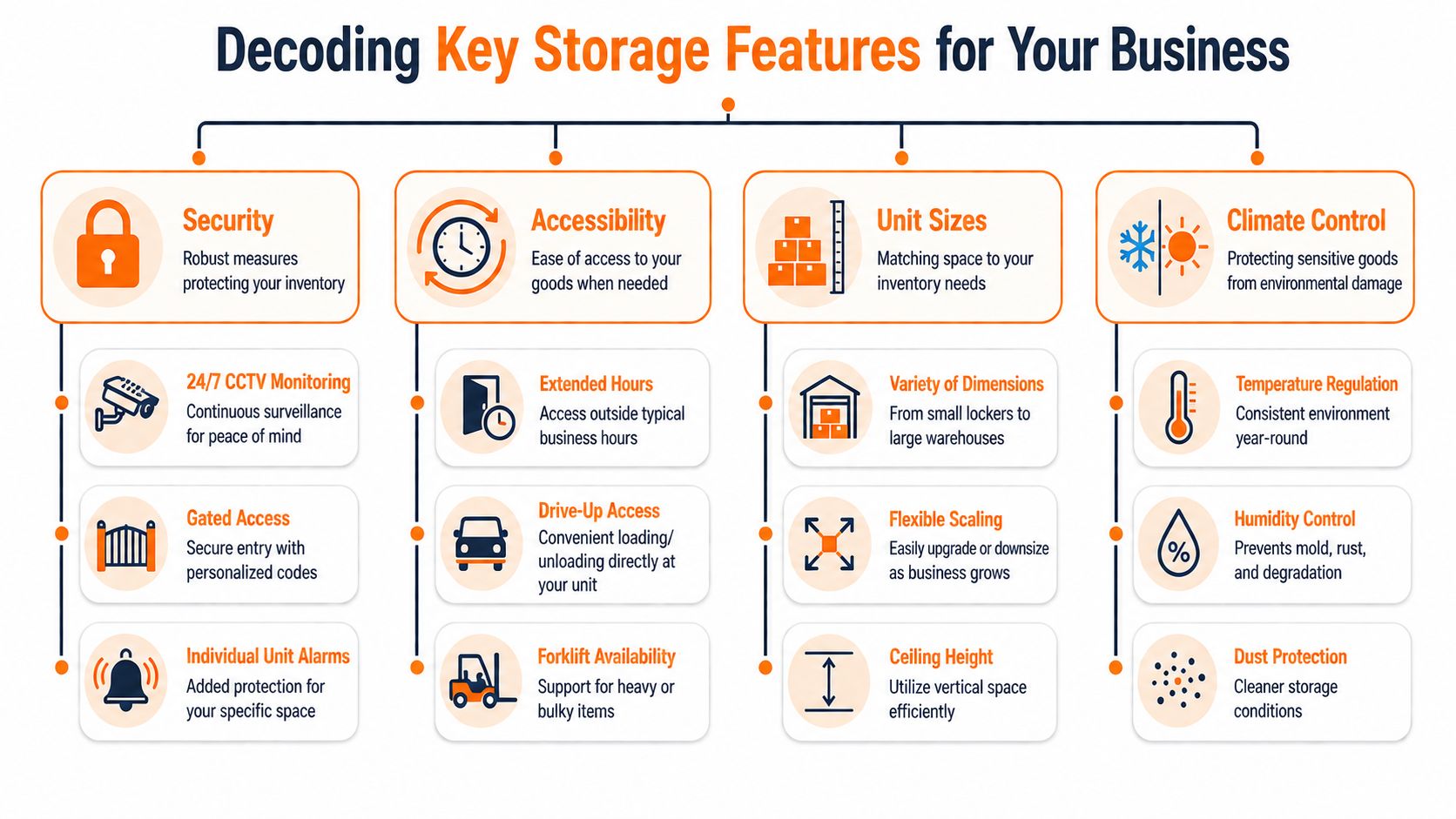
Features matter when they change outcomes. A facility can list security, access, and climate control on a page, but the practical question is simpler. Will those features reduce stock loss, speed up handling, and keep your inventory in saleable condition?
Security that supports stock reliability
Business owners often focus on the unit itself and overlook the wider chain around it. Good storage security is layered. Site entry, shared areas, surveillance, and the individual unit all matter.
Look for:
- 24/7 CCTV monitoring: This supports traceability and gives you better oversight of goods stored off-site.
- Controlled or gated access: You want a clear boundary between the public and tenant-only areas.
- Secure individual units: Your own space should feel distinct, not like an open corner of a warehouse.
For local firms using storage as part of regular fulfilment, this matters because stock isn't just “stuff in a room”. It's tied to orders, margin, and customer promises.
Access that matches how you work
A business unit that's hard to access creates hidden cost. Staff time goes into waiting, carrying, and double-handling. Access should fit your operating rhythm, not the other way round.
A practical checklist:
- Frequent collections: Prioritise easy loading and straightforward routes from vehicle to unit.
- Bulk deliveries: Check whether the site layout suits pallets, larger cartons, or repeated drop-offs.
- Out-of-hours needs: If your team packs early or late, limited access can become a bottleneck.
Unit size that supports layout
The biggest mistake with size isn't always renting too little. It's renting a space that can hold the stock but can't be organised. A cramped unit makes picking slower and creates dead stock at the back.
Here's a practical guide to common business uses.
| Unit Size (sq ft) | Typical Dimensions | Ideal For Storing |
|---|---|---|
| 25 sq ft | Small walk-in cupboard size | Packaging supplies, archived files, marketing materials |
| 50 sq ft | Large cupboard or small office size | Etsy or marketplace seller stock, small boxed inventory, returns area |
| 75 sq ft | Half garage size | Mixed e-commerce lines, shelving with picking aisle, seasonal overflow |
| 100 sq ft | Garage size | Retail backstock, office furniture, larger product ranges |
| 150 sq ft and above | Large garage and up | Higher-volume inventory, equipment, promotional materials, trade stock |
Climate control for sensitive goods
When it comes to business stock storage, many businesses either protect margin or lose it. Business-grade climate-protected units need to maintain 15°C to 25°C and humidity below 60% to help prevent damage to paper records, electronics, and other sensitive inventory, as outlined in guidance on climate-protected storage in Long Eaton.
If you store textiles, archived documents, electronics, printed packaging, or products with moisture-sensitive finishes, climate protection isn't a luxury feature. It's part of preserving saleable condition.
Sensitive stock should be judged by replacement difficulty, not just replacement cost. Some items can be rebought. Customer trust can't.
If you want a broader external perspective on how controlled environments are discussed in other markets, this guide to reliable climate storage Boston is a useful comparison point. The geography is different, but the underlying storage principle is the same. Stable conditions protect stock that doesn't tolerate damp swings or heat fluctuation.
One local option businesses often compare is Orange Box Self Storage, which offers business storage with climate-protected units alongside CCTV and controlled access. The key question isn't the brand name. It's whether the setup fits your stock profile and your working pattern.
How to Choose the Right Storage in Long Eaton
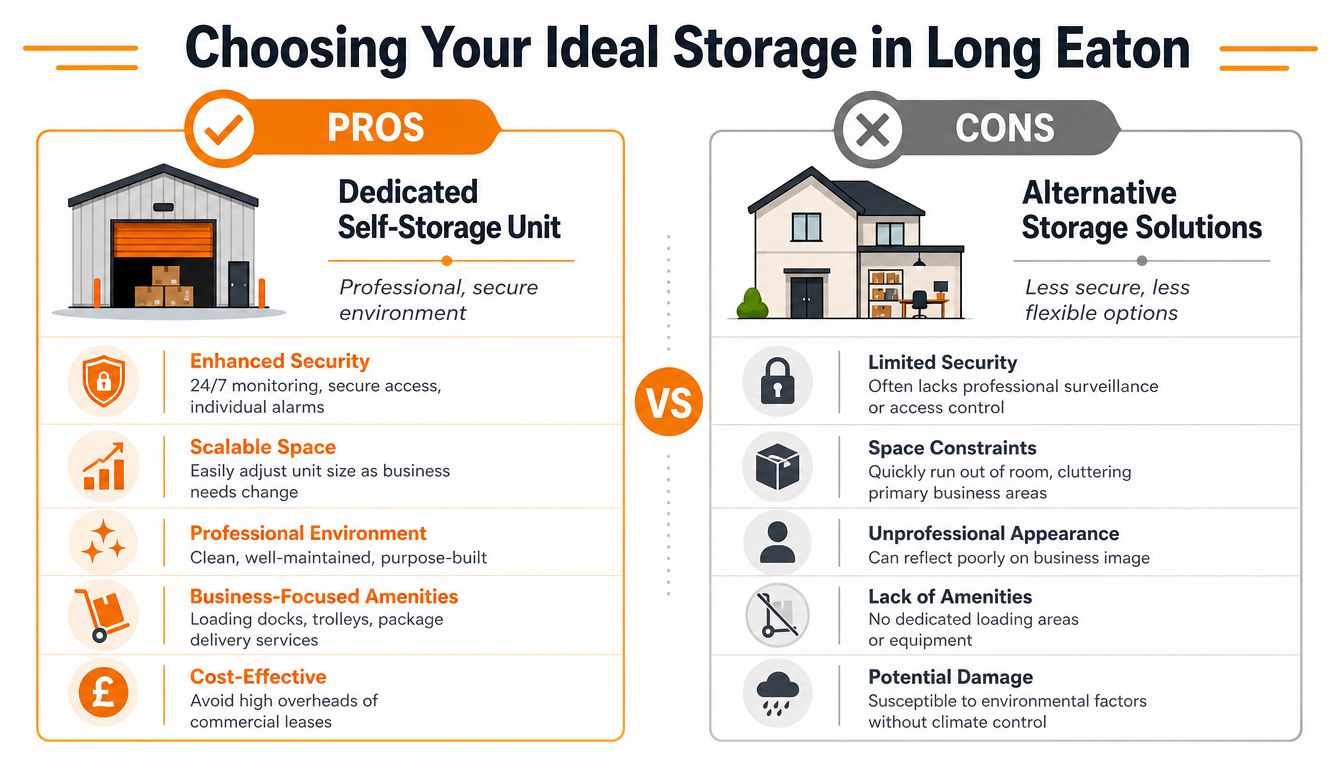
Choosing storage well comes down to one thing. Match the unit to the job you need it to do. Businesses get into trouble when they rent by headline price alone, then discover the space is awkward for access, unsuitable for stock type, or too small to organise properly.
Start with the stock, not the unit
Before looking at sizes, separate your inventory into categories:
- Fast-moving stock that needs regular access.
- Slow-moving or seasonal stock that can sit deeper in the unit.
- Sensitive goods that need stable conditions.
- Awkward items such as stands, long boxes, or bulky equipment.
That exercise tells you more than a square footage estimate on its own. It reveals whether you need shelving space, a clear picking aisle, drive-up access, or climate protection.
Decide how often you'll actually visit
Many businesses say they need frequent access when they really need predictable access. There's a difference.
If you visit several times a week to pick orders, choose a setup that supports routine movement and organised retrieval. If you mainly store surplus stock and only dip into it during restocks, bulk capacity matters more than a refined internal layout.
Use this quick filter:
- Daily or near-daily use: Prioritise layout, convenience, and a smooth loading process.
- Weekly top-ups: Balance cost against accessibility.
- Occasional overflow use: A simpler, lower-touch arrangement may be enough.
Standard or climate-protected
This is the decision that deserves the most honest thinking. Industry reporting notes that 24% of UK businesses using non-climate-controlled units in 2024 suffered inventory loss from humidity or temperature swings, according to business storage guidance on retail stock protection.
That doesn't mean every business needs climate protection. It does mean a standard unit can be a false economy for the wrong stock.
Choose climate-protected storage when you hold:
- Paper archives or printed materials
- Electronics and accessories
- Fashion items or textiles
- Moisture-sensitive packaging
- Products with finishes that degrade in damp conditions
A standard unit is usually fine for tougher stock such as tools, fixtures, durable equipment, and hard goods that aren't affected by moderate environmental variation.
Cheap storage becomes expensive the moment damaged stock has to be written off, discounted, or replaced.
Think in terms of operating cost
The right unit often isn't the smallest or the lowest-priced. It's the one that reduces friction. If staff can pick stock cleanly, find seasonal items quickly, and keep inventory separated by line, the unit is doing operational work for the business.
Questions worth asking before you commit:
- Can this space be shelved properly?
- Will my staff be able to move through it safely?
- Can I separate active stock from dead stock or returns?
- Does the environment suit what I'm storing?
- Can I scale up without disrupting the whole system?
The best storage choice is the one that supports your next phase of growth without creating a new admin problem. Good business stock storage in Long Eaton should feel like a working part of your operation, not an expensive cupboard you dread opening.
Best Practices for Managing Your Business Stock
A storage unit only helps if the inside is run properly. I've seen modest spaces work brilliantly because the stock system was disciplined, and I've seen larger units become expensive chaos within weeks because everything was piled by convenience.
Build the unit like a small warehouse
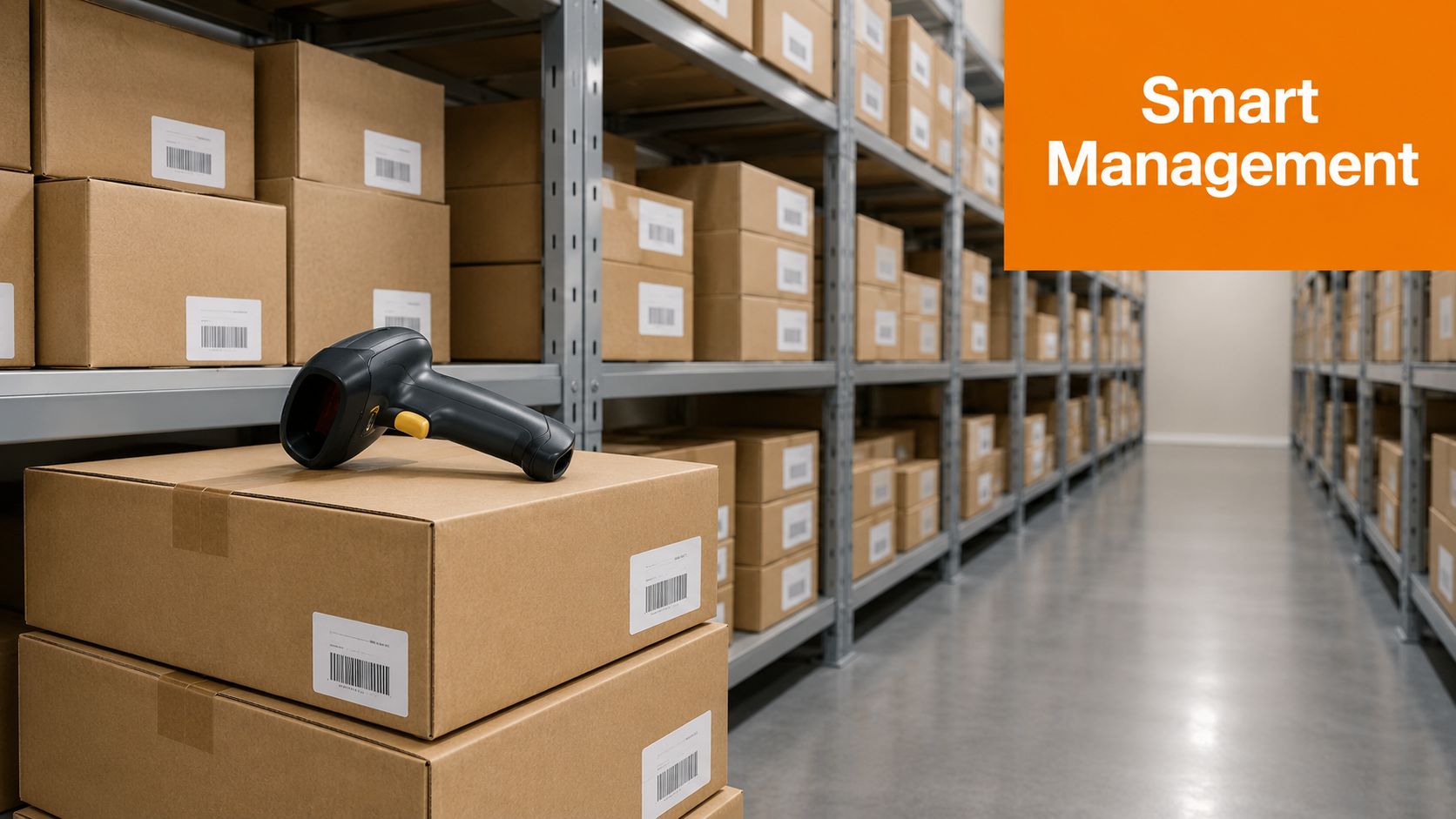
Treat the space as a micro-warehouse, not a dumping ground. That means putting structure in from day one.
The basics that work:
- Install shelving early: Floor stacks look efficient at first, then create hidden stock and handling delays.
- Keep a central aisle: You need room to reach stock without unpacking half the unit.
- Zone the space: Separate fast movers, overstock, returns, packaging, and archived items.
- Label every location: Shelf labels are just as important as box labels.
A simple bin-location system is often enough. Row A, Shelf 1, Box 3 is far better than “left-hand side near the back”.
Use a stock list you'll actually maintain
A complicated inventory platform that no one updates is worse than a plain spreadsheet used properly. For many SMEs, a practical system includes item name, SKU, box count, shelf location, and a quick photo reference for unfamiliar lines.
Useful habits include:
- Update on every visit: Don't rely on memory after loading or picking.
- Photograph shelves periodically: This helps spot space creep and stock build-up.
- Review dead stock monthly: Remove discontinued or obsolete items before they waste prime space.
For firms tightening their process, this guide to inventory management for small businesses is worth reading alongside your storage setup.
Know the line between storage and operating
This catches out more businesses than it should. Using a unit to store stock is one thing. Running active on-site operations from it can be another.
Data cited in guidance on businesses operating from self-storage shows 32% of UK micro-businesses use self-storage as a warehouse, while 68% have faced legal disputes over unauthorised on-site operations due to unclear lease terms, according to advice on operating businesses from storage facilities.
In practice, that means you should check exactly what your agreement allows. Storage, collection, and stock handling may be fine. Activities that look more like trading premises, staffed workspaces, or customer-facing operations may not be.
Don't assume “business storage” means you can run every part of the business from the unit. Read the terms and ask direct questions.
When the boundaries are clear, storage becomes much more useful. You can build a repeatable system for stock holding and logistics without drifting into a setup that creates compliance problems later.
Book Your Long Eaton Storage Unit Today
Once you know what you're storing, how often you need access, and whether climate protection matters, booking is usually straightforward.
Keep the booking process simple
A practical approach is:
- List what's going in first. Include stock type, rough volume, and whether any items are moisture-sensitive.
- Choose the storage format. Decide between an indoor unit and a container based on handling needs.
- Select a size with layout in mind. Leave room for shelving and access, not just box count.
- Check the access arrangement. Make sure it fits your collection and restocking routine.
- Confirm the agreement terms. Short-term flexibility matters if your stock levels change through the year.
Businesses looking specifically for commercial options can review business storage services in Long Eaton and nearby areas.
What usually makes the switch easier
- Flexible terms: Useful when stock levels rise and fall with seasons, promotions, or supplier schedules.
- Scalable space: You don't need to overcommit too early.
- A cleaner workflow: The benefit is often felt immediately at your main site, because staff get their working space back.
The right unit should solve a live operational problem quickly. If your office, shop, stockroom, or home setup is already under pressure, delaying the decision usually makes stock control worse, not better.
Frequently Asked Questions
| Question | Answer |
|---|---|
| What types of businesses use business stock storage in Long Eaton? | Online sellers, retailers, trades, office-based firms, event businesses, and service companies all use storage when stock, tools, records, or materials start taking over their main premises. |
| Is indoor storage or container storage better for stock? | Indoor storage usually suits boxed inventory, paperwork, and products that need cleaner conditions. Containers often suit bulky equipment, trade materials, and durable stock where drive-up loading matters. |
| How much space should I rent? | Rent enough room to organise stock properly. A unit that technically fits everything but leaves no aisle or shelving space usually causes more problems than it solves. |
| Do I need climate-protected storage? | If you store electronics, documents, textiles, printed packaging, or anything that can be affected by damp or temperature swings, it's worth serious consideration. Tougher stock often works well in standard storage. |
| Can I use a unit as my business premises? | Not automatically. Storing stock is different from operating a business on-site. Always check the agreement so you know what activities are allowed. |
| How should I organise stock inside the unit? | Use shelving, labels, clear zones, and a simple inventory log. Keep fast movers near the front and maintain a central aisle so staff can retrieve items without reshuffling the whole unit. |
If you need practical help choosing the right setup, Orange Box Self Storage offers local options for businesses that want a cleaner, more organised way to handle stock, equipment, and archive storage without taking on extra premises too soon.