


A student HMO tenancy ends, the incoming tenants are due soon, and the landlord's spare furniture is still taking up the rooms needed for cleaning and repairs. The compliance files are in a different pile, the contractor needs a clear route through the property, and every extra day before move-in risks extending the void. In that moment, storage isn't just somewhere to put things. It's part of running the tenancy efficiently and keeping records organised.
For landlord storage in Nottingham, I'd separate the job into two needs: temporary storage for property and equipment, and a controlled archive for landlord records. Choose a unit and contract around how you'll use it, not around a vague urge to clear space. That makes it easier to retrieve what you need, avoid paying for empty capacity, and keep tenant belongings and compliance documents under proper control.
Why Nottingham Landlords Turn to Storage
A landlord with a single let might need to remove a sofa and spare bed while decorators work between tenants. An HMO operator may need to clear common-room furniture, hold replacement mattresses and lamps, and keep a contractor's tools out of the way while several rooms are turned around. The pressure is practical: rooms need to be accessible for work, but useful items shouldn't be discarded just because there's nowhere suitable to put them.
Storage can help protect the letting timetable, but only if it's organised for retrieval. If a replacement chair or smoke alarm is buried behind unlabelled boxes, the unit has shifted the problem rather than solved it. Put items you expect to reuse near the entrance and store them in a way that lets a cleaner, contractor or authorised colleague find them without unpacking everything.
Two jobs, two kinds of storage
Treat furniture and supplies as a temporary holding job. These are items you'll bring back into a property, such as HMO furniture, spare fittings, clean soft furnishings or renovation materials. A storage unit can keep them together and out of a work area while you coordinate repairs and changeovers.
Treat tenancy records differently. Agreements, inventories, deposit evidence, correspondence and safety paperwork need a reliable filing system, restricted access and a clear link to the relevant property and tenancy. They shouldn't be mixed into a general furniture unit where boxes get shifted around every time someone needs a table.
My rule: if you need to retrieve an item quickly to prepare a property, label it and keep it accessible. If you need to produce a record to explain a decision later, file it by property and tenancy, then protect it as an archive.
I wouldn't promise a monthly cost without checking a provider's current rates, unit availability, contract terms and insurance. The right comparison is the total price for the space you'll use, alongside the cost of keeping belongings in a property or extending a void. Ask for a written quote for the expected stay, then check whether fees, cover or notice terms change the total.
What Nottingham's Rental Market Means for Storage Demand
Storage has a practical role in Nottingham because the city's rented housing market includes small landlords as well as operators managing shared homes. A Local Government Association review, citing a BRE study, estimated around 43,000 privately rented properties in the Nottingham City Centre region, with roughly 32,000 individually let properties and the remainder largely HMOs. The review also describes selective licensing across more than 30,000 privately rented homes in designated areas, while the citywide additional licensing scheme introduced in January 2024 was estimated to include more than 2,300 smaller HMOs. The council's selective-licensing information sets out the local licensing context.
The workload behind those schemes affects what landlords need to organise. A single-property owner may mainly store a spare appliance, a box of tenancy records and furniture during a repair. An HMO operator has more moving parts: shared-room furniture, replacement items, maintenance supplies and documents that relate to different rooms or tenancies. A storage system needs to make those distinctions obvious.
Nottingham City Council's social-impact study recorded 33,318 licences issued across selective, additional and mandatory schemes from 2020 to 2024, representing 16,373 licence holders. It found that 86% of selective-scheme licence holders were individuals, 70% of all registered holders had one licence, and 28% held between two and ten. The same study recorded investigations into potentially unlicensed landlords, checks and properties improved following inspection, underlining how much administration and property oversight sit behind licensing. The council's housing-licensing social-impact summary offers the fuller account.
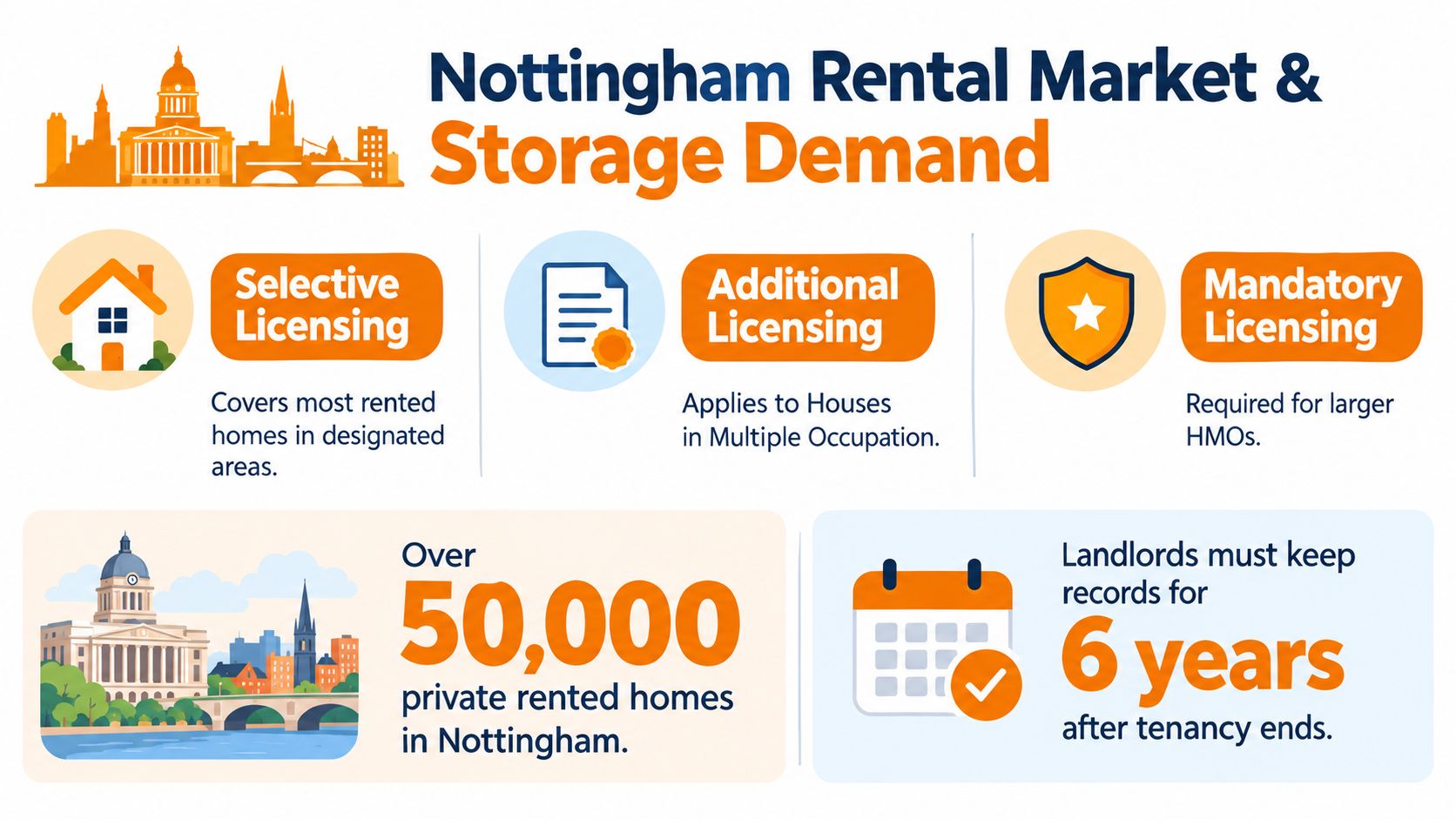
The takeaway is not that every landlord needs a unit. It's that the storage plan should reflect the number and type of homes managed, and the likelihood of a changeover, inspection or refurbishment. A clearly indexed archive and a separate, accessible place for reusable property items solve different problems.
Choosing the Right Unit Size and Type
Start with the job, then estimate the volume. Don't rent a large unit because it might be useful one day. Equally, don't cram furniture so tightly that retrieving one appliance requires unloading the whole room.
| Storage Job | Best-Fit Unit | Typical Use | Notes |
|---|---|---|---|
| A small archive or a few labelled boxes | Locker or compact unit | Files, small fixtures and supplies | Keep paper records separate from damp or dusty equipment. |
| Furniture and appliances between lets | Around 35–75 sq ft | A modest furniture set, boxes and household items | Measure bulky pieces and allow a clear route to retrieve them. |
| HMO furniture or a larger changeover load | Around 100–150 sq ft | Shared-room furniture, mattresses and multiple appliances | Check whether you need walk-in access or can stack items for the full stay. |
| Renovation stock or contractor equipment | Container storage or a larger business unit | Tools, materials and bulky equipment | Confirm permitted contents, access arrangements and weather protection. |
These are planning guides, not guaranteed capacities. A dismantled bed frame and stacked chairs take up less room than an assembled sofa and several white goods. List the actual items, measure the largest pieces and ask the provider how the unit's dimensions work in practice.
Match the environment to the contents
A standard unit can suit sturdy furniture and boxed household items if everything is clean and dry before storage. Paper files and soft furnishings need more care. Ask about climate protection, ventilation and moisture management, especially if the contents will stay for an extended period.
Container space can make sense for bulky kit that needs straightforward loading, but don't assume every container offers the same environmental protection or access. Check the arrangement in person and make sure the unit suits the goods, not just the price.
If you're unsure how much room your inventory will need, use this storage unit size guide as a starting point, then confirm the fit with the provider. For landlords who need to access stock regularly, two smaller units may work better than one packed room if they let you separate furniture from tools or records. That option only pays off if the additional access and cost are justified.
Pricing, Contracts and How to Pay Less
Storage quotes are easy to misread if you compare only the headline rate. A provider may offer a rolling arrangement, a fixed stay or a lower rate for a longer commitment, while charging separately for administration or optional insurance. The sensible comparison is the total cost for the period you expect to store, including any charges needed to make the unit suitable for your goods.
| Contract approach | When it may suit a landlord | What to check |
|---|---|---|
| Rolling arrangement | A changeover or repair with an uncertain end date | Notice period, billing frequency and how a mid-cycle move-out is handled |
| Fixed stay | A planned refurbishment or known gap between tenancies | Whether early exit is allowed and what happens if work overruns |
| Longer commitment | A permanent archive or recurring need for stored stock | Total saving against flexibility, fees and access conditions |
A discount isn't automatically a saving. For a short turnaround, flexibility may be more valuable than a lower weekly price, especially if the contractor's finish date changes. For a continuing archive or a planned renovation, a longer arrangement could make sense, but only if you've checked the exit terms and know the contents will remain there.
Read the contract before you move in
Ask the provider to set out the full charge, payment schedule, any opening fee, insurance options, notice requirements and rules for changing unit size. Check how the contract treats a move-out part-way through a billing period and whether the quoted price applies for the full intended stay. Compare written quotes on the same assumptions rather than relying on a verbal estimate.
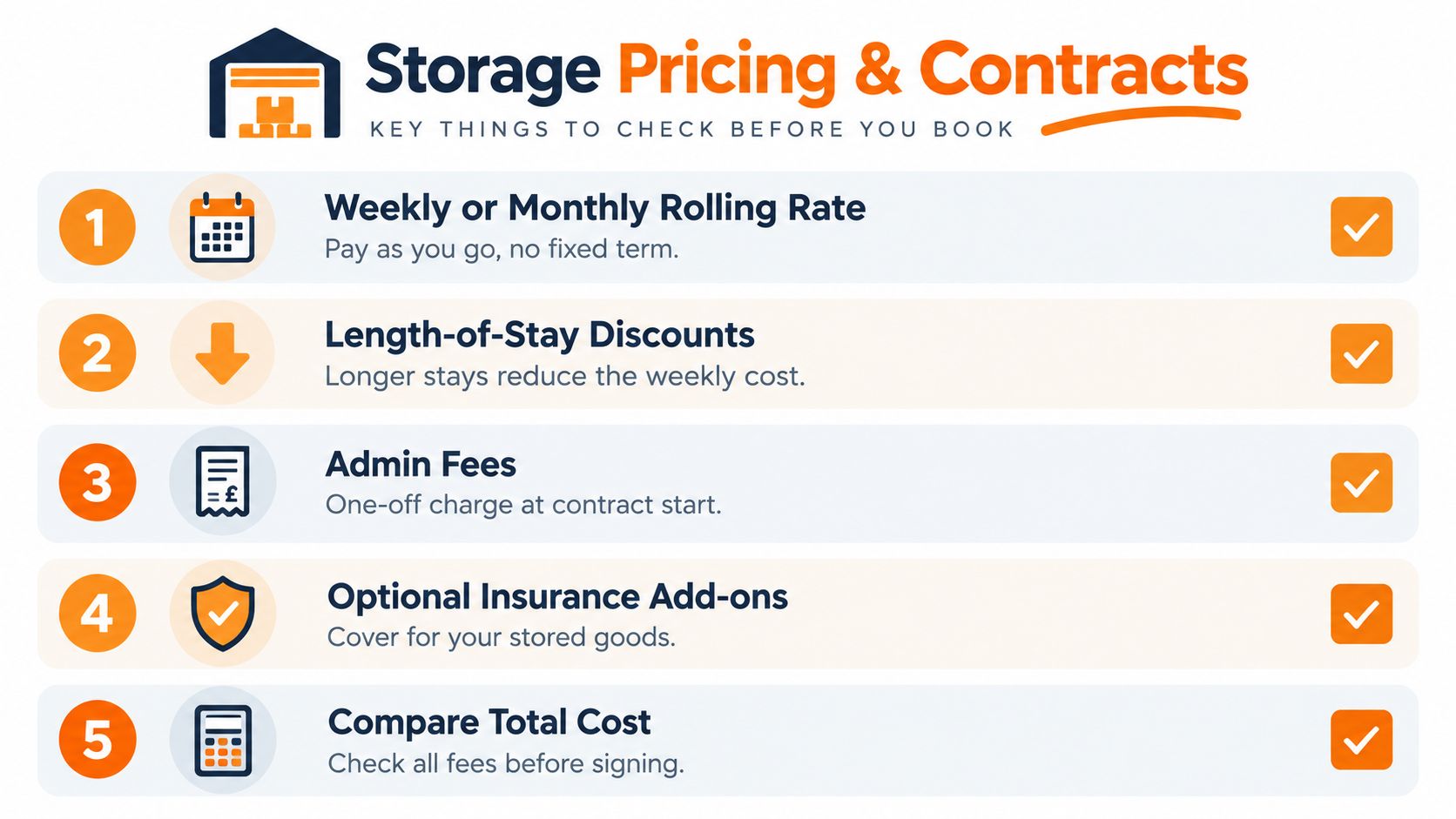
Security deserves the same scrutiny as price. Ask what the site's CCTV covers, how access is controlled, whether units have individual alarms or require a customer-supplied lock, and how loading areas are lit. Confirm who can access the account and whether a named colleague or contractor can be authorised. Don't assume reception hours and unit access hours are the same.
Insurance needs a landlord's perspective. Check whether the policy covers your goods in storage for theft, fire and flood, and whether the insured value reflects replacement cost. Items that belong to you remain your responsibility to insure; a tenant's home contents policy shouldn't be treated as cover for furniture or appliances owned by the landlord.
For a cost comparison, start with cheap storage units in Nottingham, then ask providers for a like-for-like quote. I'd choose a rolling arrangement for uncertain repair work and consider a longer term only for a defined, continuing need. In either case, the contract should be clear enough that you can tell what you'll pay and how to get your goods back.
Storing Tenant Records, Inventories and Compliance Files
A landlord archive isn't a box of old paperwork. It's the record of what was agreed, what condition the property was in, what action was taken and when. If a deposit dispute, possession issue or tax enquiry arises, a coherent file is easier to use than scattered emails and documents with no property or tenancy label.
A practical UK retention benchmark is to keep most tenancy records for the tenancy duration plus six years. Right to Rent records are generally retained for the tenancy plus one year, while HMRC records must be kept for at least five years after the relevant Self Assessment deadline. These periods and the operational guidance on organising files are summarised in this guide to landlord compliance documents.

Build an archive that can be retrieved
File records by property, then tenancy, and keep the contents in a consistent order. A folder might include the agreement, inventory, check-in and check-out reports, deposit-protection evidence, repair correspondence, safety certificates and notices. Label archive boxes with a property code and date range, not a tenant's personal details on the outside.
Keep encrypted digital copies as the primary working archive and maintain a separate backup. Paper files should be access-controlled because tenancy records contain personal data covered by UK GDPR. A climate-protected unit can help safeguard physical files, but it doesn't replace secure digital storage or sensible access controls.
Before signing, ask whether the site offers climate-protected units, what access hours apply, how entry is controlled and whether your insurance covers the full replacement value of stored contents. Also confirm how authorised staff or representatives can access the unit if you can't attend. Landlords who need sturdy cartons for a structured paper archive can compare Archive Boxes and Storage Boxes when planning supplies. For related retention guidance, consult this overview of how long to keep business records.
Moving In, Labelling and Handling Abandoned Goods
A well-packed unit should save time at the next changeover, not create another search task. Start by separating items into groups: property furniture, maintenance supplies, contractor equipment and records. Don't mix tenant belongings into those groups. They need their own evidence trail and careful handling.
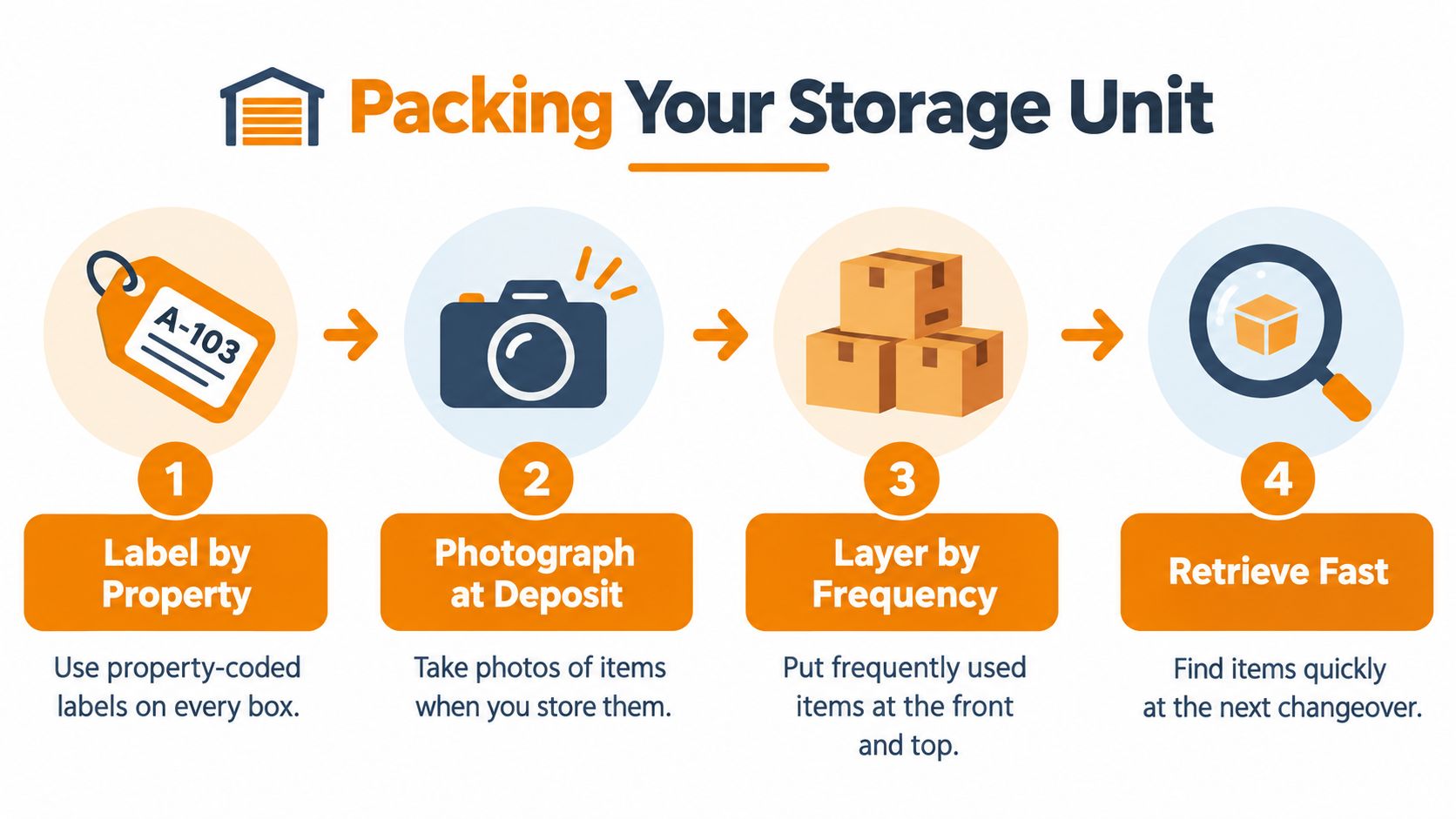
Use a simple routine whenever you move items in or out:
- Label by property. Put a property code and contents description on each box. Keep labels readable from the aisle.
- Photograph items at deposit. Take dated photos of furniture, appliances and equipment before storage, and note any existing damage.
- Pack for access. Put frequently used items near the front. Stack safely, keep heavier boxes low and leave a route to items you'll need soon.
- Keep an index. Record the unit, box label, contents and date in a digital list so another authorised person can find a spare fitting or file.
For larger furniture, dismantle what can be safely taken apart and keep fixings in a labelled bag attached to the item. Pallets can help keep bulky goods grouped, but make sure the provider permits their use and that goods remain stable. Keep smoke and carbon monoxide equipment, HMO common-room furniture and contractor tools in separate, clearly marked groups.
Tenant belongings need a separate process
Finding possessions after a tenancy ends doesn't automatically give a landlord the right to dispose of them or charge storage costs. Record what remains, take dated photographs, communicate with the former tenant and follow the applicable legal process. The rules depend on the circumstances and jurisdiction, so don't treat a storage unit as a substitute for proper notice, evidence or lawful possession procedures.
A resource on how to avoid costly abandonment mistakes discusses abandonment rules in Texas, so it isn't a guide to Nottingham law. Use it only as a reminder that abandoned goods can raise legal issues, then check the relevant UK requirements before moving, charging for or disposing of a tenant's property.
Comparing Nottingham Storage Providers and Where Orange Box Fits
Compare providers against the way you manage properties, not just distance from home. A unit near your managed stock can reduce the effort of collecting furniture or supplies, but a cheap rate won't help if access is inconvenient, the contract is inflexible or the site can't protect the contents you plan to store.
Use these questions when comparing options:
- Contract: Can you store short term, extend a stay or change unit size without unclear penalties?
- Security: How are entry and individual units protected, and who can access the account?
- Environment: Are climate-protected units available for paper records or vulnerable furnishings?
- Insurance: What risks are covered, and how do you set the insured value?
- Access: Can you reach the unit when your contractors or changeover schedule require it?
- Price: Does the written quote include all required fees and charges?
Orange Box Self Storage is one local option, with facilities across Nottingham, Derby, Long Eaton and Beeston. Its offer includes compact lockers, larger business storage and container storage, as well as flexible rental options and climate-protected units. The company describes its sites as using 24/7 CCTV monitoring and access controls. Check directly which features, unit types and access arrangements apply at the specific site you're considering.
Visit any shortlisted facility before committing if you can. Ask to see the route from loading area to unit, confirm whether you can move bulky furniture safely, and check the actual unit dimensions. For landlord records, ask how the environment is managed and whether your insurance covers the archive. For regular property work, clarify whether a colleague or contractor can be authorised to collect supplies.
Don't choose based on a brand name alone. Choose the provider whose contract, security arrangements and location fit your properties and whose written terms answer your questions clearly.
Building a Landlord Storage Plan That Scales
A workable plan starts by deciding what stays at the property, what goes into storage and what should be digitised. Keep everyday maintenance items and essential equipment accessible to the people who need them. Store reusable furniture, spare fittings and renovation stock only when you have a clear reason to keep them. Archive records by property and tenancy, with secure digital copies and a separate backup.
For a single-property landlord, a small locker or compact unit may be enough for boxed records, spare fixtures and a few changeover items. Don't pay for furniture space unless you regularly remove and reuse furniture. If the need is occasional, compare the cost of storage with the practical cost of keeping items safely elsewhere.
An operator with several HMOs has a different job. Separate crates by property, label shared-room furniture and keep contractor tools apart from tenancy files. A permanent small unit can make sense if staff need regular access to a known stock of spares, but it should have an inventory owner. If nobody updates the list, even a secure unit becomes a place where useful items disappear.
Refurbishment creates another cycle: clear rooms, record the condition of removed items, store what will be reused, and dispose of what has no practical value through the appropriate route. Landlords planning recurring decoration and repairs may find this portfolio maintenance resource for landlords useful when coordinating property upkeep.
Review the plan at least annually and whenever your portfolio or operating pattern changes. Check whether the unit is too large, whether the contract still suits the storage period, and whether files can be retrieved quickly. The right setup is the smallest secure arrangement that supports your next changeover and keeps your records organised.
Orange Box Self Storage offers locker, business and container storage with flexible rental options across Nottingham and nearby areas. If you're preparing a changeover or setting up a landlord archive, compare the unit and contract against the items you need to store, then visit Orange Box Self Storage to explore your options.