


You've outgrown the garage, the spare room is full of shelves and extension leads, and every job seems to start with moving a van out of the way. That's usually the point when workshop units in Ilkeston start making sense, not as an abstract property search, but as a practical fix for space, workflow, and the small frustrations that slow a trade business down.
Ilkeston is a sensible place to look because the town's working identity was shaped by industry long before modern estates and roadside units arrived. By 1850, it had already developed into a manufacturing centre with five hosiery and six lace manufactories, and Francis Ball's Albion Works, dating to around 1845, still survives as an early milestone in that shift from farmland to workshop-based production Erewash Borough Council local history appraisal.
That history matters because workshop space here isn't bolted on to the town. It sits within Ilkeston's commercial fabric, on industrial estates and working premises that continue to serve trades, fabricators, repair businesses, and hybrid storage users. If you're trying to decide whether a unit fits your business, the questions aren't just about rent. They're about power, access, lease length, and the true monthly cost of occupying the space.
Introduction to Workshop Units in Ilkeston
A joiner still stacking timber in a garden shed, a plumber with boxes lining the hallway, or a small e-commerce seller who has turned a dining room into a packing station, they all hit the same wall. The space starts to control the work instead of supporting it.
Workshop units in Ilkeston solve that problem by giving a business a proper base. They provide room for tools, stock, loading, and day-to-day tasks without turning home life into a makeshift depot. That matters because the cost of a unit is not just the asking rent, it is how well the space fits the way you work. A cheap unit with poor access, weak power, or awkward lease terms can be more expensive in practice than a better-specified space that saves time every day.
Ilkeston also makes sense as a place to look because its working identity has long been tied to industry. The town's growth through the 19th century was shaped by workshops and factories, which helps explain why this type of property still feels like part of the local fabric rather than something added later Erewash Borough Council local history appraisal.
The useful question is simple. Does the unit help you work without friction?
Some spaces suit light repairs or assembly. Others work better as storage with occasional use. A few give you flexible room that can adapt as your business changes, which is often the safer choice if your workload shifts from month to month.
What Workshop Units Are and How They Work
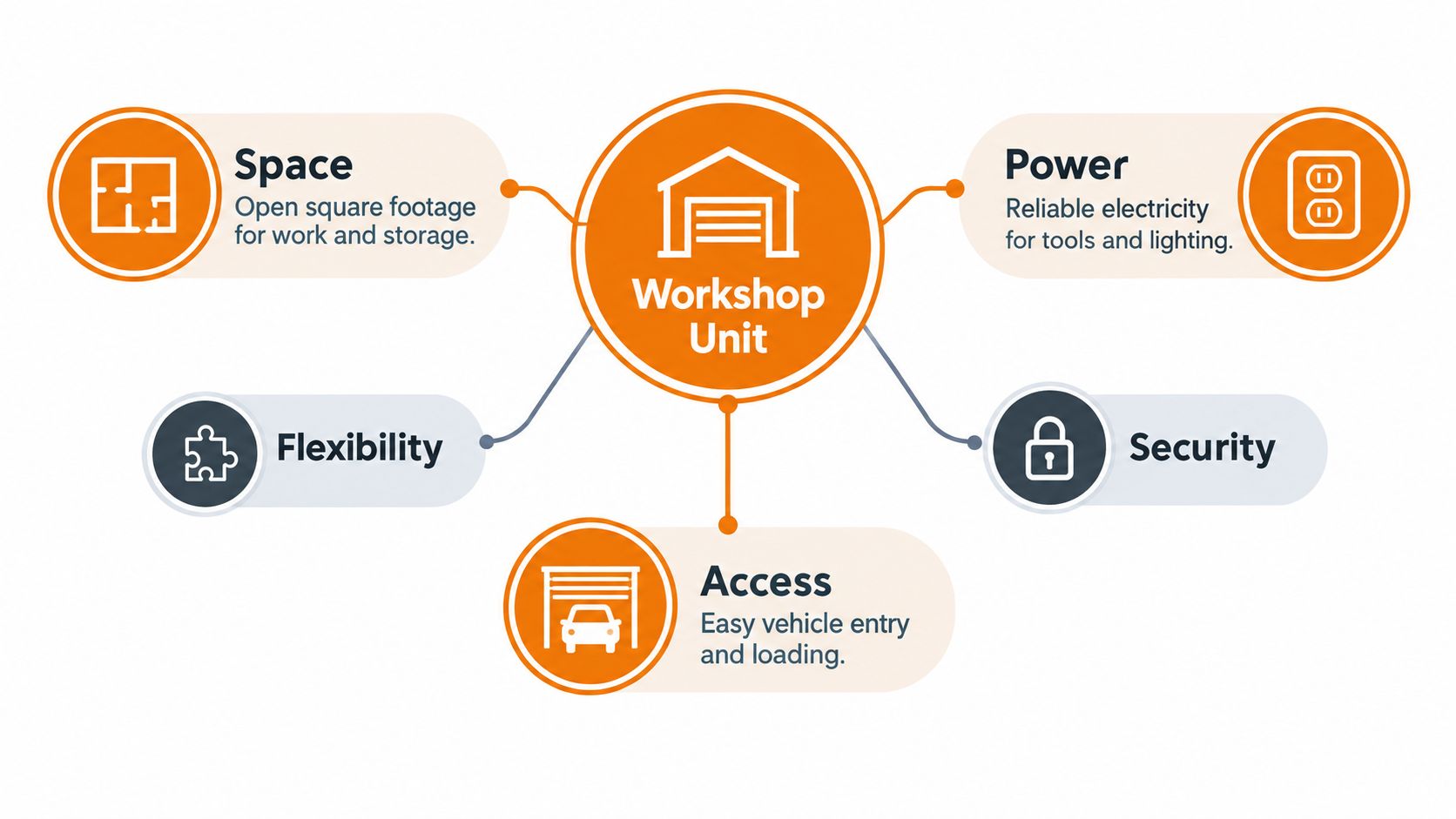
A workshop unit works like a blank canvas with utility built in. It gives a business open floor space, vehicle access, and services for tools, lighting, storage, and everyday operations. The practical value comes from how well those features fit the work, not from the headline rent alone.
The basic idea
A storage locker holds things. A workshop unit lets you do things. You can sort stock, maintain equipment, assemble products, or move materials in and out without repeatedly clearing the same work area.
The useful combination is straightforward: space for work and storage, power for equipment and lighting, and access for vehicles, deliveries, and loading. If one part falls short, the unit may cost more in time and disruption than its rent suggests.
Ilkeston's workshop stock is commonly found on industrial estates rather than in premises designed mainly for self-storage. A representative 1,485 sq ft light industrial/workshop unit on Quarry Hill Industrial Estate is listed with an open-span warehouse/workshop layout, three-phase electricity, front level loading, and shared-access parking Quarry Hill Industrial Estate listing. Features such as these help a unit support regular operations instead of functioning as improvised storage.
Who uses them
Workshop units suit a wide range of occupiers. Tradespeople use them for tools and materials. Light manufacturers use them for assembly or production. Repair businesses need benches, parts, and equipment. Some businesses combine storage with a working area, especially when their stock or workload changes.
The right choice depends on the business model. A cleaner, builder, caterer, and small online retailer may all need workspace, but their requirements for layout, power, loading, and vehicle access will differ. A lower rent can lose its appeal if staff spend extra time handling stock, working around poor access, or adapting to an unsuitable layout. The better measure is the total cost of occupying and using the unit each day.
Key Features to Look For in a Workshop Unit
A good viewing starts with a simple question. Can this unit support the work you do every week, or is it just cheap space with a door on it? That question cuts through a lot of glossy listings, because the right unit for a trade business often depends on details that don't look dramatic in photos.
Size, layout, and power
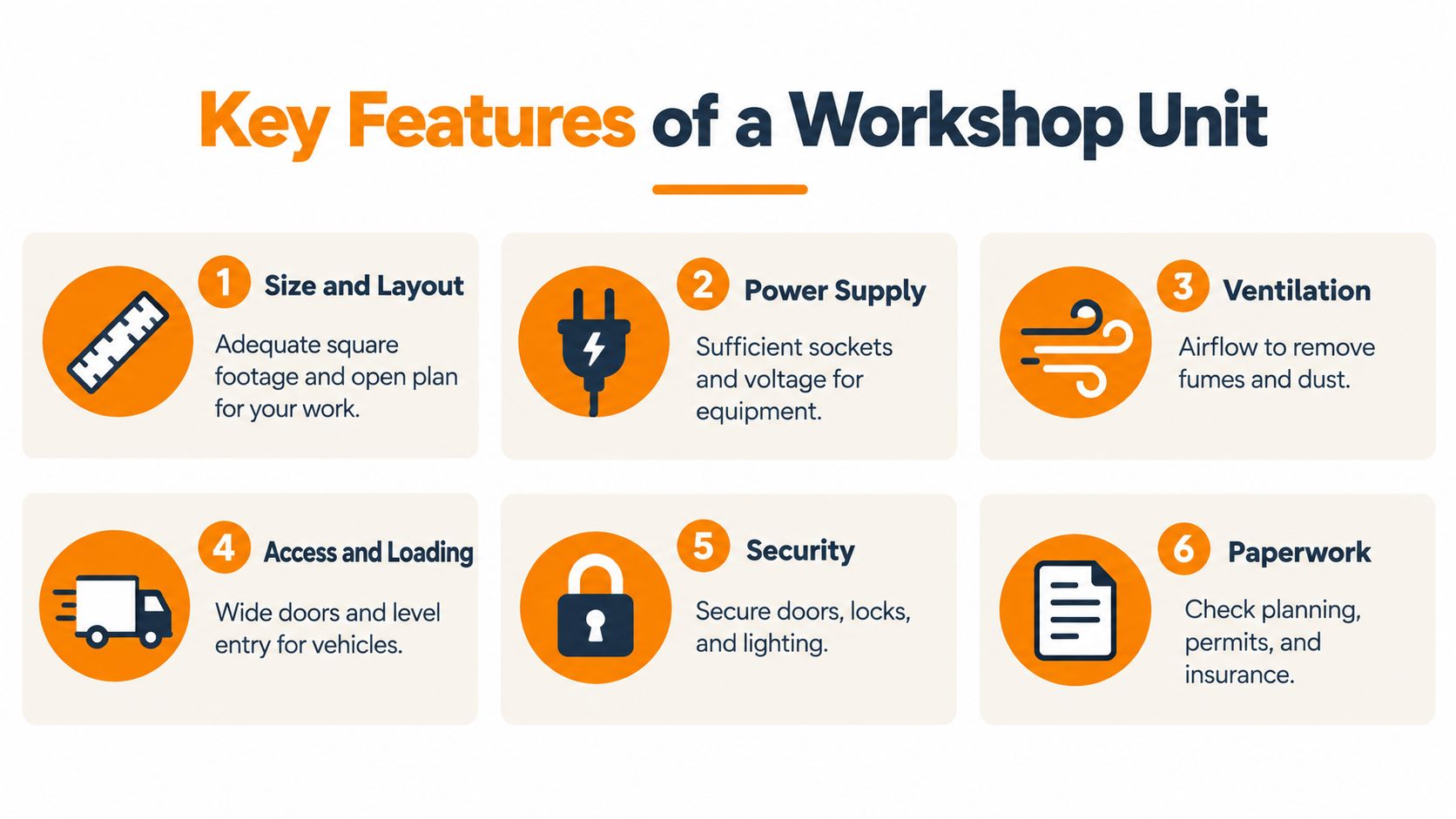
Size and layout come first. An open-span unit is usually easier to use than one chopped up by awkward internal structures, because it gives you more freedom to store, work, and move materials around. If you're handling sheets, lengths, pallets, or equipment on trolleys, that openness can make a day's work smoother.
Power supply is the next filter. A workshop with enough sockets can still be underpowered for machinery, compressors, or fabrication equipment. The Quarry Hill example above includes three-phase electricity, which matters because it supports heavier tools and plant more reliably than a basic domestic-style setup Quarry Hill Industrial Estate listing. If your work depends on that kind of equipment, power isn't a nice-to-have, it's a core requirement.
Access, loading, and environment
Access and loading affect every delivery and every job start. Front level loading reduces the hassle of pallet handling and makes movement in and out quicker, especially when you're loading by hand or with a pump truck. If a unit makes you fight the doorway every day, it slows everything else down.
Ventilation also matters, even when it's easy to overlook at first glance. Dust, fumes, and moisture can affect both the building and the work inside it. A space that feels fine on a dry viewing day can become uncomfortable or inefficient once equipment is running and the unit is full.
If a unit feels hard to move around in during a quiet viewing, it'll feel worse once it's filled with stock, tools, and packaging.
Security and paperwork
Security is about more than a strong lock. It's about doors, lighting, site control, and how exposed your goods are when you're not there. Shared-access parking can be useful, but you still need to think about who can see in, who can reach the unit, and how the site is managed.
Finally, paperwork matters. Planning, permits, insurance, and lease terms can all change what the unit really offers. If you use the space in a way the lease doesn't allow, a good-looking unit can become a problem quickly.
Understanding Costs and Availability in Ilkeston
Headline rent is only part of the story. A workshop can look affordable on a listing page, then become much more expensive once business rates, service charges, VAT, and lease length are added in. That's why the cheapest quoted rent is not always the cheapest unit to occupy.
Current Ilkeston listings show rents ranging from about £4.47-£6.00 per sq ft or roughly £15,000-£68,056 per year, depending on size and specification, and several listings say business rates and charges may apply Ilkeston commercial listings. The practical point is simple, the rent is only one line in the budget, and the rest can change the maths fast.
The market is also segmented. On one side, you might be looking at compact units that suit a solo trader or small team. On the other, there are larger spaces for businesses that need separate work and storage zones, or room to scale. That spread means the right unit for one occupier may be a poor fit for another, even if the rent per square foot looks similar on paper.
| Cost Element | What to Check | Impact on Budget |
|---|---|---|
| Headline rent | The quoted rent per sq ft or annual figure | Sets the starting point, but rarely the full cost |
| Business rates | Whether rates are included, estimated, or payable separately | Can change affordability materially |
| Service charges | Estate upkeep, shared areas, or management fees | Adds ongoing occupancy cost |
| VAT | Whether VAT is charged on rent and extras | Raises the cash outlay |
| Lease length | Short licence, flexible lease, or longer commitment | Affects risk, deposit, and exit flexibility |
If you're comparing workshop and storage-style space, it helps to look at a local example of how pricing is framed in practice. The guide on cost of storage in Ilkeston is useful because it shows how quoted price and usable value can diverge once the full occupancy picture is considered.
Layout also affects cost efficiency. If the unit is hard to organise, you may need more floor area than you expected just to keep workflow sensible. A useful companion read on this point is practical warehouse design tips, because a well-planned layout can save space without forcing you into a larger unit.
How to Evaluate and Set Up Your Ideal Workshop Unit
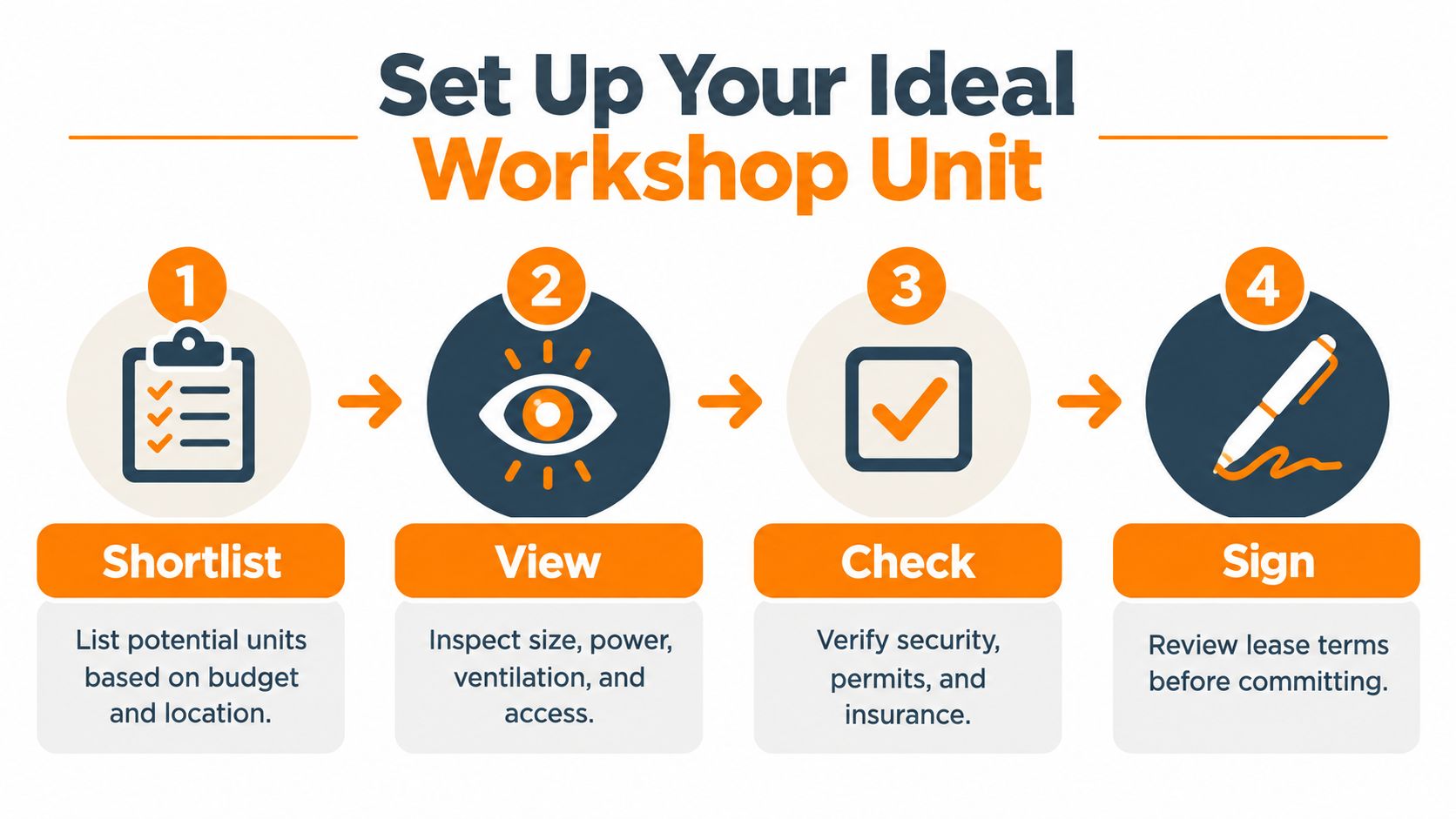
Walk the unit door-first. Can your van pull up to the loading area? Can you move a full pallet through the doorway without reversing? Is there enough clear floor space to turn, sort, and work safely? These checks should come before rent, because access and usable space shape the cost of occupying a workshop.
Test the unit as your business will use it
Bring your likely working routine into the viewing. Trace the route from vehicle to doorway, then from doorway to bench, storage area, and dispatch point. A unit may look spacious on an empty viewing, yet become awkward once a pallet, workbench, and materials occupy the floor.
Check the specification before assuming the unit is ready for your equipment. Confirm the socket locations, lighting, and power supply with the agent or landlord. Compressors, saws, chargers, and other machinery may place different demands on the electrical setup. Ask which alterations are permitted, who maintains the services, and whether the lease gives you enough flexibility to adapt the space.
Access outside the unit matters too. Look at parking, turning space, delivery timing, lighting, and site security. These details affect lost time, customer visits, and the risk of leaving tools or materials on site. A slightly higher rent can prove cheaper if it prevents repeated delivery problems or limits the need for extra storage.
Set up a layout that earns its floor space
Use the unit like a production line. Put frequently handled tools near the main work area, keep heavy stock at a safe low level, and place lighter items on labelled shelving. Mark clear routes for people and materials so storage does not gradually take over the working floor.
Draw the layout before moving in. Mark the bench, machinery, pallet position, packing area, waste point, and vehicle route. Leave room for the largest routine task, not only for the unit when it is tidy. If work and storage share one space, give each a defined zone.
For flexible storage alongside workspace, container storage for tradespeople in Ilkeston offers a useful comparison. Separating rarely used materials from daily tools can keep the workshop smaller and easier to work in.
Rule of thumb: if you cannot show where one pallet, one tool kit, and one completed job will sit, revise the layout before signing.
Practical Tips for Tradespeople and Small Businesses
A busy morning exposes a poor workshop quickly. If the drill is buried, materials block the entrance, or a delivery vehicle cannot turn, cheap rent stops looking cheap. Good routines and a workable specification save time every day.

Build a space that supports real jobs
Start with the work your business does. A roofing trader taking on seasonal extensions may need to move from a smaller working area to additional storage without signing an entirely new long-term commitment. Flexible lease terms, separable units, and clear options to expand can matter more than choosing the lowest headline rent.
A workshop should adapt like a set of labelled drawers. Use shelving, racking, and marked zones so stock can grow without swallowing the work area. Keep daily tools close to the bench, place less-used materials higher or farther away, and leave a defined route from the entrance to the main work zone.
The full occupier cost includes lost time. Check whether vehicles can load conveniently, whether delivery hours suit your schedule, and whether power, lighting, ventilation, and security match the jobs you carry out. A unit with better access may cost less in practice if it reduces waiting, awkward unloading, or repeat journeys across Ilkeston's M1-linked estates.
Moisture control also protects the budget. Keep boxes off the floor, avoid storing materials directly against damp-prone walls, and ventilate the unit where the work allows it. These habits help protect tools and materials while keeping the workspace easier to inspect.
For trades that quote regularly, Exayard plumbing estimating software provides an example of software for organising pricing and job planning. Keeping estimates and workshop stock under control reduces the chance that administration, materials, and unfinished jobs become mixed together.
Keep the unit safe and efficient
Treat security as part of the daily close-down. Lock tools away, keep valuable stock out of sight, and avoid displaying expensive equipment near the entrance. Confirm who controls gates, lighting, alarms, and shared areas before you move in, because a secure unit depends on both your routine and the site's arrangements.
For overflow materials or rarely used equipment, container storage for tradespeople in Ilkeston can provide a separate comparison. Moving occasional stock out of the working area may let you choose a smaller workshop while keeping room for current jobs. Review the arrangement as demand changes, so storage supports the business instead of becoming another unmanaged cost.
Finding Your Next Workshop Space in Ilkeston
A cheap unit can become expensive if poor access delays deliveries, limited power restricts equipment, or unclear lease terms force an early move. Compare the true occupier cost, including rent, rates, utilities, security, travel, storage, and the time spent working around site limitations.
Ilkeston's M1-linked estates can suit trades and small operators, but each unit needs testing against the work you do. A workshop should fit like a well-sized tool: enough room and specification for current jobs, with flexibility if demand changes. Check vehicle access, loading arrangements, power supply, permitted activities, and repair responsibilities before treating a low headline rent as good value.
Lease flexibility also changes the calculation. Shorter terms and flexible licences are becoming more common across Quarry Hill and nearby roads, which can help occupiers who want to test demand before committing to a long lease. A storage-backed arrangement may bridge the move from home-based work to a dedicated unit, while keeping overflow stock separate. Compare storage options in Ilkeston with workshop units, and use this tenant representation blog to consider fit, terms, and occupier risk together.
For accessible, secure space, Orange Box Self Storage offers Ilkeston facilities for tools, stock, and equipment. Its expansion gives local trades and small businesses another flexible option without requiring every item to sit inside a long-term workshop lease.