


You've got the boxes packed, the keys are nearly in hand, and the sofa is still sitting in the wrong place for the next few weeks. Maybe you're waiting for a rental to be ready, maybe you've sold a house before the new one is finished, or maybe you just can't fit a dining table, bed and wardrobe into a flat that's already tight on space. That's where furniture storage in Derby stops being a vague extra and starts acting like a simple buffer between one stage of life and the next.
For many Derby movers and renters, storage isn't really about owning too much. It's about timing, housing pressure and having somewhere safe to keep furniture when your move doesn't line up neatly. Derby's local housing picture, with a substantial waiting list and a storage market that looks close to balanced on supply, makes that timing question especially relevant, not just the size of the unit. The right choice depends on how long you need the space, what you're storing, and how often you'll need to get to it.
Introduction to Furniture Storage in Derby
A family in Derby clears out one home on Friday and can't move into the next until the following week. A student leaves halls with a desk, mattress topper and boxed-up room contents, but the summer break is longer than anyone expected. A small business finishes a refit and suddenly has chairs, shelving and archived stock in the way. Each of those situations calls for the same practical fix, temporary furniture storage that keeps belongings out of the way without forcing a rushed decision.
That's the value of furniture storage in Derby. It gives you time. Instead of squeezing a sofa into a garage, crowding a spare room or making a quick disposal choice you may regret later, you can keep items secure until the move, the renovation or the tenancy change settles down.
Derby is a good place to think carefully about this choice because local housing movement is active. The English Housing Survey says about 1.8 million UK households moved home in the previous 12 months in 2024-25, and around half of those moves involved the private rented sector, which is exactly the kind of churn that creates temporary storage needs New households and recent movers. That movement shows up in everyday life as delayed completion dates, shorter leases, awkward handovers and furniture that needs a safe pause.
Practical rule: if your furniture is waiting for a home, not waiting to be thrown away, storage is usually a timing decision first and a space decision second.
This guide keeps that angle in view. It starts with how furniture storage works, then looks at unit size, climate control, booking and security, packing, access and the local situations where storage makes the most sense. If you're trying to work out whether storage fits your move, your tenancy or your business, the aim is to make that answer feel straightforward.
How Furniture Storage Works and What It Protects
A proper storage unit is a managed environment, not leftover space in a garage. You are placing furniture into a setting where access, security and day-to-day conditions are controlled more carefully than in a loft, shed or spare corner. That matters because wood, fabric, foam, leather and metal fittings all react to their surroundings.
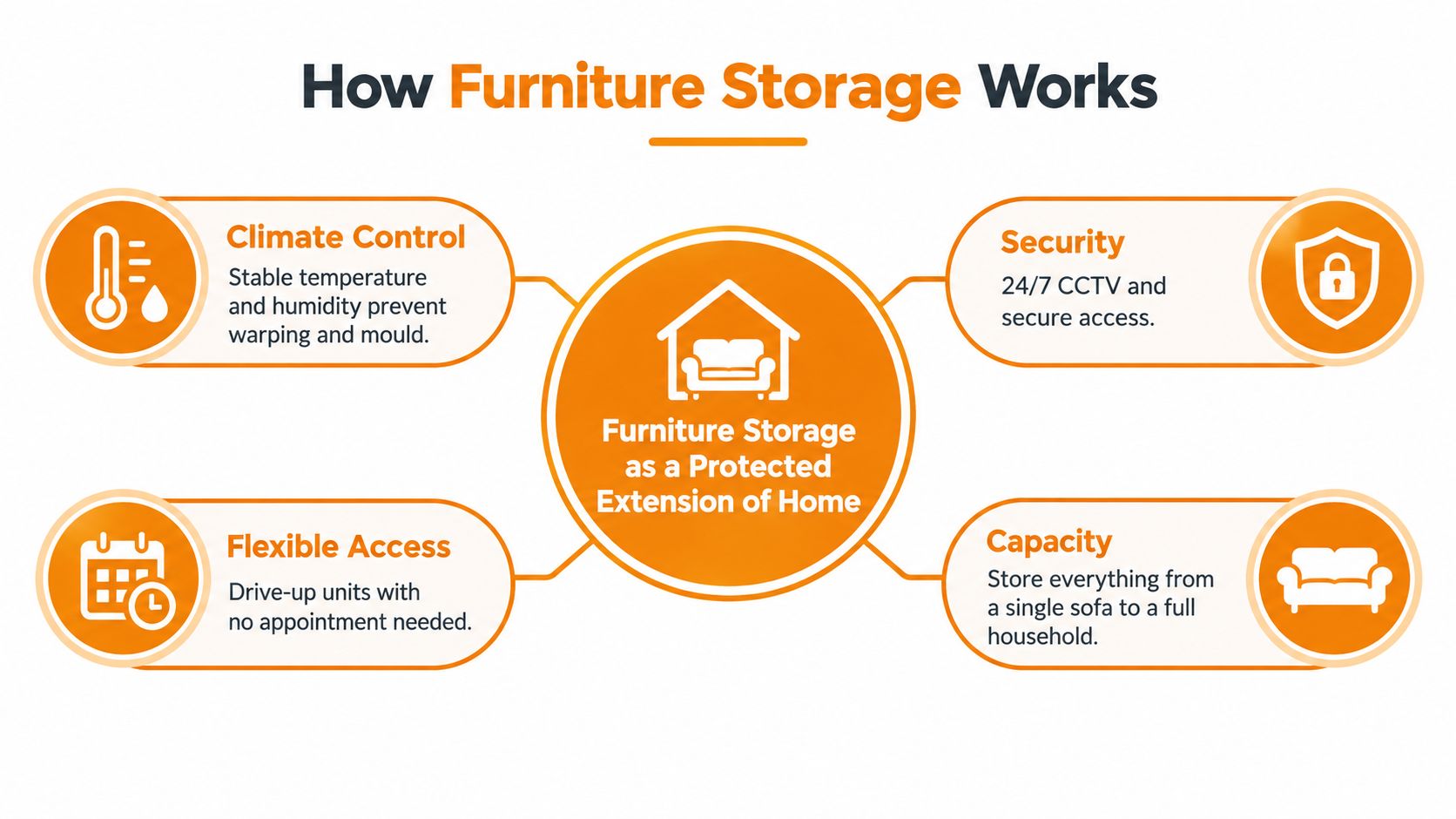
What changes inside a proper storage unit
A good storage unit does three basic jobs. It keeps furniture apart from daily living, reduces exposure to damp or temperature swings, and gives you a set place to return to the items when you need them. That is why a proper unit usually works better than a borrowed garage corner. A garage may seem fine for a while, then turn damp without warning, while a managed facility is designed to stay steady.
Conservation guidance for UK storage environments recommends keeping ICON environmental management guidance in a controlled band of about 35% to 65% relative humidity and avoiding big swings, because fluctuations speed up deterioration. The same guidance says closed storage areas can be kept above 5°C, with pipe-freezing risk making 5°C a practical floor. You do not need to memorise the figures. The simple point is that furniture lasts better when the environment stays even.
Why climate matters for furniture
Wood expands and contracts as moisture changes. Upholstery can hold humidity. Leather can dry out if the air is too harsh, and mould becomes a risk if the space stays damp and still.
UK-oriented storage advice often narrows the working target to roughly 10–15°C and 40–60% humidity, and recommends putting furniture on pallets or shelving so air can move underneath Furniture storage guide.
Airflow matters more than airtight wrapping for most furniture. Keep items covered, but do not trap moisture against them.
That steady environment is what separates furniture-grade storage from ordinary holding space.
Choosing the Right Unit Size and Climate Option
A storage choice is rarely just about square footage. For Derby renters and movers, it is usually a timing decision too. If your tenancy ends before your next place is ready, or you are waiting on a housing handover, the unit needs to bridge that gap without forcing you to repack everything twice.
Start with the furniture you need to protect, then match the space around it. A few boxed items and one chair need a very different setup from a living room, bedroom set and dining table. The right unit gives you enough room to stack safely and still reach the back without moving half the contents first. If you want a quick sizing check, what size storage unit do I need is a useful starting point.
Unit sizes and when climate control starts to matter
For short overlaps between homes, standard storage can work if the furniture is sturdy and well packed. Once items are likely to sit for more than a season, treat climate control as standard rather than optional. That extra stability matters because wood, fabric and leather respond to slow changes in air and temperature, a bit like a door that starts sticking when the weather turns.
Climate control becomes easier to justify when the furniture is valuable, sentimental, or made mostly of wood and upholstery. It also helps when the unit will stay closed for longer periods, because the problem is often not one wet day, but repeated small changes that build up over time.
| Furniture Storage Unit Sizes and Best Uses in Derby | ||
|---|---|---|
| Unit Size | Fits Best | Climate Recommended When |
| Small locker or compact unit | Boxes, a few chairs, bedside pieces | The items are staying put for longer than a short move, or include mixed materials that should not sit in changing air |
| Medium unit | One-bed flat contents, a sofa, bed frame, wardrobes | Furniture will be stored through a tenancy gap, or includes upholstered pieces and wood that need steadier conditions |
| Large unit | Three-bed house contents, multiple rooms, bulky dining sets | You are holding furniture for a longer housing delay, or storing high-value pieces that would be awkward to replace |
A good rule is to size the unit around the bulkiest item first, then leave space for the path you will need later. That keeps the layout practical, not just theoretical.
Climate and packing should be read together. A unit can be the right size and still be poor storage if furniture is pressed tightly together or placed straight onto the floor. Raising items on pallets or shelving helps air move underneath and reduces contact with any moisture that settles lower down.
The same planning approach applies to how you load the unit. Quote My Wall storage tips is useful because it reinforces a simple idea, put the pieces you may need first near the front and leave a clear route into the unit. In Derby, where people often store furniture while waiting for housing to line up, that small bit of planning saves a lot of back-and-forth later.
Security Pricing and Booking Essentials in Derby
A storage choice can feel calm or stressful long before the van arrives. In Derby, the local market looks fairly well supplied by UK standards, with one independent tracker estimating 7 self-storage sites, about 243,374 sq ft of lettable space and 0.89 sq ft of storage per resident, compared with a UK average of 0.9 sq ft Storage Compass Derby profile. That gives renters room to compare, which matters when you are matching a unit to a tenancy gap rather than trying to buy time for clutter.
Derby also shows ongoing movement in the sector, with the same source reporting 4 storage planning applications in and around the city in the last 12 months, all approved. A market like that usually means more choice, but choice only helps if the quote is clear and the site fits the way you need to store.
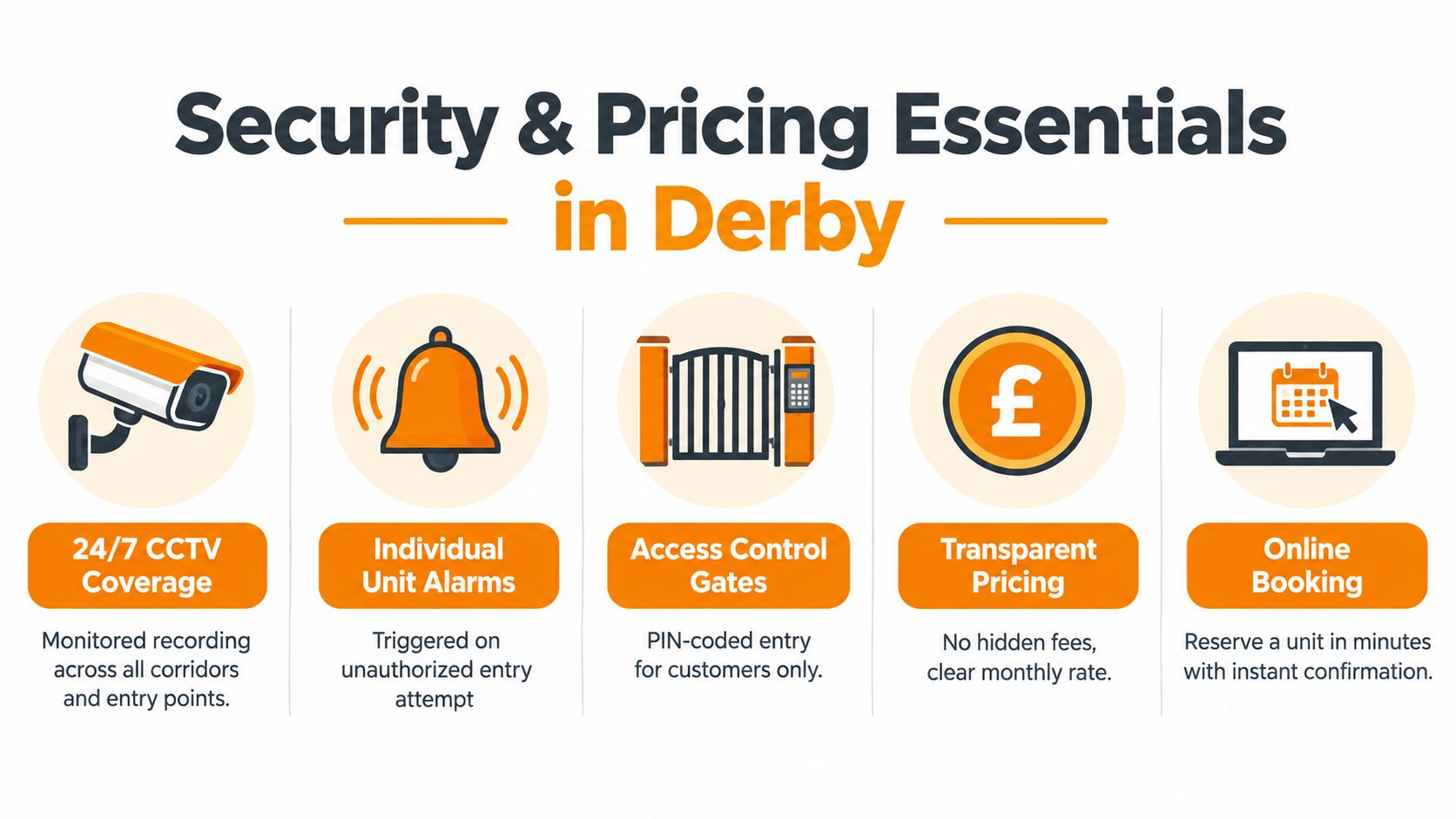
What to check before you book
Before you compare quotes, the guide to how much self storage costs in the UK helps explain what shapes the monthly rate.
A short checklist keeps the process clear:
- Controlled access: ask how renters enter, and who else can get onto the site.
- CCTV coverage: look for monitoring across entrances and internal routes.
- Pricing clarity: check what the monthly rate includes, and what is extra.
- Contract flexibility: make sure the term fits a move, renovation, or tenancy gap.
- Booking process: online reservation should be easy, not buried in admin.
These details matter because a low headline price can rise once you add access charges, transport delays, or a cancellation rule that does not suit your timing. Booking should feel like labelling boxes before a move, straightforward work that saves confusion later.
Why local availability changes the decision
Derby City Council's housing data shows 8,492 households on the waiting list, including 3,424 waiting for one-bedroom homes Derby housing research and intelligence. That points to real pressure in the local housing system, even while storage supply looks reasonably balanced. For many residents, a housing gap rather than clutter drives the storage decision.
Orange Box Self Storage offers that kind of arrangement alongside secure access and climate-protected units, so it remains one practical option among several when you compare local facilities. The aim is to choose a place that matches timing, access needs, and budget, not the first unit with spare space.
Packing and Protecting Furniture for Storage
Good packing prevents most of the damage people blame on storage itself. Start before anything goes into a van. Clean each item, let it dry fully, and remove crumbs, dust, and residue that can attract smells or pests while it sits.
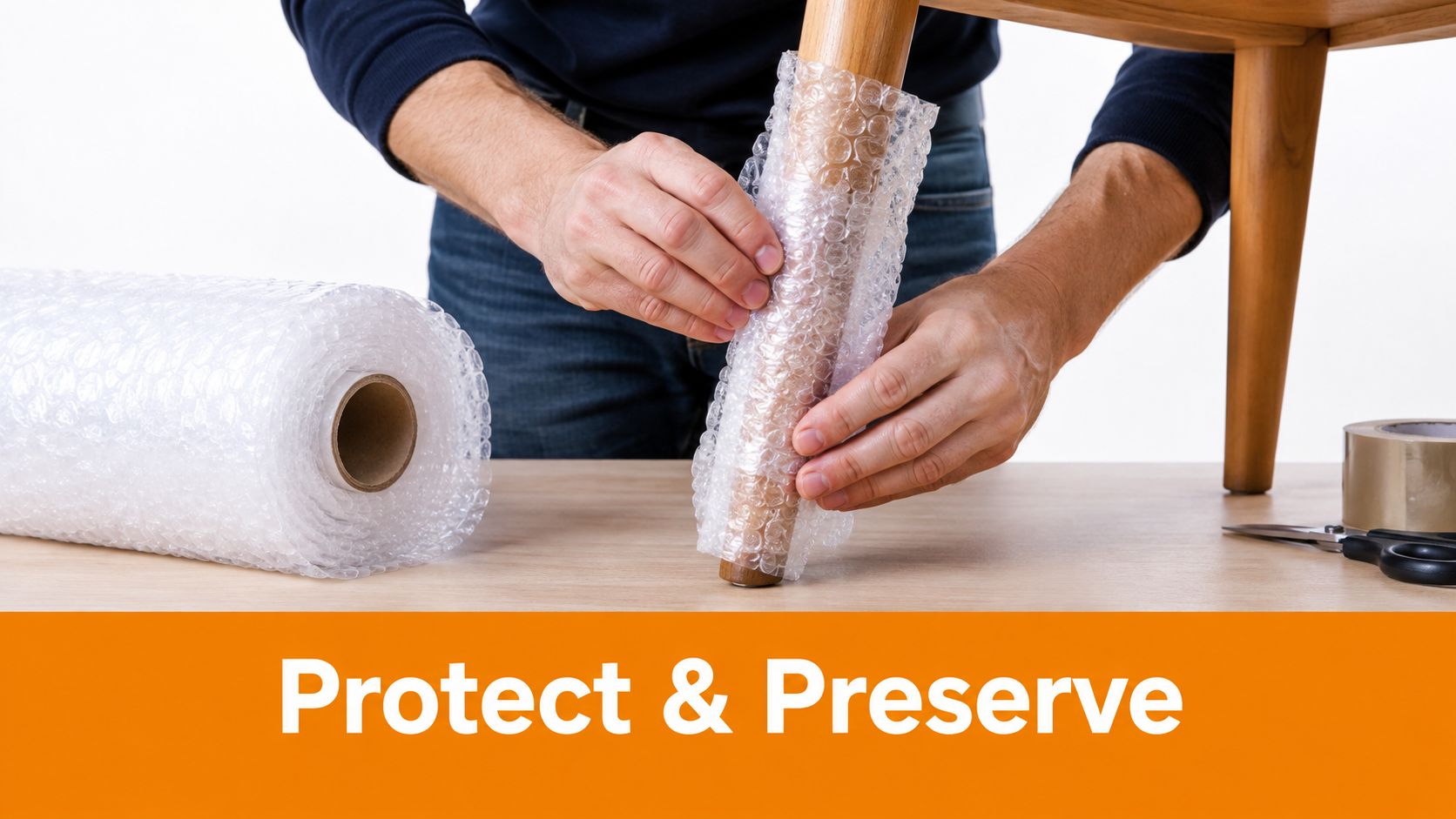
Pack in the order the furniture will need protection
Take apart anything that comes apart safely. Bed frames, table legs, and shelving units take less space when separated, and loose fittings should go into labelled bags taped to the matching item. If a piece has glass, fragile trim, or drawers that shift, secure those parts before the move.
Use the wrapping material to match the job. Breathable covers suit longer storage because they protect surfaces without trapping damp. Bubble wrap works better for corners, legs, and other impact points during moving or loading. Plastic film can help for transport, but leave it on only for the short haul. If it stays in place too long, it can hold moisture against wood or upholstery.
Cover the item, not the air around it. Protect against scuffs, but do not seal in damp.
That matters most for wood and upholstery. If a chair or wardrobe comes off the van slightly cool and then gets wrapped airtight, condensation can become part of the problem rather than the solution. Never place wooden or upholstered pieces directly on concrete, use pallets or shelving so the floor does not transfer moisture into the base of the item.
Stack for access, not just for height
Put the heaviest pieces at the back or along the wall, then keep lighter boxes and smaller pieces where they are easy to reach. Do not bury the item you are likely to need first. If you are storing a dining set and a sofa together, plan for which one may need to come out first when the new home is ready.
A few practical habits make a big difference:
- Label clearly: write what each item is and which room it came from.
- Keep a pathway: leave enough space to reach items without shifting everything.
- Protect contact points: use blankets or padding where wood meets wood.
- Separate soft from hard surfaces: that helps stop scratches and pressure marks.
The full packing guide at tips for packing when moving house is useful because the same habits that help on removals day also help during storage. Pack once with retrieval in mind, and you will not need to unpack half the unit later just to find one chair leg.
Local Access Transport and Who Storage Suits Best
Storage works best when transport and access fit the way you move. If your home, workplace or temporary stop is in Derby, Nottingham, Long Eaton or Beeston, a site with easy road access can cut the stop-start routine that comes with moving furniture in stages. A smooth route matters because large pieces are awkward enough without adding extra trips and reshuffling.

Different users need storage for different reasons
Homeowners between completions often need storage because the dates do not line up neatly. Renters use it when they move on short notice, downsize, or bridge between tenancies. Students need it for holiday breaks, placements, or the shift between halls and private housing. Businesses and tradespeople use it for stock, archived files, tools and bulky items that do not sit well in a shop, van or workspace.
That mix suits Derby's housing pressure. As noted earlier, local demand can leave people waiting for the right property or the right move date. In that setting, storage becomes a practical pause while the housing side catches up. A larger home is not always the better answer, especially if the gap is temporary and the furniture already has a next stop.
Matching storage to real life
The easiest way to judge fit is to ask three questions. How soon will you need the furniture again? How delicate is it? How often will you want access while it is stored? A student with one room of belongings and a contractor storing tools will answer those questions differently, and the storage plan should reflect that.
A student might only need occasional access, which makes longer stays and simpler access patterns easier to manage. A tradesperson may need to get to equipment more often, so short visits and straightforward loading matter more than the size of the unit alone. Furniture storage follows the same rule. If a dining set is likely to stay untouched until move-in day, that needs a different setup from a sofa or wardrobe you may want to retrieve sooner.
For many people, the right choice is a flexible term with easy access and protection that suits the contents. A Derby facility with secure entry, climate control and simple booking can fit those needs without making the process harder than the move itself.
Furniture Storage in Derby FAQs and Next Steps
How long Derby residents need furniture storage depends on the move in front of them. Some people only need a few weeks between tenancies or completion dates. Others keep items stored through a longer housing search or renovation. The right storage length depends on whether the furniture has a clear next home.
Short-term storage often makes sense when housing is tight. If you are waiting for the right property or the right move date, storage can act like a holding bay while the housing side catches up. That is why the decision is often about timing as much as space.
What about bulky waste and reuse? Derby City Council's bulky waste and reuse context shows that oversized household items do have to be handled carefully, and some pieces may be better passed on than thrown away. That gives furniture storage a useful middle ground. It lets you hold onto a good piece while you decide whether to keep it, reuse it or remove it. A sofa, wardrobe or table can sit in storage a bit like a spare room offsite, ready when the next home is settled.
If you need a secure place for furniture while you sort out a move, tenancy or renovation, compare unit access, booking terms and how well the facility suits your timetable. Orange Box Self Storage offers secure self-storage in Derby with flexible rental options, so it is a straightforward place to start when you want furniture kept safe without taking on more space than you need.