


You're setting up a stall at dawn, the van is half-unloaded, and the day's best stock still needs somewhere safe to sit. In Derby, that is part of the trading model. With high footfall at Market Hall and a trader base that needs quick turnaround, storage for market traders in Derby has to do more than hold boxes. It has to fit around early starts, late restocks, and the constant movement between van, unit, and stall.
Derby's restored Market Hall points to that reality. The BBC reported that the city council turned away over 780 traders who applied for space, and that the venue averaged 15,785 weekly visitors between July 21 and November 16, with a peak of 18,519 in one week and a low of 10,054 in another BBC reporting on Derby Market Hall demand. That level of activity matters because traders need a place for surplus stock, but they also need a back-of-house system that keeps packaging, displays, and seasonal overflow organised.
Derby also has the civic structure to support that kind of setup. The city council identifies a dedicated Markets Service inside Derby City Council, which shows markets are part of the city's formal framework rather than an informal sideline Derby City Council Markets Service. If you want to keep your stall clear, protect fragile goods, or cut down on daily transport, nearby storage can separate a rushed setup from a controlled one. A unit close to your route works like a spare workbench, it gives you room to stage stock before it reaches the stall.
For traders comparing location, access, and loading convenience, container storage in Derby is worth a look alongside the council and market routes you already use. If you are also refining how you pack stock, eco-friendly packaging for UK hospitality helps you think through the materials that move with you every day, especially when boxes, wraps, and carriers have to travel between home, storage, and the market.
Why Market Traders Need Storage in Derby
You usually notice the storage problem only after the stall starts to crowd itself. Crates end up behind the counter, spare signage leans on the wall, and the trading area starts to work like a corridor instead of a selling space. Off-site storage solves that by acting as a second back room, one that keeps the stall clear without forcing you to cut stock.
A trader's day changes quickly, so the storage setup has to match that pace. Derby's Market Hall has been busy enough to create pressure on stock flow, and the demand pattern described earlier shows why stock has to move in and out without creating clutter. If you sell produce, packaged food, gifts, or seasonal lines, the challenge is not only having enough stock. It is also having a place where the overflow can wait safely until you need it.
That is where storage becomes part of the trading system, like a prep table that sits outside the stall. It gives you space for boxes, displays, paper goods, and backup inventory that would otherwise live in the van or underfoot. For traders who want to keep presentation sharp and handling simple, a unit close to the route into town can make setup and pack-down feel more controlled.
The choice is not only about space. Access policy matters as much as proximity. A unit that is nearby but awkward to reach can slow you down, while a slightly better-located site with easier loading can save time every trading day. For Derby traders comparing options, Orange Box Self Storage Derby storage units gives a local example of how access, loading, and unit use can be arranged around regular market work.
Traders also need to think about what travels between home, storage, and the market. Boxes, wraps, and carriers all take up room, and they matter more than many stallholders expect. If you are planning your stock movement with materials in mind, eco-friendly packaging for UK hospitality can help you think through the kinds of supplies that move with you every week.
A storage unit also helps when the rhythm of trade changes through the week. One day may call for a light load, while events, weather, or a stronger sales day can suddenly increase what you need on hand. With a secure place for surplus stock, displays, and packaging, you spend less time juggling items in the van or unloading them on the pavement.
Practical rule: if you keep carrying the same items back and forth every day, the van is being used like a warehouse. A proper storage unit gives that load a fixed home.
The benefit shows up in small, useful ways. Repacking takes less time, displays stay cleaner, and the stall feels easier to manage. For Derby market traders who want a calmer setup, storage works like the back room that a busy pitch often does not have.
Storage Options for Market Traders in Derby
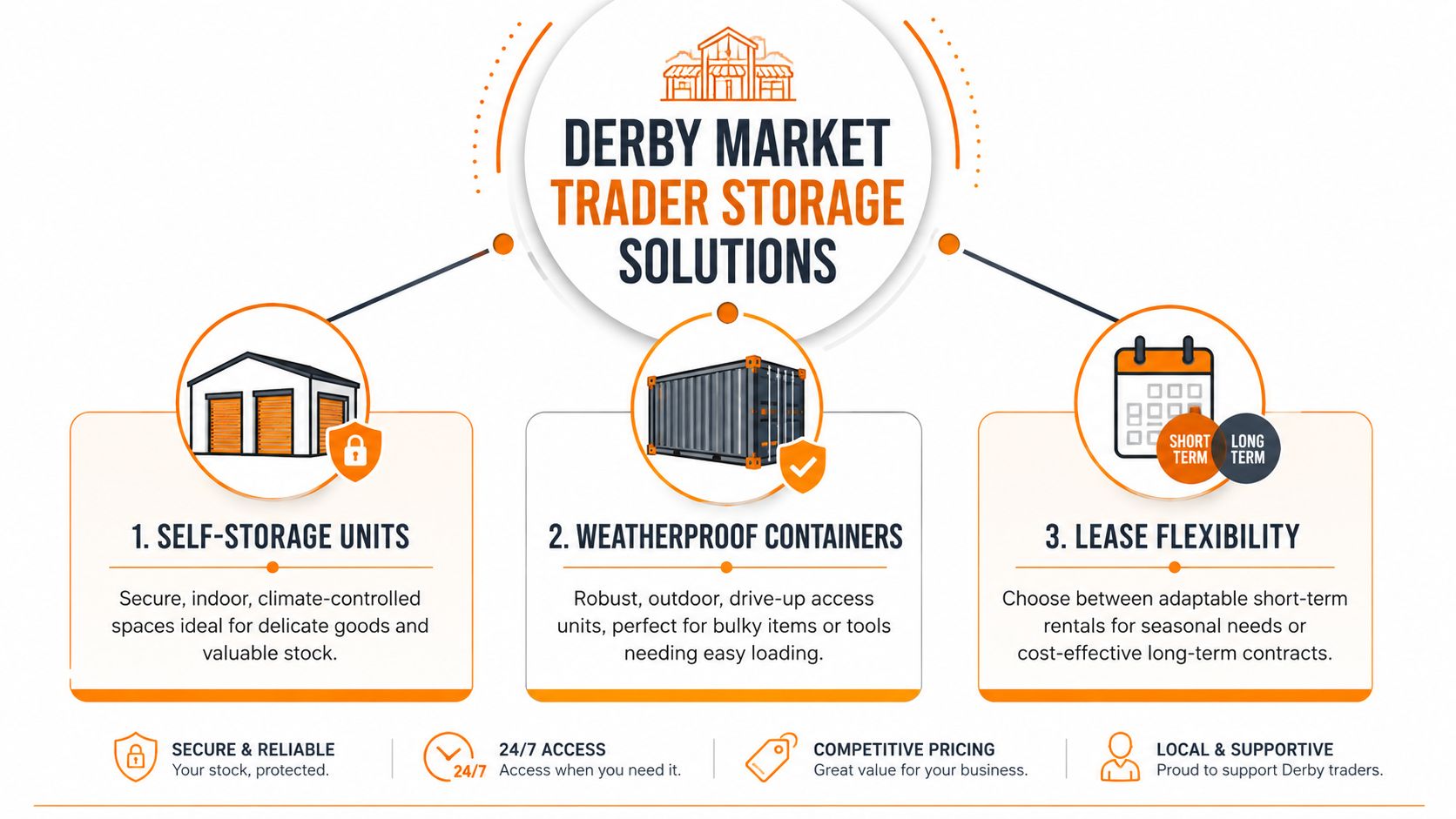
A Derby trader choosing storage usually ends up comparing three practical formats, self-storage units, weatherproof containers, and flexible leases. Each one solves a different kind of day-to-day problem, so the right fit depends on what you store, how often you need it, and how quickly you need to reach it. The choice is a bit like picking the right van layout, the answer changes with the load, the route, and how often you stop to unload.
Self-storage units for mixed stock
Self-storage suits stock that needs protection from dust, weather, and rough handling. It works well for traders carrying mixed items, such as labels, small appliances, folded displays, or boxed goods, because the unit can be organised in layers and the less-used items can sit at the back. If you want a local example of how business storage can be arranged for market work, Orange Box Self Storage container storage in Derby shows one approach that local users can compare against their own routine.
The main advantage is control. You decide how the unit is packed, and you can sort stock by season, product line, or event without having to reshuffle everything each time you visit. For traders who like a tidy system, it works like a back room attached to the stall, only without the limitation of a market pitch.
Weatherproof containers for bulky gear
Container storage is better when bulk and access matter more than delicate handling. It gives traders a place for trestles, signage, crate stacks, and heavier equipment that needs to be loaded quickly, which is why it often suits the parts of a market setup that are awkward to keep in a van. Local trader storage guidance also points to container formats around 160 sq ft with dimensions of 6.0 m × 2.4 m × 2.7 m, a size profile that suits palletised stock and mixed racking U Can Store It market traders page.
That kind of layout helps when you need to move items in and out without rearranging the whole unit. For many traders, a major benefit is that the container acts like a sheltered loading bay, so the gear stays together and the setup time stays predictable.
Flexible terms for seasonal trading
Lease length matters as much as the unit itself. Seasonal traders often need a shorter commitment, while established traders may prefer a longer arrangement if the space keeps working well. The right choice is the one that lets you grow or scale back without paying for empty floor space you do not use.
Access policy matters here too, because a cheap unit can become expensive if you lose time getting in and out. A trader who needs early, regular access will value a different setup from someone who stores reserve stock and visits only when the season changes. That is why a side-by-side look at access rules and location matters for Derby traders, not just headline price.
Derby's storage market is broad enough to support those choices. The city has local facilities clustered around industrial areas such as West Meadows and Pride Park, which shows there is a real micro-logistics network behind the local market economy. For a wider view of how traders can match storage to business security planning, the 2026 guide for South Wales businesses is a useful reference point for thinking about practical site protection and access control.
Choosing the Right Storage Size and Type
A lot of traders end up with too much space because they picture stock as loose piles. A better way to choose is to break the unit into working zones, cartons, racks, clear walkways, and enough room to pull items out without emptying the whole place. Once you measure it that way, the right size becomes much easier to judge.
Match the unit to the way you trade
Derby traders usually need storage that fits the way stock moves through the week, not just the way it looks on paper. That is why unit choice should start with your routine. If you carry a compact range of boxed goods, signage, and consumables, a smaller unit can be enough. If you separate fast movers from reserve stock, or keep bulky display gear with seasonal inventory, a mid-sized or larger space makes more sense.
For a practical comparison, the Orange Box storage unit size guide gives a useful reference for matching footprint to inventory. Traders in the city often see units in 75, 150, and 300 sq ft bands, alongside 160 sq ft containers, and those formats suit palletised stock and racking layouts well. The smaller band fits compact stock and seasonal overflow. The middle option is usually better once your stock needs a clearer split between active items and back-up supply. The larger choice works when you hold several product lines, bulkier display systems, or a deeper buffer for busy trading periods.
A simple rule helps here. Vertical storage suits boxed stock and lighter equipment because it uses height without spreading everything across the floor. Wider footprints suit traders who need to wheel items in and out quickly, because the access path stays clear and you are not shifting one stack to reach another.
| Unit Size | Dimensions | Recommended Use |
|---|---|---|
| 75 sq ft | Compact band | Small traders, boxed stock, signage, seasonal overflow |
| 150 sq ft | Mid-size band | Mixed inventory, display materials, reserve stock |
| 300 sq ft | Larger band | Higher SKU counts, racking, bulky back-stock |
| 160 sq ft container | 6.0 m × 2.4 m × 2.7 m | Palletised stock, tools, quick-load trade gear |
Don't pay for dead space
A unit can look generous and still work badly if the layout is awkward. If you cannot reach the stock you need on market day, the extra space is not helping you. Use the front of the unit for frequent-access items and the back for slower stock, in the same way a trader keeps the most-used items nearest the counter and the reserve supply behind them.
That side-by-side view matters for Derby traders because size and access should be judged together. A larger unit with poor layout can waste more time than a smaller unit that is organised properly. The right choice is the one that keeps stock visible, easy to reach, and off the stall until you need it.
Evaluating Security Access and Contract Flexibility
A trader can have the right unit size and still run into trouble if the site's security is weak or the access window does not fit market hours. Stock, tools, packaging, and display gear all need a place that feels controlled and practical, not a storage unit that adds another layer of stress before opening time.
The features that actually protect trader stock
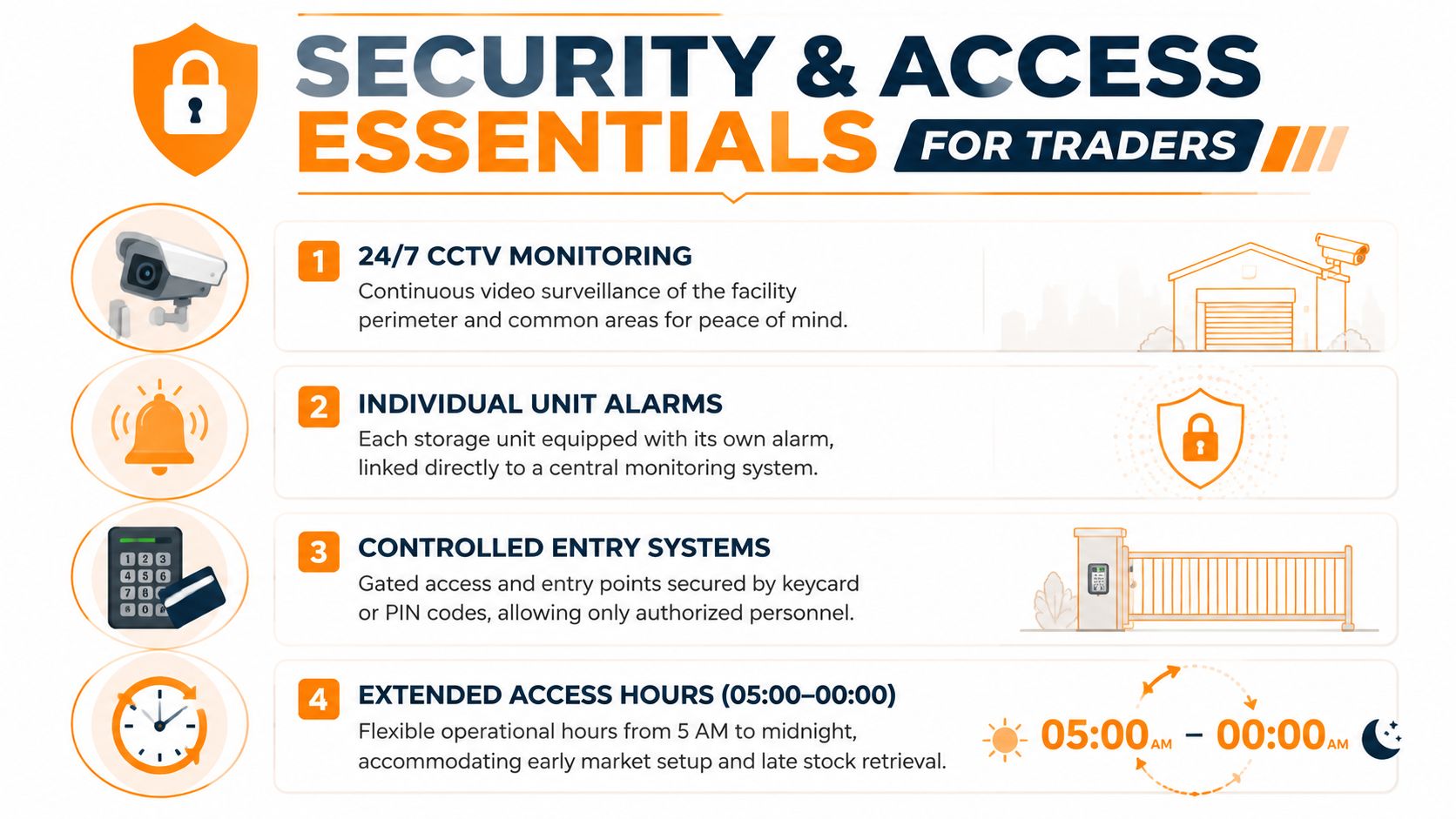
For Derby traders, the strongest setup usually combines 24/7 CCTV, individual alarms, and controlled access. The market traders page from U Can Store It describes those protections, including intruder alarms in some cases, which shows the basic pattern traders should look for: a site that watches entries, limits who gets in, and leaves a trace if something goes wrong. U Can Store It market traders page
That matters because off-stall stock is often a working inventory, not spare clutter. If you are holding resale goods, tools, and packaging on site, you need the same sort of control you would want for a secure stockroom behind a shop counter.
Access can be just as important as alarms. Some Derby storage sites offer 05:00–00:00 daily access with drive-up, ground-floor units, which cuts down the time spent moving crates through shared corridors or waiting for lifts. Storebox Derby access details For a trader loading before the market opens, that is the difference between a quick pickup and a delayed start.
Compare access before you sign
Access policies are not uniform across Derby. One listing shows 05:00–00:00 access, while another opens at 08:30, so the schedule itself can decide whether you can collect stock before dawn or only after the day has already started. Explorage Derby access listing A facility can look suitable on paper and still fail in practice if the gate is shut during your loading window.
Treat the access rule like a shop doorway. If the door is open when your van arrives, the rest of the process stays simple. If it is closed, every later task gets delayed, from loading to stall setup.
Before you book, ask for the exact entry policy, not a general promise that access is “convenient.” If the answer does not clearly match your market routine, keep looking.
Ask one direct question before you book, “Can I get in when I need to load for market day?” If the answer is vague, keep looking.
Contract flexibility matters for the same reason. Seasonal traders should not be tied into space that sits half-empty for long stretches, because unused storage still takes time to manage and still costs attention. A better fit is a format that lets you adjust as your stock profile changes through the year.
For traders who also want a broader view of layered site protection, the 2026 guide for South Wales businesses gives a useful way to think about security in practical terms. The point is simple, match monitoring, access control, and routine behaviour to the value and movement of what you store.
Optimising Proximity Logistics and Packing Strategies
A unit can be secure and still waste time if it sits in the wrong place. For market traders, proximity is not just about convenience. It changes how many times a box is lifted, moved, and checked before it reaches the stall. Fewer handlings mean fewer chances for damage and fewer delays on market morning.
Build the route around the unit, not the other way around
Derby's storage pattern supports that approach. Facilities are often grouped around industrial areas rather than right beside the market, so the key question is whether the unit is near enough for quick turnover runs and whether the access policy matches your loading window. If you collect stock before market setup, a gate that opens too late can create more trouble than a slightly longer drive.
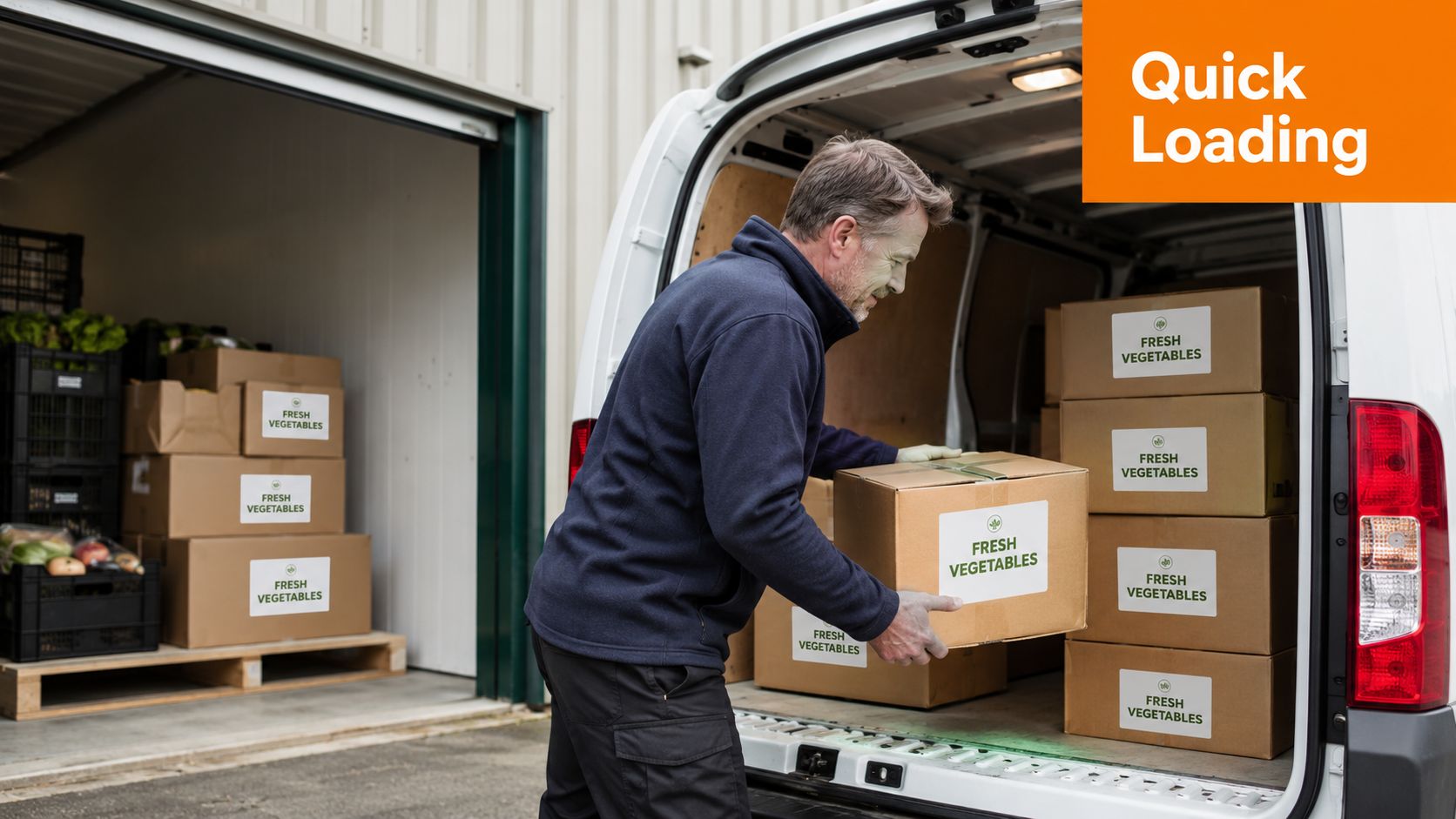
A simple route plan keeps the process tidy. Load the van in the same order every time, with the last items you need placed nearest the door. Put the stock for the first stall stop at the front and the least urgent goods further back. That cuts re-handling and makes unloading feel like a sequence, not a scramble.
Pack for speed, not just protection
Clear labels save time. “Fresh vegetables”, “display hooks”, and “winter wrap stock” tell you far more than “miscellaneous”. If you use tubs, crates, or boxes, keep one category per container where possible so you can find what you need without opening every lid.
Packing should also follow the way stock moves through the day. Heavy items belong low down, fragile items need fixed positions, and the things you will use first should be easiest to reach. That lowers the risk of breakage and keeps your van from sitting open while you search through stacked containers.
Helpful habit: pack the day before, then check whether the first three items out of the unit are also the first three items you will need on the stall.
That kind of routine makes storage part of the trading system, not just an off-site cupboard.
Why Choose Orange Box Self Storage for Market Traders
Orange Box Self Storage offers Derby traders a practical mix of business storage, container storage, flexible rental terms, and secure facilities with 24/7 CCTV, gated access, and individually alarmed units, according to the publisher's own service description. That matters for market traders because the best storage choice is usually the one that removes small daily frictions, loading, storing, and collecting without adding extra steps.
The primary value is suitability. If you need compact storage for boxed stock, more open space for racks, or a container for tools and bulkier items, a single provider with multiple formats makes comparison easier. You also avoid the common mistake of choosing a unit that looks cheap but forces you into bad access hours or awkward loading routines.
For Derby traders, the decision should come back to three questions. Can you get in early enough for market prep? Can the unit handle your actual stock shape? Can you keep the stall clear without overpaying for unused space? If the answer to those is yes, storage starts paying its way in saved time and cleaner trading routines.
A CTA for Orange Box Self Storage.