


You’ve cleared the room, the bed frame is gone, and the mattress is the awkward last item leaning against the wall while you decide what to do with it. It still has years of life left. You don’t want to replace it, and you definitely don’t want to pull it out of storage later and find stains, a musty smell, or damage that wasn’t there when it went in.
That’s where many get caught out. They assume a mattress just needs “covering”, as if any loose sheet of plastic or a fabric dust cover will do. In UK storage, that’s rarely enough. Mattresses absorb damp, pick up grime through tiny tears, and give pests a place to hide if the seal is poor.
Good covers for mattresses in storage aren’t about appearances. They’re about creating a barrier, using the right material for the storage period, and packing the mattress in a way that doesn’t trap moisture or distort its structure. If you get those parts right, the mattress comes back out in usable condition. If you get them wrong, the cover becomes little more than a dirty outer layer around a damaged mattress.
Why Your Mattress Needs More Than Just a Dust Sheet
You see this mistake after a house move all the time. The mattress gets wrapped in an old sheet, stood on its side, and left in storage with the assumption that “covered” means “protected”. It does not.
A dust sheet keeps loose dirt off the surface. That is all. It does not seal out damp air, it does not stop scuffs and punctures during handling, and it does not give pests much resistance if the cover sits open around the corners or seams. In UK storage, those gaps matter because mattresses hold moisture and odour far more easily than hard furniture.
I have seen mattresses come out of storage looking fine on the outside, then fail the moment the cover comes off. The outer layer is dirty, the edges are marked, and the fabric underneath has picked up that stale, slightly musty smell that is hard to remove once it sets in. A cheap cover often creates a false sense of security.
A storage cover's main purpose is simple. It needs to act as a proper barrier against airborne grime, light moisture exposure, rubbing during transport, and the kind of poor sealing that gives insects a place to get in and hide. A loose fabric sheet cannot do that well enough for anything beyond very short-term indoor protection.
That matters even more in Britain, where damp conditions are a practical risk for stored household goods, especially in garages, sheds, and older buildings. Mattresses are soft, absorbent, and awkward to handle, so they tend to suffer first and show the damage late.
If the mattress has any existing marks or dust on it, sort that out before it is sealed. A good starting point is this guide on how to clean a mattress. Then choose a cover that suits the storage period and the environment, not just the journey from house to unit.
If you are booking a unit, it also helps to avoid the wider packing errors that damage upholstered items and soft furnishings. Orange Box Self Storage has a practical guide to common storage unit mistakes and how to avoid them.
The Crucial First Step Before Covering Your Mattress
On moving day, mattresses often become ruined. Someone strips the bed, slides the mattress into a bag, tapes it up, and assumes the job is done. Six months later, the fabric smells stale, a faint stain has spread, and the corners have collected grit that rubbed in during transport.
A cover only protects what goes into it. If the mattress is dusty, marked, or holding even a little moisture, sealing it usually makes those problems harder to put right.
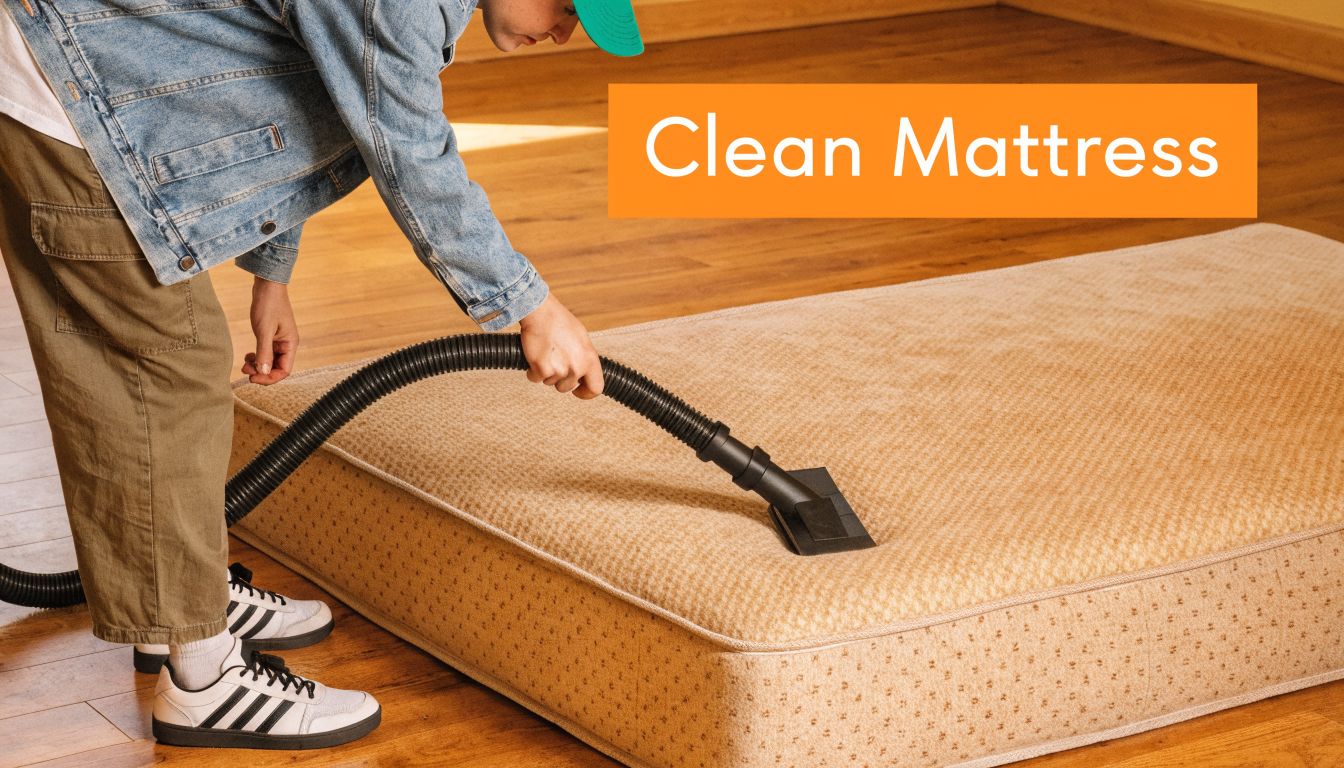
Vacuum both sides properly
Use a vacuum with good filtration and take your time over the whole mattress. Clean the top, underside, side panels, piping, and stitched seams. Those edges hold the dust, hair, and fine debris that get missed in a rush.
In storage, especially in UK conditions where damp and pests are real risks, that debris matters. Dust and skin flakes give insects more reason to settle around seams and handles, and once the mattress is bagged, anything left behind stays there.
Lift the mattress and work methodically. A quick once-over is rarely enough.
Clean marks carefully and keep moisture under control
Treat stains before storage, but do it with restraint. The aim is to remove the mark without soaking the filling.
Use a cloth and a suitable cleaner, and work on the affected area only. Blot the stain. Do not scrub hard, and do not spray the whole surface because one patch looks dirty. I see this mistake often with mattresses that have been stored after a hurried house move. The surface may look cleaner at first, but too much liquid sinks below the fabric and takes far longer to dry than people expect.
If you want a practical refresher before you start, this guide on how to clean a mattress covers the basics well.
Drying decides whether storage goes well or badly
This is the part that separates a mattress that comes out fresh from one that comes out musty.
After any spot cleaning, let the mattress dry fully before it goes anywhere near a cover. In British homes, garages, and older buildings, air can already be damp, so guessing is risky. A mattress can feel dry on the surface while still holding moisture deeper in the quilting or padding.
Use airflow. Open windows if the weather is dry, run a fan if needed, and stand the mattress so both faces can breathe. If it feels cool to the touch in the cleaned area, give it more time. Bagging it early is one of the costliest mistakes because trapped moisture has nowhere useful to go.
Check the condition before you seal it
Give the mattress a final inspection once it is clean and dry. Look for small tears, loose piping, weak handles, or damaged corners. Minor faults get worse during carrying and stacking, and they are easier to spot now than after the mattress is wrapped.
Before any cover goes on, make sure you have done all of the following:
- Remove bedding, toppers, and protectors.
- Vacuum the full mattress, including seams and lower edges.
- Treat stains lightly, without soaking the fabric.
- Let the mattress dry fully.
- Check for rips, worn corners, or loose stitching.
Done properly, this prep takes a little longer. It saves far more time and money than dealing with mould, odour, or fabric damage after storage.
Choosing Your Mattress Cover Plastic vs Fabric vs Vacuum Bag
A mattress going into storage in the UK needs a cover chosen for real risks, not shop-shelf labels. In my experience, the two problems that ruin mattresses are trapped moisture and small openings that let dirt or pests in. The right cover controls those risks without creating a new one.
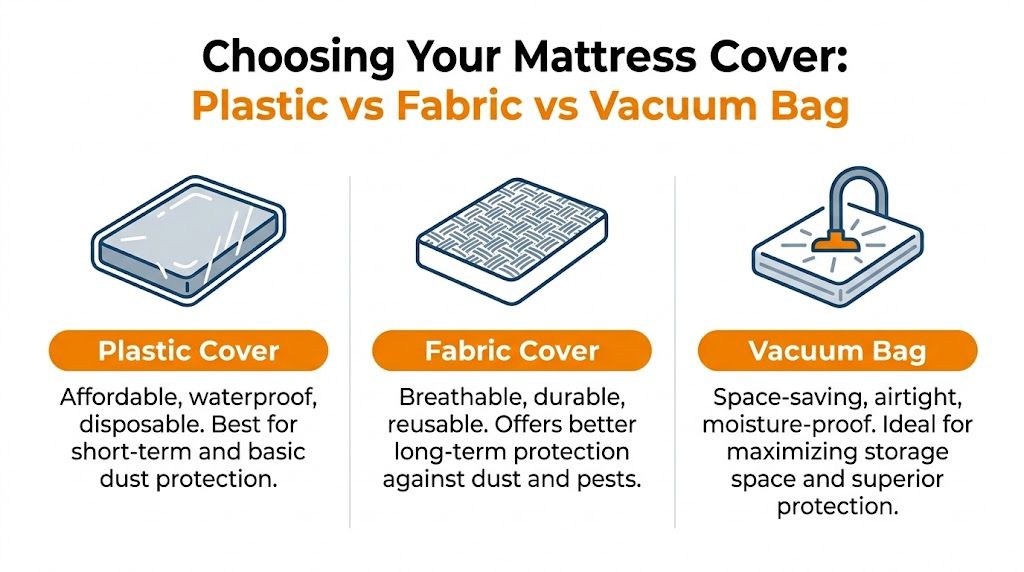
Start with the storage conditions. If the mattress is headed into a clean, dry room for a short period, you have more flexibility. If it is going into a unit through a British winter, or anywhere damp might creep in, the cover needs to act as a proper barrier. If you are also worried about pests, the seal matters as much as the material.
Plastic covers
Plastic is the standard choice for storage because it gives the best protection against surface moisture, dust, and knocks during handling. For most customers, a heavy-duty mattress bag is the safest starting point.
The trade-off is breathability. Plastic does not forgive a mattress that still holds moisture inside. It also varies wildly in quality. Thin moving bags tear at the corners, split around handles, and leave gaps once they are dragged in and out of vans or units.
Plastic works best when:
- the mattress is fully dry and ready to seal
- storage is short to medium term
- damp, dust, or rough handling are the main risks
If you are also packing the rest of a house move, the same rule applies across the load. Use materials that suit storage conditions, not just transport. Orange Box Self Storage has a useful guide on packing properly for a house move that follows the same practical approach.
Fabric covers
Fabric covers are easier to carry, easier to reuse, and less likely to snag while you manoeuvre the mattress. They are a sensible option if the mattress will be moved several times before it settles into storage.
They are weaker against damp unless the product is specifically designed to resist moisture. That is the point many people miss. A tidy-looking fabric cover is not automatically suitable for storage in UK conditions.
If you are comparing products, look at purpose-built durable mattress protectors and check what they are designed to do. Some are made for everyday bedroom use, not for long periods in storage.
Fully sealed encasements
A full encasement is usually the best choice for longer storage or for units where pest prevention is a serious concern. It closes around the whole mattress and leaves fewer weak points than a simple slip-on bag.
This option costs more, but it solves a real problem. A cover that fits loosely or leaves an open end does little against insects or contamination at the edges. For customers storing for months rather than weeks, that extra protection is often worth paying for.
Vacuum bags
Vacuum storage sounds appealing because it promises less bulk. For mattresses, it is a narrow-use option, not a default recommendation.
Some foam mattresses can be compressed if the manufacturer says so. Many cannot. Traditional sprung mattresses should not be vacuum packed. Even with foam, the risk is simple. Save space the wrong way and you may end up with a mattress that does not recover its shape or comfort.
If the manufacturer instructions are unclear, do not compress it.
Mattress Cover Comparison for Storage
| Cover Type | Best For | Pros | Cons / Risks |
|---|---|---|---|
| Plastic cover | Short to medium-term storage in damp-prone conditions | Strong moisture barrier, affordable, good protection from dust and handling damage | Traps moisture if the mattress was not fully dry, cheap versions tear easily |
| Fabric cover | Cleaner indoor handling, repeat use, lighter protection needs | Reusable, easier to carry, less slippery | Often poor against damp unless specially designed for storage |
| Fully sealed encasement | Long-term storage or higher pest risk | Better full-cover protection, fewer openings, stronger defence against contamination | Higher cost, needs correct sizing and fitting |
| Vacuum bag | Specific mattresses where compression is approved | Can reduce bulk in the right case | Unsuitable for many mattress types, can affect shape and support |
Sealing and Packing Your Mattress the Right Way
A mattress usually gets damaged in the last ten minutes before it goes into storage. Someone catches a corner on concrete, leaves the end of the bag half-open, or stands it in a damp van while loading the rest. In UK storage, especially through a wet spell, small mistakes like that are what turn a usable mattress into one that smells musty or picks up contamination.
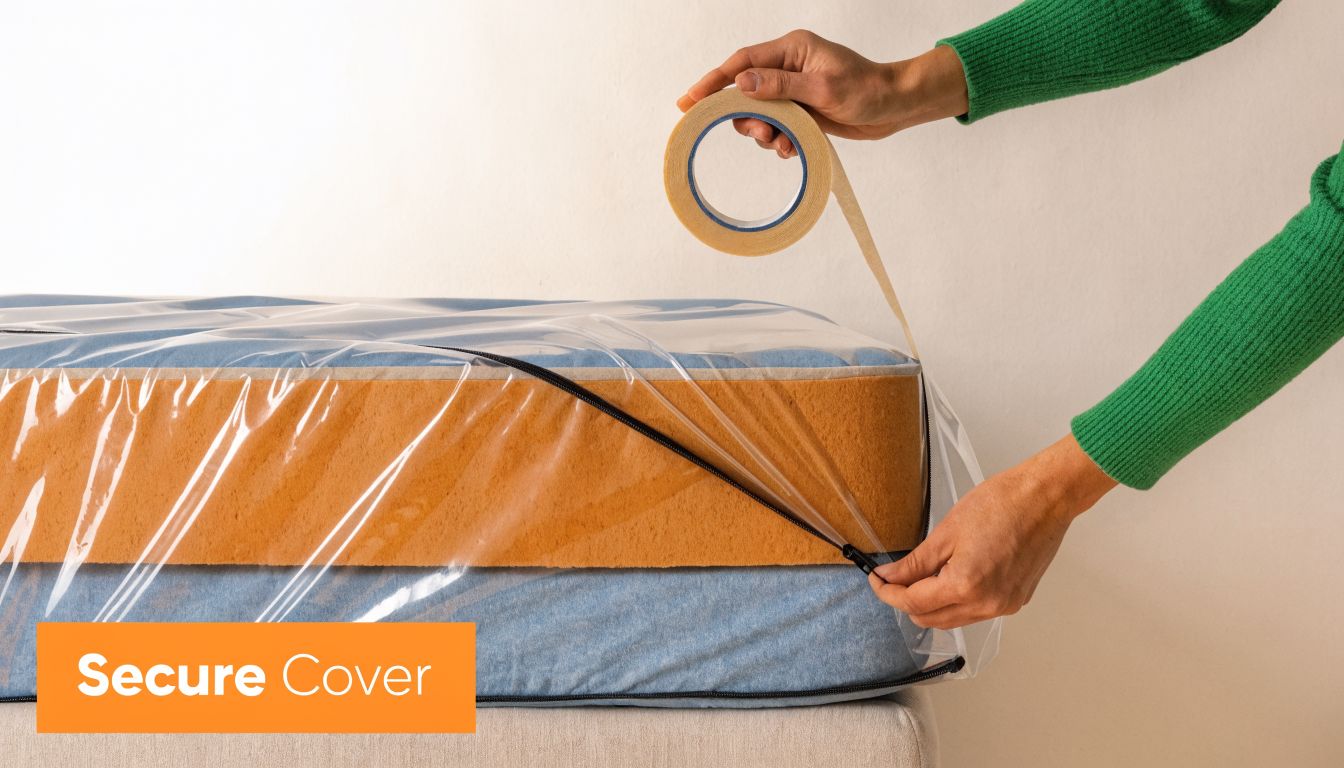
Get the mattress into the cover without damaging the cover first
Set up the area before you touch the mattress. Use a clean, dry floor indoors if possible. If you bag it outside on paving, or in a car park after rain, you are creating the problem the cover is meant to prevent.
Open the cover fully and check the seams. The easiest method is with two people. One holds the mattress upright and steady while the other feeds the cover over the top corners first, then works it down evenly. That keeps strain off the weak points.
Carry the mattress in short, controlled lifts. Do not drag it over thresholds, rough concrete, or gravel. Corners split covers fast, and once the cover tears, dust, damp air, and pests have an entry point.
Push excess air out so the cover sits close to the mattress, but do not force the mattress into a tighter shape just to make it look neat.
Seal the opening properly
The opening is where poor packing shows up. A loose fold or a token strip of tape is not enough for long-term storage, particularly in UK conditions where damp air can work its way into any gap.
If the cover has a zip, close it fully and check both ends. If it uses a flap, fold it flat and tape the full width, not just the middle. Add extra tape on the corners if the plastic feels thin or the mattress will be moved more than once.
Seal it before the mattress goes into the unit. Trying to tape a bag closed once the mattress is already leaning against a wall usually leads to twisted plastic, missed gaps, and split seams.
Keep the mattress in its proper shape
Do not fold a sprung mattress. Do not bend it to get it round a tight corner. Internal damage often does not show until the mattress is back in use.
Foam models vary. Some can tolerate limited compression or temporary bending, but only if the manufacturer says so. If the label or manual is unclear, store it flat and handle it as if it cannot be compressed.
This is also the point where people undo their own care by propping the mattress somewhere dirty while they sort the rest of the load. Keep it covered, upright only while moving it, and off wet ground at every stage.
Use this order:
- Prepare a clean, dry packing area: Do the bagging before loading the van or entering the unit.
- Fit the cover with two people if possible: Start at the top corners and work it down evenly.
- Press out loose air: Keep the fit close without forcing compression.
- Seal the opening fully: Zip it completely or tape the entire flap and corners.
- Move it by lifting, not dragging: Protect the cover from snags and tears.
- Set it down on a clean raised surface once inside the unit: That helps protect it from floor moisture and general dirt.
If the mattress is part of a full house move, Orange Box Self Storage also has practical tips for packing when moving house that help you avoid the usual loading mistakes.
Storing Your Mattress Safely at Orange Box Self Storage
The cover protects the mattress itself. The unit setup determines whether that protection keeps working.
A mattress shouldn’t be shoved into the first open gap. It needs a dry, stable position, no crushing weight on top, and enough room around it that the cover doesn’t snag every time someone moves boxes in or out.

Place it for stability, not convenience
Inside the unit, the mattress should sit on a raised base such as slats or a pallet. Leave a bit of air around it rather than pressing it hard against every surrounding item. Don’t stack dense furniture or heavy cartons on top of it. Even when a cover prevents surface scuffs, pressure can still distort the internal build over time.
If you’re storing bedroom furniture as well, load the unit so the mattress isn’t the item you need to shift every time you want access to something behind it. Frequent moving creates tears, corner wear, and bad handling decisions.
Damp control and pest control work together
In the East Midlands, storage advice has to reflect real local conditions. Damp is one part of the problem. Pests are the other.
That’s why a generic loose plastic sleeve isn’t enough if the mattress will sit for any length of time, especially for renters or students moving in and out of shared housing. Amid a reported 300% rise in UK bedbug infestations in 2025, especially in student-heavy areas such as Nottingham and Derby, non-zippered covers showed an 80% breach rate in Pest Control Association tests, and renters and students make up 20% of the UK storage market according to this UK bedbug and storage encasement guidance.
That points to a clear trade-off. Basic plastic may be fine for light dust and splash protection, but if pest exposure is a concern, you need a fully zippered, bedbug-proof encasement rather than an open-ended bag with a folded flap.
In shared-living towns, the right seal matters just as much as the right storage unit.
Match the cover to the unit conditions
A climate-protected environment reduces the strain on the mattress and on the cover itself. If you’re comparing unit types, it’s worth reading about climate-controlled storage units so you can judge whether you need that added environmental stability for a mattress, upholstered furniture, or anything else sensitive to damp.
Orange Box Self Storage also offers mattress bags in multiple sizes, including Twin, Full, Queen, and King, for customers who need a fitted protective layer before loading the unit. That’s useful if the main problem is getting the right size quickly rather than improvising with a cover that doesn’t seal properly.
The practical setup is simple. Clean and dry the mattress first. Use a cover matched to the specific risk. Keep it raised, uncrushed, and accessible. That combination gives the mattress a decent chance of coming out in the same condition it went in.
Your Mattress Storage Checklist A Final Summary
Most mattress damage in storage comes from one of four mistakes. Packing it dirty, sealing in moisture, choosing the wrong cover, or placing it badly inside the unit. None of those are complicated. They’re just easy to overlook when you’re rushing through a move.
Here’s the checklist worth following on the day.
The non-negotiables
- Clean it before storage: Vacuum both sides and deal with stains before you cover anything.
- Let it dry fully: Never bag a mattress that still holds moisture from cleaning or room humidity.
- Choose the cover based on the primary risk: Heavy-duty plastic works well for damp protection. A fully sealed encasement is the better answer where pests are a concern.
- Seal every opening properly: Don’t rely on a loose flap or weak self-adhesive strip.
- Keep it off the floor: Use slats or a pallet so the base can breathe and stay separated from the unit floor.
- Avoid crushing pressure: Don’t stack heavy items on the mattress.
- Store it in a stable environment: The better the unit conditions, the less stress on the mattress over time.
What works and what doesn’t
What works is a dry mattress, a tough fitted cover, a proper seal, and careful placement.
What doesn’t work is a dust sheet, thin torn plastic, rushed cleaning, or treating the mattress like a spare board that can be folded, bent, or wedged wherever it fits.
A mattress is expensive to replace and unpleasant to discover ruined after months in storage. A little extra effort before the unit door closes is usually the cheapest part of the whole process.
Store the mattress so you can forget about it. Not so you’ll have to inspect for damage every time you think about it.
If you want the mattress back in usable condition, don’t aim for “covered enough”. Aim for dry, sealed, raised, and protected.
If you need a secure place to store a mattress, furniture, or the contents of an entire room, Orange Box Self Storage offers storage options across Nottingham, Derby, Long Eaton and Beeston, including climate-protected units for items that don’t cope well with damp and temperature swings.