


Your exams are done, your tenancy is ending, and your room still looks like a small warehouse. There’s a duvet you don’t want to drag home, a chair you regret buying, kitchen gear that somehow multiplied, and a laptop you definitely can’t afford to damage. You’ve probably also got a move-out deadline that feels much closer than it did last month.
That’s the point where a lot of students make expensive decisions. They leave everything to the final weekend, grab the first “cheap” option they see, and only later realise the cheap option wasn’t cheap at all once transport, packaging, insurance, and faff were added in. Storage options for Students in the UK aren’t just about finding space. They’re about timing, access, security, tenancy rules, and not wasting money on the wrong setup.
Navigating the End of Term Storage Challenge
One of the most common move-out scenes I see is this: a student in a tiny room, sitting among half-packed boxes, trying to decide whether to bin half their stuff, bribe a mate with pizza, or book storage in a panic. That stress isn’t unusual. It’s built into the way many student tenancies work in the UK, especially when halls contracts end before your next place is ready.

The pressure is often underestimated. In the 2021/22 academic year, the UK student population reached 2.86 million, and over 60% lived in accommodation averaging just 10 to 15 square metres, which is why off-site storage often becomes a practical necessity rather than a luxury, according to higher education storage findings reported by EdTech Magazine.
That small-room reality changes everything. You can’t “just tuck things away” if your room barely fits your bed, desk, and a narrow wardrobe. And if you’re in halls, PBSA, or a shared house with strict check-out rules, you may need the room fully cleared whether you’re ready or not.
Practical rule: If you’re leaving for more than a couple of weeks and you own anything bulky, breakable, or hard to replace, decide your storage plan before your final fortnight of term.
The right choice depends on what you’re storing and how long you need it gone. A few boxes of clothes are one problem. A bike, monitor, bedding, kitchen kit, and mini-fridge are another.
Your Main Student Storage Choices at a Glance
Most students are choosing between five routes: on-campus storage, private self-storage, container storage, shipping items home, or leaving things with friends or family. None is perfect. One will suit your situation much better than the others.
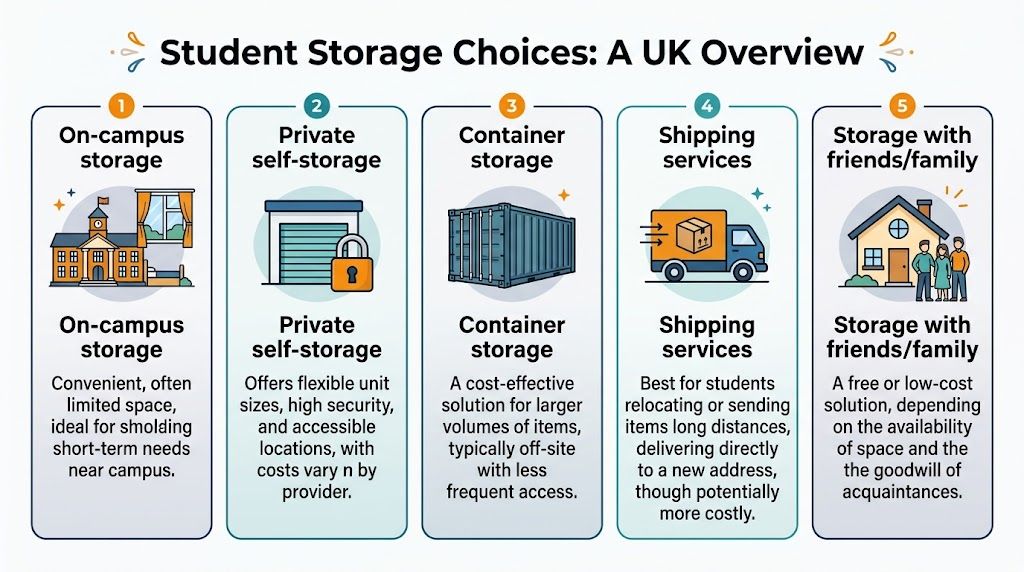
Use this as your quick decision table.
| Option | Best for | Main upside | Main downside | My view |
|---|---|---|---|---|
| On-campus storage | Students with very small loads and short gaps | Close to halls or campus | Often limited, seasonal, and not ideal for bulky items | Fine if available, but don’t rely on it blindly |
| Private self-storage | Most students with boxes, furniture, or valuables | Flexible sizes, better security, easier access | You need to compare contracts and extras carefully | Usually the most balanced choice |
| Container storage | Larger loads, bikes, furniture, sports kit, group storage | Good for bulkier items | May be less convenient if you need frequent access | Strong option if volume matters more than regular access |
| Shipping services | Students moving long distance or not returning to the same city | Direct delivery to another address | Can become expensive and awkward for mixed loads | Best for relocation, not just temporary storage |
| Friends or family | Very small loads and high trust | Low cost or free on paper | Access, guilt, damage risk, and awkwardness | Cheap only if nothing goes wrong |
The hidden-cost problem is real. A 2025 survey found that cheaper-looking options led to 15% budget overruns because students overlooked costs such as transport and insurance, especially in cities such as Nottingham and Derby, according to UK student storage cost analysis at Storage Sense.
What matters most when you compare
If your main priority is price, friends or family may look tempting. If your main priority is not damaging your stuff, professional storage is usually safer. If your main priority is speed on move-out day, proximity and access matter more than headline price.
The mistake students keep making
They compare only the weekly rate.
That’s the wrong comparison. You should compare the full cost of getting your belongings from your room to the storage location, keeping them secure, and getting them back without hassle. The “cheap” option often stops looking cheap once you add taxi trips, missed collection windows, replacement costs for damaged items, or the social cost of asking favours twice.
If you need storage for the summer, judge each option on total hassle, not just the advert price.
A Deep Dive into Your Student Storage Options
On-campus storage
This is the easiest option when your university or accommodation provider offers it and you only have a modest amount of stuff. It suits students with a couple of boxes, bedding, and a few small kitchen items. The biggest advantage is obvious. It’s close, familiar, and usually simple to coordinate around move-out.
The problem is capacity. On-campus options are often limited, and they can disappear quickly at the end of term. They also tend to work poorly for bigger loads such as furniture, bikes, or a room’s worth of belongings if you’re between tenancies for the whole summer.
It’s a decent option for a light packer. It’s a weak option if you’ve accumulated the normal amount of student clutter.
Private self-storage
For most students, this is the most practical middle ground. You can choose a unit size that fits what you own, use the space for a few weeks or longer, and keep bulky or valuable items together rather than scattering them across different places.
This matters even more if you’re storing electronics, books, or anything affected by damp. Demand for climate-controlled student storage in the UK Midlands rose by 35%, and a 2025 NUS poll found 22% of students reported damage to electronics and books in non-climate-controlled units, as noted in student storage reporting on climate-related damage.
If you’re comparing room setup versus external storage, it’s worth thinking about both. Better in-room organisation can reduce what you need to store later. Something like futon bed storage drawers can help keep seasonal bedding, spare clothes, or extra linens out of the way during term, which means fewer low-value items need to go into a paid unit when summer arrives.
For students around Nottingham and Derby, one local option is Orange Box Self Storage. It offers student-oriented storage across nearby locations with standard self-storage and container choices, which makes it relevant if you need either a small locker or more space for furniture and larger gear.
Container storage
Container storage works well when your issue is volume, not frequent access. Think bikes, desks, sports equipment, spare furniture, and the kind of household overflow you get when several housemates all need somewhere to put things at once.
This option tends to make sense for:
- Students in shared houses who want to split one larger space
- Placement or study abroad students storing a fuller room setup
- Anyone with awkward items that don’t fit neatly into smaller lockers
The trade-off is convenience. Containers are excellent for bulk, but they’re not always the right fit if you expect to pop in regularly for a charger, folder, or winter coat you forgot you’d packed.
Store with your future self in mind. If you’ll need regular access, don’t bury essentials behind a disassembled desk and six laundry bags.
Leaving items with friends or family
This can work. It can also go wrong in very predictable ways.
It’s best for small loads, short periods, and high-trust situations. A suitcase in your cousin’s spare room is one thing. Half your student house in a friend’s parents’ garage is another. Access becomes awkward, people forget what belongs to whom, and your free option starts depending on somebody else’s schedule, tolerance, and available space.
The hidden cost here is not just money. It’s friction. You may need to transport everything across town, carry it upstairs, collect it at an inconvenient time, and feel obliged to be grateful even if your things come back dusty, damp, or mixed up.
Shipping items home
Shipping is useful when you’re not coming back to the same area or when travelling with your belongings makes no sense. International students, graduates relocating, and students moving between distant cities often find direct delivery simpler than temporary storage plus later transport.
It’s less attractive if your load is mixed. Boxes ship easily. Chairs, lamps, bedding, kitchen kit, and random room extras don’t. If you’re only trying to bridge an 8 to 12 week summer gap, local storage is usually simpler than sending your life home and then moving it all back again.
Calculating Costs Sizes and Insurance Needs
The cost question matters, but so does the sizing question. Students often pay too much because they book in a rush and choose more space than they need. They also underbudget because they focus only on the rental price.

The market is competitive. The UK student storage market was valued at £250 million in 2024, and around 75% of UK self-storage operators offer student discounts averaging 20 to 30%, according to student storage market analysis from WiseGuy Reports. That means you should assume discounts are available and ask for them.
How to think about price properly
Start with the total, not the weekly headline.
Check:
- Rental charge for the unit or locker
- Insurance cost if it isn’t included
- Transport cost to get your items there
- Packing supplies if you need boxes, tape, covers, or vacuum bags
- Access costs if extra trips mean more travel
If you want a clearer idea of local pricing, have a look at Orange Box Self Storage self-storage unit cost information and compare it with the full cost of your alternatives, not just the weekly fee.
Choosing the right size
Students usually overestimate how much room they need because loose items look bigger when they’re still scattered around a bedroom. Pack first, estimate second.
A simple way to judge it:
- Small locker or compact unit suits boxes, bedding, kitchen gear, and a few personal items
- Mid-sized unit makes sense if you’re adding a desk chair, bike, or small furniture
- Larger space is for a near-complete room setup, or a shared booking with a flatmate
If you haven’t packed yet, make a quick inventory by category:
- Clothes and bedding
- Kitchen items
- Books and course materials
- Electronics
- Furniture
- Sports or hobby gear
That list tells you more than guessing from floor clutter.
Insurance is not optional
Students skip this when they’re trying to save money. That’s a mistake. If you’re storing a laptop, monitor, tablet, bike, or anything you’d struggle to replace, you need to know what cover exists and what it excludes.
Read the policy for:
- Accidental damage
- Water or damp-related exclusions
- Theft conditions
- Single item limits
- Proof of value requirements
Reality check: The cheapest storage deal becomes expensive very quickly if one uninsured item needs replacing.
Don’t overinsure, but don’t wing it either. Add up the replacement value of what’s going into storage and make sure your cover matches that risk.
Packing Smart to Maximise Space and Protect Your Gear
Packing badly is how students end up paying for extra storage they didn’t need, or opening boxes in September to find mildew, cracked screens, or a bag of “misc” that should’ve been binned in June.

Pack by category, not by panic
Keep similar items together. Books with books. Kitchen items with kitchen items. Tech in clearly marked boxes with chargers and cables bagged inside. When students pack in a rush, they mix everything, then forget what they own.
Use strong boxes or durable bins, and don’t overload them. Heavy books belong in smaller boxes. Bedding and clothes can go into vacuum bags if they’re fully dry.
For better organisation during term, I often recommend looking at smart bedroom storage solutions. Good room setup reduces clutter, and less clutter means fewer pointless items going into paid storage later.
Protect the expensive stuff first
Your laptop, monitor, console, headphones, and course notes deserve more care than your cutlery drawer. Wrap electronics properly, avoid pressure on screens, and never pack damp textiles or unclean kitchen equipment beside them.
Do these before move-out day:
- Photograph valuables before boxing them
- Back up your data before storing devices
- Remove batteries where appropriate
- Defrost and dry appliances fully
- Tape screws and fittings to dismantled furniture in labelled bags
Build a simple inventory
You do not need a fancy spreadsheet. A note on your phone with box numbers and contents is enough. Add a few photos and keep one image of the final packed unit if possible.
This helps with:
- remembering what you stored
- finding essentials quickly
- checking nothing was left behind
- supporting any insurance issue if one arises
For practical move-day prep, packing tips for moving house from Orange Box Self Storage are useful because the same principles apply to student move-outs. Pack vertically, label clearly, and keep one “first open” box separate for things you’ll want immediately when you move back in.
Label one box “first week back”. Put your kettle, mug, chargers, extension lead, bedding, and basic kitchen kit in that box. You’ll thank yourself later.
The Ultimate Student Move Out and Move In Checklist
Students who move smoothly usually do one thing differently. They start earlier than they think they need to.
Four weeks before move-out
Check your tenancy end date and your next move-in date. Don’t assume they line up. If there’s a gap, book storage before everyone else starts scrambling.
Sort your room into four groups:
- Keep with you
- Store
- Take home
- Bin, donate, or sell
Three weeks before move-out
Buy packing supplies. Don’t wait until the campus shop has sold out of boxes and tape. Start with non-essentials such as extra cookware, off-season clothes, decorations, and books you won’t need for exams.
If you’re sharing storage with someone, agree now on how costs, keys, transport, and access will work. Friendships get strained when that conversation happens too late.
Two weeks before move-out
Pack properly, label everything, and make your inventory. Wash and dry clothes and bedding before storing them. Clean kitchen items and empty any appliances fully.
At this point, confirm any transport you’ll need. If you’re borrowing a car, make sure it’s available.
One week before move-out
Finish packing all but your daily essentials. Confirm your booking, access details, and opening arrangements. Put documents, medication, keys, chargers, and valuables in a separate bag that stays with you.
Move-out day
Do a final room sweep. Check under the bed, inside drawers, behind the door, and on wardrobe shelves. Take photos of your room if required for your tenancy records.
Then keep the return in mind:
- Store the items you’ll need first near the front
- Keep your inventory on your phone
- Make a note of your return date
- Set a reminder to arrange collection before term starts
Move-in week
Collect your essentials first. Rebuild the room in zones. Bed, desk, clothes, kitchen, then everything else. Don’t drag every box in and leave yourself another pile-up to deal with.
Your Questions Answered and Finding Storage in Nottingham
A few questions come up every year, and the answers are usually straightforward.
Can I share a unit with a friend
Yes, if the provider allows it and you both agree on payment, access, and responsibility. Put that agreement in writing, even if it’s just a message thread. Shared storage saves money, but only when expectations are clear.
What shouldn’t go into storage
Don’t store anything illegal, perishable, or unsafe. Avoid leaving damp fabrics, unclean food containers, or anything likely to leak. If you’re unsure about a specific item, check the provider’s rules before move-out day.
Is professional storage worth it for just one summer
Usually, yes, if your alternative is hauling everything home, paying for repeated transport, or risking damage in a garage or spare room. For a short but awkward gap between tenancies, convenience matters more than students often admit.
What should students in Nottingham and Derby look for
Prioritise contract flexibility, location, access, and proper security. For students in Nottingham and Derby, local providers such as Orange Box Self Storage offer 99.8% CCTV uptime compared with a 98.2% industry average, along with flexible 4-week contracts and online booking that cuts setup time to 90 seconds, according to student storage details for Nottingham users and the cited benchmark data in the source material.
If you’re studying near Nottingham, Beeston, Long Eaton, or Derby, local access is a practical advantage. It means less time coordinating lifts, less risk of overpacking “just in case”, and fewer problems when your tenancy dates don’t match neatly.
My advice is simple. If you have more than a few boxes, or you care about the condition of your things, don’t gamble on the cheapest-looking option. Choose storage that fits your actual load, your actual dates, and your actual risk.
If you need a straightforward local option, Orange Box Self Storage is worth checking for student storage in Nottingham, Derby, Beeston, and Long Eaton. Compare the unit size you need, check the contract length, and book before the end-of-term rush starts.