

Orders are coming in. That part feels good. What doesn't feel good is stepping around cartons in the hallway, moving tape guns off the kitchen table, and using your spare bedroom as a picking bench.
That stage catches a lot of online retailers. The business is clearly working, but the operation underneath it is starting to fray. E commerce storage becomes the pressure point first. Then fulfilment slows, stock counts drift, returns pile up, and home stops feeling like home.
The fix goes beyond “find more room”. The job is to build a storage setup that helps the business move faster, stay organised, and scale without locking you into the wrong cost structure too early.
When Your Business Outgrows Your Home
A growing online shop usually outgrows domestic space in a very predictable order. First the shelves appear. Then the packaging station takes over a corner. After that, incoming deliveries and returned goods start competing for the same floor space. At that point, every restock creates a new problem.
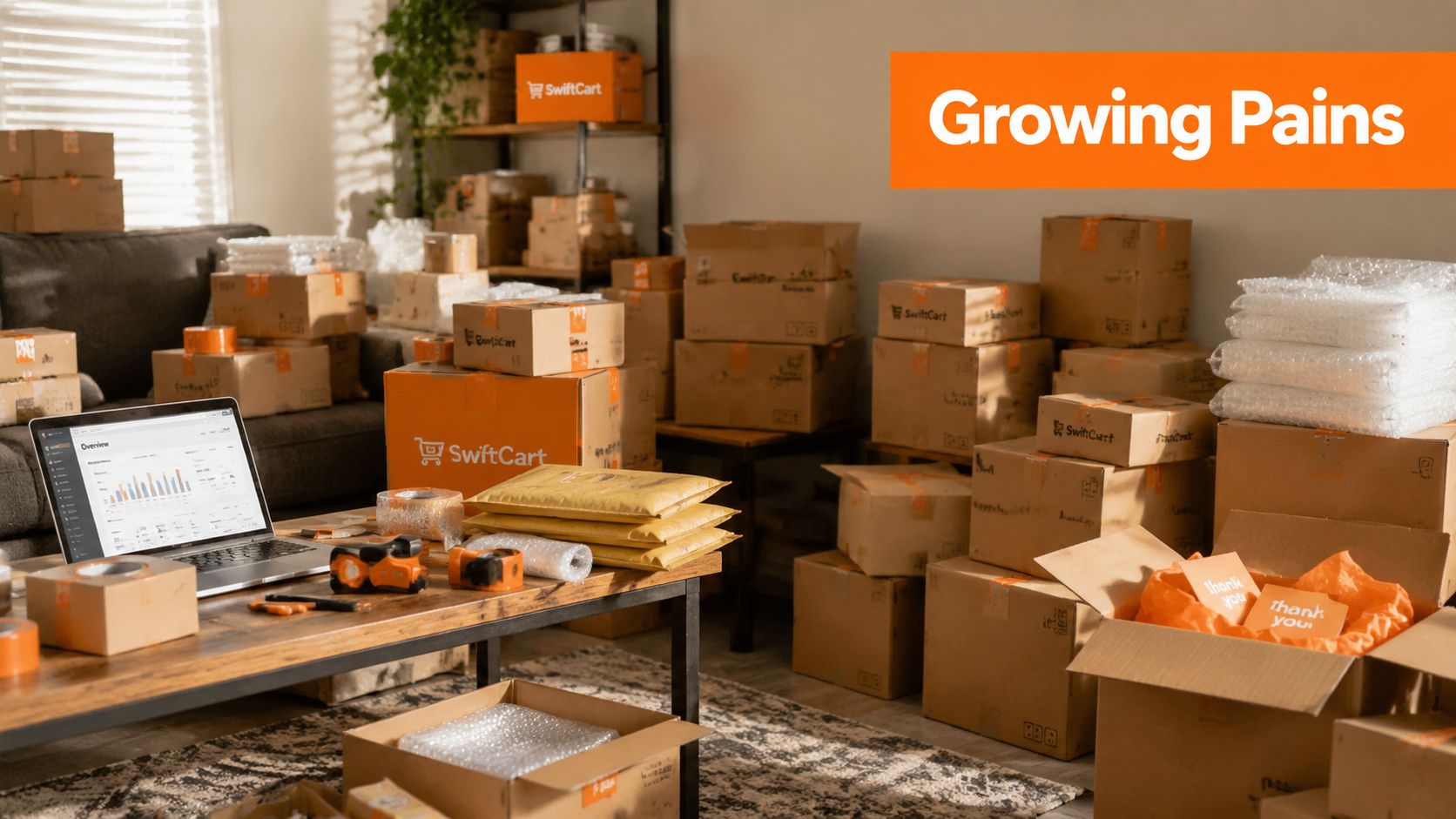
That isn't failure. It's usually a sign that demand has moved beyond hobby scale. What matters is what you do next. If you keep treating storage as an afterthought, the business starts paying for it in time, errors, and stress.
The point where space becomes strategy
The storage problem tends to show up before owners think of themselves as needing logistics. They still see themselves as running a shop, not managing a supply chain. But the moment you hold stock, process returns, and prepare outbound orders, you're already in logistics.
The market context explains why this has become so common. Retail e-commerce sales in the UK were estimated to exceed 3.6 trillion US dollars worldwide in 2025, and the UK remains one of Europe's most advanced online retail markets according to Statista's online shopping market overview. The same source notes that U.S. e-commerce sales reached $1,233.7 billion in 2025 and accounted for 16.4% of total retail sales, which is useful as a benchmark for how quickly online demand translates into warehousing intensity.
For a small UK retailer, that shows up in practical ways:
- More stock on hand: You need buffer inventory so bestsellers don't run out.
- More handling steps: Goods must be received, checked, stored, picked, packed, and sometimes reworked after returns.
- More overflow pressure: Seasonal lines, promotional bundles, and packaging supplies all need somewhere to live.
Practical rule: If your stock storage is reducing your living space or slowing down dispatch, you've already reached the point where external storage is operational, not optional.
What usually stops working first
Home-based fulfilment breaks down in a few familiar ways.
- Stock visibility slips: Items get split across wardrobes, lofts, garages, and under-desk tubs.
- Picking gets slower: Each order means walking room to room instead of pulling from one organised location.
- Returns create clutter: Unchecked returns mix with sellable stock and distort your inventory picture.
That is why e commerce storage matters earlier than many founders expect. It gives you breathing room, but beyond that, it creates the first layer of process discipline. Once stock has a proper home, you can start running the business with repeatable routines instead of daily improvisation.
Understanding E-commerce Storage as a Business Tool
Storage is often described as square footage. That's too narrow. In practice, e commerce storage is a business function. It supports availability, order speed, accuracy, and cash flow.
A useful way to think about it is as a physical cloud for inventory. You don't buy a giant server room on day one if your software business is growing. You use capacity that can expand when needed, stay accessible, and support the way you work. Stock storage works the same way. The right setup gives you space when sales rise, keeps goods secure, and lets you retrieve inventory without friction.
Storage doesn't sit still
Inventory in an online business is always moving, even when it looks static. Goods arrive from suppliers, get checked, shelved, picked, packed, returned, relabelled, or held for a future launch. Storage supports every one of those decisions.
That means a good setup should answer practical questions such as:
- Can staff or owners reach stock when orders come in late?
- Can returns be separated from saleable inventory?
- Can fast-moving products be accessed without digging through dead stock?
If the answer is no, then the storage isn't neutral. It's actively getting in the way.
The link between storage and control
A lot of small retailers focus on marketing and product first, then treat fulfilment as admin. The result is usually preventable chaos. Better storage creates cleaner stock counts, easier replenishment, and fewer rushed decisions.
For smaller teams, the operational discipline matters just as much as the floor area. A simple bin system, clear shelf labels, and a reliable intake routine can do more for fulfilment than moving into a large but badly organised space. If you're tightening those basics, this guide to inventory management for small businesses is a sensible companion to any storage decision.
Storage should reduce decisions, not create them. If you have to “remember where things are”, the system is too fragile.
The strongest operators don't view storage as a place to dump stock. They use it as part of the fulfilment engine. That mindset shift is usually what separates a business that's merely coping from one that's prepared to grow.
Exploring Your E-commerce Storage Options
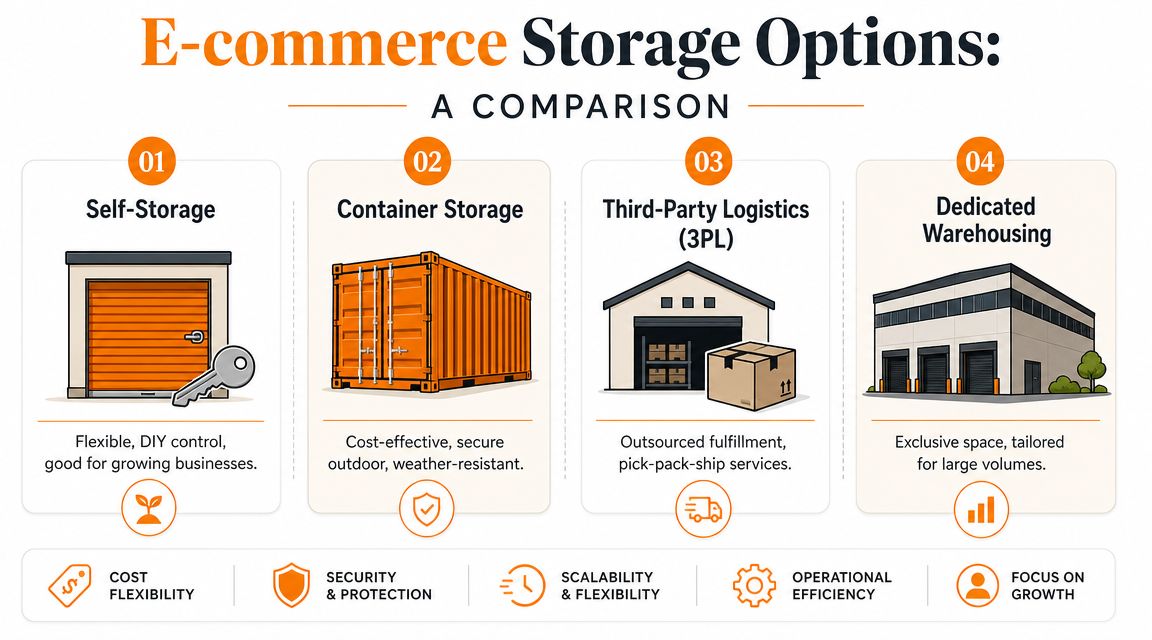
The storage model that suits a two-person brand won't suit a retailer shipping at much higher volume. The wrong choice usually shows up in one of two ways. You either overpay for capability you don't use, or you save on rent and pay for it later in delays, awkward access, and handling inefficiency.
Self-storage
Self-storage works well for businesses that want control without taking on a traditional warehouse. You rent a unit, organise it yourself, and use it for stock, packaging, returns, and overflow.
This is often the most practical step for startups, Etsy sellers, Amazon and Shopify merchants, and local brands moving out of the home. It suits businesses that still pick and pack themselves but need cleaner separation between domestic life and operations. A practical example is warehouse self storage for business stock, where the unit acts as flexible operational space rather than long-lease warehousing.
Pros
- Flexible commitment: Useful when demand is still changing.
- Direct control: You decide layout, labelling, and access routines.
- Good for overflow: Especially helpful for packaging, reserve stock, and seasonal lines.
Cons
- DIY fulfilment: You're still handling the work.
- Limited built-in services: No automatic pick-pack-ship layer.
- Layout quality depends on you: A messy unit becomes a slow unit.
Container storage
Container storage is a straightforward option for tougher stock profiles. Think tools, bulky products, trade materials, event kit, or packaged inventory that doesn't require a polished indoor environment.
It's often chosen for value and access rather than process sophistication. If your goods are durable and your main need is secure external storage, a container can be a strong fit.
Pros
- Simple and sturdy: Well suited to heavier or awkward stock.
- Secure holding space: Useful for reserve inventory and equipment.
- Practical loading: Easier for some businesses moving goods in bulk.
Cons
- Less refined for frequent picking: Not ideal if you need a highly organised small-item workflow.
- Product suitability matters: Sensitive stock may need a more controlled environment.
- Can tempt poor slotting: Owners often stack for volume, not accessibility.**
Third-party logistics 3PL
A 3PL stores your inventory and handles fulfilment processes on your behalf. That can include receiving, picking, packing, shipping, and sometimes returns.
This suits brands that want to spend less time touching stock and more time on product, marketing, and customer acquisition. It's useful when founder-led fulfilment has become the bottleneck.
Pros
- Outsourced operations: Frees internal time.
- Scalable fulfilment: Helpful when orders are becoming harder to manage in-house.
- Process support: Better for businesses that want systematised dispatch.**
Cons
- Less hands-on control: Stock is no longer physically with you.
- Fee complexity: Charges can stack across storage and handling activities.
- Not ideal for every product: Custom packing or frequent stock tweaks can be harder.**
Dedicated warehousing
Dedicated warehousing means taking exclusive space for your business, often with more bespoke racking, staff workflows, and equipment.
This suits established operators with steady volume, more complex stockholding, and confidence that they need a permanent footprint.
Pros
- Exclusive operational space: Built around your exact process.
- Better for mature volume: Useful when shared or flexible options start to constrain you.
- Customisable layout: You can design around product flow.**
Cons
- Higher commitment: Rent, fit-out, and operational overhead rise together.
- Less forgiving: Harder to scale down if sales soften.
- Management burden: You take on more responsibility for the facility.**
Choosing storage is a lot like choosing software infrastructure. Some firms need full outsourcing, some need flexible capacity, and some need dedicated systems. The same thinking used in a cloud data migration guide applies here. Match the model to your current complexity, not the version of the business you hope to become later.
E-commerce Storage Options Compared
| Feature | Self-Storage | Container Storage | Third-Party Logistics (3PL) | Dedicated Warehouse |
|---|---|---|---|---|
| Cost structure | Usually simpler and more flexible | Often practical for straightforward storage needs | Layered charges for storage and fulfilment | Higher fixed commitment |
| Scalability | Easy to adjust up or down | Good for space changes, less suited to process changes | Scales operationally if volume rises | Scales well if demand is predictable |
| Access | Direct owner access | Direct access for loading and unloading | Managed through provider processes | Full control within your leased space |
| Services | Space-focused, self-managed | Space-focused, self-managed | Fulfilment and related services | Depends on your own setup |
Warehouse pressure is one reason these flexible models have become more attractive. An industry summary reports that the global warehouse market was worth $1.08 trillion in 2024, that e-commerce warehousing reached $47.60 billion in 2025, and that it is projected to rise to $64.32 billion by 2030. The same summary notes a historic low U.S. warehouse vacancy rate of 3.2% in 2023, showing how quickly online demand can tighten supply, as outlined in this warehouse capacity statistics summary.
For many UK SMEs, that makes flexible, local storage less of a stopgap and more of a smart operating model.
How to Choose the Right Storage Solution
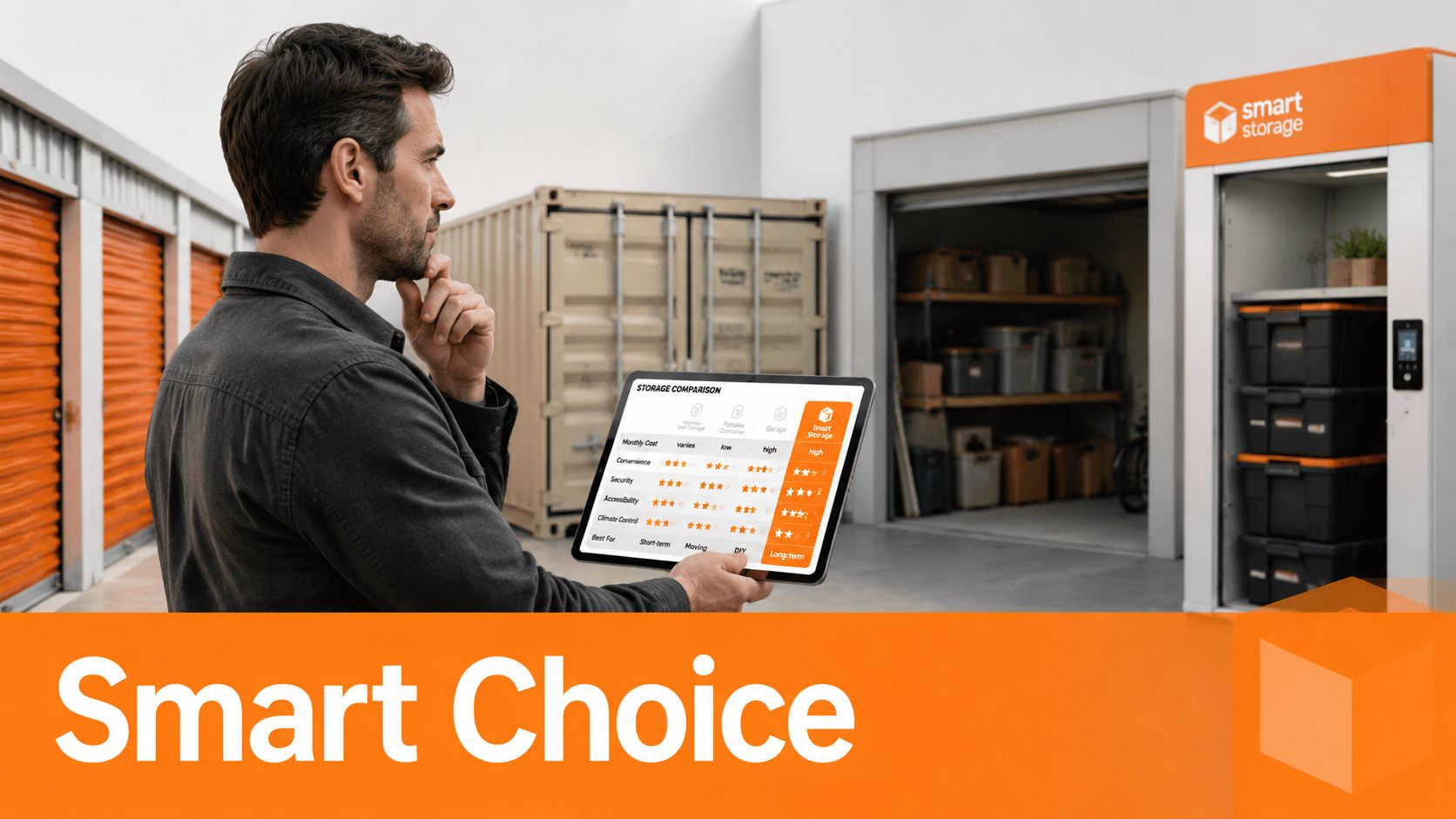
The best storage decision usually comes from asking sharper questions, not from touring the most units. Floor area matters, but workflow matters more. A unit that technically fits your stock can still slow the business if receiving, picking, and dispatch are clumsy.
Start with stock behaviour
Don't just ask how much stock you hold. Ask how it moves.
Some products sit for weeks and then sell in bursts. Others turn over constantly. Some have many variants in small quantities. Others are bulky and simple. Those patterns should shape your storage choice and internal layout.
Practical warehouse guidance for e-commerce recommends a clear sequence from receiving to storage, then picking, packing, and shipping, with high-velocity SKUs placed near packing stations to reduce travel and search time, according to QMH's e-commerce warehouse planning guide. The same guidance notes that once pick paths become congested and backtracking increases, extra capacity doesn't restore throughput.
That is the point many owners miss. More space won't fix a bad flow.
Ask the questions that affect daily work
Use this shortlist when comparing options:
- How often do you access stock? If you're in the unit daily, convenience and opening hours matter more than headline rent.
- What does a restock day look like? You need enough room to receive, check, and shelve without blocking your own aisles.
- Do you process returns properly? Returned goods need a separate zone for checking, cleaning, relabelling, or quarantine.
- Which SKUs move fastest? Bestsellers should be the easiest products to reach.
- Do any goods need protection from temperature swings or damp? Product type should drive storage environment.
A fast-moving SKU stored at the back of an overfilled unit costs you time every single day. That usually matters more than saving a small amount on monthly rent.
Measure cubic use, not just floor space
A lot of businesses estimate storage by eye. That works until it doesn't. Better operators plan around carton size, pallet footprint, shelf height, and working aisle space.
You need room for more than static stock. You also need space for receiving, quality checks, packing consumables, dispatch staging, and returns. That is where many businesses choose a unit that looks affordable but becomes awkward within weeks.
If you're reviewing software alongside physical setup, it helps to understand how stock systems support layout discipline. This overview of ecommerce warehouse software solutions is useful for thinking through barcode workflows, order syncing, and inventory visibility.
Choose for the next stage, not just today's mess
A sound choice gives you enough room to work properly now and enough flexibility to respond when demand changes. That doesn't mean renting the largest space available. It means selecting a model you can reorganise, expand, or pair with better systems as the business matures.
Look for the combination of access, stock protection, clean zoning, and manageable commitment. If any one of those is badly wrong, the storage will become a drag on fulfilment instead of a support for growth.
A Practical Look at E-commerce Storage Costs
Most owners start with the monthly rent. That's understandable, but it's not enough. The cheapest quote can still become the more expensive option once time, travel, labour, and operational friction are added back in.
The visible and less visible costs
The obvious costs are the unit fee, insurance, and any upfront charges tied to move-in. Those matter, but so do the working costs that sit around them.
Common hidden or underestimated costs include:
- Travel time: A cheaper site further away may add repeated collection and replenishment trips.
- Handling inefficiency: If stock is hard to access, every order takes longer to pick.
- Space mismatch: Too small, and you lose productivity. Too large, and you pay for dead space.
- Access friction: Restricted access hours can force rushed fulfilment windows or delayed dispatch.
A retailer shouldn't price storage like a utility bill. It should be priced like an operational tool. If one option saves time on every order, keeps stock easier to count, and reduces emergency reshuffles, that value is real even if the monthly line item is higher.
Think in total operating value
A practical way to compare options is to ask what each one lets you stop doing.
Does it stop your team double-handling boxes? Does it stop bestsellers getting buried behind slow stock? Does it stop stock taking over rooms that should be used for actual work or home life? Those are meaningful gains because they affect capacity.
Cost check: If a storage decision saves rent but creates regular delays, stock errors, or wasted travel, it isn't actually cheaper.
Technology plays a role here as well. If you're building a more structured fulfilment setup, it's worth understanding the cost trade-offs behind a cloud-based warehouse system investment. Software and storage don't need to be complex from day one, but they should support each other.
The best budgeting habit is simple. Compare options using total value over a normal trading month, not just the advertised rental figure. That keeps the decision grounded in how the business operates.
E-commerce Storage in Action Near Nottingham and Derby
Local businesses around Nottingham and Derby often face the same storage problem in different disguises. One seller needs to reclaim a spare room. Another needs a short-term buffer before a seasonal rush. A third needs somewhere secure for stock and equipment that doesn't fit a standard office or garage.
A maker in Derby
A Derby-based seller of handmade homeware starts out packing orders from the dining table. It works until product variants multiply. Raw materials, finished goods, packaging, and returns all end up mixed together.
She moves the sellable stock and packing materials into a small unit, keeps a simple shelf map, and uses home only for admin and product planning. The main benefit isn't just space. It's separation. Work stops bleeding into domestic life, and dispatch becomes more predictable.
A retailer in Nottingham with seasonal spikes
A Nottingham e-commerce brand selling gift-led products trades steadily most of the year, then sees a heavy surge around promotional periods. The business doesn't want a full warehouse lease for stock it only needs to hold temporarily.
In that case, a flexible local unit works as overflow capacity. Core stock stays organised, promotional bundles can be staged separately, and packaging supplies don't swamp the main workspace. For firms assessing local options, this guide to secure self storage options in Nottingham for home and business helps frame what to look for in access, security, and stock protection.
A Long Eaton trades business selling online
A tradesperson in Long Eaton sells tools, fittings, and materials through online channels alongside regular contract work. He needs storage that handles durable goods, supports loading, and keeps valuable stock secure when jobs run early or late.
A container-based setup can suit that pattern well. Bulkier lines stay outside the home and van, stock is easier to replenish in batches, and online orders no longer compete with day-job equipment for space.
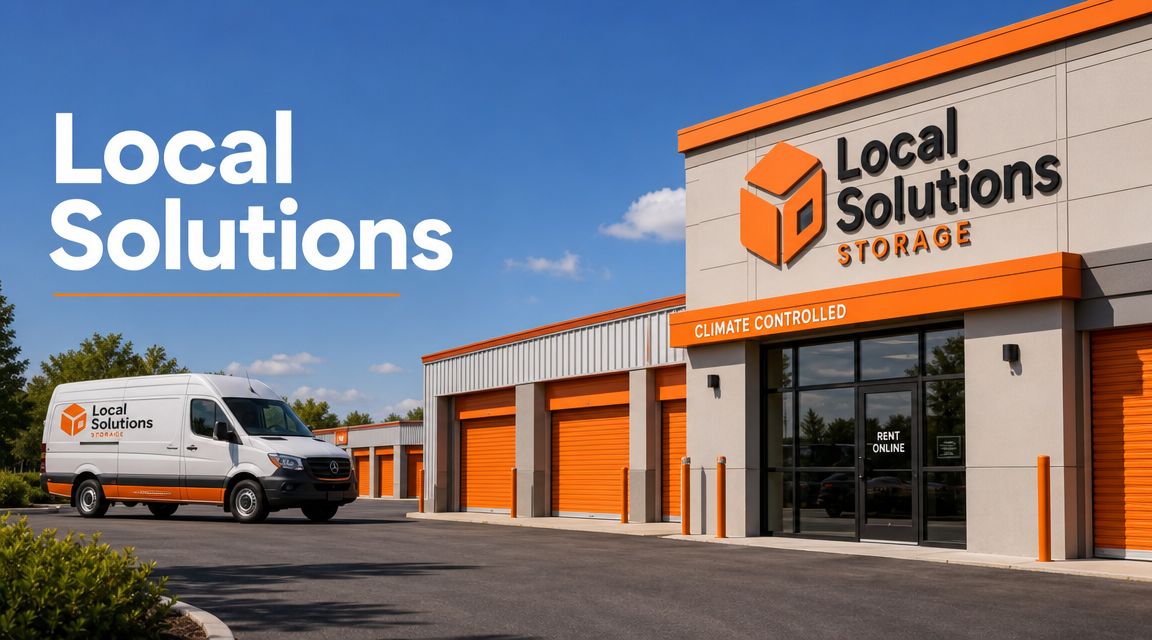
One local option businesses use for these kinds of needs is Orange Box Self Storage, which offers business units, container storage, flexible contracts, monitored sites, and locations across Nottingham, Derby, Long Eaton, and Beeston. For the right operator, that kind of nearby capacity can bridge the gap between home fulfilment and formal warehousing without forcing a large fixed commitment.
Finding Storage That Grows With You
The early storage problem usually looks like clutter. The primary issue is capacity. Once stock outgrows the home, the business needs a setup that supports cleaner fulfilment, better organisation, and easier scaling.
Good e commerce storage does more than hold products. It protects your working time, creates order in the daily routine, and gives you room to grow without rushing into the wrong warehouse commitment. For some businesses, that means self-storage. For others, container space, 3PL support, or dedicated warehousing will make more sense.
The best choice is the one that fits how your stock moves, how often you need access, and how much flexibility the next stage of growth will require. If your current setup is slowing dispatch, blurring stock visibility, or taking over your home, that is already useful information. It means the business is ready for a more deliberate operating model.
If your online retail business needs stock space that's secure, flexible, and close to Nottingham, Derby, Long Eaton, or Beeston, Orange Box Self Storage is worth considering. Review how often you access stock, how your bestsellers move, and how much room you need for returns and packing. Then choose a setup that helps the business run cleanly now and adapt as order volume changes.